

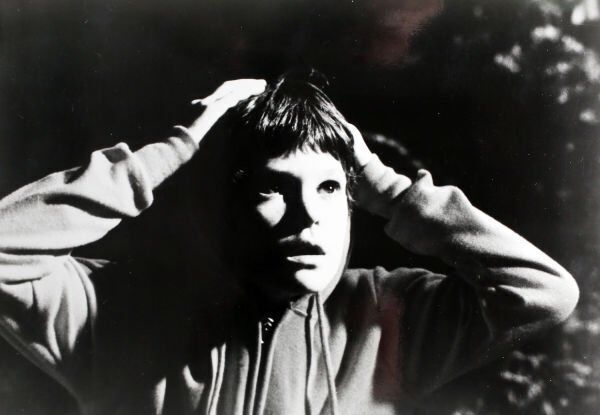
Movie critic Bruce Miller sits down to talk with Henry Thomas about his role in “Crawlspace.”
Forty years ago, "E.T., the Extra-Terrestrial" premiered in theaters. Here's our review from that year.
It’s ironic. The same summer Disney reissues its classic cartoon, “Bambi,” Steven Spielberg marches out with “E.T., the Extra-Terrestrial.”
Celebrating many of the same values and emotions as its animated predecessor, “E.T.” revives the art of simple storytelling, enthralling us with its zest for the unknown, its fascination with the fictionalized fact.
A kids’ film for adults, “E.T.” rarely fails to move us. Able to summon both cheers and tears, the exploration of friendship in its earliest stages is about as perfect as a two-dimensional film can be.
Built around one boy’s love for a Yoda-like alien, “E.T.” will undoubtedly secure Spielberg’s reputation as one of the industry’s most astute directors.
People are also reading…
Responsible for both “Jaws” and “Raiders of the Lost Ark,” Spielberg takes his other science-fiction epic, “Close Encounters of the Third Kind,” one step further, allowing us to enjoy the relationship that develops once unknown entities land.
Inadvertently abandoned by his people, E.T. (as the squatty creature becomes known), follows 10-year-old Elliott (an effectively expressive Henry Thomas) to his suburban tract home.
Hidden in the boy’s bedroom (like Bambi, faceless hunters are on his trail), E.T. begins to learn the ways of a juvenile world, wherein television is good, Reese's Pieces are fun and beer is intoxicating.
In one of the film's best scenes, E.T. raids Elliott’s refrigerator while the youngster is at school. Hitting upon a six-pack, he immediately becomes drunk, bumping into everything that towers above his stool-like height.
Sharing the creature’s emotions, Elliott becomes similarly affected, wreaking havoc in an elementary school science class.
Able to mesh the two segments flawlessly, Spielberg creates a cinematic pas de deux that instantly allows us to sense the bond that has instantly developed.
When E.T. tells Elliott he wants to go home, we immediately know the boy’s reaction. Unselfish, he does everything in his power to make the journey a reality.
Although the film has the power to reduce both children and adults to uncontrollable tears, the emotions are not wasted. Generating believable situations out of unbelievable circumstances, Spielberg allows each of us to subliminally recall the golden moments of our lives. Like the best of Disney, “E.T.” never panders. It merely presents the facts and lets us take them from there.
Unlike the prior genius of family films, Spielberg fills his production with more than succinct dialogue and winning performances. Painting pictures with Allen Daviau’s camera, he creates a surrealistic background upon which any number of realistic portraits can be laid.
Of the human performances, Henry Thomas’ is undoubtedly the best. Able to communicate on any level, he serves as a guide for everyone, taking adults back into the wide-eyed world of innocence, children into the tangled web of maturity.
Though Carlo Rambaldi’s mass of rubber and lights will win its rightful share of admirers, the heart of E.T. can only be credited to Spielberg and screenwriter Melissa Mathison.
Infusing him with more life than most people have, they make E.T. one of the most adorable characters in screen history.
Setting standards other creative talents will find difficult to duplicate, “E.T., the Extra-Terrestrial” is easily the best movie of the year. In short, it’s extra-terrific.
Rated PG, “E.T.” features several scenes children under 7 may find frightening. Don’t let that deter you, however. The kids will love it.
This review appeared June 24, 1982 in the Sioux City Journal.


