

Angelo Joaquin Jr. wasn't sure how many people would attend the first Arizona Historical Society-sponsored Waila Festival.
In 1989, the concept of holding a major event celebrating the food, culture, dance and music of the Tohono O'odham had never been attempted in Tucson.
"We didn't know what to expect," Joaquin said. "We thought maybe 600 would show up."
The festival, held in the Historical Society's auditorium, brought in an astounding 3,000 people.
"That indicated right away that there was interest there," he said. "We had to look at the festival through new eyes after that."
Today, the number of those in attendance has doubled as the event has expanded beyond the walls of the society building. An estimated 6,000 are expected to dance their way through this year's festivities at the University of Arizona's Bear Down Field on Saturday as coordinators celebrate the Waila Fest's 20th anniversary.
People are also reading…
The six-hour event will feature cholla buds, fry bread, cultural information and bands with years of experience behind them.
It serves as a popular gathering for the O'odham, including elders who are bused in from the reservation, as well as an opportunity for Tucsonans unfamiliar with the music to get a feel for the all-instrumental genre.
Waila's origins lie within the introduction of violins to the O'odham by European missionaries who wanted music played during church services according to Joaquin.
From there, the budding style grew to embrace the instrumentation and melodies that surrounded it.
Government boarding schools introduced many O'odham children to brass and wind instruments, such as the alto saxophone, a waila music staple.
And many early waila melodies took elements from norteño songs heard just across the border.
Homer Marks Sr., bass guitarist for the Santa Rosa Band, remembers picking up inspiration as a kid from the family's annual pilgrimage to Magdalena, Sonora.
"At that time, they didn't have CDs or tapes," Marks, 59, recalled. "They had albums, but most of us didn't have phonographs, so when we heard it, we just had to try and remember it."
Marks started the Santa Rosa Band with family members and friends in 1978. He is the only original member still performing with the group.
Santa Rosa is, by Joaquin's count, one of an estimated 25 active bands who play a mix of polka, schottische, mazurka and cumbia tunes on a regular basis on the reservation and around Arizona.
Like many O'odham, Marks recalls as a child being constantly surrounded by the upbeat rhythms of waila at events like the dedication of the Santa Rosa Community Center and at church feasts.
"As a kid you always went where the music was playing," he said. "I heard it all the time growing up and it became a part of me, I guess."
Leonard Joaquin, Angelo's cousin, bassist and keyboard player for the waila band Valenzuela and Company, was 12 years old when he began performing with the Joaquin Brothers, one of the most popular waila bands in its heyday.
Led by Angelo's father, the Joaquin Brothers performed at prestigious venues and events throughout the East in the 1980s and '90s. They played in Washington, D.C., twice, in 1980 and 1992, as part of the annual National Folk Festival.
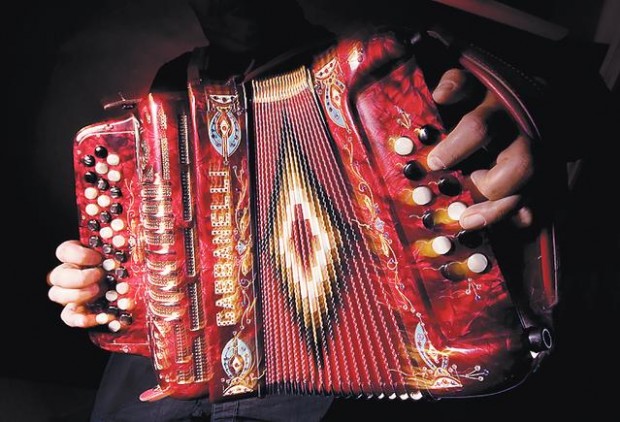
And they partied for crowds in the thousands at performances in Toronto and Buffalo. At one point, they were invited to participate as part of a concert series dedicated to the accordion at Carnegie Hall in 1992.
"They gave us complimentary tickets to a show when we got there and a personal tour the next day," Leonard said. "We took some family with us. They got to see New York City."
After all that touring experience, Leonard says, it's nice to have an event like the Waila Festival right in Tucson, especially when it brings in such a mix of people.
Many of those who attend have no O'odham ties. They're just curious or were brought up on the same European polka tunes that influenced waila's muse, norteño music in the late 19th century.
"I think that is more important," he said. "There are a lot of people who haven't heard this before. It gives a lot of exposure to the music."
"One thing that has been consistent is that non-O'odham will stay for a couple of hours while O'odham stay for the entire six hours," Angelo added. "At the end of the festival there is no grass where the people are dancing."
If you go
• What: The 20th annual Waila Festival.
• With: Henry Juan and Company, the Santa Rosa Band, Valenzuela and Company and the Tucson Fiddlers.
• When: 5-11 p.m. Saturday.
• Where: Bear Down Field on the University of Arizona campus.
• Cost: Free.


