

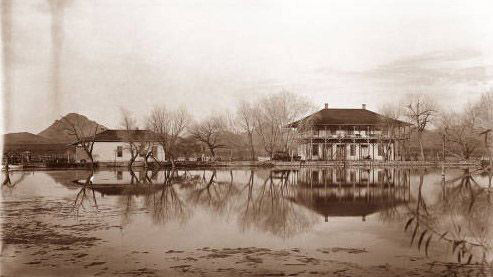
In 1857 or 1858, two brothers from Virginia built a dam on the Santa Cruz River about 1½ miles south of Tucson, forming a lake that extended a mile or two.
Soon after that, on Oct. 27, 1859, the Weekly Arizonian published an advertisement about those brothers — Capt. Alfred M. Rowlett, 45, and William M. Rowlett, 49 — saying their Rowlett’s Flour Mill, was prepared to grind wheat into flour, “Having purchssed (sic) at San Francisco the most improved milling stones and bolt.”
In late 1860, they sold the mill, which was on the west bank of the Santa Cruz River and south of present-day Silverlake Road, to William S. Grant. They sold their property in the city on Feb. 22, 1861, and left Tucson.
Grant, born in 1825 in Maine, bought the mill — built of cottonwood logs and “driven by water impounded by a dam across the Santa Cruz River” — for $5,500. He spent another $2,000 rebuilding the dam and making substantial repairs to the waterwheels and buildings. He also built a second, wooden mill along with a large adobe and timber building that served as a store, warehouse, blacksmith shop and housing for employees. He set a price of $1.25 per fanega (1½ bushels) and by the spring of 1861 he was grossing $1,500 per month, with a $300 net income.
People are also reading…
Grant’s main reason for running the mill was to fulfill his contract with the U.S. military to supply flour, among other things, to Fort Buchanan (named for President James Buchanan) and Fort Breckinridge (named for Vice President John C. Breckinridge) as well as two forts in present-day New Mexico.
This only lasted for a short while because on July 15, 1861, 1st Lt. Richard Lord of the U.S. First Dragoons burned the mill to prevent it from falling into the hands of Tucson secessionists or the Confederate Army.
The Rebels came and went, and on March 20, 1862, the California Column of the Union Army occupied Tucson. Union soldiers partially repaired one of the mills, which they used for some time to grind wheat into flour for their own use.
In 1864, the mill was rebuilt by James “Jimmie” Lee, an Irish immigrant who ran the mill along with William F. Scott, namesake of Scott Avenue.
It’s likely the mill they ran was the new one built by Grant, not the original Rowlett Mill. In 1870, the partners had their new Eagle Steam Flour Mill built on Main Street (now Main Avenue) and Camp Street (now Broadway).
In 1874, Scott sold to Lee and the Eagle Mill was sold to E.N. Fish. Lee continued to run the mill at Silver Lake, which became known as the Pioneer Mill.
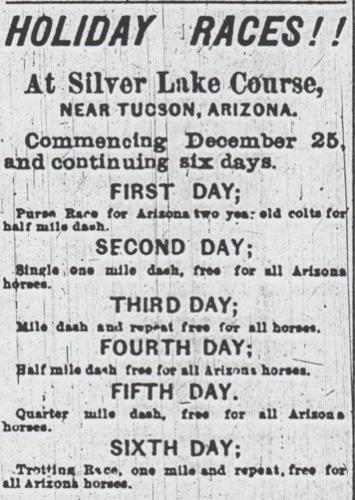
Sometime around 1878 or 1880, Lee leased 20 acres of land on the north shore of the lake to J.F. Rickey and J.O. Bailey, proprietors of the mile-long race track nearby, where the annual horse races were held.
The pair rented out boats, which patrons sailed around the lake and “some of the young men would row up the Santa Cruz for some distance,” said Bernice Cosulich’s 1953 book, “Tucson.”
By 1881, they had built a “row of commodious bathhouses for bathers and put a stout rope across a portion of the lake for the convenience of persons learning to swim,” Cosulich’s book said.
They also had a hotel, a pavilion and a grove for picnickers seeking relief from the brutal summers, that year’s high being 110 degrees Fahrenheit.
Jimmie Lee died in 1884 and passed the property on to Fred Maish and Thomas Driscoll. The partners would turn the hotel into Tucson’s first roadhouse and nightclub. The resort, once frequented by civic groups, families and Sunday school classes, changed clientele with its wild parties. Gamblers and drunks became common sights and the respectable citizens of Tucson found other places for entertainment, such as a picnic at Sabino Canyon.
In 1886, a flood damaged the masonry dam. It was repaired, but attacked again by nature’s wrath in 1890.
The following year, the floods cut away 40 feet of Silver Lake’s banks. The end came around 1900, when the dam was washed out and Silver Lake disappeared.
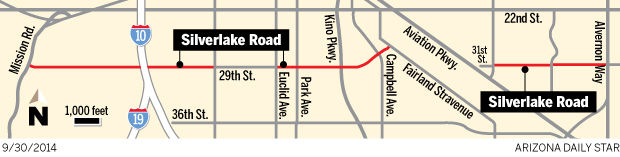
The name “Silver Lake Road” appears on official Pima County documents as early as December 1926, but the name likely was used, at least in common parlance, many years before that. The name was later shortened to “Silverlake Road” as it appears today.
Sources:
Special thanks to Jane Eppinga, author of “Southern Arizona Cemeteries”
Bernice Cosulich, “Tucson,” Arizona Silouettes Pub., 1953
“Landmarks of the Old Pueblo,” Arizona Land Title and Trust Company, 1951
J. George Hilzinger, “Treasure Land 1897,” The Rio Grande Press Inc., 1969
Gilbert J. Pedersen, “A Yankee in Arizona: The Misfortunes of William S. Grant, 1860-1861,” Journal of Arizona History, Summer, 1975
Constance Wynn Alsthuler, “Starting with Defiance,” The Arizona Historical Society, 1983
“The Silver Lake,” Arizona Weekly Citizen, June 14, 1884
Rowletts’ Flour Mill ad, The Weekly Arizonian, Oct. 27, 1859
1881 Tucson City Directory
Pima County Department of Transportation file


