

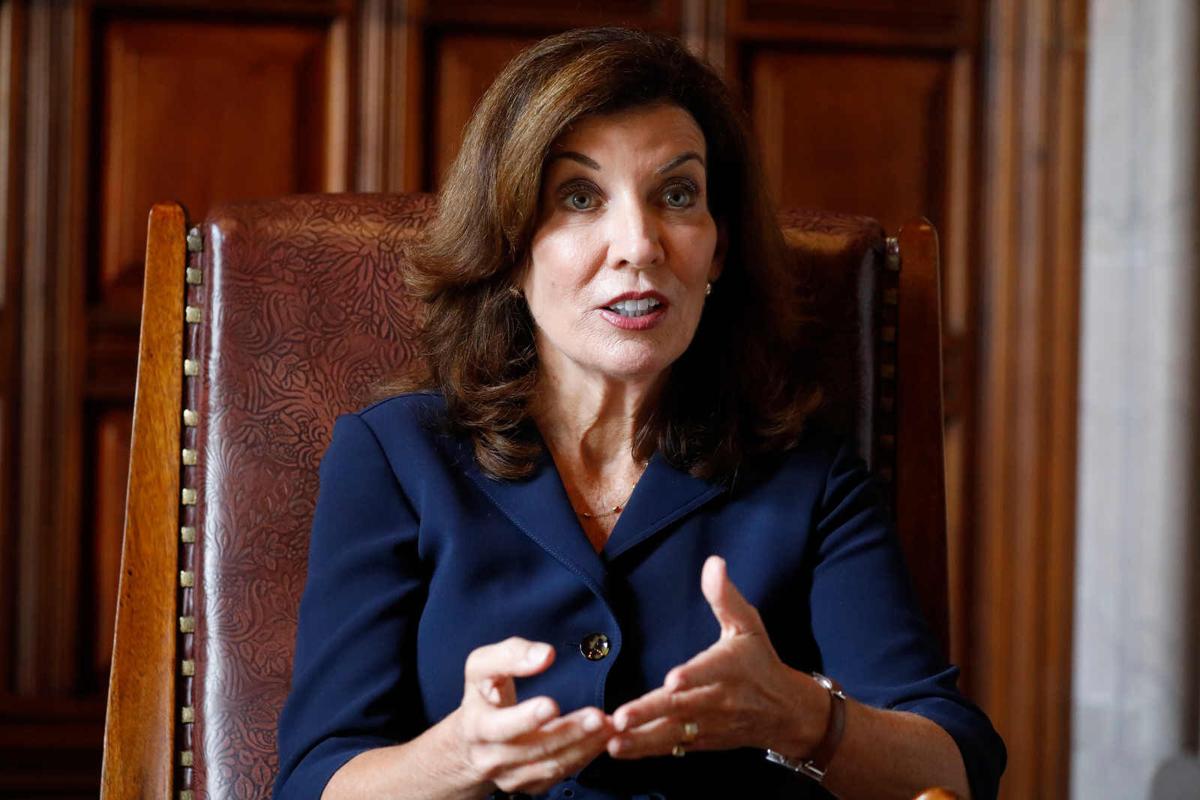
ALBANY – Step aside, Andrew Cuomo. There’s a new fundraiser-in-chief in town and her name is Gov. Kathy Hochul.
And while last week she reported a record amount of funds raised during a state disclosure cycle, Hochul has something very much in common with her predecessor: turning to millionaires and billionaires to dispatch outsized, though legal, campaign donations her way.
In a continuation of a practice that a long line of New York governors have employed, Hochul has turned to deep-pocket contributors to pave the way to build her campaign account – both to scare off potential competitors and to pay for her run against any who will challenge her in a primary or general election bids as she seeks to win a full term in November.
Hochul received 330 separate donations totaling $20,000 or more each. They gave her $12.9 million of the $22.6 million she reported in total receipts since shortly before becoming governor following Cuomo's resignation in August. Forty-seven donations to her hit the maximum amount allowed by law: $69,700.
People are also reading…
It all helps explain one of the reasons Hochul in her first few months in office spent so much time in New York City. Gotham, as politicians know well, is the equivalent on the campaign fundraising circuit – for presidents, members of Congress, governors and state lawmakers – to what sun is to Florida.
And, owing to her growing political power, Hochul has done well among the wealthy. Dozens made the quick transition from opening their wallets from Cuomo to Hochul, the governor from Buffalo who a year ago was relegated by the former governor as a bench player in his administration.
An array of rich people
Hochul has gotten big money from hedge fund executives, politically wired real estate developers, a media mogul or two, trial lawyers, energy industry investors and every usual big player in Albany, from dozens of unions to political action committees associated with everyone from title agents, dentists, electrical contractors and cemetery owners to charter school advocates and lobbyists.
Hundreds of New Yorkers gave Hochul small donations, but they don’t have the access or influence that the big financial boosters get by their donations, many made during personal gatherings with the governor at events mostly in Manhattan.
The governor’s campaign boasted not just on how much money she has raised since August, but also that nearly 88% of donors are from New York State and that she got money from people or entities in all 62 counties of the state.
What her campaign didn’t focus on are what watchdog groups like to call the “fat cat” donors.
In all, 111 individuals and different entities, with locations from Manhattan and Boca Raton to Greenwich and Los Angeles, gave her donations totaling at least $50,000 apiece. Just shy of 500 came in denominations between $10,000 to $50,000.
Comedian Jerry Seinfeld, with not a lot of known business dealings before the state, dropped $50,000 on Hochul.
Hochul’s father, John Courtney, who retired years ago from a computer-related company in Buffalo and lives in St. Petersburg, joined in on the Hochul donation stampede: He donated $67,500 to his daughter’s campaign.
Howard Zemsky, the state’s former economic development czar under Cuomo and a longtime friend of Hochul, dropped $50,000 on her 2022 campaign bid, the same amount as donated by his wife, Leslie.
But the steady, eye-popping ones came from members of the new and old school wealth class, mostly downstate with hundreds of thousands of dollars in out-of-state money for good measure.
Pro sports team owners give
Four members of the prominent New York City Tisch family – including Jonathan Tisch, a wealthy hotelier and co-owner of the New York Giants – combined gave Hochul $239,400 since August.
Indeed, she did well with sports interests. Besides Tisch, the New York Yankees Partnership gave her $25,000, and she got a total of $137,600 from Alexandra Cohen and her husband, Steve, a hedge fund executive who owns the New York Mets. From the world of the NHL came a $50,000 donation from Jonathan Ledecky, who owns the New York Islanders, along with co-owner Scott Malkin, who gave Hochul $50,000. A New York real estate executive, David Mandelbaum, a minority owner of the Minnesota Vikings, gave her $69,700.
From California came a $50,000 contribution from influential sports industry executive Timothy Leiweke, a former president of Maple Leaf Sports & Entertainment in Toronto.
No direct donations came her way from Terry or Kim Pegula, owners of the Buffalo Bills, which are in active talks with the Hochul administration and Erie County for public money to build a new stadium.
JoAnne Wilson, whose husband, Fred, is a major venture capitalist in Manhattan, tossed Hochul $55,000.
Heirs to fortunes were among those writing checks, tapping their credit cards or wiring donations to Hochul. Stavros P. Niarchos, whose interests include a foundation with offices in Athens, Monte Carlo and Manhattan and whose father was a billionaire Greek shipping magnate, gave the governor $40,000, and Leonard Lauder, the heir to the Estee Lauder fortune, gave her $37,100.
From the entertainment world came $50,000 from Barry Diller, the former Twentieth Century Fox chairman and CEO where he created the Fox Network; his wife, fashioner designer Diane Von Furstenberg, gave Hochul $25,000.
Hochul did sprinkle her campaign report, filed on Thursday with the state elections board, with hundreds of relatively small donations, including people giving $5 to $10.
The Hochul campaign is doing nothing unusual – though with a record-breaking take during a campaign reporting cycle compared with previous governors – and that is: taking advantage of New York’s porous election laws when it comes to permitting donations massive enough to make members of Congress envious.
The response from a long line of previous governors and statewide officials: Until the campaign donations are reduced they have no interest in unilaterally disarming to give potential political adversaries any advantages.
"Governor Hochul is proud of the fact that her bold agenda to move New York forward has resonated with a diverse coalition of supporters. Although the campaign anticipated a strong response, we are fortunate to have seen incredible energy and contributions from all 62 counties across our state. In keeping with the governor's commitment to maintain high ethical standards, campaign contributions have no influence on government decisions," said Jerrel Harvey, the Hochul campaign spokesman.
Watchdogs: This show has been seen before
The individual contributions, often from people with business before the state, have long caught the eye of government watchdog groups.
“Inevitably, there is a head-on collision between Kathy Hochul’s desire to be the ethics and transparency governor and the political reality of being a candidate for governor who raises huge contributions from people trying to buy influence. The more an interest group depends on the state for spending or contracts, the more they give, and it usually pays off," said John Kaehny, executive director of Reinvent Albany.
Kaehny noted that big donors to Hochul got big things from the governor’s new spending plan she unveiled last week, like major funding hikes for hospitals and hospital workers, trade unions that will get jobs from capital spending programs she wants, and the film industry getting a continuation of a lucrative tax credit.
“The problem is with our campaign finance system, not with Kathy Hochul," said Susan Lerner, president of New York Common Cause, another government watchdog group.
Both Kaehny and Lerner hold out hope that a new public financing system – set to begin after this year’s elections and which is supposed to include lower contribution limits for candidates – could alter the largess of big donors dominating the political landscape in New York for years.
Donors deftly transition from Cuomo to Hochul
Billionaire Eric Schmidt, the former Google CEO, also gave the top allowable individual contribution – $69,700 – to Hochul. He was tapped by Cuomo to lead a board charged with recommending ways during Covid to improve telehealth and broadband services for the future.
Lots of money went to Hochul from people with interests – or possible interests – in New York big real estate deals. Boston Properties’ Owen Thomas maxed out with his $69,700 donation, while Nicholas Mastroianni II, a South Florida developer, donated $50,000. Rob Speyer, a Manhattan developer with many projects influenced by state decisions, donated $69,700, and Hochul received additional money from entities associated with him; he was just one of the many big donors to Cuomo who easily pivoted with their money to Hochul’s way.
Lloyd Goldman, a politically potent real estate developer whose projects have included work on the World Trade Center redevelopment, maxed out, as did Larry Silverstein, the major developer of that lower Manhattan project, as well as Silverstein’s wife, Klara.
Money also came her way from real estate interests that would benefit if Hochul’s plan to license three more casinos – all of them likely to be located in or around New York City – is approved by lawmakers.
Hochul shattered the fundraising record for an elections board reporting period; in 2002, then-Gov. George Pataki raised $12.8 million in six months.
Cuomo, Hochul's predecessor, amassed huge money-in-hand numbers, surpassing $30 million at some points, and he still has $16.5 million in the bank. Hochul has $21 million on hand in her campaign account.
U.S. Rep. Thomas Suozzi of Long Island, who is running a Democratic primary challenge against Hochul, raised $3.3 million during the same recent reporting period, while New York City Public Advocate Jumaane Williams, her other Democratic foe, raised $222,000.
News staff reporter Mary Pasciak contributed to this report.


