

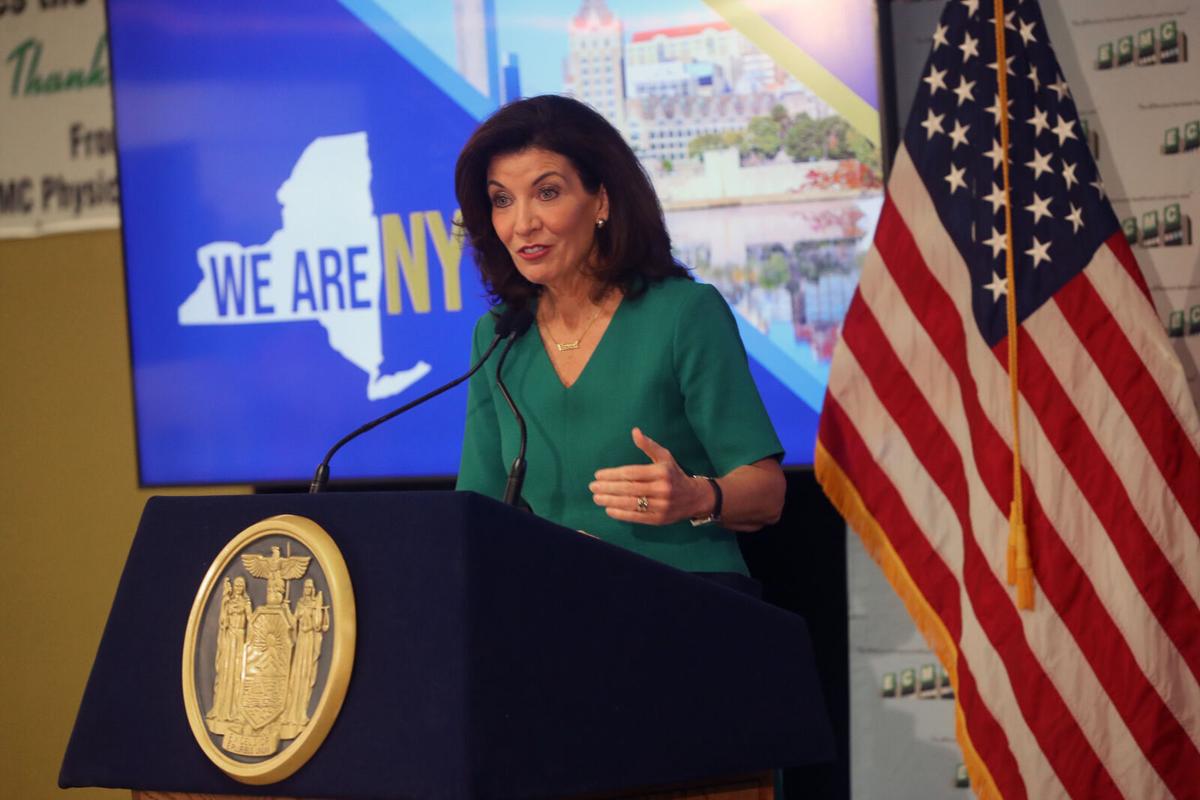
ALBANY – Facing an election campaign this year, Gov. Kathy Hochul on Tuesday presented a state budget plan that spreads spending hikes for schools and health care programs, adds potentially billions for environmental and transportation infrastructure projects and offers property tax rebate checks to more than 2 million New Yorkers – timed for distribution around the fall general elections.
“New Yorkers, this budget’s for you," Hochul said in delivering her first state budget proposal since becoming governor in August.
While the state for years sought to control spending increases to 2 percent, the new Hochul plan seeks to spend $216.3 billion, up 3.5 percent from last year’s enacted budget, and drives increases to public schools and health care workers and their employers.
It all comes as the state is flush with cash, thanks to Covid-19 relief dollars flowing from Washington and higher-than-expected tax revenues and receipts from tax hikes enacted last year.
People are also reading…
But it also came with a warning from Hochul, and her budget director, Robert Mujica, that as New York learned well during the first year of the pandemic, anything can happen in the future.
Hochul called her spending plan “socially responsible and fiscally prudent.”
“It’s cautious optimism," Mujica said of the plan, which includes a steady driving of more and more state money into reserve accounts.
Hochul created many winners in her financial plan for the fiscal year starting April 1 – from middle-class homeowners to gambling companies to frontline health workers to farmers to small business owners.
Not in her plan, as expected, is any appropriation for a new stadium for the Buffalo Bills.
“Those talks are ongoing," Mujica said of negotiations among the state, Erie County and the team. That means the real deadline for a stadium deal has to come before the end of March, when Hochul and state lawmakers will put down their pencils in secret talks and cut a final overall budget agreement that will include many new additions.
But spending in the budget includes:
• $1 billion for various health care initiatives, as well as $1.2 billion for bonuses for health care and other frontline workers – up to $3,000 – whose ranks have been hit hard during the pandemic.
• Various plans for tax relief, including speeding up the full impact of a previously enacted middle income tax break program and $2.2 billion in property tax relief that Hochul said will benefit 2 million homeowners. For a homeowner making under $75,000 a year, it will mean about $1,050 in savings – to be given to them in the fall. But the amounts will vary, depending on variables that include property tax rates and a person’s income.
• An infusion of state funding for road and bridge repairs, as well as a record increase in the state’s Environmental Protection Fund and a $4 billion environmental bond act to be considered by voters this fall.
• $350 million in direct pandemic relief payments for businesses and entities such as theaters and music venues and an overall pandemic response fund – to be worked out with legislators – totaling $2 billion.
On education matters, Hochul wants to increase state funding for nearly 700 local public school districts by 7.1%, or $2.1 billion, for a total of $31.2 billion.
The Board of Regents, the state’s education-setting policy panel, in December called on Hochul and lawmakers to pass a budget that would include a $2.1 billion total aid increase, including $1.5 billion for the main funding lines that pay for operational expenses, chiefly salaries and benefits. In a break with other governors, Hochul went even higher with that funding program, called Foundation Aid, proposing a $1.6 billion increase.
She said New York needs to do more to boost reserve funds to account for future events that can dent tax receipts and drive up spending for response efforts. She acknowledged the special federal bailout money will run dry in a couple of years, but said her budget plan will keep future state budgets balanced through the 2027 fiscal year.
She called her plan a “once-in-a-generation opportunity to make thoughtful, purpose-driven investments in our state and in our people that will pay dividends for decades.”
Hochul's presentation totaled just 16 minutes, a stark break from her predecessor, Andrew Cuomo, who routinely spoke for more than an hour.
The Hochul plan will include more than $1.4 billion for subsidies for day care that she says will make 400,000 additional families eligible for the services, and the state will spend $75 million to help boost the salaries of workers in that field.
The state will invest $1.5 billion for the State University of New York and City University of New York in additional operating aid over the next five years, even as enrollment in the SUNY system has been dropping.
The budget proposes to make the Tuition Assistance Program available to part-time students, as well as return tuition aid benefits to incarcerated people taking college courses – a funding stream halted in 1995.
The spending plan comes as Hochul, who took office in August after Cuomo resigned amid mounting scandals, is running for a four-year term this year. One bow to that political reality: She is vowing to spend $1 billion this year to repair potholes around the state.
Gambling companies also are poised to be big winners. Hochul wants to speed up the awarding of three additional commercial casino licenses, and they likely will all go downstate with the biggest prize that gambling companies worldwide have been trying to get into: New York City.
State officials said Tuesday that mobile sports betting, which began earlier this month in the state, saw more than $150 million in wagers made during the first weekend. The state has, therefore, upped its tax receipt projections from that form of gambling to $518 million by 2027.
The first money flow from the state’s legalization of retail marijuana sales is also expected in the coming fiscal year. Hochul’s budget anticipates $58 million in revenues, but $40 million of that is from licensing fees assessed on future distributors, growers and retailers. That means it could be more than a year before sales commence and the state starts seeing taxes flow from those sales.
Localities are also big winners, whether through straight state aid proposals for operating purposes, or an explosion of transportation funding or Hochul’s plan to make permanent local county and city sales tax rates – at either their existing levels or 4 percent – which would end their need to lobby governors and lawmakers every two years to keep their tax rates intact.
Groups benefiting loudly applauded the governor’s budget plan. The National Federal of Independent Business, whose small business members are in line for tax breaks, offered quick praise, but noted that many businesses are being crippled by high unemployment insurance taxes in the state.
The Hochul plan was slammed by Republicans who want to challenge her in the general election. GOP lawmakers, too, joined in; Assemblyman Steve Hawley from Batavia said Hochul’s budget “exhibits no fiscal constraint nor the imagination needed to help reverse the decline of our state.”
And Gerard Kasser, chairman of the state Conservative Party, said Hochul’s budget is more than the combined sizes of Texas and Florida, and that 200 nations have smaller budgets than what she wants to spend.
The Citizens Budget Commission, a nonpartisan fiscal watchdog group, praised some Hochul plans, such as a multi-year focus on boosting rainy day accounts. But the state would “better served” by taking a number of other steps, like rolling back big tax hikes from last year and reliance on “an eye-popping” $5 billion in receipts in each of the next four years and that budget talks this year in Albany risk “a feeding frenzy that could destabilize the state’s future finances," said Andrew Rein, the group’s president.


