After years of community engagement and planning, the construction of Ralph C. Wilson Jr. Centennial Park – formerly LaSalle Park – starts Tuesday.
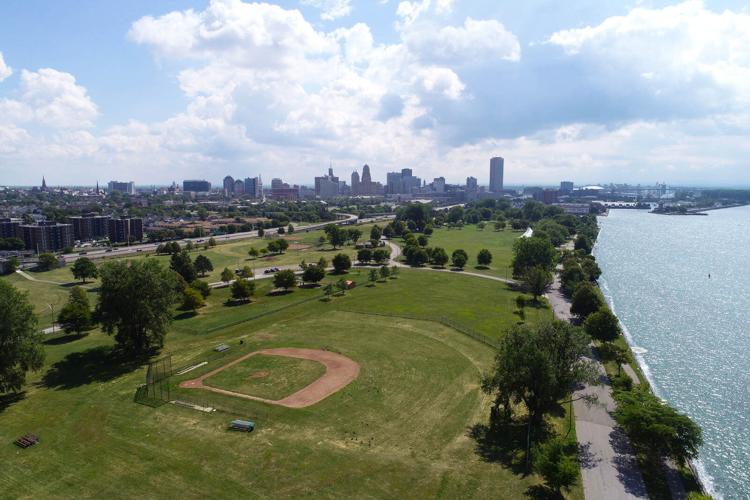
On tap are the first three projects: a new pedestrian bridge over the Niagara Thruway, new baseball diamonds and soccer fields, and a redesigned shoreline for public access and habitat restoration.
The park is expected to be completed in late 2025.

The sheer scale of the playground proposed for LaSalle Park promises a vast playland unlike any in Western New
“Development of this scale only happens once in a lifetime," said Keith Belanger, board president of Ralph Wilson Park Conservancy in a statement. "Ralph Wilson Park will rank among the country's best parks and profoundly impact neighborhoods."
The Ralph C. Wilson Jr. Foundation four years ago announced the initiative to bolster the region's trails system and transform the waterfront park on Buffalo's Lower West Side. The estimated capital cost for the park project is $110 million, with 90% of the funding in hand, said J.J. Tighe, who directs the Wilson Foundation's Parks & Trails Initiative. Engineering, design and other costs, along with a $16 million endowment, bring the overall amount to $140 million.
People are also reading…
The Wilson Foundation has committed an estimated $80 million of that amount, including the endowment.
Mayor Byron Brown hailed the start of work at the park.
“Today’s groundbreaking is a major milestone in the inclusive and transparent planning process to create a people’s park that will be enjoyed by the neighboring community and all Buffalo residents for generations to come," Brown said.
The park, designed by Michael Van Valkenburgh Associates, will be built in phases, starting with preconstruction work under newly named construction manager Gilbane Building Co. The work will change the park's topography, provide waterfront access and improve recreation, including adding the largest playground in Western New York.
The public will notice fencing going up this summer, said Andy Rabb, the city's deputy park commissioner.
"You will be seeing a lot of activity next year, though we don't have the specific time frame laid out yet on when you'll be seeing cranes and big trucks," Rabb said.
Bridge to the park
Bridge installation and demolition of an aging bridge will occur in 2023, Rabb said.
"It will take months and months of construction to get to that point," he said.
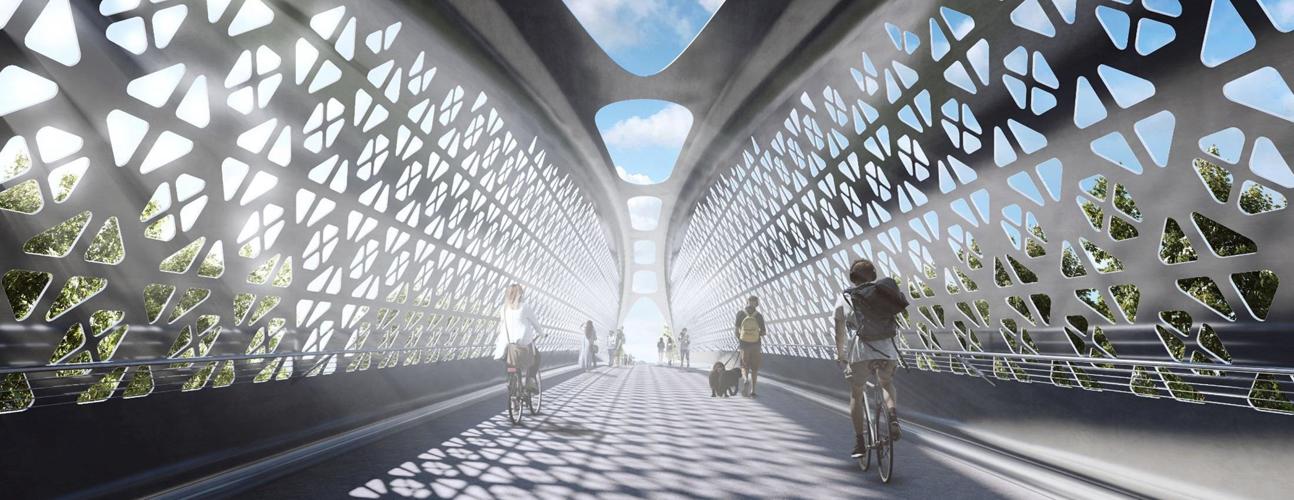
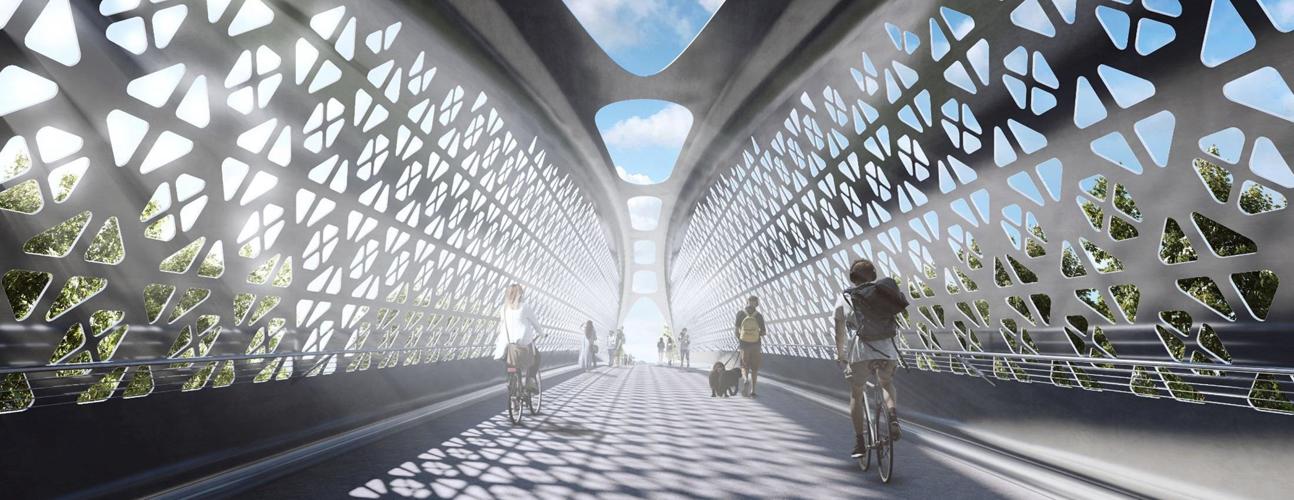
The sleekly-designed bridge by German design firm Schlaich Bergermann Partner will cross the Niagara Thruway near a planned sledding hill on what will be called the Great Lawn, a short walk from a planned, 2½-acre playground.
"The bridge will truly be a link to the neighborhoods of the West Side into the park," Rabb said. "It's going to be a bridge that people want to walk across."

A rendering of the new bridge planned over the Niagara Thruway to Ralph C. Wilson Jr. Centennial Park. Installation is expected in 2023.
The bridge is expected to be assembled next to the site as one unit and installed in one night. Demolition of the old bridge, slightly south of where the new bridge will be installed, is also expected to be done quickly, possibly over a couple of days, he said.
There are plans for one large hardball field and four baseball diamonds for Little League and softball use, with outfield fences, dugouts, and some fields with outdoor lights.
They will be completely reconfigured ballfields than the ones there now, Rabb said.
There will also be two new soccer fields at the park.
"These are going to be brand-new athletic fields," Rabb said. "People are going to want to play on these fields."
Buffalo Niagara Waterkeeper, which for decades has led the cleanup of the Buffalo and Niagara rivers, helped get the park site and section of the river listed as a habitat priority. That led to an announcement of $10 million in federal funds for the shoreline work, matched with $5 million from the Wilson Foundation.
"We've worked hard to ensure that this shoreline will both be safely accessible for people and one of the best habitat restoration projects on the Niagara River," said Jill Jedlicka, Waterkeeper's executive director.
A Buffalo Blueway site with a paddle sport launch will be built by Waterkeeper south of the Col. Ward Pumping Station, where the U.S. Army Corps of Engineers earlier this year completed a significant renovation of the existing seawall.
"A lot of the work done to create exciting destinations on the water is the grunt work," Rep. Brian Higgins said. "It's seawalls, it's foundational work. It's the stuff you have to do to achieve the transformative nature of these projects."
Higgins said what's happening to Wilson Centennial Park will quickly make it a destination.
"This promises to be a most beautiful and inclusive public space that will rival any in the country," he said.
The Wilson Foundation began the project with the University at Buffalo Regional Institute to create an “Imagine LaSalle” community-driven process to determine what people wanted in the park.
Planning involved 1,100 community surveys, 22 residents who visited parks in Brooklyn, Chicago and Cincinnati, and technical guidance from nearly 20 organizations.
The foundation's commitment to a park and to a trail system in Western New York was intended to reflect Wilson's appreciation for the outdoors and recreation.
"Generations of Buffalo Bills fans knew of founder Ralph Wilson's commitment to Buffalo and generosity during his life," Gov. Kathy Hochul said in a statement.
"The groundbreaking of Ralph Wilson Park will bring a collaborative transformation of this waterfront park into a vibrant community space where future generations will enjoy gathering for many years to come, and that will ensure Ralph Wilson's love for our community continues to make an impact."
Mark Sommer covers preservation, development, the waterfront, culture and more. He's also a former arts editor at The News.