

A cooperative supermarket. A publicly funded East Side community land trust. Tearing down or rehabbing substandard housing. And removing the mindset that “it’s normal to live in these types of conditions.”
The outpouring of condolences, donations and support from all over the world was warmly received after a self-described white supremacist shot and killed 10 people – all Black – and wounded three others May 14 at Tops Markets on Jefferson Avenue.
Beyond the short term, however, those advocating for the East Side want urgent and long-lasting steps to lift the community beyond the store's immediate neighborhood.
“We know the news cycle generally runs for about four or five days, but we live here. And so even when it’s no longer national news, we want to make sure we don’t let the energy, that emotion of this moment, pass without us using it in some way toward creating some long-term solutions or benefits for our community,” said Duncan Kirkwood, a community advocate who organized a recent meeting of Black community leaders.
People are also reading…
About 75 people attended in person and virtually, Kirkwood said, including City Court Judge Philip Dabney, NAACP President Mark Blue and attorney Miles Greshem, policy fellow at the nonprofit Partnership for the Public Good.
The purpose was to discuss ideas for a plan to help build community resilience and increase safety” Kirkwood said.
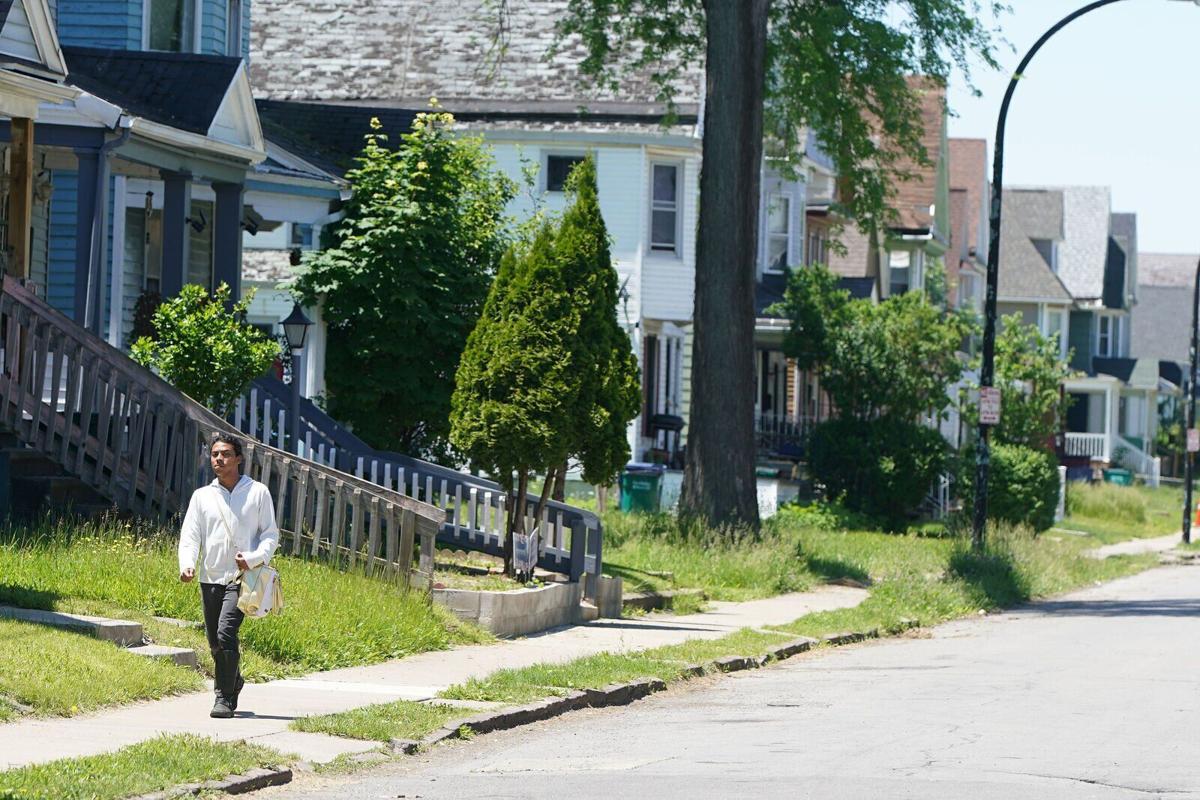
Long-term plans must be developed to tackle root problems of the entire East Side, including substandard housing, health inequities and outdated infrastructure, among other problems, East Side residents say.
And mental health issues will linger for the those across the East Side traumatized by the deadly racist attack.
“All this is cool and all. You’ve got the prayers, but where’s the solution, though?” said Austin Leeper, 27, a resident of Dodge Street near Tops, who spends almost all of his time in the neighborhood.
“This is an underserved community, and you can’t dance around that," said Rana Ryan, 53, a clinical social worker and therapist in Buffalo. "I don’t think one administration is going to solve that. It’s a community understanding that they’re living in oppression. We should be talking about why is this building empty? Why is this lot empty?”
Rebuilding the community
The gunman on May 14 reportedly chose the street, the community and its 14208 ZIP code for the location of the murderous rampage specifically because the area is home to so many Black people.
Researchers, community advocates, city planners and mental health experts say rebuilding the community will require long-term strategies and solutions that encompass the entire East Side.
“We’re talking really about the East Side as a whole because we think that the attack on the grocery store was an attack on Black Buffalo,” said Henry Louis Taylor, director of the Center for Urban Studies and professor of urban and regional planning at the University at Buffalo.
The neighborhood around the Tops grocery store is one of the poorer ones in Buffalo. Within the U.S. Census tract that includes the Tops supermarket, the median household income is just over $24,000. Almost 29% of its 2,666 residents live below the poverty line. That’s more than double the rate for Erie County.
The 14208 ZIP code has a high percentage of Black residents, about 78%.
But the people who live and work there, and the businesses and institutions that serve the community, say there is much more to their neighborhood than a demographic designation.
There are new affordable housing units and a thriving commercial district after years of neglect brought on by politics, policies and poverty.
According to a 2019 report from Empire State Development, the Jefferson Avenue commercial district has a vibrant lineup of community resources, entrepreneurial strengths and stable businesses, but it has long struggled with high vacancy rates and outdated infrastructure. The state report counted 67 businesses on Jefferson or on corner lots, accounting for 608 jobs.
Taylor said what he hears from groups he’s associated with and people he talks to is that they’re concentrating on a “handful” of long-term items.
“The whole idea of perhaps moving toward a cooperative supermarket. The idea and concept of asking and pushing the city toward the establishment of an East Side-wide land trust that is publicly funded. The focus on substandard housing. The efforts to create a green infrastructure and, most importantly, the turning of all of the economic activities that could occur on the East Side into a highly developed on-the-job-training program so the Black people who live on the East Side would be allowed to participate in the process of rebuilding their communities as they rebuild their lives,” Taylor said.
Working together
At his recent Black leaders meeting, the group “came up with the first steps of creating a Black agenda of things we want to see happen in the community,” Kirkwood said.
The agenda centered on concerns about economic problems and issues around housing and the challenges Black children and families face in public education, among other issues, Kirkwood said.
“We talked about safety in our community and well-being and generally the mindset people have adopted … to believe it’s normal to live in these type of conditions,” he said.
A smaller group of volunteers will do research. Then the larger group will meet again, Kirkwood said.
But it is important that organizations work together to find solutions.
“We live in a perpetual system of oppression that we’re all fighting against," Kirkwood said. "You add to that police violence. You add to that over-policing. You add to that white terrorists, and it’s a scary existence to be a Black person in America.
"So we’ve got to do something about that. We’ve got enough Black leaders and Black churches and Black elected officials that if we could just get people to work together, we can find and create the solutions that we need to advance our own community.”
“We want to bring together all of the people and have a large-scale initiative on Buffalo’s East Side so that we can create some type of semblance of unity,” Taylor said. “When I say unity, some kind of general agreements on what it is that they’re attempting to do; find better ways to collaborate and cooperate. And continue to fashion a vision of the kind of East Side that we want to build.”
“You need everybody to step up – it takes a village to build a community. It doesn’t take one person,” said Ryan, the clinical social worker and therapist. “Somebody tried giving me money. I don’t want money. It takes a family and a community to stop feeling so oppressed. I’m tired. We get tired. I just hope the momentum builds.”
Mental health needs
The reality of what occurred has to be digested, and that will look different for everyone, experts in mental health say.
Days after the mass shooting, David Louis of Buffalo, for example, said he was still processing what happened.
The day after the incident, Louis was driving to the Jefferson Avenue Tops. On his way, he realized “this thing just happened,” and it occurred to him the Jefferson Avenue Tops was the only grocery store where he regularly shopped.
He drove to a Sam’s Club, where he noticed only white people going in and out the store, which made the mass shooting “even more surreal,” he said.
“I was scared. I’m a fighter. I was scared to get my strong, Black male self out of the car and go into the store because I thought I was going to be shot … because I’m Black,” Louis said.
That is a sign and normal response to a traumatic event, said Susan Green, a clinical professor and co-director of the University at Buffalo's Institute on Trauma and Trauma-informed Care. “What we’re talking about here … is that when something occurs that is considered an experience as being traumatic to someone, it basically overwhelms one’s capacity to process all aspects of the event at an emotional, cognitive – or thought process – and/or a physiological level.”
A minority of people who were exposed to this “kind of life-threatening trauma” will develop post-traumatic stress disorder, which is different from being traumatized, said Dr. Steven Dubovsky, professor and chair of Psychiatry Department at UB’s Jacobs School of Medicine and Biomedical Sciences.
“Obviously, everybody’s traumatized by something like this, and everybody’s upset, and people get scared and people get a little afraid to go out. ‘What if it happens again?’ But those kinds of acute feelings for a significant number of people go away on their own without treatment, and a distinct group of people develop post-traumatic stress disorder … feeling on edge all the time, feeling scared, on the lookout for something else dangerous,” Dubovsky said.
“It includes reliving the traumatic experience in your mind; sometimes consciously having thoughts of the trauma go over and over in your mind or having bad dreams about the event. There’s an element of avoidance of things that remind you of the trauma. ... There’s an element of disjointed emotions: feeling depressed, feeling irritable, feeling anxious, having mood swings and so forth. This does not develop in everybody who’s been exposed to a trauma.”
Therapies include crisis counseling, relaxation training and cognitive restructuring, where people reorganize their thinking to enable them to feel safe and equipped to deal with any danger that might come along.
“Just because you feel this way now,” he said. “It doesn’t mean you’re going to feel this way forever.”
News Staff Reporter Charlie Specht contributed to this report.
In this Series
Complete coverage: 10 killed, 3 wounded in mass shooting at Buffalo supermarket
-
Updated
Hochul pledges pursuit of justice after shooting, calls on sites to crack down on white supremacist content
-
Updated
Sean Kirst: In Buffalo, hearing the song of a grieving child who 'could not weep anymore'
-
Updated
Recently retired police officer, mother of former fire commissioner both killed in Tops shooting
- 249 updates


