

The National Compassion Fund exists for one reason: to collect and distribute donations to victims of mass-casualty crimes.
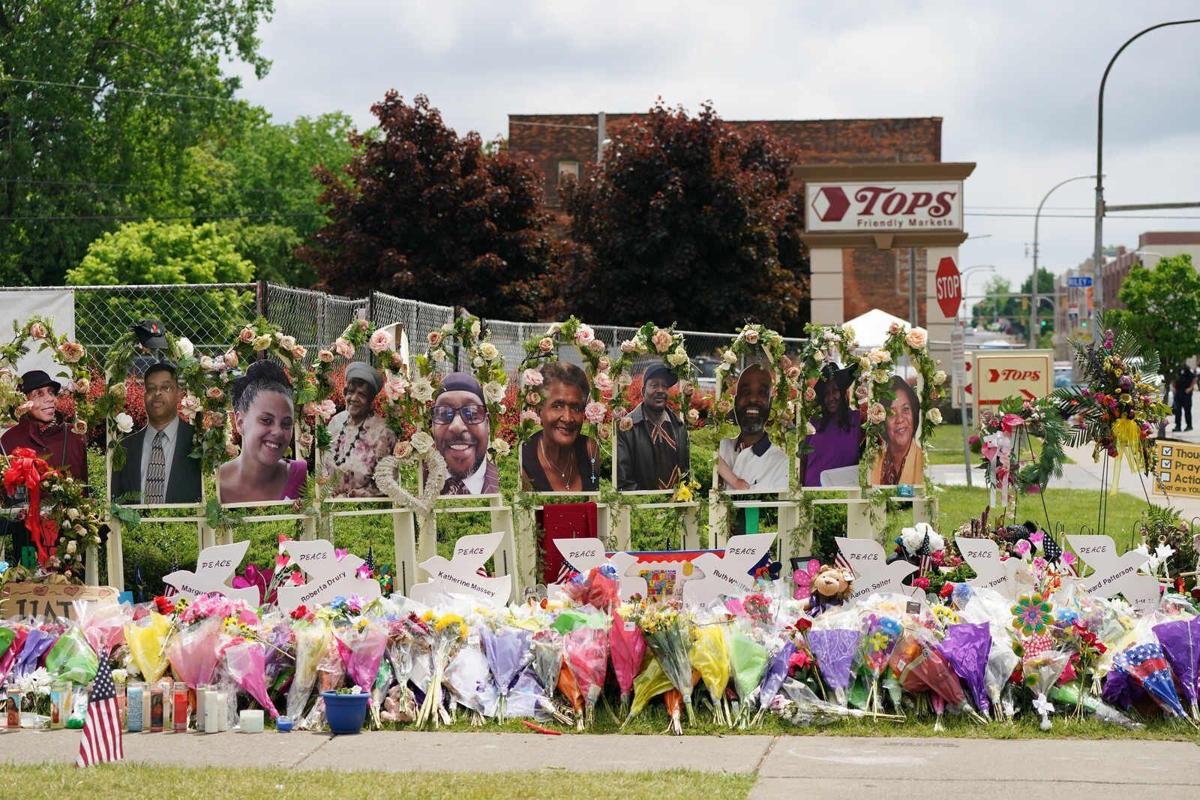
And that's why Tops Markets is partnering with the National Compassion Fund to administer the Buffalo 5/14 Survivors Fund, established following the May 14 mass shooting at a Tops store on Jefferson Avenue that killed 10 people. As of early Saturday, the fund had received $2.44 million in donations from 11,900 contributors.
The Buffalo 5/14 fund will give all donated money to the victims – from the families of those killed in the shooting, to the three people who were wounded, along with store workers and shoppers who endured the traumatizing event.
Tops chose to work with the National Compassion Fund because of its experience in handling donations in other traumatizing events.
People are also reading…
"People want to help," said Jeffrey Dion, the National Compassion Fund's executive director. "And we want to give them the opportunity to help while it's on their minds. And if you wait too long, they're going to get distracted and start paying attention to something else."
The supermarket chain is covering the Buffalo 5/14 fund's expenses through a separate $75,000 donation, in addition to Tops' own contribution to the victims fund.
That means none of the donations will be used to cover administrative expenses – a cost that can quickly diminish the money that flows to a charitable organization's stated purpose.
In contrast, nearly a quarter of the $442,000 raised by Buffalo Bills fans for the Andy and Jordan Dalton Foundation after a game that propelled the Bills into the playoffs in 2017 went toward expenses.
It is expected to take months for the money to be distributed to the Tops victims. That will allow time for more donations to be made, and a thorough application process for recipients to be completed.
"We're talking about millions of dollars, and we want to make sure we do it right, that we have a process that is fair, and transparent and trauma-informed," Dion said.
That process starts with a steering committee, composed of community members who will make key decisions about how to distribute the money.
"People take this responsibility very seriously," Dion said. "It's very much like a jury deliberation: they try and figure out what's fair, what's the right thing to do to spread out that money."
A separate fund, called the Buffalo Together Community Response Fund, is addressing community needs beyond those of the victims. That fund is led by the Community Foundation for Greater Buffalo and the United Way of Buffalo and Erie County.
Dion described how the Buffalo 5/14 fund and its local decision makers will proceed:
• Rev. Mark Blue, president of the NAACP's Buffalo chapter, and Paul Vukelic, president and CEO of Try-It Distributing, were named co-chairs of the steering committee. More members will be named soon.
Steering committees for other funds have ranged from 12 to 25 people, Dion said. "The most important thing is that you have the right kind of people and you have a committee that is a representative reflection of the community it's serving."
The National Compassion Fund asks that certain skill sets be represented on the committee, including a trust and estates lawyer, a psychological trauma expert, a victim services expert, as well as faith and business leaders. Sometimes, large donors are named to the committee. And when a unionized workplace is involved – such as Tops – the fund recommends a union representative be part of the committee.
• Before the committee meets for the first time, the National Compassion Fund provides its members with the outline of a draft protocol, with sections where members will have to make decisions about their own fund and community.
Once approved, the draft protocol is published for public comment. The fund's website contains a link where anyone interested in tracking its progress can sign up for updates. At the end of the public comment period, a town hall meeting is held.
"They can ask a question about the protocol, they can offer feedback," Dion said. "In my experience, sometimes people just want to come and share their story and be heard. And all of those things are perfectly legitimate."
• The steering committee finalizes the protocol, setting the rules the National Compassion Fund will operate under. Then an online application for potential recipients is created, a process that takes about two weeks.
The steering committee decides how long the application period will remain open. With some other funds, that has been about a month.
• The applications then will be reviewed. Paralegals from three large Washington, D.C.-area firms volunteer their services to perform that work, for free. The paralegals ensure the submitted paperwork is complete; if not, they follow up with applicants to fix any problems.
• The next step is to verify the claims, ensuring applicants were at the store that day. If the applicant is a Tops employee, the fund will validate the information with the company. If the applicant was a customer, the fund will verify the information with law enforcement.
Applicants who were injured must authorize release of their health information, and the fund follows up with the hospital to confirm details of their treatment.
Once that research is complete, the National Compassion Fund reviews the applications. If everything appears in order, the applications are sent to another D.C.-area law firm whose paralegals do a "fresh eyes review and make sure everything is complete and ready to be paid," Dion said.
• Then the applications sit and wait.
"We don't make decisions about how much people get until the end of the process, because we're giving out 100% of the money," Dion said. "In order to make that determination, we have to tell the steering committee, 'This is how much money has been donated and this is how many people have been validated in each category' (of recipients). Now we have to approve a distribution plan that gives 100% of that money to those validated applicants."
Then the steering committee determines how much money goes to each category of recipients.
Once the distribution plan is approved, recipients will start receiving funds within a matter of days, he said. Until then, the funds are held by Bank of America, a partner of the National Compassion Fund.
There are no strings attached to how recipients spend the money, Dion said. Some have set up scholarship funds. Others have paid a mortgage for a year.
"There are as many options and reasons as there are victims, and that's why we want them to be able to decide what helps them," Dion said.
• The VictimConnect Resource Center – a program of the National Center for Victims of Crime - has trained victim specialists who update victims about the fund and information about resources available in their communities.
The National Compassion Fund has distributed nearly $106 million in donations to more than 3,500 beneficiaries in 21 different incidents since 2014. It is a subsidiary of the nonprofit National Center for Victims of Crime.
Of all the funds administered by the National Compassion Fund, the one that received the largest amount of donations – about $33.6 million – was for victims of a mass shooting at a nightclub in Orlando, Fla., in 2016.
For donations made online through GoFundMe, a credit card processing fee is charged. Donors have the option of increasing their donation to cover that fee. The National Compassion Fund recommends donors contributing $5,000 or more pay by check or wire transfer.
Matt Glynn
In this Series
Complete coverage: 10 killed, 3 wounded in mass shooting at Buffalo supermarket
-
Updated
Hochul pledges pursuit of justice after shooting, calls on sites to crack down on white supremacist content
-
Updated
Sean Kirst: In Buffalo, hearing the song of a grieving child who 'could not weep anymore'
-
Updated
Recently retired police officer, mother of former fire commissioner both killed in Tops shooting
- 249 updates


