


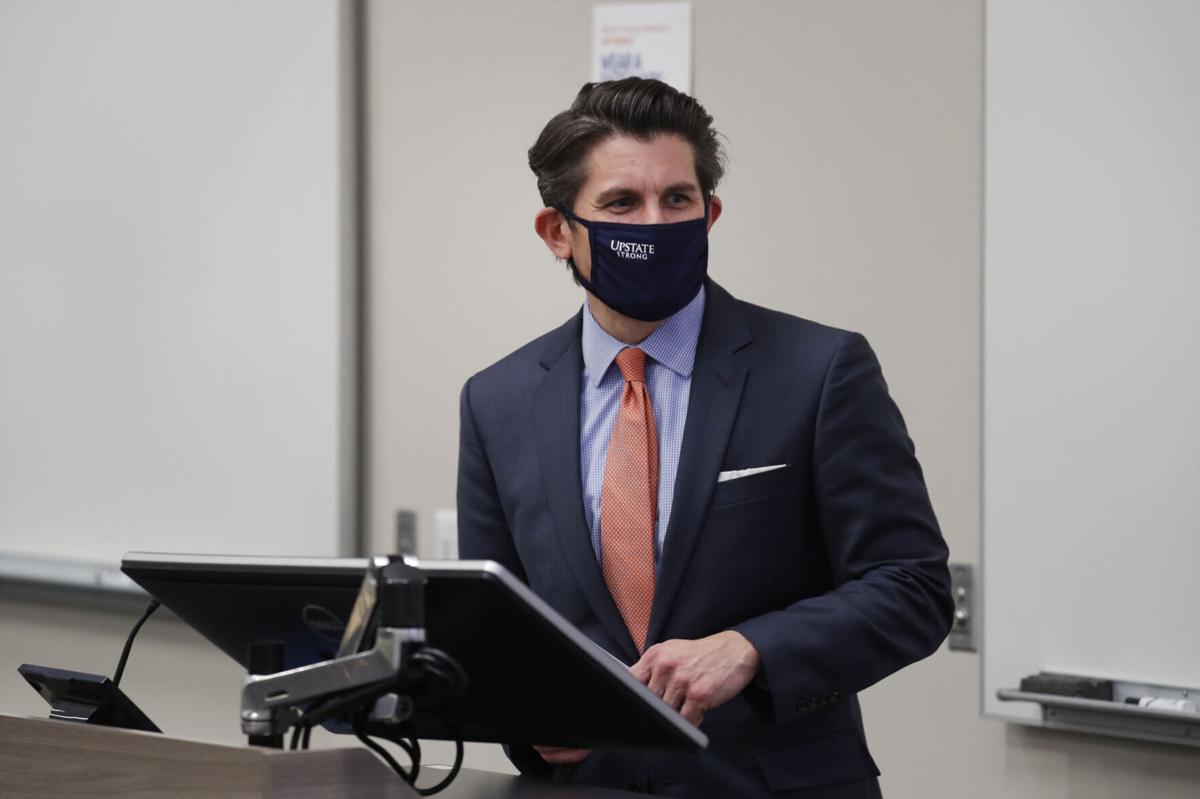
The State University of New York will ramp up the fight against Covid-19 on three fronts, with increased and quicker pooled tests, stricter enforcement of rules governing student behavior, and a new statewide SUNY dashboard that will display prompt and comprehensive statistics from each campus.
The changes were announced by new SUNY Chancellor Jim Malatras Sunday afternoon in a news conference in the Jacobs School of Medicine and Biomedical Sciences. It followed a meeting attended by the presidents of the local SUNY institutions, as well as Buffalo Mayor Byron Brown, state Assembly Majority Leader Crystal Peoples-Stokes and Eunice A. Lewin of the SUNY Board of Trustees.
In his first visit to Western New York since he was named SUNY Chancellor 16 days ago, Malatras announced the changes and encouraged students to obey the restrictions.
"These are not normal times," he said, referring to "the beast that is Covid-19."
People are also reading…
"It hasn't gone anywhere yet," Malatras said. "We're not out of the woods yet. But I think what we're doing here, although in a new normal, will instill confidence in the community, with our parents, with our students, with our faculty and staff that we can remain open safely."
Malatras noted that at SUNY Oneonta, parties caused a spike in Covid cases and the closure of the campus. He praised the leadership of University at Buffalo President Satish Tripathi, Buffalo State President Catherine Conway-Turner, and SUNY ECC Interim President William Reuter for making sure "that has not happened" here.
"Allow me to once again stress: This means no on-campus and off-campus parties," said Tripathi. "Violations of health and safety guidelines may result in suspension from the university."
Tripathi said the university had been working with the City of Buffalo and Buffalo police to break up off-campus student parties.
"Across the SUNY system, we are going to enforce suspensions and other penalties for people who do not comply with the rules," said Malatras.
Malatras also announced the introduction of "more robust testing across the entire SUNY system," using a simplified surveillance test that pools self-collected saliva samples.
Previously, if a pooled sample showed that someone in the group had Covid-19, everyone in the sample had to be brought back to be re-tested, he said. The current test uses the original samples to find the infected person without the need for re-testing.
He called the test "student-friendly and faculty-friendly."
Malatras noted that the inexpensive new tests, developed and produced by SUNY Upstate Medical University in Syracuse, will allow 105,000 tests to be done weekly across the system. "SUNY once again is leading the nation when it comes to testing," he said.
Finally, the new statewide Covid-19 dashboard provides daily statistics from all 64 SUNY colleges and universities. Each campus reports new data every 24 hours.
"We take this seriously," Malatras said. "Transparency builds confidence in our communities."
UB is also working with Erie County to develop ways to test the wastewater from campus buildings, which will show whether someone using a toilet in the building has Covid-19.
"All three of these things – uniform enforcement, more testing, more transparency in real time – will help us take mitigation efforts when we need to more quickly," Malatras said.
During a question and answer period, Bob Miletich, chair of the UB Faculty Senate, asked if a cutoff of 100 diagnosed cases, after which in-person classes will be suspended, was too few in a community of 35,000. "I think there's wisdom in that number," Malatras said, arguing that cases increase quickly.
Asked about reports that students at SUNY Fredonia were holding Covid parties, collecting admission at the door and paying off the first student to be diagnosed with the disease caused by the novel coronavirus, Malatras did not directly comment on whether he'd heard the reports. Instead, he spoke to any students who might be involved.
"I don't want to be the chancellor that takes away everyone's fun, but we are not in normal times," he said. "By the way, I was that SUNY kid who wanted to have fun on campuses. Individual actions have consequences for the entire student body.
"Before you have that party, think about the senior who wants to stay on campus for their final year and have a little bit of an experience. Think about that older family member, who, if you went home and exposed that family member, you could get sick and there could be consequences. I saw that daily, and it's real life," Malatras said.
"I don't want people to make light of Covid. I think that is reprehensible."


