

Colleges across the region took steps throughout the summer to make it possible for students to return to campus in the midst of the Covid-19 pandemic: smaller classes to encourage social distancing, requiring the use of personal protective equipment such as masks and offering more remote learning options.
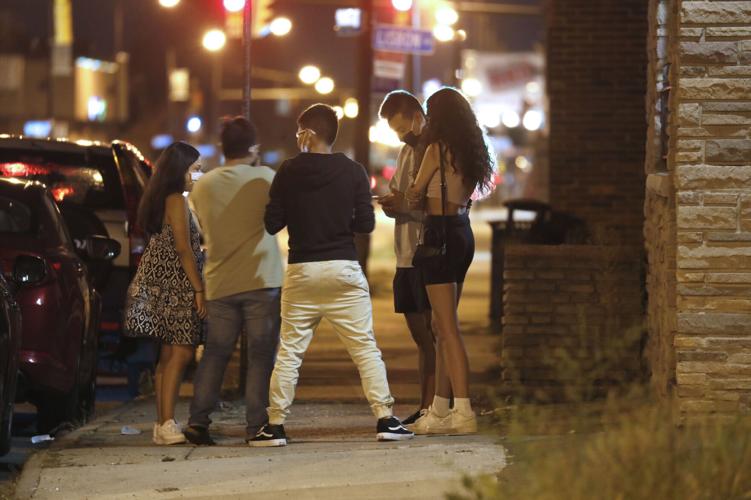
But those efforts might be for naught because of something the schools have been unable to control: parties.
“There are health consequences to this,” Tess Morrissey, director of community relations at the University at Buffalo, said of the persistence of social gatherings. “Students are seeing that this can happen here, and if we want the university to keep in-person learning, students are going to have to stop going to parties, because a few people’s actions can affect an entire community.”
A rapid uptick in cases is pushing UB to the verge of a shutdown, the same week that a different SUNY school had to make that decision and as other public colleges in the region struggle to keep their number of cases from hitting the state-imposed benchmark of 100.
People are also reading…
UB reported 78 active Covid-19 cases Thursday night, which jumped to 91 Friday afternoon. University officials are hammering home what can be done to curb the spread of Covid-19 among its student population that lives off campus, and how UB can maintain in-person learning.
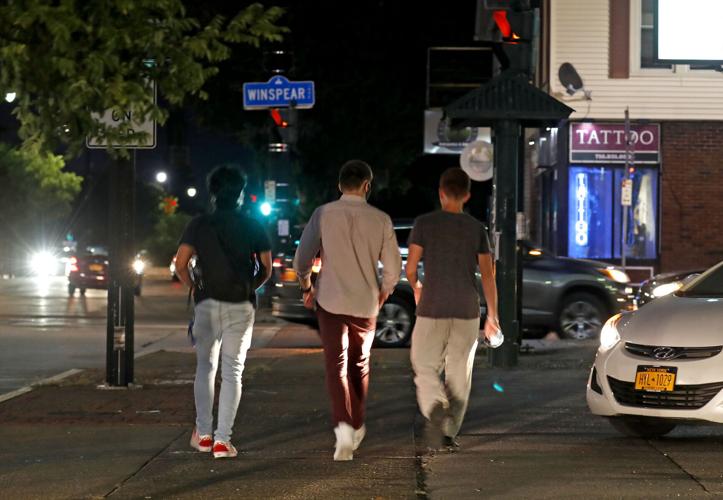
UB said in a statement that it received case data from the Erie County Department of Health that showed, based on ZIP code, that the majority of the new and active student cases of Covid-19 appear to be in the University Heights neighborhood. University Heights, which is well-known as a hot spot for student parties, abuts UB’s South Campus.
UB's 91 active cases appear to bring the school perilously close to Gov. Andrew M. Cuomo’s requirement that a school temporarily shift to online-only instruction when it reaches 100 cases or 5% of the campus population.
UB has a student enrollment of nearly 29,000 undergraduate and graduate students on its two campuses.
Yet as more UB students test positive for Covid-19, the university contends not all of its coronavirus cases count toward the state’s threshold that would require shutting down the campus for two weeks. The university said only 43 of its active cases are “on-campus” cases, per the state Health Department guidelines for colleges. The university on Friday began breaking out “on-campus” cases from total cases on its online Covid-19 dashboard.
UB said infected students who live off campus and take all of their classes remotely don’t count toward the 100-case benchmark. The university said in a statement Friday that State University of New York officials have concurred with this interpretation.
SUNY Chancellor Jim Malatras referred to this distinction in a statement that praised the response to UB’s outbreak, including Friday’s scheduled start of randomized Covid-19 surveillance testing in partnership with SUNY Upstate Medical in Syracuse.
“The campus has continuously acted swiftly to protect their community,” Malatras said.
It’s not clear where things would stand with other SUNY campuses if they apply this standard. SUNY Fredonia, for example, reported Friday that active Covid-19 cases had risen to 50 from 42 the day before. It’s not clear how many would count as on-campus versus off-campus cases. A college spokesman was not able to immediately provide that information.
Yet the rising Covid-19 caseload at UB is “really alarming,” said Yousouf Amolegbe, an international student from Nigeria and president of the UB Student Association.
Amolegbe, who is now working toward a master’s degree in industrial engineering and will leave his post once the Student Association elections are held later this month, is taking all of his classes remotely this semester.
He lives off campus in University Heights and said he hasn’t seen as many students walking around the neighborhood as normal.
In a statement to the campus community on Friday, UB Dean of Students Barbara Ricotta cited recent reports of large gatherings in the neighborhoods near South Campus that jeopardize the health and well-being of the UB community.
“These gatherings have been in clear violation of health and safety guidelines and will not be tolerated,” the statement read.
Among the consequences UB outlined for gatherings that are reported:
- Fines up to $1,500 for off-campus gatherings such as large parties
- Suspension or expulsion from UB
- Endangering an individual’s long-term health
- Risking the health and welfare of students and the community at large
- Ruining a successful fall semester for everyone
SUNY Oneonta on Thursday announced it had canceled in-person classes for the fall semester, after more than 500 cases were reported on campus in the first two weeks of the school year.
Spikes in Covid-19 cases aren’t isolated to New York schools, either. Colleges that have moved to online learning in the last three weeks because of Covid-19 outbreaks include Notre Dame, North Carolina and Gettysburg (Pa.) College.
That isn’t solely an indictment of the capricious nature of college students, though gatherings such as parties and close living quarters such as dorms and apartments aren’t helping the spread of the disease. It’s also a dubious hallmark of Covid-19 – a highly contagious disease, with no cure, no vaccine and inconsistent testing and testing turnaround.
Dr. Gretchen Snoeyenbos Newman is an assistant professor of infectious disease at Wayne State University in Detroit and the founder and editor of Covid-101.org, a website that answers common questions about Covid-19. She explained that several factors accelerate the spread of Covid-19 in college communities, including bringing people from regions where the prevalence of infection is higher than in college communities into a confined, dense space of a college community. Youth – combined with a level of cabin fever – also factors into the current jump.
“Even when everyone is following the precautions, it is very, very hard to ask 18-25-year-olds, many who have been stuck at home for the last six months, to consider their release,” Newman said. “They’re gathering in groups, making decisions to be social, and all of that serves to increase the risk of transmission. Even with all the testing that has been done – and some of it has been adequate, some of it has not – this is not surprising that bringing together large groups of people is resulting in this.”
UB’s spike in cases in the University Heights district is a contrast to other parts of the university community, such as the athletic program, which is mostly contained to UB’s North Campus.
UB athletic director Mark Alnutt told The News earlier this week that in 2 1/2 months of baseline testing, there have been only seven positive Covid-19 tests in the athletic department. There have been 1,058 tests among 388 athletes and 110 staff members since June 15.
Alnutt credited the leadership of Brian Bratta, UB's associate athletic director for sports medicine and wellness services, and the department's work in concert with county health officials to put an education plan in place for UB's athletes, one that counsels them on temporal checks, facilities use and screening policies.
“We are constantly educating athletes on these guidelines, and we need to stay in their ear," Alnutt said. "So far, they’re getting it. We hope we can maintain adherence to these guidelines.”
The spike in the UB community also comes after a summer of spikes of Covid-19 around the country, including in Western New York. The region has had the highest daily Covid-19 rate among the state’s 10 regions for 14 of the previous 15 days, and its daily positive rate has been above 1 percent for 16 straight days.
That prompted Gov. Cuomo to issue a warning to the region this week: Follow guidelines that prevent the spread of Covid-19, or expect shutdowns.
Despite warnings this summer that have been based on epidemiological evidence, preventative nature and societal impact, it appears that some students simply haven’t heeded those calls. Over the past week, house parties and large gatherings have continued in the University Heights neighborhood, which is made up both of students and of families with no connection to UB.
“One of the important things is, especially for students who live off campus, is that our neighbors love having the students around them, and they don’t want to be in an adversarial relationship,” said Morrissey, UB's community relations director. “They are worried about the students. They don’t want to see parties or call the police, because they are worried about students’ health.
“We don’t want to be punitive, but we have to do this, because we are worried about you and we care for your health.”
Amolegbe said he isn't going to any of the house parties that are happening despite warnings from university administrators.
“There’s only so much you can do or say to stop people from congregating, to stop people from meeting each other,” Amolegbe said.
He understands why people want to hang out with friends they haven’t seen since the spring semester ended abruptly. But, he said, “There’s a lot more at risk here.”


