

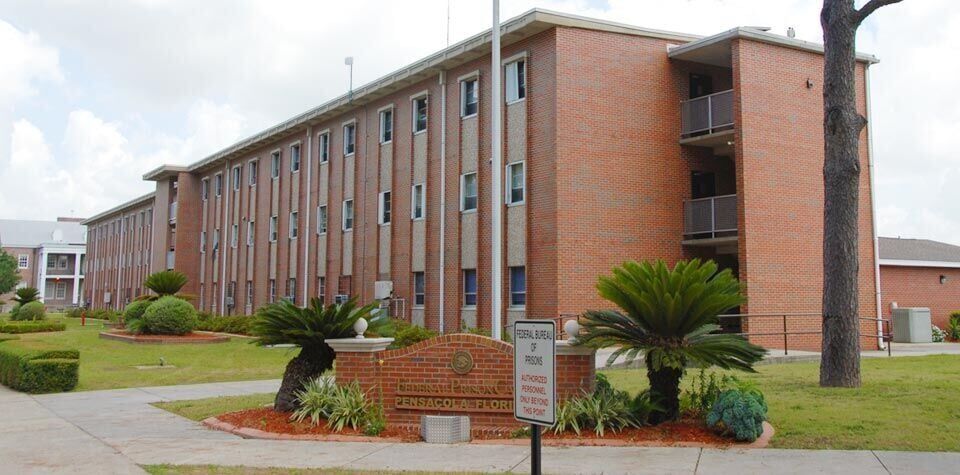
WASHINGTON – Former Rep. Chris Collins is scheduled to begin serving his sentence Tuesday afternoon at Federal Prison Camp Pensacola, a Florida facility that, judging from those who know it, lives up to its name.
It is a bit like a prison and a bit like a camp.

On his last afternoon of freedom before reporting to prison for at least the next 17 months of his life, Chris Collins seemed to experience just about every emotion possible.
Prisoners at the minimum-security facility generally do not stay locked up in dank, tiny prison cells. Most sleep in bunk beds in dormitories.
And while prisoners cannot leave the facility and cannot use cellphones, they can use a well-stocked library, a gym and a running track. They can play racquetball, volleyball and horseshoes. They can even gather in the prison theater for movie night.
"If I had to do time, that's one of the places I'd want to be designated to," said Alan Ellis, a prominent defense attorney who annually publishes a "Federal Prison Guidebook" that includes the above details about the Pensacola facility. "These federal prison camps are much better to be at than other federal prisons."
People are also reading…
Collins requested that he be assigned to Pensacola in January, when a federal judge sentenced him to 26 months in prison after the four-term Republican congressman from Clarence resigned and pleaded guilty to felony insider trading charges.
But as of late Monday, it was not yet certain exactly when Collins would report to Pensacola. His imprisonment has been delayed three times because of the Covid-19 pandemic, and his lawyers want it delayed once more to Dec. 8, or else converted to a sentence of home confinement. Prosecutors, who did not object to those earlier delays, now say it is time for Collins to serve his sentence.
U.S. District Court Judge Vernon S. Broderick will decide whether Collins will go to prison now or later – that is, if the judge decides at all. If Broderick simply lets time pass without ruling, his order from August, which said Collins must report to prison at 2 p.m. Oct. 13, remains in effect.
"The law of the case right now says he goes to prison tomorrow," Dennis C. Vacco, a former U.S. attorney and state attorney general and a Republican, said on Monday.
In the increasingly likely event that that happens, Collins will commence what is likely to be the worst two weeks of his time in prison: a brief visit to Pensacola, followed by two weeks of Covid-19 quarantine.
The Pensacola facility isn't equipped for solitary confinement, so after his Covid-19 test, Collins will be temporarily locked up at a less camp-like prison 144 miles to the east.
"When new prisoners arrive at FPC Pensacola – assuming they test negative – they are then subject to movement (presumably on buses) to another facility, FCI Marianna, a medium security prison, and then shuttled back two weeks later after they are forced to serve in solitary confinement," Collins' attorneys – Jonathan B. New, Jonathan R. Barr and Kendall E. Wangsgard – said in court papers last week. "Such additional, unnecessary movements only risk further exposure and spread."
When Collins returns to Pensacola, though, he will be back at a facility that is among the more comfortable federal facilities, Ellis said.
FPC Pensacola is adjacent to Eglin Air Force Base, so many inmates work there, doing landscaping or other chores. And because it is a stand-alone facility, not adjacent to a medium- or maximum-security prison, the guards in Pensacola stay there and do not rotate to and from tougher facilities – an experience that, Ellis said, can affect their attitudes.
"So it's a pretty laid-back experience," Ellis said of life at FPC Pensacola.
Prison Professors, a consulting firm that helps prisoners and their families and that prepares ex-convicts to re-enter society, has even warmer words for the Pensacola lock-up.
"The federal prison camp in Pensacola has a great reputation," Prison Professors said on its website.
Sam Mangel, a Prison Professors consultant who joined the firm in July, spent 23 months in a federal prison camp in Miami after a wire fraud conviction. In the similar facility in Pensacola, he said, Collins will have a choice of how to spend his time.
"When one is incarcerated, people do different things," he said. "They can sit around and feel sorry for themselves and for the system and walk around with their head down and feel dejected. Others can really take advantage of the downtime and better themselves and move forward."
Mangel took courses in prison and even taught one. Tim Donaghy, a former National Basketball Association referee who pleaded guilty to two gambling-related charges, said he used his 11 months at Pensacola more than a decade ago to write a book and to work himself into the best shape of his life at the facility's outdoor gym.
"It has every dumbbell and barbell that you could imagine," Donaghy said.
The Pensacola facility is clean and safe, he added. Many of the inmates are either white-collar criminals or drug offenders serving the tail end of long sentences after getting moved to Pensacola for good behavior.
Once there, those prisoners had such a comfortable environment that Donaghy wonders why such a prison even exists, given that its inmates pose no violent threat to society.

Instead of another delay, the Collins legal team also suggested an alternative – "time-served plus a period of supervised release with the special condition of home confinement."
"I don't get why you use tax dollars to do that, to pay all those guards, pay all those doctors and nurses and all those people that are there, when you really can just put these people on house arrest," he said.
That is just what Collins pushed for: home confinement at his waterfront home in Marco Island, Fla. But neither the prosecutors nor the judge bought that idea – meaning it is now up to Collins to make the most of prison life, both Donaghy and Mangel said.
Donaghy said Collins might have the opportunity to learn a foreign language in one of the prison's classes – and Mangel suggested Collins might want to teach a class himself.
"Given his knowledge of government, maybe he can teach a class on government affairs," he suggested.


