

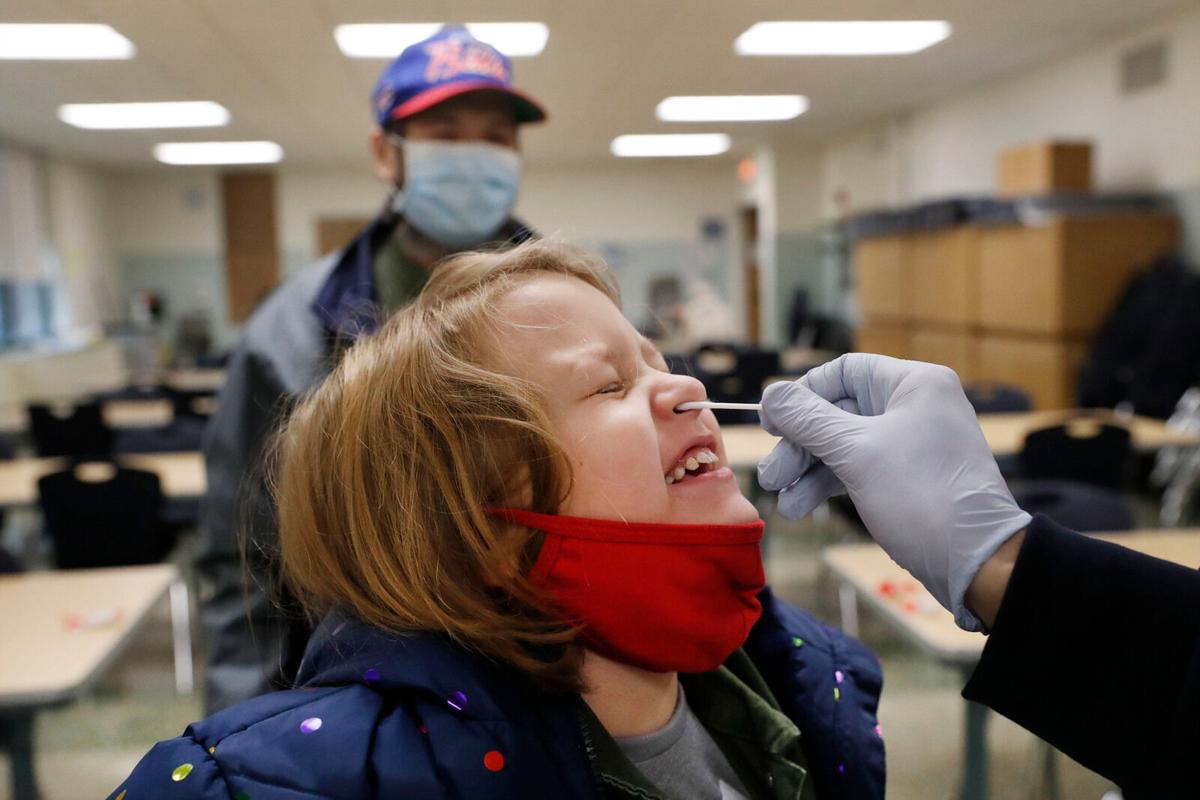
With public health officials bracing for another spike in Covid-19 cases as people gather for Christmas and the New Year, the push for greater access to at-home testing is gaining steam.
On Thursday, the Erie County Legislature debated the merits of requiring the county Health Department to distribute free at-home tests, similar to what is being done in Monroe County, the Province of Ontario and several other states.
The same day, Gov. Kathy Hochul stated that New York would begin making free at-home Covid tests available to residents across the state. New York City Mayor Bill de Blasio also announced that the city will be distributing 500,000 of the at-home tests to cope with a likely surge after the holidays. Monroe County is distributing 750,000 of these tests.
Erie County's Republican-supported minority caucus pushed a resolution Thursday directing the administration of County Executive Mark Poloncarz to make a large purchase of over-the-counter rapid tests and establish at least 15 distribution sites for people to pick up free test kits.
People are also reading…
"Providing access to a test where somebody can have an answer within 15 minutes on whether or not they're safe and healthy enough to go to a family gathering for the holidays and into the New Year's, I think it's the whole purpose why we got federal funds," said Legislator Chris Greene, R-Clarence.

Canadian officials, at a news briefing Friday, described the move as an attempt to discourage travel as the omicron variant spreads rapidly on both sides of the border.
But after some debate, the Erie County Legislature's Democratic majority opted to send the idea of at-home testing to committee for further discussion.
Majority Leader Timothy Meyers, D-Cheektowaga, expressed concerns about cost and the failure of people who test positive at home to report the data to health officials.
Health and Human Services Committee Chairwoman Lisa Chimera, D-Town of Tonawanda, questioned the accuracy and availability of at-home tests but said she would be glad to host further committee discussion on the matter to find a way forward.
Based on the current schedule, the Health and Human Services Committee would not meet until Jan. 13. Republican-supported legislators said that would be too late to help quell the anticipated holiday surge in Covid cases.
"The CDC has come out publicly and said the next punishing wave of the pandemic is going to be in early January," said Minority Leader Joseph Lorigo, C-West Seneca. "We won't have a committee discussion until mid-January at the earliest."
Legislator Jeanne Vinal, D-Amherst, and Chairwoman April Baskin, D-Buffalo, said the Legislature should work cooperatively with the Poloncarz administration to see what's possible, without ordering the administration to do something without having all the facts.
Baskin rebuked the minority caucus for pressuring the Democratic majority to make a huge fiscal decision without more thorough discussion.
"We shouldn't be politicizing or accusing people who are not in favor of this resolution today as being against it," she said. "Let's not accuse our colleagues of not caring."
Both she and Legislator Kevin Hardwick, D-City of Tonawanda, said they were open to moving up the Health and Human Services Committee meeting to take on the matter.
As of Friday, the Erie County Health Department has said it has no plans to purchase any rapid antigen tests to distribute to the public, even though the state and other local governments are pursuing such efforts. Poloncarz said on social media Friday that to keep up with the growing testing demand for the holiday season, the Health Department has spent $1.2 million to purchase 20,000 Abbott ID NOW rapid molecular test kits.
These are different and more accurate than the rapid antigen tests that can be bought at local pharmacies and are being distributed by other government agencies.
Antigen tests look for certain proteins in the Covid-19 virus that triggers an immune response. Unlike molecular tests, antigen tests do not require specialized lab equipment to process a test sample. As a result, they are easier to use, cheaper and can produce results in 15 minutes.
However, antigen tests are less accurate than molecular tests and are more likely to produce false negative results, especially if they aren't administered within the first week of symptoms. For those who have no symptoms, or who have had longstanding symptoms for more than a week, the likelihood that someone might test negative, when they are actually positive, grows.
Read the full story here.
A spokesman for the county Health Department said the county has a lot of available testing options that are free and more accurate, and the Health Department wants more assurance that rapid antigen tests can detect the new Omicron variant.
The U.S. Food and Drug Administration stated last month that preliminary findings show both PCR and rapid antigen tests detect the Omicron variant. Antigen tests don't specify which variant of the virus a person has, only whether or not an individual is infected.
Hardwick said Thursday that even though he supports further discussion on the distribution of free at-home rapid tests, he thinks that discussion should happen soon.
"I think we all need to do something, and I think masks and vaccines are part of it," he said. "But I think so, too, is testing. So I would urge the county executive, I would urge the health commissioner, to take another look at this idea. They could implement this before the end of the year, so that when these gatherings do happen and these infections do result, we could pick up on them right away. I still think there's time to do that."


