

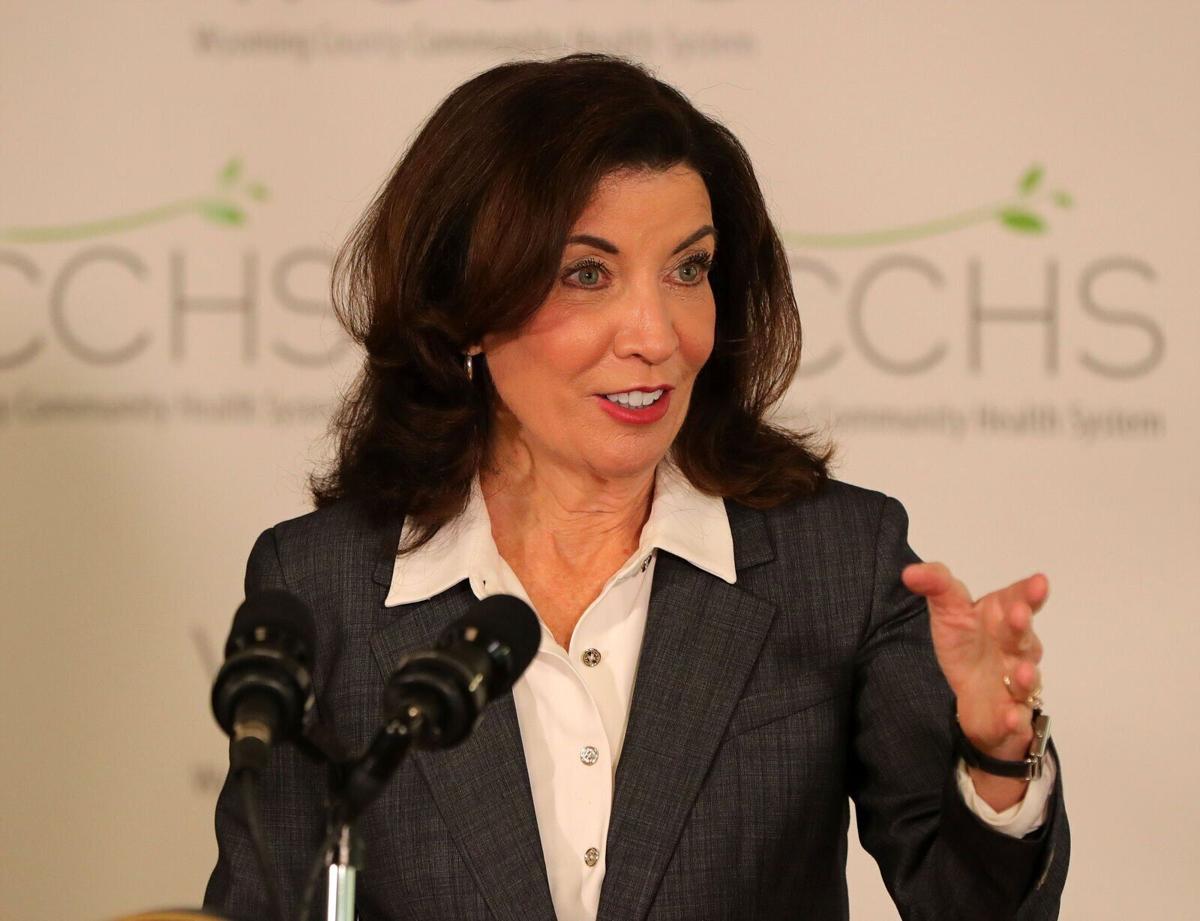
Gov. Kathy Hochul on Monday announced that counties would be given the leeway to enact a test-to-stay program that would enable children who have been exposed to Covid-19 at school to avoid quarantining, expanding what began as a pilot program in Erie County to the entire state once schools return from winter recess.

Erie County lawmakers debated whether to purchase and distribute rapid at-home Covid tests, citing the cost and potential inaccuracy of the kits.
To help facilitate the expanded school testing, Hochul said the state has bought and will distribute 2 million rapid tests to school districts, reserving the lion's share of 5 million rapid tests expected to arrive before the end of the year for the program. Hochul said an additional 5 million rapid tests, the same version that people can buy over the counter in pharmacies that produce results in just a few minutes, will arrive in New York and be distributed throughout the state in January.
Also Monday, Hochul said the state would be making a total of $65 million available to counties to "do the right thing" and enforce her controversial mask-or-vax policy, which requires people to wear masks in any public setting unless the venue has a vaccine mandate in place.
People are also reading…

On Monday, the first schools in Erie County will begin the test-to-stay program as part of a pilot in the Grand Island Central School District.
The test-to-stay in school newscomes as Covid-19 vaccinations for young children continue to lag behind those of adults across New York. While upwards of 80% of New Yorkers age 18 or older have at least one dose of a Covid-19 vaccine, that number dips to just one in four children ages 5 to 12.
Since returning to full in-person learning at the start of the school year in September, districts have faced the problem of scores of children being forced to quarantine at home if just one classmate or teacher they encountered tests positive. District leaders said the vast majority of students forced to quarantine for up to 10 days are healthy, but had to stay home anyway. The situation frustrates parents who, on a moment's notice, are forced to figure out who can stay home with a young child .

“I believe it's here,” University at Buffalo biochemist Jennifer Surtees said about Omicron in Western New York on Saturday, “and we just need to get the sequence data to back up that suspicion. We are anticipating another wave."
"This is so disruptive to their education, and to their parents," the governor said.
With the influx of rapid tests, Hochul said she hoped that families would, with the help of their local schools, be able to quickly learn if a child has Covid-19 – and if not, avoid stressful and often costly disruptions to their normal routines.
"In their backpacks, they'll be taking home testing kits," Hochul said.
Local school leaders applauded Hochul's announcement.
"This is welcome news," said Michael Cornell, president of the Erie-Niagara School Superintendents Association. "Every kid who is healthy and well should be in school every day."
Currently, Grand Island is the only school district in Erie or Niagara counties operating a test-to-stay program, as a pilot. Superintendents hope county officials will decide to give all schools the green light to implement it.
"We hope that we get to yes on test-to-stay in Erie County," Cornell said.

"We've come a long way," Hochul said, noting vaccines, booster shots and testing are more available.
Buffalo Superintendent Kriner Cash welcomed Hochul's announcement, but said he has a number of questions: How did the Grand Island pilot go? How could it be scaled up for a district as large as Buffalo? Under Hochul's plan, will students be given antigen tests or PCR tests? How will parents be educated on how to administer the test and understand the results?
"I like the initiative, but the devil's in the details," Cash said.
Cornell appealed to families to be patient while schools worked through the logistics.
Because Hochul plans to have children take the Covid-19 testing kits home to use, schools will have fewer challenges to work through, Cornell said. He acknowledged that sending the kits home with students, though, requires a certain level of trust that families will follow through with administering the tests.
"It seems to me an acknowledgement that the vast majority of people will adhere to the social contract and keep their friends and neighbors safe," he said.
The news came the same day that Cash sent a district-wide email to students and staff reminding them to take their laptops home with them over the winter break given the possibility the district could go remote in January. Cash's note didn't say how likely he thought that development would be, but said it was necessary "to ensure the district is fully prepared for any eventuality."
On the political front, Hochul's mask-or-vax enforcement funding comes as a number of county leaders have refused to enforce the mandate, which the governor announced last week. It will remain in place until at least the middle of January amid a statewide spike in Covid-19 infections likely fueled by the hyper-transmissible Omicron variant.
Other county leaders said they agreed in spirit with Hochul's mask mandate, but said they lacked the resources to do meaningful enforcement of it.

Dutchess County Executive Marc Molinaro, a Republican, said a top Hochul official told him and other county executives on a phone call Friday that counties were not even expected to enforce the order during the first two weeks. The state has not said that publicly.
Hochul said $1 million would be made available for "smaller" counties, and $2 million for larger ones, to help them fund "innovative" ways to enforce the mask mandate. She said she'd met with some county leaders, who would perform spot checks of businesses, set up online portals or call centers for people to report places failing to abide by the mask-or-vax rules, and buy and distribute masks.
"There are creative ways for enforcement – (counties) purchasing thousands of masks and have teams taking them to the stores so when someone walks in the door, they can hand them a mask," Hochul said. "We want to make sure we pick up the cost of this."
The Covid-19 developments were announced in Manhattan following a whirlwind tour of the state that's quickly become a hallmark of Hochul's tenure as governor. Her travels took her to two rural counties, Wyoming and Broome. While Warsaw, N.Y., doesn't have much in common with midtown Manhattan, they do share a disturbing recent spike in Covid-19 cases and burnt out hospital workers. Hochul took pains at all three events to thank frontline workers.
The governor's office announced 21,027 people tested positive for Covid-19 on Thursday, a one-day record in New York State.
The state set another disturbing record for overall cases reported in a single day on Sunday – 23,391 people tested positive. As in the early days of the pandemic, New York is seeing what Hochul called a "vertical" spike in cases, but expressed optimism based on early data from other Omicron hot spots. Those places have showed an immediate spike, but a similar drop because the newest iteration of the virus could be more easily spread, but cause less severe illness.
"Those numbers went up quickly and they dropped quickly and that's what we expect to see," Hochul said. "The severity wasn't as bad, with respect to Delta and other variants. It's very likely to be minor symptoms if you're vaccinated and boosted."
Statewide, the number of positive cases per 100,000 people stood at 93.78 and there were 60 deaths Sunday.
New York State Health Commissioner Dr. Mary Bassett was not present at Monday's briefing after Hochul said a Covid-19 rapid test Bassett took came back positive. Hochul said a molecular test was administered and Bassett is awaiting the results to confirm the diagnosis. Bassett had not shown any symptoms and is fully vaccinated and boosted, Hochul said.


