

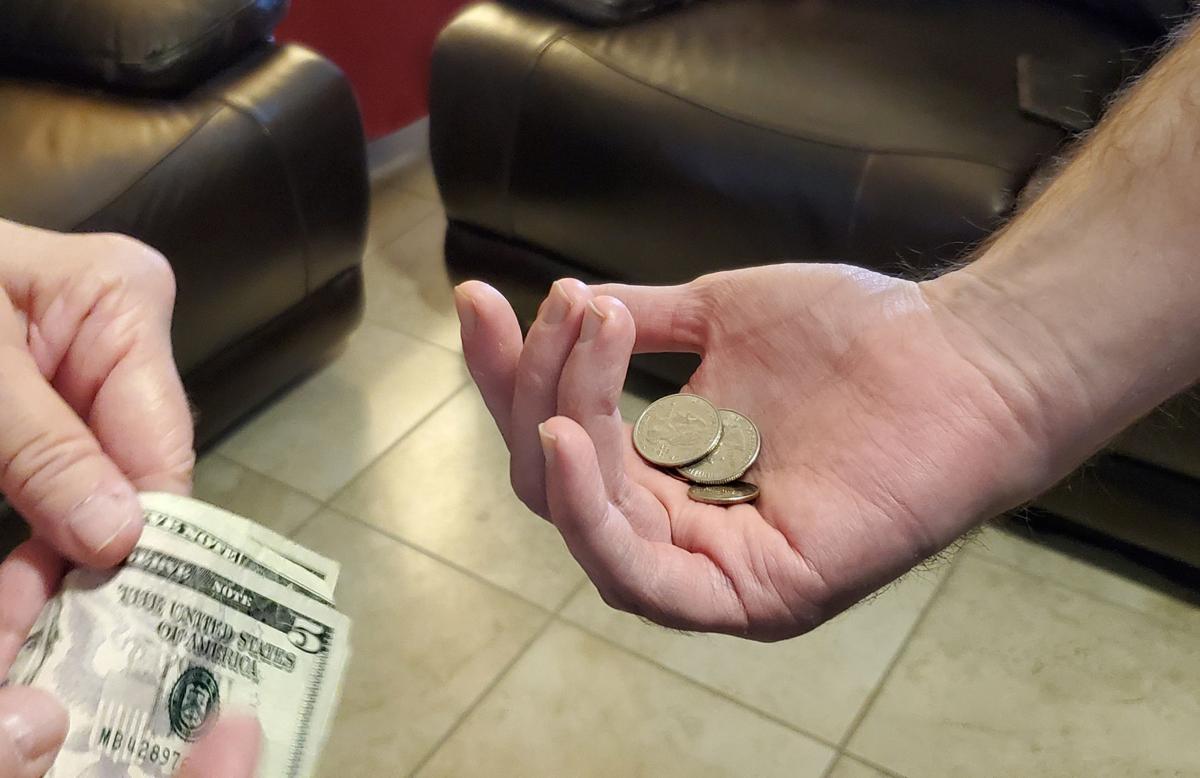
A couple of years ago, I was in a fast-food restaurant, one in which you order and pay at the counter, when the computers were down.
As people came in, a manager announced that because the computers weren’t working, the cashiers could not run credit or debit cards and customers would need to pay cash. That shortened the line a bit and is a good reason to always carry a little cash.
There was one big problem. The cash registers would open with a key, but they didn’t add, calculate the bill or calculate the change.
The cashiers were generally teens and young adults and made me lose faith in our educational system because it seemed not one of them could even calculate change without whipping out their cell phones and using a calculator app.
A customer’s total was $6.07 and she handed over a $20 bill. The cashier picked up her phone/calculator because she was too accustomed to have a cash register that told her what the change should be. Almost immediately, a few of the customers in line shouted out “It’s $13.93.” I don’t really remember the amount, but the rest is true.
People are also reading…
Not everyone is good at math. It’s almost a given that most of us will need a calculator to figure the tax, especially when it’s not a whole number (in Tucson it is 8.7% ). Few of us can do that in our heads.
However, just because you can’t do math in your head, doesn’t mean you can’t count out change without the use of a calculator.
Here’s how:
Keep the $20 bill between a couple of fingers on one hand so you can put change in that hand as well. That way you won’t forget what denomination the customer gave you.
Count the coins first. If the charge was $6.07, you’ll need to count up from that amount to $20. First get to the next dollar amount: $7. Pick out three pennies to get to $6.10, then a nickel ($6.15) and a dime ($6.25) and three quarters ($7.00). Then you’ll need three one-dollar bills to get to $10 and a $10 bill (or two $5 bills) to get to $20.
When you give the change to the customer, count it out the same way, counting up from the total of the bill to the amount given to pay the bill. Drop the change into the customer’s hand by smallest value coin first and count up to $20 as you give the change: “Your total was $6.07. This makes $6.10, $6.15, $6.25, $7, $8, $9, $10 and $20.” Then you put the $20 bill the customer gave you in the register.



 Tucson's having a big fast-food reshuffle


