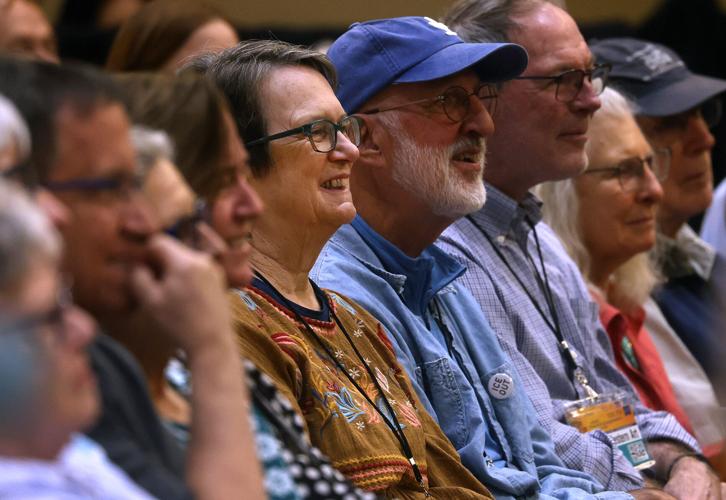
For all of his intellectualism and potentially intimidating reputation as one of the most acclaimed writers of the late 20th century, Salman Rushdie's sentences are powered in part by "a comic propulsion," author Gary Shteyngart pointed out Sunday at the Tucson Festival of Books.
And not just on the page.
Rushdie's appearance Sunday with his friend Shteyngart on a book festival stage at the University of Arizona was full of playful repartee, wry humor and dishy talk about famous literary figures. The laughs propelled the conversation even as it wound its way to more profound thoughts about last acts, mortality, and the dangers of our societal divisions.
It was an embrace of joy and a lightness of spirit on stage that surprised some in the audience, who know how much Rushdie has been through in his 78 years, having lived for decades with a bounty over his head, set by the Iranian ayatollah because of his novel "The Satanic Verses," and barely surviving a stabbing at a public lecture in New York less than four years ago.
People are also reading…
Rushdie, a larger-than-life figure knighted by Queen Elizabeth II for service to literature, set the tone for his Tucson visit with his opening line, when he mused to the audience in the packed ballroom: "In the big Beatles documentary, Peter Jackson's film, there's a moment where Lennon and McCartney are developing what becomes 'Get Back.' And they write the line, JoJo left his home in Tucson, Arizona. And you hear John saying, 'Can somebody check if Tucson is in Arizona?'"
The retort from Shteyngart, a best-selling author known for his satirical style: "Notice that the Beatles use Tucson, not that other city slightly north. Phyonics, I can't pronounce it. I definitely like this town more."
And then Rushdie: "We went driving around looking at cacti and things yesterday. And it occurred to me that maybe the reason why aliens come to this part of America, do the aliens look like cacti? So they recognize their friends. I think that's fact. I can publish that."
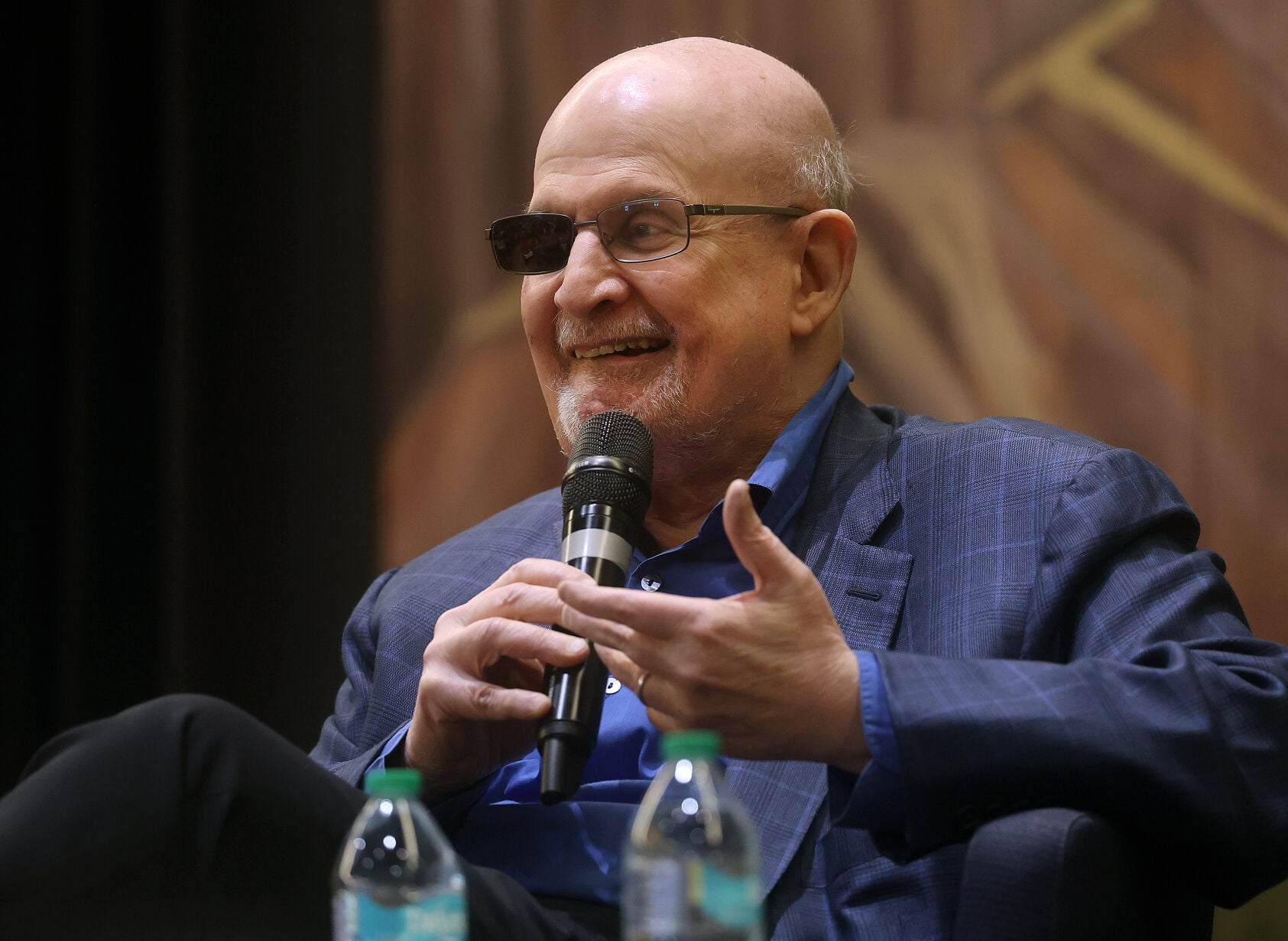
Author Salman Rushdie speaks Sunday during the 17th annual Tucson Festival of Books at the University of Arizona.
And, they were off and running. Here are excerpts:
Shteyngart: 'The Eleventh Hour' (Rushdie's newest book) is one of my favorites of the Rushdie canon. I read it last summer and our nation was having some kind of crisis. I can't remember which one. But I desperately needed to read something that would make me calmer. I grew up in the Soviet Union and I realized my parents looked toward literature in a time of authoritarianism as the one sort of balm for their soul. This was their chance to get away from the horror around them and to enter the consciousness of another human being. And I think that's what 'Eleventh Hour' is for me. It's this chance to time travel, to travel around the world with you.
Rushdie: Thank you. It strikes me that it's a kind of summary of my career, because it's spread around the world in the various places that I've written about. So if you've never read a book of mine, it's not a bad place to start. Your short introduction, before you get into the 600-page numbers.
Shteyngart: Yes, it's the Cliffs Notes, but these are very good Cliffs Notes.
People talk about immigrant writers, but I see you as a global writer. This book, like many of your books, really hops across three continents, South Asia and Europe and the United States. Is that something you think about when you start writing, because you really are trying to sum up the world?
Rushdie: It's because I've hopped around three continents. I'm a double migrant. Born and raised in India. Then there's a long period in England, university and afterwards. And then the last, close to 27 years, in New York City. So I feel that I'm like three writers. There's a disadvantage to it. I sometimes envy those writers deeply rooted in one place. Faulkner. Eudora Welty, people like that. And that's not my story, you know? So you lose something, but you gain something, which is you gain a kind of panoramic view.
Shteyngart: Things actually happen in your novels and stories.
Rushdie: I do plot.
Shteyngart: And I think for contemporary literature, which is mostly 'a person in Brooklyn is sitting and moping around,' it's so rare. Can you talk about your love of storytelling and (laughs) of not living in Brooklyn?
Rushdie: No, I always say Brooklyn is very nice, but it's in Brooklyn. And, throw a stone, you hit a novelist (laughs).
I just thought, I'd be the great believer in story. I remember telling myself as a young writer, when I was writing this enormous book that I hoped people would want to read, 'if you're going to build a big car, you have to put a big engine in it.' And to have a big car with a small engine? That's the Ford Edsel. Story is the engine. And if you look at the history of literature, this difference between art and storytelling didn't exist. You can't read Dickens without story. You can't read Thackeray without story. You can't read Jane Austen without story — I mean, it's all the same story (grins). At the end there will be a wedding, and the rest was about getting there. Sorry, Jane-ites.
Shteyngart: Brooklyn, Jane Austen, not going to be any unscathed by the end of this.
Rushdie: When we teach this stuff that we do, everybody's told to 'write what you know'. And I say, yeah, but only write what you know if what you know is really interesting. Otherwise, for God's sake, go find something else. When I finish a book, I hope I know something that I didn't know when I started, so the book becomes a process of discovery. For me, and hopefully for the future readers.
I don't usually teach creative writing, but there was a moment when I was, and a lot of the students were producing variations on the same story, about a bourgeois upbringing, in which their parents didn't understand them and were probably getting along very badly themselves. And there was a kind of sameness. And I said to one of them, how about if you have that family that you've just described, but a spaceship lands on their lawn? Write about that. That would make an interesting ripple into family life. So that's what I mean, just make things up.
Shteyngart: That's something for inspiring writers to remember. As much as I do want to read the Great Tucson Novel, you may want to write about Phoenix instead. No! No! I mean, Sedona, maybe?

Audience members laugh as they listen to author Salman Rushdie at the Tucson Festival of Books Sunday.
Rushdie: Maybe write the Tucson novel with the aliens that look like cacti. Now there's gonna be 100 novels like that. ... I start with place. It's very hard for me to get going until I know exactly where I'm sitting, which part of the world and what moment in life and what house. I have to know the place before I can make anything move. But then I think, what happens here? And there are five answers to 'what's the story'.
These stories (in 'The Eleventh Hour') go back to what sometimes feels like home. Which is not just Bombay, but this particular tiny little neighborhood where I grew up. Across the street from the swimming pool. The swimming pool, which was notorious, because for a long time, it didn't allow people to get in unless they were white. And then after the independence of India, it decided to become modern. And so it said that Indian people could come in as long as they were the guests of a white person.
Shteyngart: 'Guest of a white person' is a great name for a story.
Rushdie: I was on the hill across the street from that pool. ... This tiny little weird enclave of a little hill where the character in 'Midnight's Children' (Rushdie's 1981 novel) grows up. I just revisited it. I found another story there. And I felt nostalgic. I thought maybe this is the last time I'm going to walk up this hill. And the narrator of the story, who is kind of me, says 'just going to take one last walk up this hill and find one last story to tell.' So it has that kind of elegiac quality. I was very moved by that.
Shteyngart: I remember when I was in Bombay last, I was shown a 37-story skyscraper built and purchased by one family. There's one room that has 'snow' falling all over it. So there's all these water trucks parked next to the skyscraper in a city with water shortages. I thought that was very emblematic.
Rushdie: Yes, it has 12 floors of cars — his cars. Two helipads. His wife, who teaches in a school for young children, proves she's 'a woman of the people' by getting into a helicopter every morning. Flying to the school, teaching little kids and then flying back to the helipad. But see, that's a great story. That's the thing, there's invariably no shortage of stories. The story (in 'The Eleventh Hour') we're talking about is kind of my revenge against the Indian billionaire. It's a story in which billionaires have a very, very bad time.
Shteyngart: Yes. And deserve it. Could it fly elsewhere? Not only India. There are billionaires elsewhere. Well, not in our country (laughs).
Rushdie: This is a very egalitarian place. We wouldn't stand for it (billionaires). No. 'Democracy', and so on and so on.
Shteyngart: I was teaching Martin Amis (books) at my school (Columbia University) — we're both fans of Amis. And Amis talked about a depressive tendency, specifically in British literature. I do find a lot of novelists of the contemporary moment — of course, we are living in somewhat depressing times — but there's a depressive quality. A weight that's almost there for its own sake sometimes. But your sentences still have a kind of comic propulsion. I see that in all of your books.
Rushdie: In the case of Martin, maybe the biggest influence on him was an American writer, Saul Bellow. And the Bellowian sentence is legendary. You know, a sentence that goes from the great books to the Chicago streets in like six words. ... It's been said of (Bellow's) 'Augie March,' 'this is the great American novel,' and I think that's pretty close to being right. Between that and (Bellow's) 'Herzog'.
Well, there's also the book about the fish. Even when first published, it wasn't called 'Moby Dick'. No. It was called 'The Whale'. I began to wonder why is it called 'Moby Dick'? And I started looking into whales of the period, because sometimes whales have names. This is a terribly anticlimactic story, but there was a whale called Toby Dick. And Melville changed one letter.
Shteyngart: Toby Dick does not have the same gravitas. 'Hey, Toby Dick.'
Rushdie: And yes, I know that whales are not fish.
Shteyngart: We're about to be canceled by the whale lobby. 'Oh, that's a fish.' You, as a writer, are also a symbol. You're one of the few writers I know who's also sort of larger than their excellent work. I remember how I first read your books. There was a kid in my high school, in the '80s, who carried 'Satanic Verses' around with him all the time. He was very, very popular with the girls. So I started carrying that around.
Rushdie: Not so popular (with the girls)?
Shteyngart: Not so popular. How did you know? But it was a very big book. It was in hardcover, and I was like, oh, this is really straining my back. So I started to read it. And once I read it, I loved it, became influenced by it, as many writers of my generation. But before the book, it was you as a symbol.
Rushdie: The symbol gets in the way. I remember when I first met the great Israeli novelist, Amos Oz. He had something of the same problem, in that he was supposed to be the national writer, and it's a real burden for a writer, especially a writer with a comic inclination. The national story is not supposed to be funny.
Shteyngart: Unlike the national scene here.
Rushdie: It is ridiculous every day. Every minute.
So no, I do my best to try and persuade people that I'm not symbolic. I'm actual. I'm somebody, doing his work. But it's a problem, and it's a problem I get around by ignoring it. But I'm aware of the fact that sometimes when people meet me for the first time, the thing they think they're meeting actually doesn't exist because standing in front of them is only me. Not the Statue of Liberty or whatever it might be. So I don't like being — sometimes I feel like I'm turned into a Barbie doll. Like Free Expression Barbie. Maybe Free Expression Ken.
Shteyngart: I wouldn't genderize it (laughs).
Rushdie: But, I don't feel like that. I feel like somebody who is trying to write interesting stuff. And my problem is finding interesting stuff to write, because the problem of having written 23 books is that it's not easy to find the next interesting tale. Because what you don't want to do is write something which is a version of what you've already written. So, where do you look, you know? And that's one of the things I tell students, to depress them, is that writing doesn't get easier as you get older. It gets more difficult. I tell them, when you're young, you have to fake wisdom. When you're old, you have to fake energy.
Shteyngart: Obviously the terrible tragedies that have happened in your life, you haven't devoted yourself to them. A lot of your fiction is not about any of those things at all. But your previous book ('Knife') was a masterpiece about a tragedy. How does it feel to transition between the truths?
Rushdie: That book came out of very unpleasant circumstances. For a long time, the circumstances were getting in my way, and I couldn't — this is after I was out of hospital and I was feeling better — but I actually couldn't get back to writing. I tried to go back — I had these fragments of ideas of stories that I wanted to look at. But I looked at the file I had and everything looked like rubbish. And so eventually I discovered that, or I told myself, that the only way of getting past this thing was to deal with it, to go through it. And it wasn't easy, you know? Chapter One of 'Knife' is the description of the actual attack, or this description that I pieced together from my own memory and from what other people said. That was not easy to write, but when I got past that, the book got easier and easier as I went on.
By the time I finished it, I really felt that, to my satisfaction, I had dealt with what I needed to deal with. And almost immediately, within months, the fiction started coming back. It's like some blockage had been removed, and these stories started showing up. The first story I wrote (for the newest book) is the ghost story. Do you know why I was thinking about ghosts? Odd coincidence. ... It turned out to be a book with a theme, and the theme turned out to be, not surprisingly, mortality. But not just because I got attacked, also because I'm getting old. And so, that question of how you face the last act of life.
And then I reread my old friend Edward Said's famous essay called 'On Late Style'. He discusses the idea that people reaching that final act, great artists, can react either with serenity and peace and acceptance, or with rage — Dylan Thomas, 'The Dying of the Light.' Beethoven, in a really bad mood when he was old, hated being deaf, hated getting old. So what does he do? He writes the Ninth Symphony, which is based on the Ode to Joy. That's so interesting that artists can do that. They do the opposite of what they seem to be feeling. And Beethoven gave me a clue, because I thought, it doesn't have to be either/or. It doesn't have to be either peace or rage. It can be peace on Tuesday and rage on Wednesday. We can be both things.
So the book becomes several of the characters facing the fact of being in Act 5 of the play, and how do they respond to it?
Shteyngart: One of the propulsive things for me (in the 'Knife' memoir) was love. A sense of love almost as the opposite of mortality; a love of life, love of your wife, a love of everything that's wonderful and beautiful. There's even a passage about a suit you were wearing that I found absolutely engaging.
Rushdie: This was when I when I was attacked and I was being stabbed several times with the knife. One of the things I remember thinking was, oh, my nice Ralph Lauren suit. That's how elevated my thinking was.
Shteyngart: But that's the thing: You were talking about, obviously, a horrific subject, and yet, it was the opposite of the depressive treatment that I expected, given the horror of the situation; I laughed at some parts of it. I was also just, happy to be alive. I was so happy you were alive. We were all very worried, obviously, but it was just this, I saw it as a testament to joy.
Rushdie: Literature, at its best, is an exploration of the joy of life. There's so much to see and to know and to learn from and to be inspired by — this is the world. Plus it's the only world we got, so we may as well.
Shteyngart: 'The Eleventh Hour' ends with a story set in this almost metaphysical piazza. Spoiler alert, the final sentence is: Our words fail us. And I thought that was incredible to encounter at the end because your words never fail you, I know that, knowing you in person and reading your books. But our words fail — I started thinking about different ways in which that is a reality. Obviously, when our politicians get up at a podium, their words fail us, literally. We are failed by their words. But also I was thinking of AI. And so when words fail us — is this a kind of premonition about what may happen to us?
Rushdie: That story, the old man in the piazza, is probably the most directly allegorical of the stories in the collection, and in a way, it's a warning. The country is not named and the city is not named, because I think it applies to more than one place. We're reaching a point in our societies where we are so divided, the gulfs are becoming so deep and so wide, that we can't talk to each other. Even though, in fact, we are speaking the same language, we can't understand each other. We can't hear each other. Our words fail us.
And if you live in a moment of history where communication breaks down, that's an amazingly dangerous thing for a society. And that's where we live. In that piazza.
But just to lighten the tone, the other source of that story — well, there's one literary source, which is I really admire the short stories of Donald Barthelme. The craziest, zaniest stories in the world.
But also, I was thinking about The Pink Panther. In the original, the first Pink Panther movie, if you remember the climax, there's this ridiculous car chase, where people are dressed in zebra heads and all kinds of crazy costumes, in sports cars, zooming across a piazza. There's this old gent who just kind of watches it, and this crazy shit goes down. Eventually there's a huge pileup. And he's just sitting there, he pulls up a chair. So I stole him. I stole him, but I put him in my piazza. Not an inspiration that many people would think of in my writing, The Pink Panther.
Shteyngart: I love that this is a combination of Barthelme and The Pink Panther. That's the Hollywood pitch.
Norma Coile is a writer and editor at the Star. Contact her at ncoile@tucson.com.

Norma Coile
Team leader