Miranda Spivack was being stonewalled for basic records and contracts from a county government even though she worked for The Washington Post, "the big dog in town," and had an expert newspaper lawyer helping her. It really made her wonder how citizens who aren't journalists, especially those in areas where local news outlets haven't survived, can find out anything they need to know about their school system or why their trash isn't getting picked up.
Jacob Soboroff was covering the stunning January 2025 inferno that destroyed his hometown of Pacific Palisades, California, and the home he was born into, "in real time on live TV" for NBC and MSNBC. "I had this feeling that I was witnessing my childhood sort of incinerate in front of my eyes, carbonizing as I watched," he says. But over time, he came to realize "that this was not a trip into my past, but the fire of the future," of the type that more and more of us across the land may have to confront. It needed a deeper understanding.
People are also reading…
Aaron C. Davis, who was lead reporter and writer on The Washington Post's Pulitzer Prize-winning investigative series about the Jan. 6 attack on the U.S. Capitol, was still deep into that story a couple years later, covering the trials of rioters, when his reporting partner Carol Leonnig got a tip: The Justice Department wasn't going to investigate Donald Trump's role. "We wanted to answer the question of why," Davis says. "Why was it that the Department of Justice really did not take by the horns and investigate January 6th and the people around the president and whether they were culpable or not?"

MS NOW's Jacob Soboroff, author of "Firestorm" and "Separated."
Those are the questions and issues that led to Spivack's 2025 book "Backroom Deals in our Backyards: How Government Secrecy Harms our Communities — and the Local Heroes Fighting Back," Soboroff's 2026 book "Firestorm: The Great Los Angeles Fires and America's New Age of Disaster," and Davis and Leonnig's "Injustice: How Politics and Fear Vanquished America's Justice Department" in 2025.
Spivack, Soboroff and Davis spoke Saturday to an audience at the Tucson Festival of Books about investigative reporting, a panel discussion that drew a crowd to Gallagher Theater at the University of Arizona, was shown on C-SPAN's Book TV, and was one of the festival events with high demand for advance tickets. It was moderated by Dan Balz, a former national editor for The Washington Post.
Confronting 'information blockades'
The questions that prompted Spivack to embark on her book led her to "accidental activists, which is to say, people like you who suddenly come across a problem that they want to figure out the answer to, and they're frustrated because they run up against the secrecy," she explained.
"They confront these information blockades where people are just holding onto basic public information, that under every state open records law they should have been able to get, and they get angry, and they are very tenacious. They have no training doing this whatsoever and are really self taught."
"I know here, in Tucson, there's a whole data center debate that's gone on, and there was a lot of secrecy by the local government, which signed a non-disclosure agreement," Spivack said. NDAs and claims of "trade secrets" are "two of the big, big problems that you will confront if you want information from your state and local government about anything that any corporation is doing."
"The boots on the ground are people in communities who are gonna find this stuff out," she said, especially in the growing number of places where local news outlets have gone under or have faced severe cutbacks in reporting staffs. "The decline of local news is a huge problem," Spivack said.

Thousands of people filled the University of Arizona Mall this weekend for the Tucson Festival of Books.
In those areas, getting the word out to other residents about controversies or grassroots efforts can also be a challenge, so social media "is a huge factor." "They get the word out through Facebook, to find out what was going on in other communities, to organize, to network, to shame public officials."
Asked by Balz whether that could become "a model for where we're heading in terms of how local news gets disseminated," Spivack responded: "It's a good starting point. It's good for them for communication, but is it really the news, fact-checked" with rigorous verification? "It's a little risky."
'Politics of blame and misinformation'
Soboroff, senior political and national reporter for MS NOW, investigated "the costliest wildfire event in American history, that destroyed 16,000 structures, killed 31 people, 400, if you look at excess mortality, destroyed an area three times the size of Manhattan, and left thousands of people homeless."
For the narrative structure of "Firestorm," he used the texts between fire agency heads in Southern California in chronological order, as "the spine to interweave the stories" of the residents of the Palisades and those who fought the blaze.
The investigative framework was formed by four major factors: "Climate change; our infrastructure is falling apart — there was a 117-million-gallon reservoir that was empty at the time of the fire; changes in the way we live — a thousand electric car batteries exploded during the fire. And the final one was the politics of blame and misinformation and disinformation."
"The recovery in the aftermath of that fire has been acutely affected by the policies of this (Trump) administration," Soboroff said. "Meteorologists that predicted the fire have been fired across the board from the National Weather Service." Elsewhere in the federal government, an agency "which has tracked every major mass casualty event of over a billion dollars in the last 40 years has been discontinued by this administration because it talks about climate change. Donald Trump closed the program."
"Here's the Arizona summary" of that tracking before it was canceled, Soboroff told the audience: "From 1980 to 2024, there were 34 confirmed weather climate disaster events with losses exceeding a billion dollars each to affect Arizona. Sixteen drought events, three flooding events, one severe storm event, and 14 wildfire events. Between 1980 and 2024, the annual average was 0.8 events. In the last five years, the annual average is two events, double."
"There are so many more of them" — wildfires and extreme weather events — "that are happening now."
Inside the rooms
The root of investigative reporting "is to find something that is hidden, something that nobody wanted told or somebody in power didn't want told," said Davis, who has won two Pulitzers and been a finalist for three.
"There's different kinds of investigative reporting," he noted. "There's great document work, there's great data work, there's great on-the-ground. There's this field now, visual forensic work — and this is being done every day, right now, with Iran — where we're analyzing the angle of the shadows of different sites, of different pictures that are taken to verify if a picture is a fake, or if they're real and verified by different points at the same time."
But reporting "Injustice" was "an old school kind of investigative journalism endeavor," he said, "because it was a federal crime for many of the prosecutors and FBI agents just to tell us some of the things that happened in these rooms during an act of investigation," and certainly about what happened in front of a grand jury. "And so we had to basically tell them, 'this is what we know, and if you can help us fill in the gaps, please do so.' And we would start to try to build these scenes" about what happened in key meetings.
The book's reporting takes readers "inside the room when the head of the Washington Field Office of the FBI says, 'I'm not gonna go execute a search warrant at Mar-a-Lago. You're gonna have to make me. You're gonna have to order me to do it.' ... And then you're there the night after they go in and they find this pile of documents that are stunning to the agents that, you know, they find classified documents in a bathroom, in an under stage (area), and that night, the assistant national security attorney general is going around the room, asking people, 'What do we do next?' And this woman, who's kind of the encyclopedia of classified documents cases inside DOJ, says, 'If it was anybody else, we'd arrest him tomorrow morning.'"

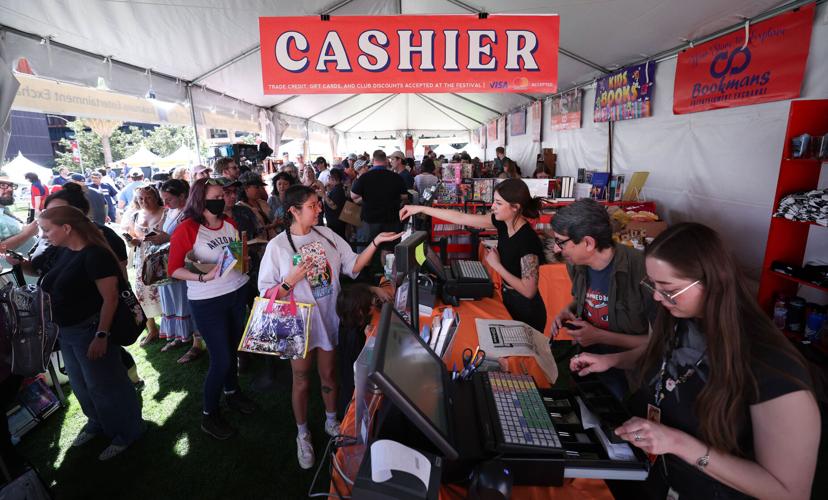
Shoppers browse the selections inside the Bookmans booth at the Tucson Festival of Books.
"We ended up getting 250 people to talk to us for this book," Davis said. "Any page of that has been sourced; there's literally ... 19 different sources involved in one sentence sometimes."
To get to answers about why DOJ handled the Jan. 6 case the way it did, "We ended up going back in time and rereported almost every major theme and storyline you can remember from Donald Trump's first term, as it intersected with the Justice Department — the Mueller Report, the Roger Stone case, the Flynn case. We found that people's careers had been bludgeoned. People were singled out, some of the agents were singled out specifically by Trump, and careers were ended. And it did have an effect, where there was a hesitancy to investigate Donald Trump immediately after Jan. 6th."
"There was also this sense in the incoming folks that they needed to get above politics and not get down in the fray again. We found kind of a tragedy in three acts," Davis said. "There were, obviously, efforts in the first Trump presidency to undermine the independence of the justice system. There was a well-intentioned effort during the Biden presidency to set the course right in the Department of Justice, and it backfired spectacularly.
"And now we're watching the third act play out in this huge retribution campaign that has guided the department."