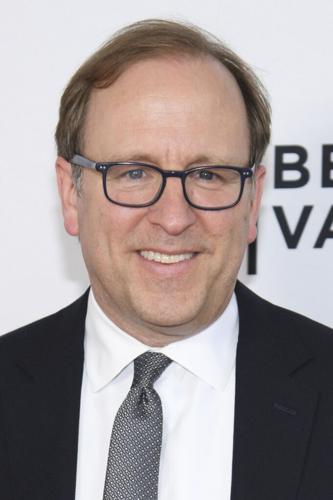
Jonathan Karl, chief Washington correspondent for ABC News, was inspired to become a journalist by a news story that unfolded across the globe when he was a college student spending his days devouring books by Kurt Vonnegut, Fyodor Dostoevsky and others. Those writers' stories were not "true", but they got at truths that forced him to think and affected the way he looked at the real world. He wanted to be a truth teller.
George Orwell's essays, in particular, spoke to him; when Orwell set out to write, "he said he often did so because there was some lie that he wanted to expose. Some fact that he wanted people to notice."
"So, I was a year from graduating college and reading a lot of Orwell when I watched something unfolding a world away that changed me forever," Karl told hundreds of writers gathered Friday night in a University of Arizona ballroom for the authors dinner that opens the annual Tucson Festival of Books, where he was the keynote speaker.
People are also reading…
"I sat glued to the television as students, kids my age, started marching and protesting in the middle of China's capital, in Tiananmen Square. They seemed like me. They seemed like my friends.
"They were taking a stand for their own freedom. They were protesting joyfully and peacefully with purpose. Some of the Chinese students created a large plaster statue of a goddess of liberty, like the Statue of Liberty, but with Chinese characteristics. I was inspired. China was not a free country. But people just like me were trying to change that.
"The protests went on for three weeks, larger and larger. And then the Chinese government decided it was time for them to end. ... Peace- and freedom-loving students were no match for the heavily armed soldiers and imposing tanks rolling down the square. The students were beaten; a lot of them were shot. It was a massacre.
"And the reason that I knew what was happening, as I sat in my dorm room in Poughkeepsie, New York, was because there were American journalists there, to bear witness."
But, "if you were graduating from college today in Shanghai or Guangzhou or Beijing, you wouldn't know a damn thing about (it)," he said. "The Chinese government has erased the memory, or tried to erase the memory, of what happened in Tiananmen Square."
"I set out to be a journalist because I wanted to be there watching history unfolding. I wanted to be a truth teller, of the good, the inspiring, the tragic."
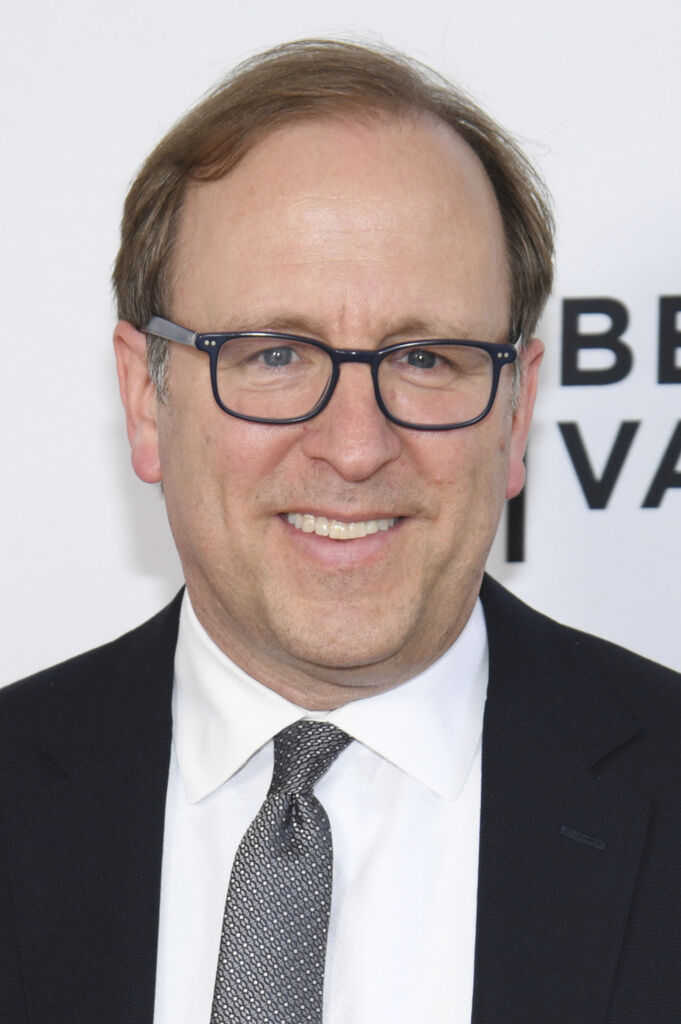
Jonathan Karl
As his career took him to Washington, D.C., Karl said, "I felt both humbled and proud to live in a country where I could ask tough questions of the most powerful people on the planet, without fear of retribution. A country with a freedom" the Chinese students did not have. "A country where the First Amendment of the Constitution guarantees freedom of speech, freedom of the press, a country where a president can't, or shouldn't be able to, banish a reporter, or a news organization, simply because he doesn't like a question that was asked, or the editorial policy."
Here, Karl's audience broke into applause for his references evoking current news stories. The clapping would resume a minute later, after he said he had been proud to work in a country where "even the military leadership welcomes the scrutiny of a free press, and where nobody can take away a press pass because the journalist refuses to sign a pledge that makes it impossible to do journalism," where "the secretary of defense doesn't ban photographers because his staff finds the photos unflattering."
Karl told of being at the U.S. Capitol when it was evacuated on Sept. 11, 2001, and learning later that "a group of heroes broke into the cockpit (on Flight 93) and brought down a plane that was likely headed to the Capitol dome above me. Saving countless lives" — including Karl's — "as they ended their own."
"One of those passengers was a 32-year-old software engineer/salesman named Todd Beamer, who was heard saying 'let's roll' as he helped lead the charge on the cockpit to take out the hijackers," Karl noted.
"I was there at the Capitol late that night when members of Congress, from both parties, briefly returned and assembled on the steps." A few, "including a freshman congressman from Indiana whose name was Mike Pence, started singing 'God Bless America'. Soon, they were all singing. Look, reporters are trained to be skeptical. ... But as I stood there, watching them sing that song, I had to hold back tears. I had never felt more proud in my country or more privileged to be on the grounds of the U.S. Capitol. In the darkness of that night, the Capitol seemed to me like sacred ground," Karl said.
Twenty years later, Karl was at the White House "when that same Capitol building came under attack on January 6. Police officers were beaten. Windows were smashed. People called out for the hanging of the vice president. I was horrified. The Capitol still felt like sacred ground. So I worked hard to document what happened on that day. I reported on it extensively for ABC News. I wrote a book about it. I wanted the world to know, in history, you know, the truth about what happened."
"Almost immediately after that, people in positions of power and authority were denying what had just happened, pretending that January 6th was peaceful, that we didn't witness a violent attempt to overturn a presidential election for the first time since George Washington took the oath of office. There are people who would like to cover up the truth of that day, just as the Chinese have tried to cover up the truth of what happened in Tiananmen Square. ..."
"The biggest lie of all is that there is no truth," Karl said. "It is true that those students in Tiananmen Square tried to stand up for their own freedom and their country's, too. And they were brutally brought down. It is true that terrorists attacked the country on September 11, and that a brave group of strangers on Flight 93 sacrificed their lives to save the Capitol.
"It is a lie that Renee Good and Alex Pretti were domestic terrorists," Karl continued, to more applause, calling out the names of the two U.S. citizens shot and killed by federal officers in Minneapolis in January.
"Orwell's warning about lies lurking behind vague, loaded language feels almost quaint today," he said. "Today, the lies are in bright neon lights declared by people in positions of power. The lies are loud and brazen. 'War is peace'. 'Ignorance is strength'."
Karl, a New York Times best-selling author, said he has written four books in the last six years, from what he called "the front row of the Trump show," the title of one of those books.
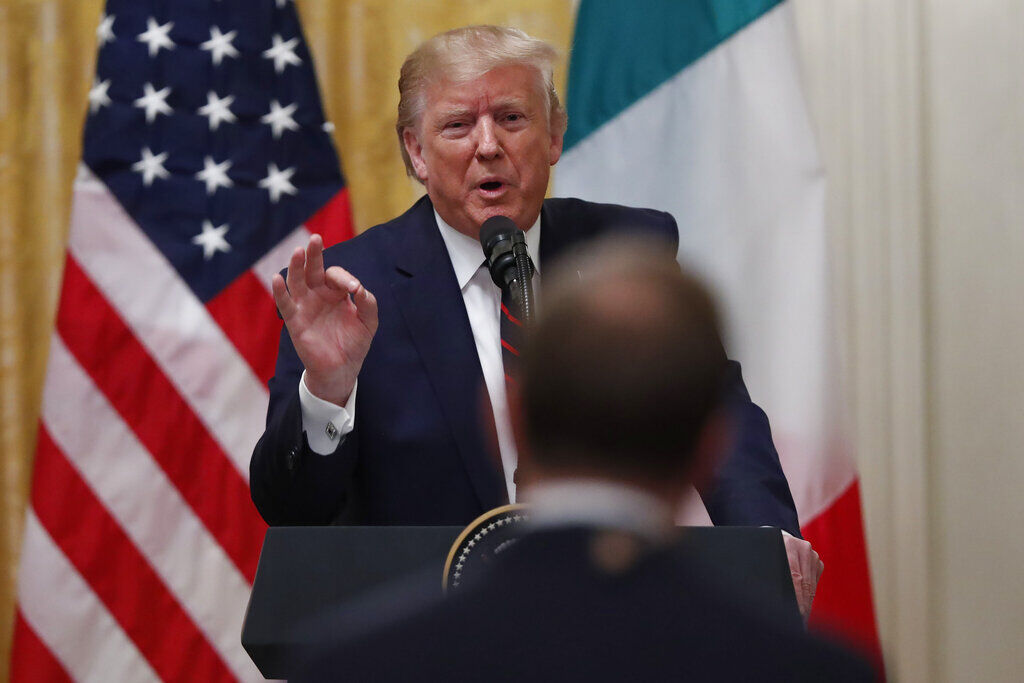
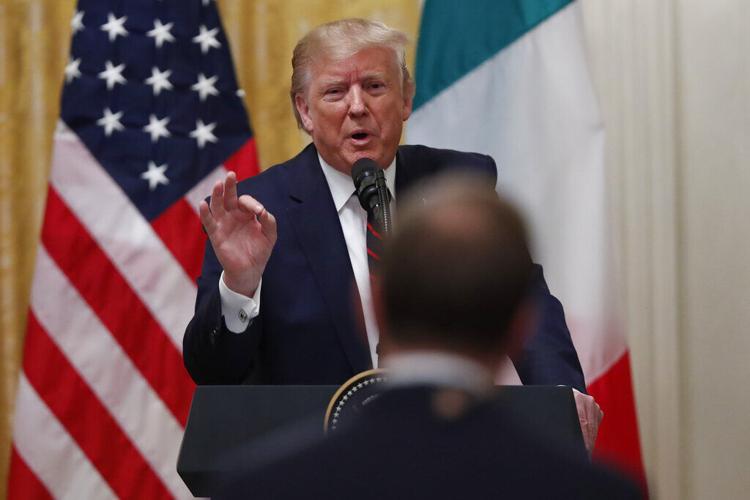
President Donald Trump gestures while answering a question from Jonathan Karl, ABC News chief White House correspondent, in 2019.
"My motivation was a basic one at first. I was covering a remarkable story. It had captured the world's attention, and I believed that people would be talking and arguing about and wondering about it for many years to come. ...
"But after the events of 2020, and the efforts by a president of the United States to overturn a presidential election, my motivation became more Orwellian. I mean, not in the way the word is misused, but in a way Orwell saw himself. The motivation he saw. I was writing to expose lies, writing to document the truth. I saw the effort to erase the very recent history, the raw history of January 6th, as an echo of what the Chinese had done for the memory of Tiananmen Square."
Karl has covered the White House, Capitol Hill, the Pentagon and the U.S. State Department, and has reported from more than 30 countries, covering U.S. politics, foreign policy and the military. His latest book is "Retribution: Donald Trump and the Campaign That Changed America." (Dutton, October 2025).