

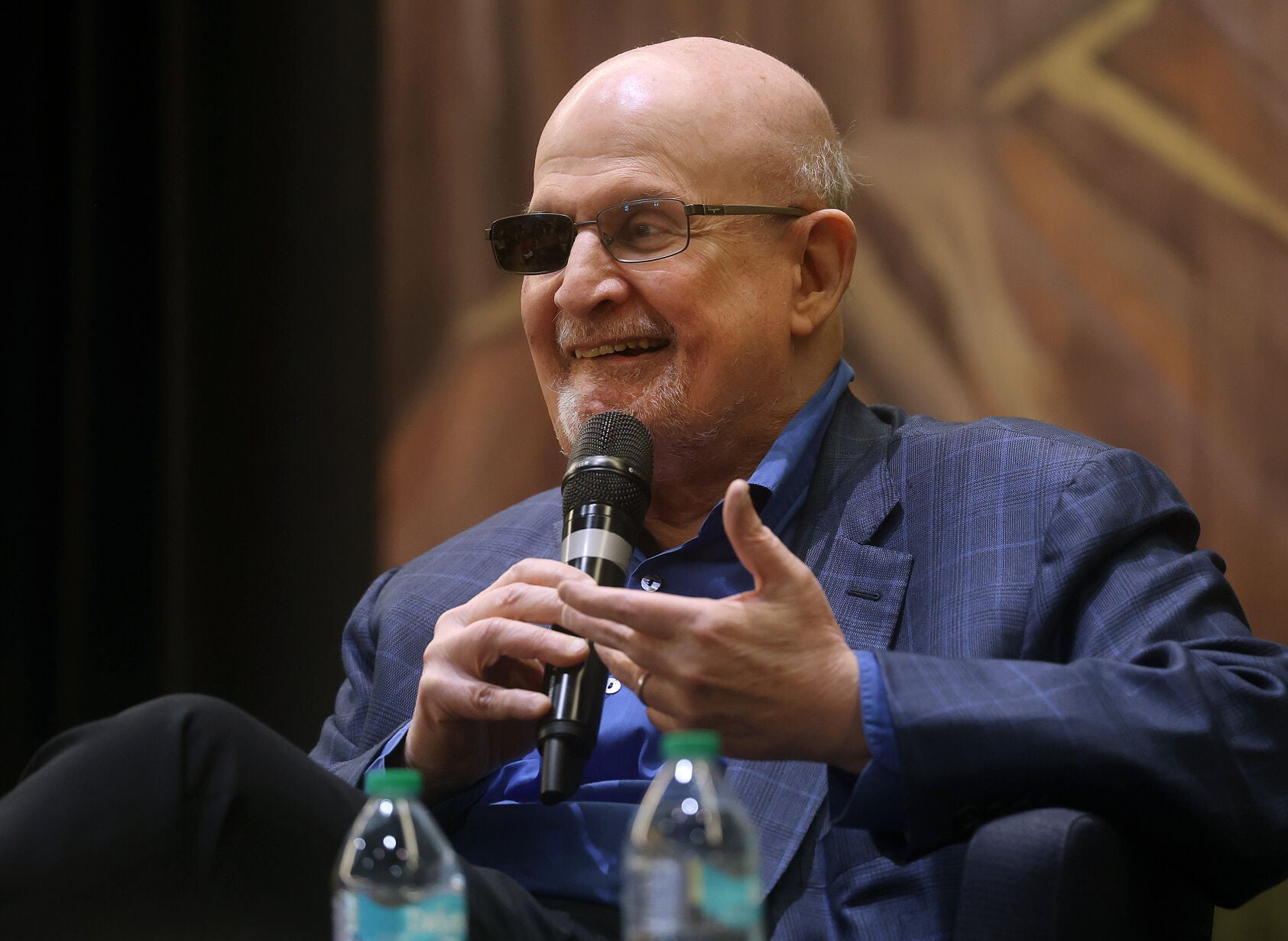
Salman Rushdie, the most prominent literary figure to appear at the Tucson Festival of Books in its 17 years, spoke to about a thousand people Sunday from a festival stage at the University of Arizona.
The author of 23 books, including the Booker Prize-winning "Midnight's Children" in 1981, Rushdie received a British knighthood for service to literature. The 78-year-old Indian-born author, who now lives in New York City, is included on many lists of the most acclaimed writers of the late 20th century.
In 1989, the Iranian ayatollah put a bounty on Rushdie's head because of his outrage over his novel "The Satanic Verses," and in 2022, Rushdie was stabbed and nearly killed by an attacker as he took a stage in New York state to give a public lecture about free expression.
People are also reading…
Rushdie's highly anticipated appearance Sunday at the Tucson book festival touched on such weighty topics, but also featured his playful humor; you can read the Star's full story here, which includes a partial transcript of his lively conversation with a fellow author.
Here are seven quotes from the event:
Rushdie musing about Tucson
"In the big Beatles documentary, Peter Jackson's film, there's a moment where Lennon and McCartney are developing what becomes 'Get Back.' And they write the line, JoJo left his home in Tucson, Arizona. And you hear John saying, 'Can somebody check if Tucson is in Arizona?'"
"We went driving around looking at cacti and things yesterday. And it occurred to me that maybe the reason why aliens come to this part of America, do the aliens look like cacti? So they recognize their friends. I think that's fact. I can publish that."
Rushdie on his larger-than-life public image
"I do my best to try and persuade people that I'm not symbolic. I'm actual. I'm somebody, doing his work. But it's a problem, and it's a problem I get around by ignoring it. But I'm aware of the fact that sometimes when people meet me for the first time, the thing they think they're meeting actually doesn't exist because standing in front of them is only me. Not the Statue of Liberty or whatever it might be. So I don't like being — sometimes I feel like I'm turned into a Barbie doll. Like Free Expression Barbie. Maybe Free Expression Ken."
Rushdie on today's societal divisions
"We're reaching a point in our societies where we are so divided, the gulfs are becoming so deep and so wide, that we can't talk to each other. Even though, in fact, we are speaking the same language, we can't understand each other. We can't hear each other. Our words fail us. And if you live in a moment of history where communication breaks down, that's an amazingly dangerous thing for a society. And that's where we live."
Rushdie on mortality
"After I was out of hospital (after the 2022 attack) and I was feeling better ... I couldn't get back to writing. ... Eventually I discovered that, or I told myself, that the only way of getting past this thing was to deal with it, to go through it. And it wasn't easy, you know? Chapter One of (his 2024 memoir) 'Knife' is the description of the actual attack, or this description that I pieced together from my own memory and from what other people said."
"By the time I finished (writing 'Knife'), I really felt that, to my satisfaction, I had dealt with what I needed to deal with. And almost immediately, within months, the fiction started coming back. It's like some blockage had been removed, and these stories started showing up. The first story I wrote (for his newest book, 2025's 'The Eleventh Hour') is a ghost story. ... (The book's) theme turned out to be, not surprisingly, mortality. But not just because I got attacked, also because I'm getting old. And so, that question of how you face the last act of life."
"... People reaching that final act, great artists, can react either with serenity and peace and acceptance, or with rage — Dylan Thomas, 'The Dying of the Light.' Beethoven, in a really bad mood when he was old, hated being deaf, hated getting old. So what does he do? He writes the Ninth Symphony, which is based on the Ode to Joy. ... Beethoven gave me a clue, because I thought, it doesn't have to be either/or. It doesn't have to be either peace or rage. It can be peace on Tuesday and rage on Wednesday. We can be both things."
Norma Coile is a writer and editor at the Star. Contact her at ncoile@tucson.com.

Norma Coile
Team leader


