

The approaching blizzard, with strong winds with gusts as high as 70 mph, has the potential to cause widespread power outages, according to meteorologists with the National Weather Service office in Buffalo.
That's especially dangerous, considering that the winds will be accompanied by heavy snow and very cold conditions, with low temperatures expected to plummet into the teens in the Buffalo area and single digits in higher elevations of Western New York.

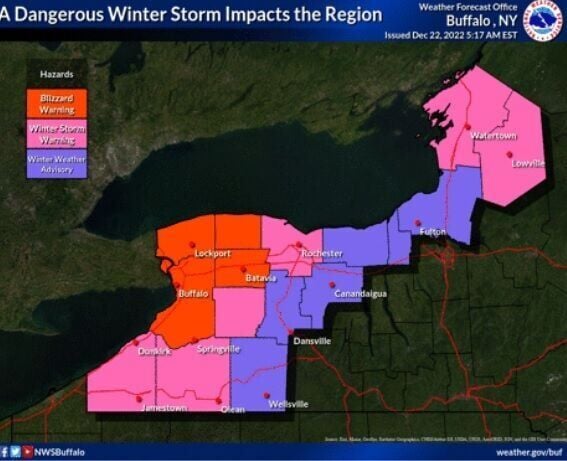
The National Weather Service replaced the blizzard warning with a winter storm warning for Erie, Genesee, Chautauqua and Cattaraugus counties.
- Complete coverage: Blizzard blasts Buffalo; at least three dead
The period from Friday night into Saturday poses the greatest risk for potential power outages.
"Winds will be very strong on Friday night in the mixed layer that are even shown to exceed 70 knots at times. This is the period when wind damage will potentially be the highest and power outages could become widespread. This is a real concern, especially with the cold temps expected for the holiday weekend," the weather service said in a forecast update Thursday.
People are also reading…
Erie County Executive Mark Poloncarz urged the public to be prepared for the possibility of a power outage.
While many use the word to describe a big snowstorm, an actual blizzard must meet specific criteria.
"We are expecting power outages. We are hoping there are none. But we plan for the worst. Hope for the best," he said Thursday afternoon at a county storm briefing.
Anticipating outages, National Grid and NYSEG are sending hundreds of extra workers across upstate New York to be ready.
Here are safety tips from National Grid and NYSEG:
Reporting outage – National Grid customers should report outages by calling 800-642-4272 or go online at www1.nationalgridus.com/outages.
NYSEG customers should call 1-800-572-1131.

With a major blizzard expected to hit the region Friday morning, Western New York on Thursda…
National Grid customers who depend on electrically powered life support equipment, such as a respirator, should register as a life support customer by calling National Grid at 1-800-642-4272.
In a medical emergency, always dial 911.
Generators – Never operate a power generator indoors, not even your garage. They must be operated outdoors at least 20 feet away from your residence to prevent the buildup of deadly carbon monoxide. Before operating a generator, be sure to disconnect from your electricity system by shutting off the main breaker, located in the electric service panel. Failure to do this could endanger power crews and your neighbors.
Flashlights – Keep working flashlights and an extra supply of batteries in your home.
Cell phones – Make sure to charge all electronic devices before the storm. Remember, if your power goes out, so will your Wi-Fi, but your cell service should still work.

"In the big picture, the storm is coming, and when it arrives it will be the most crippling blizzard we’ve suffered since at least the Blizzard of ’85," writes Don Paul.
Vehicles – Gas up your vehicle ahead of the storm.
Downed Power Lines – Stay away from downed power lines and wires. Use caution if one is nearby, and always assume they are carrying live electricity. Never touch a person or an object that is in contact with a downed line. You could be electrocuted, too.
Take caution when approaching downed trees, which could have power lines caught in them.

Residents were told to be out of their homes by 8 p.m. Thursday. The storm will bring wind and blizzard conditions to the area, starting Friday.
Remember that water can conduct electricity. If you see a line down in a puddle or flooded area, avoid contact with the water to prevent risk of shock.
If a downed wire comes in contact with your vehicle, stay inside and wait for help. If you must get out because of fire or other danger, jump clear of the vehicle to avoid any contact with the vehicle and the ground at the same time. Land with your feet together and hop with feet together or shuffle away. Don’t run or stride.
Refrigerators – Keep refrigerators and freezers closed as much as possible. Most food will last 24 hours if you minimize the opening of refrigerator and freezer doors.


