Skip to main contentSkip to main content
Register for more free articles.
Log in Sign up
Back to homepage
Subscriber Login
Keep reading with a digital access subscription.
Subscribe now
You have permission to edit this collection.
Edit
Arizona Daily Star
74°
  • Sign in
  • Subscribe Now
  • Manage account
  • Logout
    • Manage account
    • e-Newspaper
    • Logout
  • News
    • Sign up for newsletters
    • Local
    • Arizona
    • Business
    • Crime
    • Nation & World
    • Markets & Stocks
    • SaddleBrooke
    • Politics
    • Archives
    • News Tip
  • Arizona Daily Star
    • E-edition
    • E-edition-Tutorial
    • Archives
    • Special Sections
    • Merchandise
    • Circulars
    • Readers' Choice Awards
    • Buyer's Edge
  • Obituaries
    • Share Your Story
    • Recent Obituaries
    • Find an Obituary
  • Opinion
    • Submit a Letter
    • Submit guest opinion
    • Letters to the Editor
    • Opinion & Editorials
    • National Columnists
  • Sports
    • Arizona Wildcats
    • Greg Hansen
    • High Schools
    • Roadrunners
  • Lifestyles
    • Events Calendar
    • Arts & Theatre
    • Food & Cooking
    • Movies & TV
    • Movie Listings
    • Music
    • Comics
    • Games
    • Columns
    • Play
    • Home & Gardening
    • Health
    • Get Healthy
    • Parenting
    • Fashion
    • People
    • Pets
    • Travel
    • Faith
    • Retro Tucson
    • History
    • Travel
    • Outdoors & Rec
    • Community Pages
  • Brand Ave. Studios
  • Join the community
    • News tip
    • Share video
  • Buy & Sell
    • Place an Ad
    • Shop Local
    • Jobs
    • Homes
    • Freedom RV AZ
    • Marketplace
    • I Love A Deal
  • Shopping
  • Customer Service
    • Manage My Account
    • Newsletter Sign-Up
    • Subscribe
    • Contact us
  • Mobile Apps
  • Weather: Live Radar
  • Facebook
  • Twitter
  • Bluesky
  • YouTube
  • Pinterest
  • Instagram
© 2026 Lee Enterprises
Terms of Service | Privacy Policy
Arizona Daily Star
News+
Read Today's E-edition
Arizona Daily Star
News+
  • Log In
  • $1 for 3 months
    Subscribe Now
    • Manage account
    • e-Newspaper
    • Logout
  • E-edition
  • News
  • Obituaries
  • Opinion
  • Wildcats
  • Lifestyles
  • Newsletters
  • Comics & Puzzles
  • Buyer's Edge
  • Jobs
  • Freedom RV AZ
  • 74° Partly Cloudy
Share This
  • Facebook
  • Twitter
  • Bluesky
  • WhatsApp
  • SMS
  • Email

Collection: Southern Arizona mining coverage

  • Apr 20, 2022
  • Apr 20, 2022 Updated Jul 14, 2023

Read more on mining in Southern Arizona from the Arizona Daily Star.

Residents worry huge development plans could turn Rio Rico into mining town

RIO RICO — Andrew Jackson’s plans are huge, even by the big-city standards of Tucson or Phoenix.

The major Santa Cruz County landowner is pushing a 9-mile-long, mixed-use project on both sides of Interstate 19 that could spur commercial and industrial investment across this unincorporated community 60 miles south of Tucson.

His transformative plan includes 18 separate parcels and more than 3,550 acres strung along the Santa Cruz River, much of it currently zoned for ranching and covered with emerald green farm fields and thickets of mesquite.

Jackson wants the property rezoned to allow for “a major economic center providing education, employment, commercial and housing opportunities,” including hotel rooms, restaurants, retail stores, offices, railroad facilities and even a community college with student housing.

But a growing group of residents is rallying against the project, in large part because of who they think it’s really going to benefit: South32, an Australian mining giant with plans for a $1.7 billion zinc and manganese mine in the mountains outside of Patagonia.

“We’re about to lose everything. If we let them in one inch, they’re going to take 500 miles,” said Catherine Itule, a third-generation resident of Southern Arizona who has lived in Rio Rico most of her life. “This whole place will become a complete disaster area. I know what happens to mining towns.”

South32 officials have not yet said where they might build the support facilities for their proposed “next-generation” Hermosa mine, only that they are committed to locating them somewhere in the rural county to “maximize the benefits of the project” for the people living there.

“We are currently evaluating multiple commercial locations along the I-19 corridor in Santa Cruz County for our planned Integrated Remote Operating Center,” from which the mine’s automated equipment will be run, said South32 Hermosa Project President Pat Risner in a written statement.

Residents fear development plans could turn Rio Rico into mining town

Signs guard the lands just south of Palo Parado Road near the I-19 interchange. The section of land is among the few parcels on the west side of the highway that are part of a proposed mixed-use development stretching for miles along the Santa Cruz River valley.

Kelly Presnell, Arizona Daily Star

The company has also chosen the county for a production facility to make battery-grade manganese, Risner said.

Jackson’s original zoning proposal referenced Rio Rico possibly hosting a training center and operation facilities for one or more mines, without mentioning South32 by name. At recent public meetings about his plans, he has talked about a major employer looking to set up shop in the area, but he has declined to say who that might be.

His sweeping proposal was first submitted to the county in March, then resubmitted in May, but many Rio Rico residents didn’t find out about it until mid-June, when public notices began appearing on fences and in the mailboxes of homes immediately adjacent to the proposed development.

Itule thinks that was done by design.

“Those (notices) were so low to the ground, the cockroaches couldn’t even read them,” she said. “I don’t like how shady and in the dark and opaque this is. They’re trying to pull a fast one, really.”

Of course, almost any county effort to spur development along the I-19 corridor would have to be made with Jackson in mind, since he owns nearly all of the vacant land adjacent to the highway.

“Believe it or not, he pretty much owns all of Rio Rico,” said Santa Cruz County Supervisor Rudy Molera.

Even the San Cayetano Mountains that loom over the eastern edge of the community belong to Jackson’s company, Baca Float #3, LLC.

Residents fear development plans could turn Rio Rico into mining town

Devin Randolph, from the back porch of his home of more than 40 years, talks about the proposed mixed-use development along the Santa Cruz River west of his house in Rio Rico on Thursday.

Kelly Presnell, Arizona Daily Star

Sudden surprise

Two days before the county’s Planning and Zoning Commission met in Nogales on June 22 to review his proposal, Jackson hosted an informational meeting for residents at the community center in Rio Rico.

So many people showed up that he had to move the event outside to a nearby ramada, where a portable sound system was brought in so people could hear what he had to say.

“I think it just took people by surprise,” said local resident Beth Pirl, who first heard about the proposal less than a week before the planning commissioners were set to vote on it. “What is this and why is it moving so quickly?”

Jackson could not be reached for comment.

During his presentation to the planning commission last month, he indicated that the plans for his land along I-19 grew out of a meeting he was invited to several years ago with county leaders, school district officials and that major employer he has so far declined to name.

“We think it’s a fantastic project, and we’re very proud of it,” Jackson said of his proposal, though he admitted to making some “unforced errors” while rolling it out to the public.

Their recent hours-long question-and-answer session outside the community center went especially poorly.

“The meeting we had was not the one we prepared for, and we were not at all prepared for the meeting we had,” Jackson told the planning commissioners. “Nobody understood it, and we didn’t explain it very well. But we stood up for four hours and heard everybody’s concerns.”

The result was a flurry of last-minute changes to the proposal. Jackson eliminated any reference to mining and agreed to establish an open-space easement through the entire project to preserve the Santa Cruz River and the riparian area surrounding it, which is bracketed by the interstate and an important rail corridor between the U.S. and Mexico.

“I think you’ll find that all of the people that reached out to us, called us, emailed us and asked for a meeting we met with and we have adopted all their concerns,” Jackson said. “I think that’s going to satisfy most of the criticism, unless the criticism is just no growth at all.”

Residents fear development plans could turn Rio Rico into mining town

Ed Pirl walks a makeshift bridge spanning the Santa Cruz River near Rio Rico Drive, in the area being proposed for an extensive mixed-use development.

Kelly Presnell, Arizona Daily Star

Digging in

The endless, small-town tug-of-war over the virtues of growing is certainly part of the fight now unfolding in Rio Rico, but the loudest concerns seem to revolve around a potential mining operation.

Opponents of the idea are already painting nightmarish visions of heavy ore trucks and rock-filled train cars rumbling through town to a processing facility that is belching smoke into the air and chemicals into the river.

“That’s a big concern to a lot of us,” Ed Pirl said.

He and Beth are still pretty new to Rio Rico. They moved to the community from Florida in 2021, after a nationwide search led them to the natural beauty, favorable weather, rural lifestyle and seemingly secure water supply of the Santa Cruz Valley.

“We didn’t want to live in a big city or suburbia,” Beth Pirl explained. “I certainly don’t want the character and nature of this area changed.”

But she acknowledged that there are “different constituencies” in Rio Rico, including some who would welcome almost any project that might bring some revenue and better-paying jobs to the community.

South32 is promising the single largest investment in the history of Santa Cruz County, assuming its mine gets approved.

The proposed Hermosa project is now under federal review as part of an Obama-era program aimed at streamlining the permitting process for critical infrastructure. It’s the first mine to be accepted into that program, because it will produce two minerals crucial to the production of large-capacity batteries for renewable-energy storage.

But even with a fast-tracked process, federal regulators do not expect to wrap up their review of Hermosa until mid 2026, according to a timetable announced on Wednesday.

In the meantime, a coalition of environmental groups is already suing to block the mine and several other mineral exploration projects in the Patagonia Mountains.

On the Float

The Rio Rico property has a tangled and controversial history of its own.

Jackson’s holdings are the remnants of a 100,000-acre grant made to the Baca family in 1863 in exchange for an older Spanish land grant in northern New Mexico that was taken from them before the Mexican-American War.

Baca Float No. 3, as the 100,000-acre square came to be known, covered most of the Santa Cruz Valley from Tubac to the southern edge of present-day Rio Rico, but its legal status remained unsettled for decades even as its ownership changed hands.

It took a 1914 ruling by the U.S. Supreme Court to cement the legitimacy of the grant and several more years of litigation to sort out its exact location and rightful owners, none of whom actually lived there.

By then, homesteaders occupied the property, some of them for a generation. Evictions were ordered for almost 250 settlers and their families, most of them Hispanic and many of them immigrants from Sonora.

Among those forced off the land were Opata and Yaqui Indians who had fled north to escape the genocidal policies of the Mexican government, according to a Tumacacori historic resource study by the National Park Service.

Jackson and his wife, Colleen, acquired the remnants of the land grant and moved onto the property in Rio Rico about 9 years ago, registering the enterprise with state under the name Baca Float #3, LLC.

“Owning a Spanish and Mexican land grant is a mixed blessing,” Jackson told the planning commissioners with a laugh. “It has a lot of history, it has a lot of legal rights, it has a lot of legal obligations, and it costs a lot to maintain it.”

As it turns out, controlling such a large and vital slice of Rio Rico also comes with an outsized role in planning for the future of the entire town.

“We have tried to be good stewards all along the way,” Jackson said during last month’s planning meeting. “There’s a fine line (between) protecting these private property rights and also doing what’s in the best interest of the community and the growth in the community.”
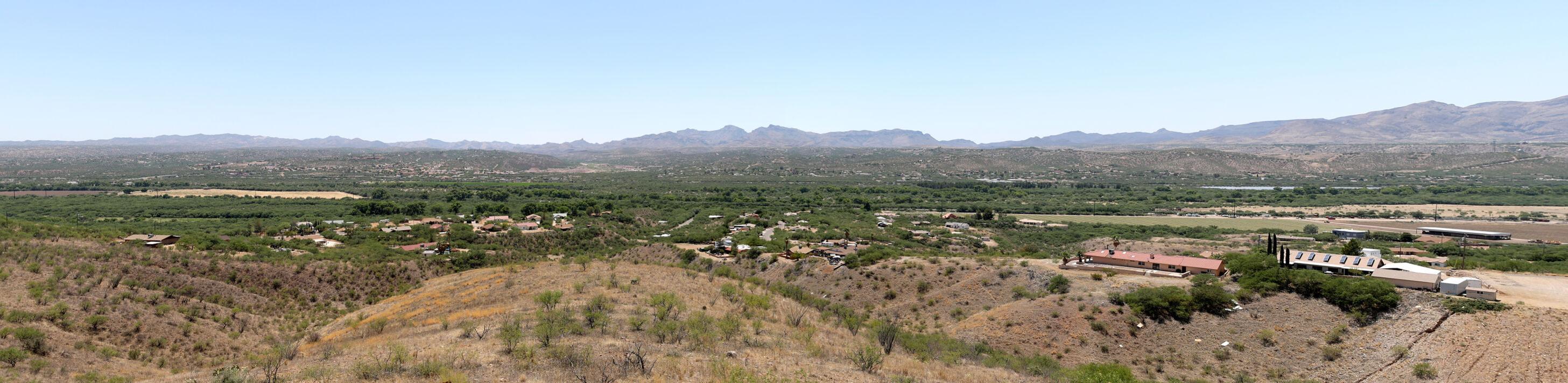
Residents fear development plans could turn Rio Rico into mining town

A panorama image from three separate shots shows the Santa Cruz River valley, the riparian zone and nearby land that would be affected by an extensive mixed-use project being proposed for miles along the waterway in Rio Rico on Thursday.

Kelly Presnell, Arizona Daily Star

Some assurances

The rezoning plan for I-19 in Rio Rico was originally scheduled for a vote by the Santa Cruz County Board of Supervisors this Tuesday.

That hearing has since been canceled for “further consideration of the request in light of public comments received,” according to an email from Frank Dillon, the county’s community development director.

Though the board is slated to meet again on July 18, Supervisor Molera does not expect the zoning proposal to show up on an agenda again until August at the earliest.

Frankly, he said, they could all use the extra time. Based on the reaction so far in Rio Rico, it’s clear that the county needs to take a closer look at the proposal and “proceed with caution,” Molera said.

Efforts to encourage development along I-19 are nothing new, according to the Nogales-born, four-term supervisor. Molera said that part of Rio Rico was identified as a retail, commercial and industrial corridor in a comprehensive plan first adopted by the county in 2004 and renewed in 2016.

In December, the county’s three-member board of supervisors approved a resolution “promoting economic development and land use” along the interstate in Rio Rico.

Then on June 6, the supervisors unanimously adopted a new code that seemed tailor-made for Jackson and his proposal: Henceforth, the county would allow so-called “specific zoning plans,” through which wholesale changes could be made to existing land-use designations, but only for projects within Rio Rico’s I-19 corridor.

Molera said he would like to see the community continue to grow, especially if it leads to new career options beyond the Border Patrol, local government or the produce distribution warehouses that now represent the county’s largest source of private employment. He thinks they can make it easier to “keep families together” by giving young people more educational and employment opportunities close to home.

As for South32, Molera said, “we want those good jobs to go here, not Pima County,” but only if the project is safe.

“If it’s going to be something that’s going to jeopardize our health and safety, I’m not going to want it. I will not allow our health and safety to be put in danger,” he said.

Incoming County Manager Jesus Valdez offered similar assurances.

“We won’t support any mining along the Santa Cruz River or near our residents,” and that includes the processing of ore, he said. “As a county, we have to protect our residents and our river.”

From the top

Devin Randolph has lived in the hills overlooking the Santa Cruz Valley for 42 years.

During that time, he and his wife, Gail, have seen the view from their front yard change as Rio Rico more than doubled in size. Where there used to be open desert and a few scattered buildings trailing south into Mexico, now they look out over a jumble of produce warehouses that form the backbone of the county’s economy, at least for the moment.

“We’re not totally against growth, but it’s got to be the right kind of growth,” the retired Nogales art teacher said. “They’re trying to turn this community into a sacrificial lamb on the altar of green energy. This is all about the mine that’s going in in Patagonia.”

Randolph accused those pushing that project of trying to “put a pretty picture on it” by promising new restaurants and retail development, more money for the schools and “six-figure jobs” he said would probably just end up going to mine workers from out of town anyway.

As far as he’s concerned, no amount of perks are worth the price.

“We don’t want to see our community polluted. We don’t want to see it ravaged,” Randolph said. “We are primarily a country agrarian area, and we want to keep it that way.”

Ruling cuts protected jaguar habitat near Tucson but how much is unclear

How much critical habitat for jaguars will be eliminated remains unclear more than a month after a court decided the U.S. government erroneously designated land, including the proposed Rosemont Mine site, as legally protected habitat.

Depending on how the U.S. Fish and Wildlife Service interprets the ruling, as little as 8.8% or as much as 51% of all 709,000 acres of critical habitat in Southern Arizona mountain ranges for the endangered jaguar could be eliminated.

The May 17 ruling from the 9th Circuit Court of Appeals overturned a wildlife service decision that designated the land surrounding the proposed Rosemont Mine site in the Santa Rita Mountains as critical jaguar habitat. But the ruling’s wording left it unclear in some observers’ views as to how much total land will be removed from critical habitat.

The outcome could have significant legal ramifications because federal law prohibits destruction or “adverse modification” of critical habitat for endangered species.

In 2014, the wildlife service formally designated jaguar critical habitat, but the same year it determined the mine would not illegally destroy critical habitat.

But U.S. District Judge James Soto in Tucson overturned that decision in February 2020 and ordered it redone. The 9th Circuit declined to rule on that issue since it has decided the critical habitat itself wasn’t properly designated.

A wildlife service regional spokesman in Albuquerque, Al Barrus, declined to say how the agency intends to interpret the decision.

Seven adult male jaguars have been spotted in the U.S. Southwest since 1996. Five have only been seen in Arizona, one only in New Mexico and one in both states.

Hudbay says impact is limited

At issue is the future of two major areas of jaguar critical habitat, known as Unit 3 and Subunit 4b. Unit 3 spans about 351,500 acres, and Subunit 4b covers about 12,710 acres.

All of Subunit 4b of critical habitat would disappear regardless of how the 9th Circuit ruling is interpreted by the feds, but the amount of land that would be removed from Unit 3 remains up in the air.

Unit 3 runs in almost a straight shot south from the Santa Rita Mountains, through the Patagonia, Huachuca and Empire mountains, south to the Canelo and Grosvenor hills near the U.S.-Mexican border. Subunit 4b covers much of the Whetstone and Empire Mountains southeast of Tucson and south of Benson.

Santa Rita Mountains, Green Valley

The Santa Rita Mountains southeast of Tucson.

Kelly Presnell, Arizona Daily Star

Hudbay Minerals Inc. is the company proposing to build the mine, which it no longer calls Rosemont but has folded into its larger Copper World project in the Santa Ritas.

Hudbay said the court decision limits the area to be removed from critical habitat to only the 50,000 acres that includes the Rosemont site at the north end of Unit 3 of jaguar habitat, and the 12,710 acres of Subunit 4b.

The Toronto-based mining company specifically referred to a footnote in the recent ruling. It noted, in referring to the wildlife service’s original determination that some critical habitat was occupied, that Hudbay was only contesting critical habitat for the northern Santa Rita Mountains area of Unit 3 — roughly 50,000 of its total of 351,000 acres.

Others find ruling unclear

But Marc Fink, an attorney for the environmental group that supported the service’s designation, the Tucson-based Center for Biological Diversity, said the 9th Circuit ruling left it unclear whether only the 50,000 acres or whether all 351,501 acres of unit 3 would be removed from critical habitat.

“It’s a great question. It’s something we’re still assessing and trying to figure out if there’s steps we want to take on this,” Fink said.

He added, “there are too many attorneys in the room” for the center to make a quick decision on how to react to the conflicting interpretations of the 9th Circuit’s ruling.

Steve Spangle, a retired Arizona field supervisor for the wildlife service, agreed the ruling is unclear. He said that if he were still on the job, “I would look at the whole designations and decide what if any modifications should be made, or should we just start all over?”

“We had a competent biologist on that designation. I would ask her to take a whole new look,” said Spangle, who oversaw the wildlife service’s Arizona Ecological Services office when it made the original critical habitat designation in March 2014. He retired in 2018.

The wildlife service biologist to whom Spangle referred, Marit Alanen, still works for the agency in its Tucson office.

Failed to prove ‘essential’ need

The 9th Circuit ruling said repeatedly that the service’s designation of the entire Unit 3 was “arbitrary and capricious,” a phrase courts typically use when they overturn or toss out a federal agency’s action. The ruling was handed down by a three-judge panel. It voted 2-1 to overturn a separate part of Soto’s ruling that had upheld the critical habitat designation of all of Unit 3 and Subunit 4b.

The 9th Circuit panel majority found the service failed to make the case that those areas were “essential” to conservation of the jaguar — a standard required by federal law to justify designation of unoccupied critical habitat — which is how this land had been designated by the service.

“In sum, the FWS has not provided a ‘rational connection between the facts found and the choice made’ or ‘articulate[d] a satisfactory explanation’ to justify its designations of Unit 3 and Subunit 4b as unoccupied critical habitat,” the panel wrote.

But the ruling simply reversed Soto’s upholding the designation of the “challenged area” as critical habitat. The “challenged area” referred to the area of critical habitat that Toronto-based Hudbay had originally challenged: the 50,000 acres in Unit 3 and 12,710 acres in Subunit 4B.

The wildlife service can’t comment on the ruling’s implications because it still considers the case pending, said Barrus. Asked why, Barrus referred a reporter to the U.S. Attorney’s Office in Phoenix.

There, a U.S. attorney’s spokeswoman in turn referred the question to Shannon Shevilin, a spokeswoman for the Justice Department’s Environmental and Natural Resources Division, who didn’t return an email from the Star seeking comment. Typically, U.S. Supreme Court rules give losing parties in a Circuit Court ruling 90 days to file an appeal to the high court.

This court-based repudiation of jaguar critical habitat is the second such instance since jaguar habitat was designated in 2014. In February 2022, the wildlife service removed about 59,000 acres of critical jaguar habitat in New Mexico after the 10th Circuit Court of Appeals overturned the agency’s previous designation of that land as jaguar prime habitat.

The 10th Circuit’s rationale was similar to that of the 9th Circuit’s last month: that the wildlife service failed to show the lands in question were essential for jaguar conservation.

More recently, in December 2022, the Center for Biological Diversity petitioned the wildlife service to establish a much more expansive jaguar critical habitat of more than 14 million acres in the “Sky Islands” of Northern and Southern Arizona and in Southwest New Mexico. A sky island is a forested mountain that rises up out of intervening desert and grasslands, the Sky Island Alliance says.

A male jaguar not previously detected by researchers was videotaped just three miles south of the recently constructed border wall between Mexico and the United States.

The jaguar appeared for the first time on camera traps along the riparian corridor of Cajon Bonito in Sonora, Mexico. The lands where the jaguar was recorded have been managed by the Cuenca Los Ojos foundation to preserve and restore biodiversity during the last three decades. Researchers have dubbed the jaguar El Bonito.

Credit: Ganesh Marin, the project leader, is a Ph.D. student in the School of Natural Resources and the Environment at the University of Arizona and a National Geographic Early Career Explorer. The research project is a joint effort of the University of Arizona and the University of Wyoming in collaboration with the Cuenca Los Ojos Foundation and members from Santa Lucia Conservancy, National Autonomous University of Mexico (UNAM), Phoenix Zoo and Arizona State University.

Environmentalists sue to block mine exploration in Patagonia Mountains

A coalition of Southern Arizona environmental groups is suing the U.S. Forest Service over several new mining ventures in the Patagonia Mountains.

The eight groups, most of them from Tucson, accuse the federal agency of failing to consider the cumulative effects of the projects, especially on endangered species in the area.

The lawsuit was filed Tuesday in the U.S. District Court in Tucson by the Patagonia Area Resource Alliance, the Center for Biological Diversity, the Tucson Audubon Society, Save the Scenic Santa Ritas, Friends of the Santa Cruz River, Friends of Sonoita Creek, Earthworks, and the Arizona Mining Reform Coalition.

The Patagonia Mountains serve as breeding territory for the threatened Mexican spotted owl and yellow-billed cuckoo, and may be used by elusive jaguars and ocelots as they venture north from Mexico.

The mountain range about 65 miles southeast of Tucson is also home to several proposed mines, including the Sunnyside copper project by Canada-based Barksdale Resources and the adjacent Flux Canyon exploration by Australia-based South32.

mining-lawsuit-p2

Environmentalists worry that exploratory drilling for mines in the Patagonia Mountains will disrupt the mating of threatened Mexican spotted owls like this pair.

Courtesy Forest Service

According to the lawsuit, the two projects could result in the construction of as many as 37 exploratory drill shafts thousands of feet deep. The work will involve machinery running day and night for several years, driving away wildlife and threatening to contaminate the water supply of the nearby town of Patagonia, the suit says.

“Reckless exploratory mining has no place in the wild, biodiverse Patagonia Mountains,” said Laiken Jordahl, Southwest conservation advocate at the Center for Biological Diversity, in a written statement. “Endangered species like jaguars, ocelots and Mexican spotted owls already face threats from border walls, climate change and habitat loss. The last thing these rare animals need is a new copper mine ravaging the heart of their Arizona range.”

“The Patagonia Mountains and Sonoita Creek watershed are the lifeblood of our beautiful region,” added Patagonia Area Resource Alliance president Carolyn Shafer. “Our priority must be to protect this critical habitat, which is the source of drinking water, clean air and the biological wealth that fuels our regional nature-based restorative economy.”

The Forest Service signed off on Barksdale’s seven-year exploratory well program on June 16, less than three weeks after granting approval for drilling to begin at the Flux Canyon site about a mile away.

Flux Canyon is part of South32’s much larger Hermosa project, a proposed $1.7 billion zinc and manganese mine now under federal review as part of an Obama-era program aimed at streamlining the permitting process for critical infrastructure.

Both manganese and zinc are designated as critical minerals by the U.S. Geological Survey, and President Joe Biden has authorized increases in domestic manganese mining and processing under the Defense Production Act to strengthen the large-capacity battery supply chain.

South32 is the world’s largest producer of the mineral, but no significant ore deposits have been mined in the U.S. since the 1970s.

Company officials are expected to make a final decision later this year on whether to proceed with underground mining on the private land the firm owns at the Hermosa site. If developed as planned, the project would represent the single largest investment in the history of Santa Cruz County.

The Hermosa site is just northwest of the proposed San Antonio project, another Barksdale-owned effort to explore a suspected copper deposit on about 6,300 acres of land in the Patagonia Mountains.

All of the recent exploration projects are located in historic mining districts that date back to the 1800s but have not seen significant activity for decades.

The Forest Service manages much of the Patagonia range as part of the Coronado National Forest. The agency and Coronado National Forest Supervisor Kerwin Dewberry are both named as defendants in the lawsuit.

Forest Service spokeswoman Starr Farrell said the agency would not comment on the litigation.

The environmental groups are seeking an immediate injunction that would block the Forest Service’s approvals and halt any drilling work until a more thorough review is conducted.

All eight groups are being represented in the lawsuit by attorneys for the Western Mining Action Project and the San Francisco-based environmental law organization Earthjustice.

“These projects threaten to drive away imperiled species and cut off wildlife movement between Mexico and the American Southwest,” said Scott Stern, associate attorney for Earthjustice’s Biodiversity Defense Program. “This needs to be sent back to the drawing board so the government can properly consider the potential harm to the land, water and species of Southeast Arizona.”

Get your morning recap of today's local news and read the full stories here: http://tucne.ws/morning

Court tosses jaguar habitat protection at Rosemont Mine site

In a victory for future mining in the Santa Rita Mountains, an Appeals Court panel tossed out a federal agency decision protecting hundreds of thousands of acres of land in the range south of Tucson and a lower court ruling upholding much of the agency’s action.

The ruling Tuesday, if not successfully appealed to the U.S. Supreme Court or responded to adequately by future agency actions, will essentially eliminate the jaguar as a factor in making decisions about copper mining in the Santa Ritas. An adult male jaguar, nicknamed El Jefe, was repeatedly photographed by remote cameras in this area from 2012 to 2015 before disappearing from public view.

Much of the new 9th Circuit Court of Appeals ruling was based on its finding that the U.S. government must rely on whether a jaguar was known to roam that area when the animal was first listed as an endangered species by the wildlife service. That happened in 1972, at a time when no jaguars had been seen in this country for years.

Aerial view of the proposed Rosemont Mine

Aerial view of the proposed Rosemont Mine/Copper World site planned by Hudbay Minerals Inc. in the Santa Rita Mountains, southeast of Tucson, on May 11. The flight was coordinated by the Center for Biological Diversity and carried out by EcoFlight. Hudbay is doing grading and land clearing on private lands it owns there and eventually plans four open pits. The site also includes roads that existed before Hudbay's work began. 

Mamta Popat, Arizona Daily Star

That meant the 2012 discovery of El Jefe, in videos and photos taken by and for environmentalists, couldn’t be considered in deciding whether that land qualified as critical habitat, the 9th Circuit found.

The ruling pulls the former Rosemont Mine site — now known as Copper World — from federally designated prime habitat for the endangered jaguar. It also voids more than half of all the 700,000 acres of federally protected critical habitat for the large mammal — 362,000 acres total — in Arizona and the U.S. as a whole, since this is the only state with critical jaguar habitat. Some critical habitat for the jaguar formerly existed in southwest New Mexico, but the 10th Circuit Court of Appeals voided that designation in 2020.

El Jefe, jaguar, 2015

A jaguar dubbed El Jefe shown in June 2015 in the Santa Rita Mountains.

Courtesy of University of Arizona / U.S. Fish & Wildlife Service

“It leaves the area vulnerable to the Rosemont Mine, or other developments,” said Michael Robinson, a conservation advocate for the Tucson-based Center for Biological Diversity, whose lawsuit against the federal government led to Tuesday’s ruling. The center has pressed for years to have that area in and around the mine site designated as critical jaguar habitat. “The Rosemont Mine is a big one, an identifiable, huge threat. But any other threats that come along, the habitat would no longer have protection.”

Hudbay Minerals Inc., which wants to build the copper mine, said in a statement that it’s “pleased that the court recognized that the U.S. Fish & Wildlife Service (FWS) erred in its designation of the northern Santa Ritas as jaguar critical habitat by not following the requirements of the Endangered Species Act and its own regulations.

“The lands in question are not, in any normal sense of the word, ‘essential’ to the survival of the jaguar species. The critical habitat designated in the United States accounts for 0.04% of all jaguar habitat and the species is not considered endangered on a worldwide basis,” Hudbay said.

Robinson said he hopes the Santa Ritas’ land could ultimately be protected as critical habitat if the wildlife service revises its original determination to take into account the 9th Circuit’s ruling.

“This was a procedural mistake or legal infirmity on the part of the Fish and Wildlife Service,” Robinson said. “It does not mean that these areas are not critically important for jaguars. They are. The Fish and Wildlife Service can go ahead, cross its t’s, dot its i’s and redo it,” he said of the original habitat designation.

The wildlife service did not immediately respond Wednesday to requests for comment on the court’s ruling or Robinson’s hope that it could revise its decision to make it more legally acceptable.

The decision comes at a time the original Rosemont Mine proposal to build an open pit copper mine on the mountains’ east slope is now essentially defunct, due to other, unrelated court rulings by a federal judge in Tucson and another 9th Circuit panel. Those rulings blocked construction of Rosemont on the grounds the U.S. Forest Service had erroneously approved the mining project without properly determining if Hudbay’s mining claims on federal land were valid.

Since those rulings occurred in 2019 and 2022, Hudbay has put its emphasis instead on developing private land it owns on the Santa Ritas’ west slope and calls the new project Copper World. Although that project would ultimately include the original Rosemont Mine site, it will cover much more ground and be mined much longer — 44 years compared to 19 for the original Rosemont site. In addition, most of its early mining will be in the west slope area.

In its statement, Hudbay said, “While the critical habitat designation has no impact on Phase I of the Copper World project, which will be on our private land, the decision will require the FWS to exercise more restraint in designating critical habitat in the future, as intended by Congress. It will also be helpful to Copper World in future consultations with the FWS, if required.”

In the new jaguar case, by a 2-1 margin, the 9th Circuit panel concluded the wildlife service had erred in designating more than 350,000 acres of national forest, state and private land as jaguar critical habitat. It also concluded that U.S. District Judge James Soto in Tucson had mistakenly upheld much of the wildlife service’s original decision protecting that habitat.

The panel found that Soto erroneously maintained this land qualified as unoccupied jaguar habitat, even while he overturned a wildlife service determination that the vast majority of that land qualified as jaguar-occupied critical habitat.

A male jaguar not previously detected by researchers was videotaped just three miles south of the recently constructed border wall between Mexico and the United States.

The jaguar appeared for the first time on camera traps along the riparian corridor of Cajon Bonito in Sonora, Mexico. The lands where the jaguar was recorded have been managed by the Cuenca Los Ojos foundation to preserve and restore biodiversity during the last three decades. Researchers have dubbed the jaguar El Bonito.

Credit: Ganesh Marin, the project leader, is a Ph.D. student in the School of Natural Resources and the Environment at the University of Arizona and a National Geographic Early Career Explorer. The research project is a joint effort of the University of Arizona and the University of Wyoming in collaboration with the Cuenca Los Ojos Foundation and members from Santa Lucia Conservancy, National Autonomous University of Mexico (UNAM), Phoenix Zoo and Arizona State University.

Two new mine proposals draw scrutiny in Southern Arizona

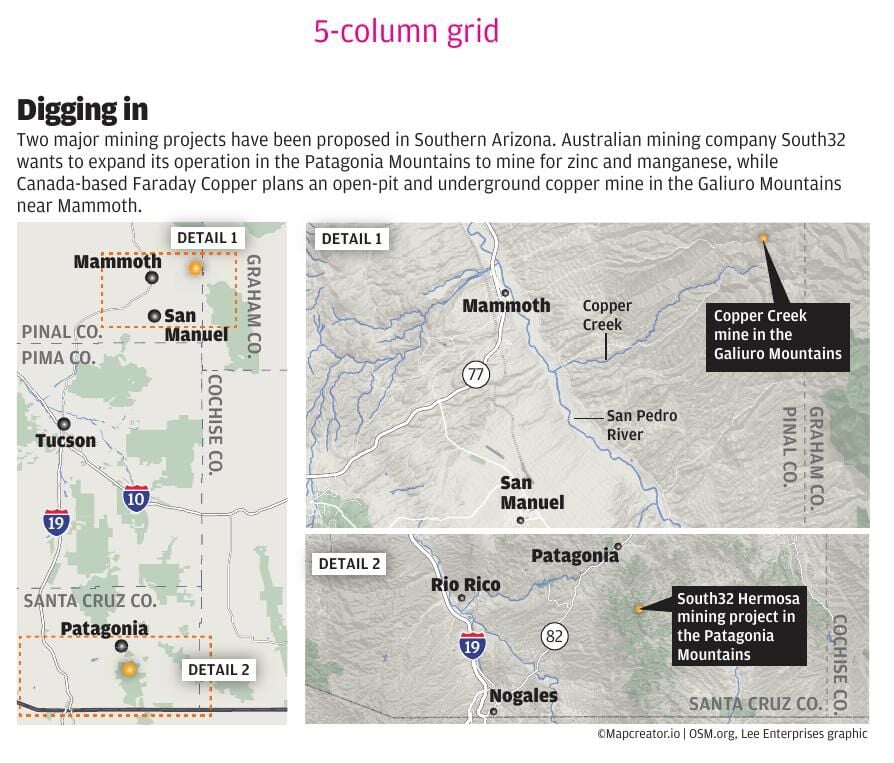
Southern Arizona could be on the cusp of a mining boom, with two major projects now in the works in mountain ranges east of Tucson.

Australian mining giant South32 wants to tunnel underground in the Patagonia Mountains near the U.S.-Mexico border in search of zinc and manganese, two critical minerals used to make electric vehicle batteries and other products for the growing clean-power economy.

On Monday, the proposed $1.7 billion Hermosa project became the first mine to be accepted into an Obama-era program aimed at streamlining the federal permitting process for what is considered critical infrastructure.

Meanwhile, in the Galiuro Mountains, about 100 miles to the north, Canada-based Faraday Copper is assembling property in hopes of developing an open-pit and underground copper mine in the steep hills 10 miles from Mammoth.

Faraday touts the site as “one of the largest undeveloped copper resources in North America,” with an estimated yield of 4.2 billion pounds of copper and a net value of $713 million.

mining-projects-p2

Water flows down Copper Creek on March 31, not far from the site in the Galiuro Mountains where Canadian company Faraday Copper is proposing to build an open-pit and underground mine.

Russ McSpadden, Center for Biological Diversity

South32 officials say their Hermosa property is sitting on one of the world’s largest undeveloped zinc deposits, as well as what could be the only viable site in North America capable of producing battery-grade manganese from local ore.

Both of the proposed mines are located in historic mining districts that date back to the 1800s, but neither site has seen significant activity for decades.

South32 spokeswoman Jenny Fiore-Magaña said the company is expected to make a final decision on whether to proceed with underground mining in the Patagonia Mountains later this year. If developed as planned, the project would represent the single largest investment in the history of Santa Cruz County.

The company acquired Hermosa in 2018 and began voluntary remediation at the site, about 9 miles southeast of the town of Patagonia, the following year to clean up historic mine waste left by a previous operator.

Fiore-Magaña said the initial mining work can be done without federal permits on the private land the company owns, but “full development of the project will require some activities that touch on surrounding federal lands and therefore require federal review.”

Download PDF Digging in

Hermosa hopes to obtain the permits it needs from the U.S. Forest Service and others in expedited fashion through its recent inclusion in FAST-41, a comprehensive federal infrastructure review program created by the bipartisan Fixing America’s Surface Transportation Act signed into law by President Obama in 2015.

Uphill fight

South32 operates 11 mines on three continents and is the world’s largest producer of manganese ore. According to the company, there has been no manganese mining in the U.S. since the 1970s, leaving the country to rely on foreign sources for its entire supply of the mineral.

Both manganese and zinc are designated as critical minerals by the U.S. Geological Survey. President Biden has authorized an increase in domestic mining and processing of manganese and four other strategic minerals under the Defense Production Act to help strengthen the large-capacity battery supply chain.

“In some ways, it’s this crazy fight between critical habitat and critical minerals,” said Russ McSpadden, southwest conservation advocate for the Tucson-based Center for Biological Diversity.

According to McSpadden, the Patagonia Mountains are home to a number of rare and protected species that could be impacted by a major mining operation, including ocelot, Mexican spotted owl and Pima pineapple cactus.

mining-projects-p4

The proposed Hermosa critical minerals mine could be built in the Patagonia Mountains within a mile of the historic World's Fair Mine, shown here in 1909.

Courtesy of the U.S. Geological Survey

The Hermosa mine also threatens to further fragment critical habitat for one of Southern Arizona’s most elusive residents. “We’ve fought for two decades to get the jaguar protected in the borderlands,” McSpadden said, only to see those protected areas gradually “picked apart” by developments like this one.

Even so, he said Southern Arizona’s two newest mining projects have largely been “flying under the radar” so far, as national environmental groups focus most of their attention on the Rosemont mine expansion in the Santa Rita Mountains south of Tucson and the Resolution Copper project at Oak Flat, east of Superior.

That has left local conservationists to challenge the projects.

Carolyn Shafer is president of the Patagonia Area Resource Alliance, a local nonprofit dedicated to preserving natural areas in and around their small town 60 miles southeast of Tucson.

The small band of volunteer activists has been battling plans to open a mine in the mountains above Patagonia for years. They worry about how the pollution, noise, dust, traffic and groundwater pumping associated with such a project will affect their community and the treasured wildlands surrounding it.

“The health and economic prosperity of our region are tied deeply to the well-being of the Patagonia Mountains and the Sonoita Creek watershed, which are the source of our drinking water, clean air and the biological wealth that drives our regional nature-based economy,” Shafer said.

If the Hermosa mine has to be built, she said, it must be done responsibly, transparently and with strict oversight to ensure its owner is held accountable in order to “avoid short-sighted destruction of natural resources in pursuit of corporate profits.”

But given the choice, Shafer would prefer to see nothing built at all.

“These mountains are no doubt filled with a lot of minerals, but these mountains are also filled with a lot of species” of wildlife, she said. “The first tenet of responsible mining should be that there are some places that should not be mined.”

Boom and bust

It’s unclear what sorts of federal reviews and permits the Copper Creek project might require.

A promotional video released by Faraday earlier this month depicts as many as six open pits at the site about 55 miles northeast of Tucson. The video also shows a massive, underground block-cave mining operation like the one that eventually caused a large sinkhole to develop next to the pit at the long-shuttered San Manuel copper mine.

A video by Canada-based Faraday Copper describes the planned excavation and potential value of a new open-pit and underground mining project in the Galiuro Mountains about 10 miles east of Mammoth.

Faraday Copper

In March, Faraday announced the purchase of a ranch surrounding its proposed project. The $10 million deal for the Mercer Ranch included 6,000 acres of private land and 32,000 acres of grazing allotments along the mine’s namesake creek in Pinal County.

The company said the Mercer family would continue to operate the ranch on the property.

In an online overview of the project, Faraday describes the area around Copper Creek as “politically-secure” with access to established mining infrastructure.

That sounds about right to environmental advocate Peter Else, who lives along the San Pedro River just outside Mammoth.

“Us grassroots conservationists are still in the minority,” he said.

Else worries about impacts to Copper Creek and the surrounding area from groundwater withdrawals, heavy equipment use and “endless truck traffic,” as ore is hauled away from the mine to be processed offsite.

Mining projects

A sign in the Galiuro Mountains marks the location of drilling activity in 2023 for the proposed Copper Creek open-pit and underground mine.

Russ McSpadden, Center for Biological Diversity

He said the project would also disrupt a migration corridor for wildlife moving between the Galiuros and the Catalinas by way of the Lower San Pedro Valley.

Ironically, one of the properties most likely to be impacted by the mine is a ranch along the San Pedro near Mammoth that was set aside for conservation mitigation as part of a 2014 land swap that gave Resolution Copper its controversial Oak Flat site.

Else said the old 7B Ranch and its 800-acre mesquite bosque lies downslope from the mine and downstream from the spot where Copper Creek empties into the San Pedro. As a result, land that was meant to offset the damage from one mining project could now be at risk from another mining project.

“These mitigation designations get degraded every time this happens. It’s just a really sad situation,” Else said. “How do you mitigate the impacts to dedicated mitigation land? I don’t think you can.”

But he also knows that plenty of his neighbors in their quiet corner of Pinal County would welcome a major new mine to the area, even if its benefits are temporary and its drawbacks might not be.

“Yeah, they’ll get an economic boost in Mammoth, but they’ll be left again when the mine plays out” or shuts down because of a dip in copper prices, he said. It’s a familiar cycle in Arizona mine country, where boom-and-bust communities sometimes end up with little more than a mess to clean up.

“This is a story that gets repeated time and time again in the Lower San Pedro Valley,” Else said. “It’s just a really sad situation.”

Senate bill would overturn court rulings blocking Rosemont Mine

Two Western senators introduced legislation Tuesday to override federal court rulings that blocked the Rosemont Mine near Tucson and a molybdenum mine in Nevada from starting construction.

The bill would make it clearly legal for mining companies to dispose of their waste rock and tailings on federal land, even on land for which the company hasn’t established the presence of valuable minerals. A judge’s ruling that mine wastes and tailings cannot be disposed on federal land that doesn’t have valuable minerals on site has been the biggest legal stumbling block for Rosemont since 2019 and threatens to derail other Western mining projects on public land.

The legislation, introduced by senators from Nevada and Idaho and co-sponsored by Sen. Kyrsten Sinema of Arizona, would insure that mining companies can dump waste on federal land when they don’t have valid claims to extract minerals from adjoining federal land.

The bill, called the Mining Regulatory Clarity Act, would amend a 1993 law involving budgetary issues, but its language primarily clarifies definitions of activities and rights central to the 1872 Mining Law, which opened up public lands in the West to mining.

National mining industry spokesmen welcomed the bill, saying it’s a necessity to insure orderly production of minerals such as copper and lithium they call critical for producing “green energy” in solar panels and electric cars.

Environmentalists denounced the measure as a giveaway to the mining industry that they said would allow companies to turn public lands into “toxic mining waste dumps.”

A 2019 ruling by Tucson-based U.S. District Court Judge James Soto, upheld by the 9th Circuit Court of Appeals in 2022, said the proposed Rosemont project in the Santa Rita Mountains southeast of Tucson couldn’t start construction.

The rulings concluded Hudbay Minerals Inc., which proposed building Rosemont, couldn’t dispose waste rock and tailings on 2,447 acres of national forest because it hadn’t shown that land contained valuable minerals. Mine opponents persuaded the judge that under the 1872 Mining Law, federal mining rights apply only on public lands containing valuable minerals.

Rosemont, slated for the Santa Ritas’ east slope facing the Sonoita highway, would have mined copper from an open pit spanning 955 acres and going down more than a half-mile, on both private and public land.

Due to the unfavorable rulings, Hudbay has folded it into a much larger project, called Copper World, that would use exclusively private land on the range’s west slope and private and public land on the east slope for mining copper and disposing of waste rock and tailings. Its officials have said they still hope to use the Rosemont land for mining and waste disposal, but that their top short-term priority is to get mining going on private land on the west slope facing Sahuarita and Green Valley.

The ramifications of those rulings and two others affecting Nevada mining proposals are worrisome, however, for President Biden’s clean energy agenda and for key projects to mine lithium, cobalt and other materials needed to manufacture batteries for electric vehicles, the Associated Press has reported.

The bill reaffirms what its backers say are long-held practices and previous legal interpretations that some public land use under a mining claim “inherently accompanies exploration and extraction activities for other mining support activities,” said bill co-sponsor Catherine Cortez-Masto, D-Nevada.

Idaho Sen. James Risch, a Republican, joined Cortez-Masto in introducing the bill. Sinema, an independent from Arizona, joined Sen. Jacky Rosen, a Nevada Democrat, and Mike Crapo, an Idaho Republican, as cosponsors.

Referring to the 2019 court ruling blocking Rosemont, Cortez Masto said, “This misguided decision would force all mining activities, even the storage of waste, to happen on mineral-rich land, which could impede critical mineral production all across the country. This bipartisan legislation will undo the damage of this decision, allow mining operations to continue under long-standing and historic application of the law and protect the good-paying jobs this industry supports in our state.”

In a statement to the Arizona Daily Star, Sinema said of the bill, “We’re fixing a federal court’s ruling to protect responsible critical mining projects in Arizona as we continue to strengthen America’s energy security and independence from foreign adversaries.”

Lauren Pagel, policy director of the Washington,-D.C.-based Earthworks, said the legislation would “further entrench the legacy of injustice to indigenous communities and damage to public lands held in trust for future generations.

“We need mining reform that serves the needs of mining-impacted communities and taxpayers. Instead of making it easier for irresponsible mining companies to exploit our public lands, we should modernize our mining laws to deliver a more fair, just and equitable hardrock mine permitting process,” Pagel said.

Blaine Miller-McFeeley, of the group EarthJustice, which has fought Rosemont and Copper World in court, said, “Mining companies have long abused this mining law, unlawfully claiming a right to destroy public lands to maximize profits. This proposal would condone that illegal practice, essentially giving mining companies a free pass to occupy public lands and lock out other uses.”

Sen. Mark Kelly, an Arizona Democrat, said through a spokesperson that he will review the new legislation closely, and didn’t take an immediate stand on it. He also declined to respond to a question from the Star as to whether he supports or opposes the Rosemont Mine.

“Senator Kelly knows mining is an important part of Arizona’s history and economy, and that it has to be done responsibly with consideration of the impacts on our local environment and community, especially the clean water supply as we face drought in the West,” his spokesperson said. “Senator Kelly also understands that the business community and Arizonans need certainty when it comes to federal regulations.”

National Mining Association President and CEO Rich Nolan said, in support of the bill, “Without strong leadership, the nation’s alarming mineral import dependence is poised to go from bad to worse as demand for minerals essential to our manufacturing and energy futures, as well as our national security, skyrocket. The bipartisan Mining Regulatory Clarity Act is critically important to ensuring that the U.S. can use our vast domestic resources to build the essential mineral supply chains we know we must have.”

When Soto issued his ruling at the end of July 2019, legal experts with varying pro-mining and pro-environmentalist sympathies predicted it would have national ramifications if upheld in higher courts. Two court rulings this year involving proposed Nevada mines relied on Soto’s and the 9th Circuit’s decisions, stirring more fears among mining interests that the earlier rulings could cast a major shadow over future mining operations on federal land.

In February, U.S. District Judge Miranda Du in Reno ruled that the Bureau of Land Management has violated the law by approving Lithium Americas’ plans for Thacker Pass mine near the Nevada-Oregon line. But the judge allowed mine construction to start last month, while the bureau works to bring the project into compliance with federal law. Environmentalists have appealed the judge’s refusal to halt the mine, and a court hearing on the appeal is scheduled for June 26.

Last month, U.S. Judge Larry Hicks in Reno vacated the BLM’s approval of Eureka Moly’s planned molybdenum mine about 250 miles east of Reno. In his ruling, Hicks said he found “no meaningful difference” between the BLM’s arguments justifying mining at the Nevada site and the U.S. Forest Service’s arguments regarding its approval of Rosemont.

The new bill is intended to insulate mines from the more onerous and likely more expensive standards imposed on the industry by Soto’s and the 9th Circuit ruling.

The bill would give a party filing a mining claim the right “to use, occupy and conduct operations on public land, with or without the discovery of a valuable mineral deposit,” under certain conditions.

One condition is that the mining claimant pays fees customarily owed to the feds for the right to extract minerals from the claimed land. Or, under certain circumstances a claimant would also have to comply with mining law requirements for doing assessment work on the public parcels in question.

This flyover shows the Santa Rita Mountains’ west slope, where Hudbay Minerals has been grading and land-clearing since April 2022 for its planned Copper World Mining Project. Video courtesy of Center for Biological Diversity.

Courtesy of Russ McSpadden / Center for Biological Diversity

U.S. agency revokes Hudbay's Rosemont Mine Clean Water Act permit

The U.S. Army Corps of Engineers has revoked its four-year-old Clean Water Act permit for the proposed Rosemont Mine.

The action could have ramifications for copper mining in the Santa Rita Mountains southeast of Tucson, but the legal authority is unclear.

Most immediately, the Corps’ decision last week means Hudbay Minerals Inc. no longer has a formal federal permit authorizing it to discharge fill through clearing, grubbing and grading activities on roughly 48 acres of washes on the Rosemont Mine site. That area includes the company’s planned open pit on the mountain range’s east slope, facing the Sonoita highway, and the utility corridor on which Hudbay would build water and electric power lines from the Sahuarita area, west of the mountain range, to the mine site.

But whether that decision stops Hudbay from ever grading in those areas remains legally unclear. That’s because the Corps previously ruled in 2021 — and reaffirmed last year — that it lacks formal jurisdiction over those washes because it determined they don’t qualify as “Waters of the U.S.” Those are washes that merit federal regulation and protection under the same Clean Water Act under which the permit was previously issued.

Hudbay said in response to the new decision that it intends to grade in the permit areas because it believes they don’t contain any federally regulated washes. In a sense, it had requested the permit revocation almost a year ago, by surrendering the permit -- an action the Corps interpreted as a request to have the permit revoked.

Also, it would be doing any future grading for its currently planned Copper World project, which it says is a separate project from Rosemont. Copper World would occupy a much larger area than the Rosemont Mine although the Copper World project includes property on which Rosemont had also planned to grade.

Mine opponents said Hudbay is “playing with fire” legally if it does so, because they consider the Corps’ 2021 decision legally invalid and have asked the Corps to reassess it.

Corps doesn’t refer to discrepancy

The new Corps decision acknowledged the agency’s past determination of no jurisdiction but made no reference as to how that could affect its handling of permit issues themselves.

While that decision was based on Trump administration rules that were later overturned by a federal judge in Tucson, the Corps has said its 2021 decision abandoning jurisdiction stays valid for five years.

Hudbay officials have repeatedly said they believe the Corps now lacks jurisdiction over the washes in question under the permit, that the permit is no longer valid and that they see no legal impediments to grading. Besides citing the Corps decisions on jurisdiction, Hudbay also cited the company’s action almost a year ago to surrender the permit — an action that the Corps has interpreted as a request to revoke it.

The company has been grading and clearing land elsewhere on the Santa Ritas’ west slope, on its private land, in activities documented in photographs taken by mine opponents that show barren areas that were heavily vegetated before.

Hudbay owns 4,500 acres on both sides of the Santa Ritas and says it intends to build the much larger Copper World project on those acres, including the east slope land that was historically part of its Rosemont proposal.

In a statement Monday, Hudbay told the Star the Corps’ decision “has no impact on the planned development of the Copper World Complex,” the company’s name for the site it formerly called Rosemont and for another area, on the west slope of the Santa Ritas, where it now plans to build open pit mines.

Its officials previously told the Corps in letters that they wouldn’t immediately start grading in the permit areas.

Hudbay received a “stop work” order from the Corps in mid-January to not grade in the permit area. In late January, company vice president Javier del Rio wrote the Corps that no grading there was planned until Feb. 27 at the earliest. Then, at a March 15 meeting between Hudbay officials and Corps officials, Hudbay said it would wait until the Corps finished work towards a decision on revoking the permit before beginning grading, says the Corps’ new decision revoking the permit.

But even before then, from August through December 2022, “our work did not include filling these washes,” Hudbay said.

Work on site ‘will continue’

If there are no jurisdictional waters present, then no permit is required under the Clean Water Act and Hudbay can perform work in those areas as necessary, the company said.

Work on the site, including in areas previously covered by the permit, “will continue based on the project timeline for the Copper World project,” Hudbay said in its statement. The statement didn’t say when work would start in the permit areas. In other areas, clearing and grading work to prepare the Copper World Complex site, including the construction of roads and other facilities, is continuing, Hudbay said.

“As work continues on the Copper World Complex, we remain committed to protecting water resources in and around the project area, which includes being a net neutral water user and a zero-discharge facility,” Hudbay said.

Before Copper World can be built and begin mining, it first needs an aquifer protection permit and an air quality permit from the Arizona Department of Environmental Quality.

But Stu Gillespie, an attorney for three tribes including two in the Tucson area that have fought the mine project, said the latest decision still is troubling for Hudbay because it says the mining company now can’t grade any federally regulated washes on the Rosemont site without having a Clean Water Act permit.

Gillespie noted that the utility corridor for a future road that will bring water and electric power service to Copper World is also covered by the just-revoked Rosemont permit. That means Copper World itself can’t be built without the company getting a Clean Water Act permit, he said.

Asked about the Corps’ 2021 decision to relinquish jurisdiction over the Rosemont site, Gillespie said the tribes regard that decision as invalid and have asked the Corps to revisit it. They have provided the Corps what they say is new information justifying that, including a detailed biological analysis laying out reasons why the washes on the mine site merit federal regulation..

“Hudbay is playing with fire. So, yes, it got what it asked for, and that only increases its legal liability as it is now proceeding without any federal permits. The Corps also sent the company a clear warning, repeatedly stating that it ‘does not have authorization to discharge dredged or fill material into waters of the U.S.,’” Gillespie said.

The permit had been suspended by the Corps since August 2019, after a federal judge overturned a separate U.S. Forest Service approval of the mine proposal. District Judge James Soto stopped Hudbay from dumping mine waste rock and tailings on 2,447 acres of national forest on the Santa Ritas’ east slope. Since then, the same judge also invalidated another approval of the mine, by the U.S. Fish and Wildlife Service.

Corps official’s reason for action

Those decisions and the permit suspension were among the factors that a top Corps official, Brigadier General Antoinette Gant, cited in her decision last week to revoke the permit.

First, the Rosemont project isn’t in compliance with the National Environmental Policy Act and the federal Endangered Species Act. Second, “there is no estimated time frame for if or when” the mine will be brought into compliance with those laws, she wrote.

Third, Hudbay itself has requested that the permit be revoked, by surrendering it, she wrote. Finally, her own review determined that revocation is in the public interest, wrote Gant, commanding officer of the Corps’ San Francisco-based South Pacific Division.

In her decision, Gant noted the Corps has reviewed drone photographs submitted by the tribes that they said show the company had been grading in various washes in the utility corridor, which they said was in violation of the suspended permit. The Corps determined all four locations were either outside areas that were or had been under the Corps’ jurisdiction or were “very likely” outside the areas authorized for construction work by the original 2019 federal permit.

Take our latest Tucson News Quiz!
Local news

Take our latest Tucson News Quiz!

    Photos of all four areas in question have been provided “for evaluation” to the U.S. Environmental Protection Agency, which the Corps has said is conducting a law enforcement investigation of Hudbay’s ongoing grading.

    EPA previously declined to say if it is conducting an enforcement investigation there. On Monday, the agency said through a spokesman, “EPA has not made any determinations related to jurisdiction in the washes referred to EPA by the Army Corps. EPA is still reviewing information submitted and determining appropriate next steps.”

    A longtime academic expert on Clean Water Act issues found the Corps’ actions on the Hudbay matter confusing and befuddling.

    “Honestly, it’s a new one for me. They revoked the permit, but that has nothing to do with whether they have jurisdiction over these washes or not,” said Patrick Parenteau, a retired environmental law professor at Vermont Law School. He has closely tracked federal agencies’ handling of Clean Water Act issues since 1975 and also has administered Clean Water Act issues for EPA and litigated cases involving the act for environmentalists. “I’ve never seen anything like this,” he said.

    “I see the chess game going on. I don’t know why they are dancing around like this,” Parenteau said of the Corps’ actions regarding the mine.

    “We used to say when I was in D.C. regarding cases like this, ‘The Corps has put the turd in EPA’s pocket’.”

    This flyover shows the Santa Rita Mountains’ west slope, where Hudbay Minerals has been grading and land-clearing since April 2022 for its planned Copper World Mining Project. Video courtesy of Center for Biological Diversity.

    Courtesy of Russ McSpadden / Center for Biological Diversity

    Federal memo may bolster Hudbay's position on Rosemont Mine site

    A top U.S. Army official reversed himself on a key decision — a reversal that could bolster Hudbay Minerals Inc.’s legal argument that the washes on its long-delayed Rosemont Mine site don’t merit federal regulation.

    Assistant Army Secretary Michael Connor wrote an August 2022 memo withdrawing a decision that had overruled an earlier decision freeing the Rosemont site’s washes from federal Clean Water Act protection. Connor’s latest decision appears to restore a 2021 Army Corps of Engineers decision that the washes at the Rosemont site aren’t covered by the Clean Water Act.

    Despite that, late Friday an Army Corps of Engineers spokeswoman referred in an email to a possibility of enforcement action against Hudbay’s plans to grade washes inside an area of the Santa Rita Mountains south of Tucson that’s covered by a now-suspended Clean Water Act permit for the Rosemont Mine.

    “Hudbay has told us they intend to proceed with filling in washes that fall within the permit areas. We are coordinating with EPA on enforcement. Enforcement is discretionary,” Dena O’Dell, a spokeswoman for the Corps’ Los Angeles District, said in the email, without elaborating.

    The Corps has already said the EPA was conducting a law enforcement investigation of Hudbay’s grading activities. EPA has declined to comment on it or acknowledge it’s happening.

    The Corps hasn’t responded to questions from the Star about the apparent discrepancy between Connor’s August 2022 decision and the agency’s increasingly aggressive actions regarding Hudbay since then, including a mid-January order that the company stop work on washes lying within the Clean Water Act permit area.

    Hudbay: Corps lacks authority over site

    Hudbay officials have said repeatedly they don’t believe the Corps has any authority over the site.

    That’s partly because of the agency’s earlier decision waiving jurisdiction over the Rosemont site, and partly because the company formally surrendered its permit almost a year ago, the company said.

    The Corps, however, hasn’t accepted the validity of Hudbay’s permit surrender, although a federal judge did that in a ruling in May 2022 in refusing an effort by mine opponents to stop Hudbay’s grading of washes in that area.

    The Corps, which Connor oversees, had decided in March 2021 that it no longer had any authority over the Rosemont washes. Until then, the agency had relied on a decade-old, preliminary determination asserting its jurisdiction over the washes, which the company proposing the Rosemont Mine had voluntarily accepted.

    That earlier, preliminary determination of Corps ‘ jurisdiction was a basis for its March 2019 issuance of a Clean Water Act permit, authorizing the mining company to deposit dredged and fill material into those washes as part of its construction work.

    Work on Copper World project

    Hudbay has been grading and clearing private land on the west slope area of the Santa Rita Mountains on and off since April 2022, for what it says are future waste rock and tailing disposal areas for its Copper World project. The company owns 4,500 acres on the east and west slopes of the Santa Ritas on which it plans to build four open pits for mining copper and numerous other facilities for processing and other activities.

    One of the pits would occupy the same area originally proposed for the Rosemont open pit. With the Rosemont Mine itself now on hold due to an unfavorable federal court ruling, Hudbay has renamed that pit the East Pit.

    The Clean Water Act permit area was intended to cover only the original Rosemont Mine site. But it also includes part of the west slope area now due to be mined by Copper World, including a utility corridor through which electricity and water would be delivered to the mine site from the Sahuarita area.

    The August 2022 memo outlining Connor’s policy reversal came to light after the Corps issued the stop work order in mid-January 2023. Hudbay replied at the end of January that it did not believe it is legally bound to comply with the order.

    Friday, in a statement released to the Star , the mining company said it agrees with Connor’s most recent decision and that his earlier decision of June 2022 “contradicted established policy and past practice.”

    The company also said it believes the Corps lacks authority over that area because the Corps only has jurisdiction over “Waters of the U.S.” Legally, those are rivers, washes and other water courses deemed environmentally and biologically significant enough to merit federal protection.

    “There is no credible evidence that the dry washes on the Copper World site are” Waters of the U.S., Hudbay said. “To the contrary, Hudbay has demonstrated that they are not ... and shared this analysis with the (Department of Justice, the Army Corps, tribes, and environmentalists) in April 2022.

    “Hudbay has studied the ability of the dry washes on the west side to transport contaminants downstream by analyzing stormwater, sediment, and plant samples. These studies show that material from the site is generally only transported 7-8 miles through the flat sandy washes,” the company said in its written statement.

    Federal agencies require the existence of a significant connection between a development site’s normally dry washes and a navigable waterway for the washes to come under federal control. Hudbay said the nearest downstream navigable water is the Colorado River, near Yuma, over 350 miles away.

    The Corps and EPA, however, have designated sections of the much closer Santa Cruz River as navigable.

    Santa Cruz River role debated

    Stu Gillespie, an attorney for three tribes fighting the mine, has sent the Corps two documents making the case that the washes at the original Rosemont site and the larger Copper World site do qualify as “Waters of the U.S.” One is a report the tribes commissioned laying out such arguments. Another is an EPA meno, from 2021, criticizing the Army Corps’ decision that year that the Rosemont washes don’t qualify as “Waters of the U.S.”

    Mark Murphy, a scientist hired by the tribes, concluded that the Rosemont-area washes, “both individually and in combination with similarly situated streams, have a significant nexus” with the Santa Cruz.

    Murphy’s “conclusion is based on an extensive review of the scientific literature, field observations, on-the-ground data, and watershed modeling. His report summarizes the extensive scientific literature on ephemeral streams and their role in maintaining the Santa Cruz River’s ecological integrity,” Gillespie wrote to the Corps in December.

    In response, Corps spokeswoman O’Dell told the Star, late Friday, “The Corps is evaluating the information provided by the tribes concerning the March 2021” decision waiving authority over the Rosemont washes.

    “No decision has been made yet to reevaluate” its determination, she said.

    Corps on ‘very shaky legal grounds’

    The final, legal impact of Connor’s August 2022 decision on Hudbay’s activities remains unknown, as are Hudbay’s actual grading plans.

    The Corps hasn’t responded to questions from the Star about what authority it has to stop work in the Rosemont permit area, in light of Connor’s August 2022 decision.

    In Hudbay’s response to the Corps’ stop work order, company executive Javier Del Rio said it has no plans for work affecting washes covered by the Corps permit until Monday, Feb. 27, at the earliest. Asked last week by the Star if it now intends to start grading and clearing in those areas, Hudbay replied only, “We are in frequent communication with the Corps.”

    A Vermont-based environmental law professor, Patrick Parenteau, told the Star last week that the Corps is on “very shaky legal grounds” in ordering Hudbay to stop work at Copper World because of Connor’s August 2022 restoration of the Corps’ earlier decision waiving authority over the Rosemont site.

    “They flipflopped,” said Parenteau, of Vermont Law School.

    He cited an Army Corps “Safe Harbor” guideline that’s been on the books for 20 years. It says a jurisdictional decision like the one the Corps made for Rosemont in 2021 is valid for a minimum of five years “unless new information warrants revision of the determination before the expiration date.” Connor cited that policy in his August 2022 memo.

    That guideline isn’t a formal regulation, Parenteau said. But a 2016 U.S. Supreme Court ruling said that such a determination “is a binding agreement.”

    When “the feds make this kind of representation for private parties, they’re entitled to rely on it,” the professor said, speaking of an agency decision waiving jurisdiction over a development site.

    He said the Corps can go to court to assert it no longer considers a jurisdictional decision valid, or environmentalists could sue to have it overturned.

    But “the cease and desist order means nothing. You need a court order to stop clearing of washes,” Parenteau said. Without it, Hudbay can refuse, he said.

    Bui if the Corps were to go to court and win on this case, “they can tack on penalties on Hudbay to the tune of $55,000 per day for every day they are in violation of a cease and desist order,” Parenteau said.

    Hudbay has to be certain it doesn’t have to obey a cease and desist order, he said, adding, “If they are wrong ... they are going to pay big time.”

    This flyover shows the Santa Rita Mountains’ west slope, where Hudbay Minerals has been grading and land-clearing since April 2022 for its planned Copper World Mining Project. Video courtesy of Center for Biological Diversity.

    Courtesy of Russ McSpadden / Center for Biological Diversity

    Caterpillar building 'mine site of the future' at Tucson Proving Ground

    In November, heavy-equipment giant Caterpillar Inc. unveiled a demonstration of its first prototype all-electric mining truck, built at its Tucson Proving Ground in Green Valley.

    The company plans to test a fleet of its electric model 793 haul trucks with mining partners across the globe starting next year, ahead of mass production planned in four or five years, a senior Caterpillar executive said this week.

    But Caterpillar doesn’t just plan on selling electric mining trucks.

    The company, a longtime supplier of large industrial diesel generator sets for mining and other applications, wants to help its mining customers create their own “microgrids” using renewable energy like solar and wind and battery storage to help fuel its electric trucks.

    At the Tucson Proving Ground, Caterpillar is building a demonstration site where solar arrays and wind turbines paired with batteries will generate and store renewable energy to create self-sustaining microgrids, while exploring onsite production of hydrogen for fuel.

    “What we’re developing is a mine site of the future, so that we can demonstrate to our customers exactly what they need to transform with their mine sites,” said Denise Johnson, president of Caterpillar’s Resource Industries Group.

    “We want to be able to show how it could be done and then validate that it’s something that will work in a setting that is pretty rigorous,” Johnson, who is based in Irving, Texas, said during a visit to the proving ground last week.

    Sun, wind and storage

    Caterpillar

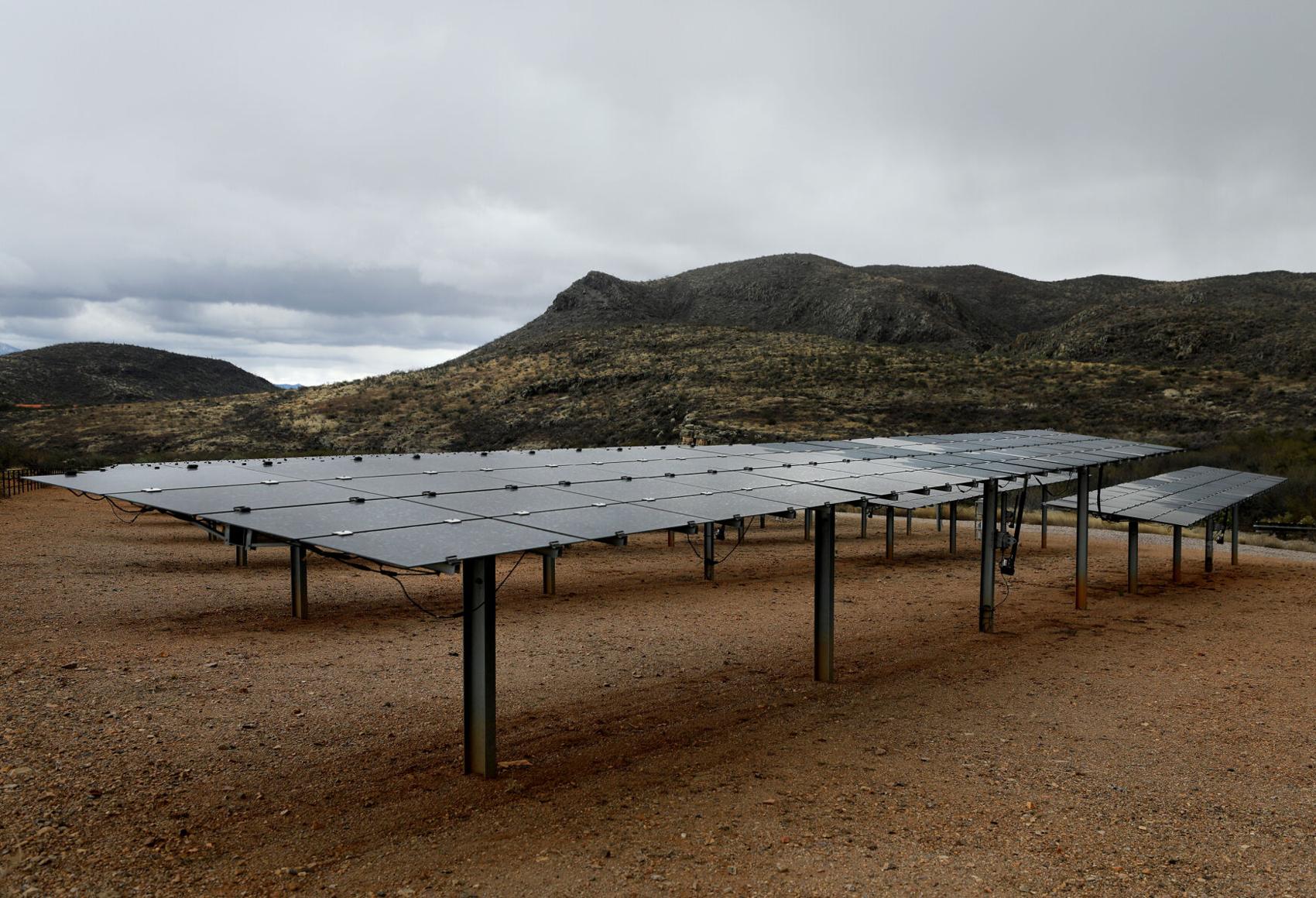
    Two solar panel fields were installed in 2016 at Caterpillar’s Tucson Proving Ground in Green Valley.

    Mamta Popat, Arizona Daily Star

    Caterpillar, which has operated the proving ground in the shadow of Freeport McMoRan’s Sierrita Mine since 1990 and opened a major mining technology center on the west side of downtown Tucson in 2019, has been trying to stay ahead of the technology curve for years.

    In 2016, the company installed an initial 500 kilowatts of photovoltaic panels and commensurate energy storage to create a hybrid solar-diesel microgrid at the Tucson Proving Ground — which is not hooked up to local utility power — to cut the off-grid facility’s reliance on diesel generation.

    The system was designed to supply much of the power needed to run the off-grid proving-ground site and allow Caterpillar to demo its then-new line of microgrid products, which range from mobile trailer-mounted rigs to scalable custom, on-site installations.

    Caterpillar later expanded solar array at the proving ground to 750kW and plans to expand that to 2 megawatts. The company also plans to install two wind turbines by next year that will generate about 3MW, as well as 18 megawatt-hours of on-site battery storage.

    The system already is supplying the off-grid Tucson Proving Ground with all of its power, and the new solar, wind and storage capacity will support more electrified machines at the site in the future, the company says.

    Johnson said the green microgrid project at the Tucson Proving Ground is an important part of the company’s efforts to reach its sustainability goals, and by extension, the goals of mining customers looking to reduce their carbon footprints.

    “At our core, Caterpillar is a technology company, and one that really believes in sustainability,” she said. “It’s one of our core values and certainly something that we see as important to our future as a company. The other piece is certainly the pull from customers, so the combination of the two of them really made sense for us to move quickly and be one of the first to lead in the industry.”

    Eye on cost

    Making sustainable microgrid technologies affordable for customers also is a priority, Johnson said.

    The gigantic model 793 electric haul truck prototype is based on a diesel-powered version with a 256-ton payload capacity that costs about $6 million.

    The electric version is expected to cost more, though pricing has yet to be decided and will depend on the final production design, Johnson said, noting that higher upfront costs for electric trucks is partly offset by lower operating costs.

    “We’re still working through all the designs of everything so we know they’ll be more expensive, but you’re offsetting that by no longer buying diesel fuel,” she said.

    The electric mining trucks also could be outfitted to drive themselves. Caterpillar was one of the first companies to offer autonomously-operated haul trucks and last year said its fleet of more than 500 of such trucks was the largest in the world.

    Early learners

    Caterpillar developed the electric truck prototype with support from key mining customers participating in Caterpillar’s “Early Learner” customer collaboration program, including Phoenix-based Freeport McMoRan, BHP, Newmont Corp., Rio Tinto and Teck Resources Ltd.

    The program, launched in 2021, focuses on accelerating the development and validation of Caterpillar’s battery electric trucks at participating customers’ sites.

    By early next year, Johnson said, the electric trucks will begin testing at customer sites in a process expected to go on for couple of years, with production expected by 2027 or 2028.

    “The idea here is that we’re going to learn with the mining company, how these machines interact around the site, what it takes to charge them, recharge them, to actually have them move across the infrastructure,” she said.

    Caterpillar also offers solar panels supplied through major manufacturers, its own line of battery units for energy storage, backup power and grid stabilization for renewable resources, as well as master system controllers, power inverters and switching equipment.

    The company can custom-design microgrids at mining sites by integrating renewables like solar and wind with storage to provide power for when the sun doesn’t shine and the wind isn’t blowing, with diesel generators for backup power.

    Highlighting hydrogen

    At the Tucson Proving Ground, Caterpillar also will be exploring production of hydrogen fuel for power generation using on-site renewable energy, as well as biofuel made from vegetable oils.

    Caterpillar generator units have been capable of burning a partial blend of hydrogen for years, and in 2021, the company began offering custom generator sets capable of operating on 100% hydrogen, as well as gensets that can be configured to operate on natural gas blended with up to 25% hydrogen.

    “We will use hydrogen as a storage mechanism, if we have access to wind or solar,” Johnson said. “Instead of just letting that go to waste, we will actually make hydrogen to store energy.”

    The company also plans to install a fuel cell to turn hydrogen into electricity, and two gensets capable of running on a blend of natural gas, 100% hydrogen or a blend of both.

    Caterpillar also will be exploring renewable biofuels at the proving ground, Johnson said.

    “We’ll have standby power that will be leveraged using natural gas and other fuels,” she said. “HVO, hydrogenated or hydro-treated vegetable oil, is a new fuel that is zero-emitting and would be considered a biofuel.”

    See how Caterpillar is transforming its Tucson Proving Ground into an all-electric mining site with solar, wind and energy storage. 

    Hudbay fights order to stop grading at mine site near Tucson

    Hudbay Minerals Inc. is contesting a federal agency’s order to stop grading and land-clearing on a portion of its Copper World project, while it’s under a law enforcement investigation by a second federal agency over its work at the entire site in the Santa Rita Mountains south of Tucson.

    The twin agency actions — one by the U.S. Army Corps of engineers, the other by the U.S. Environmental Protection Agency — raise questions about how long Hudbay can legally keep grading at the 4,500-acre, privately owned Copper World site on the west slope of the Santa Ritas. Theoretically, either one could lead to at least a partial shutdown there until the company once again gets a federal Clean Water Act permit to grade washes in that area — after the Corps suspended an earlier such permit and Hudbay officially surrendered it.

    The agency actions are:

    The Army Corps wrote Hudbay in early January to stop all work on its Copper World site lying within the boundaries of a Clean Water Act permit that the Corps issued for the Rosemont Mine nearly three years ago but has since suspended. That permit covers some but not all of the washes on the west slope area as well as those on the original Rosemont site on the east slope. But Hudbay says it no longer needs to comply with conditions of that permit because it voluntarily surrendered it in April 2022.

    The EPA’s San Francisco regional office has initiated a law enforcement investigation concerning Hudbay’s grading work for the Copper World project, an Army Corps spokeswoman told the Star. The Corps said, “EPA ... agreed to be the lead enforcement agency for investigating recent allegations of unauthorized activities by Hudbay.”

    Joshua Alexander, an EPA spokesman, declined to elaborate last week, saying, “EPA does not comment on any possible investigations.”

    EPA did send Hudbay a letter in August seeking information about whether company work at the Copper World site at least since April 2022 had placed any rock, dirt or similar material in “Waters of the U.S.” That’s a federal term for washes and other water courses that have qualified for federal regulation, “and whether that work complied with the requirements of section 404 of the Clean Water Act.”

    The letter was sent under a section of the Clean Water Act that’s aimed at determining if a legal violation has occurred of various EPA limits, including on effluent discharges and other limits. The letter asked Hudbay to send a long list of documents, containing specific information about when the work began and ended and the project’s location, size, nature and purpose, among other things. It also sought all information regarding aquatic resources at the site, including maps, photos and diagrams.

    The company replied that its analysis has shown that none of the washes in its west slope land qualify for federal regulation . It sent EPA more than 1,000 documents, agency spokesman Alexander said.

    But the company objected to many of the requests, including those seeking information about fill material being places in federally protected washes, as “overbroad and unreasonable.”

    Such requests “improperly assume that ‘waters of the United States’ are present on the Copper World property when no determination that (such waters) exist has been made and, more importantly, there is no credible evidence supporting such a determination.”

    “Hudbay cooperated with the EPA’s request for information and provided our studies of the area and other documents to the agency in September 2022. We are confident that the site work that has been conducted did not violate the Clean Water Act,” the company told the Star.

    Company officials also say Hudbay isn’t legally bound by the stop work order. The company also says it has has halted its grading for several months, but told the Army Corps that it could resume grading washes at the site as soon as the end of February.

    Hudbay noted that the Army Corps itself had in March 2021 issued its own analysis of washes for the original Rosemont Mine project, that concluded no water courses there merit having federal control over development alongside or in them. That decision covered washes on both sides of the mountain range, in cluding a utility corridor running from Sahuarita to the Rosemont site, although it didn't cover a lot of other west slope washes included in the current Copper World project where grading is now occurring.

    “As work continues on the Copper World Complex, we remain committed to protecting both the quality and quantity of the water resources in and around the project area, which includes being a net neutral water user and a zero-discharge facility,” Hudbay said.

    ‘A double wrong there’

    Back in June 2022, Assistant Army Secretary Michael Connor wrote a letter to attorney Stu Gillespie, who represents three tribes that oppose the mine, saying he had determined the Corps' 2021 decision in favor of Rosemont was not valid. That was because the Corps had issued its 2021 decision without formally consulting with those tribes, including the Tohono O’Odham and Pascua-Yaqui in southern Arizona. Hudbay took issue with Connor’s decision, saying that the 2021 conclusion should under federal rules stand for 5 years, but hasn’t legally challenged it.

    But in August 2022, Connor reversed himself, writing a memo saying that he was withdrawing his June 2022 finding. That was because he had already reached a similar conclusion withdrawing a similar finding he had made in June about water courses that would be graded at a Georgia-based titanium mine site owned by Twin Pines Minerals LLC. Connor said he had withdrawn his June memo because due to a setttlement agreement the Army reached with ?Twin Pines, after Twin Pines sued, challenging his earlier findinjg.

    The Corps stop work order fo Hudbgy last month made no mention of  Connor's August 2022 finding. Instead, the agency continues to push back against a second argument by Hudbay that the agency has no authority over grading in that area because the Toronto-based mining company voluntarily surrendered its Clean Water Act permit.

    Environmentalists and tribal officials say, based on their own analysis of the washes’ merits, that many of them are worthy of Clean Water Act protection. They are seeking to have the federal agencies take stronger steps to halt Hudbay’s grading altogether.

    “I think the evidence here is clear these are ... waters protected by the Clean Water Act, and this company is destroying the waters without a permit or in violation of a suspended permit,” said Gillespie, of the environmental law firm EarthJustice. It represents three tribes that oppose the Copper World project — the Tohono O’Odham, the Pascua Yaqui and the Hopi. “There’s a double wrong there.”

    Gillespie and top tribal officials, including chairmen of all three tribes, met with Army Corps and EPA officials in Phoenix in January and early February to discuss the Hudbay grading issues in what was termed a “government to government consultation.” At the meeting, Gillespie laid out his view that the mining company is violating the Clean Water Act.

    EPA, asked by the Star if it had determined whether the west slope washes merited “Waters of the U.S.” legal status, again said, through a spokesman, “EPA does not comment on any possible investigations.”

    Copper World, Hudbay

    Copper World mining project in January, 2021, left, and January, 2023.

    Russ McSpadden, Center for Biological Diversity

    Clearing began in April 2022

    Hudbay has said it wants to build the Copper World project on 4,500 acres of private land. In a preliminary economic analysis report last year, the company said it intends to mine copper from four open pits, including an open pit it has long planned to build on the original Rosemont Mine on the Santa Ritas’ east slope. That project has now been folded into the larger Copper World project and the pit is now called the East Pit.

    Hudbay says it intends to operate in that area for 44 years, creating 500 direct, long-term jobs and about 3,000 more indirect jobs, and generate more than $3.3 billion in local, state and federal tax revenue in that time.

    But the mine project’s opponents, including the tribes and a half-dozen environmental groups, have said the mine will pump excessive amounts of groundwater from the underlying aquifer and destroy precious wildlife habitat, Some of that land, on the east slope, is known to play host to nearly a dozen federally protected species. The environmental groups include the Tucson-based Center for Biological Diversity and Save the Scenic Santa Ritas.

    The original Rosemont Mine on the east slope is now on indefinite hold, thanks to unfavorable federal court rulings in 2019 that forbade Hudbay to bury its mine wastes on federal land near the original Rosemont open pit site.

    This flyover shows the Santa Rita Mountains’ west slope, where Hudbay Minerals has been grading and land-clearing since April 2022 for its planned Copper World Mining Project. Video courtesy of Center for Biological Diversity.

    Courtesy of Russ McSpadden / Center for Biological Diversity

    The company started clearing and grading on the west slope in April 2022, for what it said would be future mine tailings and waste rock disposal areas. Environmentalists and tribes sued unsuccessfully in federal court to stop the construction, and the grading continued for some time.

    Until the grading work stopped, the Center for Biological Diversity said its aerial drone photos had shown the company was “tearing the hell out of that magnificent place,” meaning the Santa Ritas, in the words of Russ McSpadden, a conservation advocate for the group. McSpadden said Hudbay “seems to have been at a marked lull in activity, as I’ve been able to see, since mid-January,” compared to “really intense activity” he said he saw through the last eight months of 2022 and early 2023.

    Permit surrendered by Hudbay

    The Army Corps’ stop work order stemmed from the Clean Water Act permit that the Corps approved for the Rosemont Mine in March 2019, but suspended in August of that year. The suspension was due to the federal court ruling that stopped the Rosemont Mine from being built with use of U.S. Forest Service land for mine waste disposal. The permit area also includes part of the west slope area due for mining by Copper World, including a utility corridor through which electricity and water would be delivered to the mine site from the Sahuarita area.

    Copper World, Hudbay, 2023

    Ridgeline above Copper World mining project on the west side of the Santa Rita Mountains.

    Center for Biological Diversity

    Last April, Hudbay wrote the Corps, to surrender the permit due to the uncertainty over its fate. U.S. District Judge James Soto accepted Hudbay’s surrender the same month, in ruling against mine opponents’ lawsuit seeking to have the permit overturned. and the grading halted. He wrote, “there is no longer a live case or controversy surrounding the propriety of the Corps decision, and the relief plaintiffs request is no longer available.”

    The opponents and the Corps had argued that the agency has no formal process for surrendering the permit. But Soto wrote, “It would be illogical to read the regulations such that they would prevent a permittee from surrendering its own permit when it no longer wants it and avows that it has taken no action pursuant to it and will not do so.”

    Because of the ruling, Hudbay wrote the Corps last July that it “is not bound by the permit in any way,” and that it no longer has to avoid working in the areas covered by the permit.

    In January, however, the Corps, saying it had learned that Hudbay was doing work within the area covered by the permit, wrote  Hudbay, restating its view that no legal process exists for the company to surrender the permit, and that the Corps hasn’t decided to reinstate, modify or revoke the permit. That meant the permit remains suspended, the Corps said.

    “You are reminded that you are not authorized to do work and are ordered to stop any work within the permit area that is covered by the suspended . . . permit,” the Corps’ Tori White wrote Hudbay attorney Matt Bingham. White is chief of operations and regulatory matters for the Corps’’ South Pacific Division in San Francisco.

    On January 31st, Hudbay executive Javier Del Rio wrote the Corps that due to Soto’s ruling that Hudbay had legally surrendered the permit, “the Corps cannot legally order Copper World to stop work on its private land on the basis of the permit.” Del Rio is vice president for Hudbay’s U.S. and South America operations.

    Del Rio added Hudbay has no plans for work impacting washes covered by the Corps permit until Feb. 27, at the earliest. The company also sent the Corps a series of maps that it said show it hadn’t performed earthwork in washes inside permit areas.

    Asked by the Star how it intends to proceed based on Hudbay’s response, the Corps said in an email, “With regard to the permit, we can’t discuss any enforcement matters. We are in active discussions with Rosemont/Copper World about what work they are undertaking and plan to undertake. We’ve discussed with Hudbay a potential for doing a site visit, and they were agreeable to it.”

    Conflicting responses to agencies

    But in its late September 2022 reply to EPA’s request for information about Copper World, Hudbay’s response conflicted with what it later told the Corps.

    It first said that once it had formally concluded all of its research by late 2021 that determined that its west slope washes don’t meet federal standards for coming under Clean Water Act jurisdiction, Hudbay began placing fill materials in some Copper World Washes. But it continued to avoid washes in its utility corridor — that were covered under the Clean Water Act permit.

    But after surrendering that permit in April 2022 and later telling the Corps that July it would no longer avoid washes covered by the permit, “work in those areas commenced one week later, on August 3, 2022,” the company wrote EPA.

    Earthjustice attorney Gillespie called Hudbay’s statements to the Corps and EPA “irreconcilable.” He sent photos to the Corps last week of graded areas on the Copper World site showing construction work that the environmentalists believe, based on satellite imagery, occurred in washes along the utility corridor that’s covered by the Clean Water Act permit.

    Asked by the Star about its comment to EPA, Hudbay replied, “It would have been more accurate to say that” the company lifted its restriction in August on grading inside the permit area rather than saying, “Work commenced in August.”

    Based on a recent internal review, Hudbay can confirm that none of the washes authorized for fill under the (Clean Water Act) permit have actually been filled,” the company said.

    As for the photos, the Corps’ Tori White replied to Gillespie Friday that the agency’s review found they were taken in areas outside the boundaries of Hudbay’s Clean Water Act permit. The Corps “will forward this information to EPA, as they are lead investigating agency for Copper World,” White wrote.

    It would be EPA’s responsibility to determine if new alleged unauthorized activities have occurred within federally regulated waters, and whether such work requires Clean Water Act authorization, the Corps said in a statement. “It is unlawful for Rosemont/Copper World to fill jurisdictional waters of the United States.”

    Photos: The birth and life of San Manuel mine, smelter and town in 1950s-70s

    Town of San Manuel

    Town of San Manuel

    A pipe to carry concrete to the first 1,000 homes of San Manuel winds through a cholla forest in August, 1953. The first 1,000 homes were intended for "defense workers of San Manuel Copper Company," since a large chunk of money to build the town and the mine came from the federal goverment. Initially, residents could only rent homes for the first two years. Then they would have the option to purchase then.

    Del E. Webb Construction Co.

    San Manuel copper mine, refinery, smelter

    San Manuel copper mine, refinery, smelter

    A miner drills into rock that is part of the San Manuel copper ore body in December, 1955. Explosive charges were place in the holes to blast the ore free.

    Tucson Citizen file photo

    San Manuel copper mine, refinery, smelter

    San Manuel copper mine, refinery, smelter

    The sleepy operation, support buildings and Shaft #1 at the San Manuel copper mine near the town of Tiger, Ariz., in 1953, after an investment of more than $100 million dollars by Magma Copper.

    Tucson Citizen file photo

    San Manuel copper mine, refinery, smelter

    San Manuel copper mine, refinery, smelter

    San Manuel copper mine Shaft #1 at Tiger in 1953. The townsite, in in the background, was demolished.

    Tucson Citizen file photo

    San Manuel copper mine, refinery, smelter

    San Manuel copper mine, refinery, smelter

    The head frame of the shaft at the San Manuel copper mine in 1952, just after Magma Copper secured a $94 million loan from the Reconstruction Finance Corp to dramatically expand the mine operation. Workers had joined Shafts 1 and 2 with 18,000 feet of horizontal tunnels at 1,475-feet-deep.

    Tucson Citizen file photo

    San Manuel copper mine, refinery, smelter

    San Manuel copper mine, refinery, smelter

    A miner drills into rock that is part of the San Manuel copper ore body in December, 1955. Explosive charges were place in the holes to blast the ore free.

    Tucson Citizen file photo

    San Manuel copper mine, refinery, smelter

    San Manuel copper mine, refinery, smelter

    The sleepy support buildings and Shift #1 at the San Manuel copper mine near the town of Tiger, Ariz., in 1952, prior to an investment of more than $100 million dollars by Magma Copper.

    Tucson Citizen file photo

    San Manuel copper mine, refinery, smelter

    San Manuel copper mine, refinery, smelter

    Miners get ready to plunge hundreds if not nearly 2,000 feet below the surface at the head frame of the shaft at the San Manuel copper mine in 1952, just after Magma Copper secured a $94 million loan from the Reconstruction Finance Corp to dramatically expand the mine operation.

    Tucson Citizen file photo

    San Manuel copper mine, refinery, smelter

    San Manuel copper mine, refinery, smelter

    Miners in a drift (tunnel), 1475-feet underground in the San Manuel copper mine, unload shoring timber from mine cars in April, 1954.

    Tucson Citizen file photo

    San Manuel copper mine and smelter

    San Manuel copper mine and smelter

    The head frames of the two 2,950-feet deep production shafts into the San Manuel ore body in 1955.

    Arizona Daily Star file

    San Manuel copper mine and smelter, 1955

    San Manuel copper mine and smelter, 1955

    San Manuel was once the largest underground copper mine in North America. Magma Copper began commercial underground mining in San Manuel in 1956, after sinking two 2,950-foot shafts into the San Manuel ore body in 1953.

    Arizona Daily Star file

    San Manuel copper mine and smelter

    San Manuel copper mine and smelter

    Ore milling operations at San Manuel copper mine in 1955. The mine began commercial processing of ore in 1956.

    Arizona Daily Star file

    San Manuel copper mine and smelter

    San Manuel copper mine and smelter

    Magma Copper managers interviewing a potential mine employee in 1955 as the company was adding a smelter operation.

    Arizona Daily Star file

    San Manuel copper mine and smelter

    San Manuel copper mine and smelter

    Ore milling operations at San Manuel copper mine in 1955. The mine began commercial processing of ore in 1956.

    Arizona Daily Star file

    San Manuel copper mine, refinery, smelter

    San Manuel copper mine, refinery, smelter

    Piers hold up an ore conveyor under construction at the San Manuel mine in 1954.

    Tucson Citizen file photo

    San Manuel copper mine, refinery, smelter

    San Manuel copper mine, refinery, smelter

    Mill concentrator building under construction in San Manuel in 1954. It was 700-feet long and 300-feet wide.

    Tucson Citizen file photo

    San Manuel copper mine, refinery, smelter

    San Manuel copper mine, refinery, smelter

    Huge ore storage bins atop the 185-foot tall head frames atop the 2,950-foot deep production shafts at San Manuel mine in 1955.

    Tucson Citizen file photo

    San Manuel copper mine, refinery, smelter

    San Manuel copper mine, refinery, smelter

    Magma Copper workers blast rock to make way for a 2,950 foot production shaft to access the San Manuel copper ore body in August, 1953.

    Tucson Citizen file photo

    San Manuel copper mine, refinery, smelter

    San Manuel copper mine, refinery, smelter

    Wesley P. Goss, president and general manager of Magma Copper, in 1952,

    Tucson Citizen file photo

    San Manuel copper mine and smelter

    San Manuel copper mine and smelter

    The new copper smelter at San Manuel in December, 1955. At bottom right is the casting wheel, which holds 22 anodes, each weighing 700 pounds. Above is the anode furnace and along the right side to the rear are three converters. Jutting out at left is the reverberatory furnace. The ladle hanging from the gantry crane in the background can hold 30 tons of molten copper.

    Arizona Daily Star file

    San Manuel copper mine and smelter

    San Manuel copper mine and smelter

    Managers at the new control center for the San Manuel smelter complex in 1955.

    Arizona Daily Star file

    San Manuel copper mine and smelter

    San Manuel copper mine and smelter

    Ore milling operations at San Manuel copper mine in 1955. The mine began commercial processing of ore in 1956.

    Arizona Daily Star file

    San Manuel copper mine and smelter

    San Manuel copper mine and smelter

    A horizontal mine passage in the San Manuel copper mine in 1955.

    Arizona Daily Star file

    San Manuel copper mine and smelter

    San Manuel copper mine and smelter

    Eight rod mills, right, and 16 ball mills in the 850-foot concentrator building at the San Manuel Mine operation in December, 1955. Steel rods and balls reduce the crusshed copper ore to granular consistency preceding the flotation process.

    Arizona Daily Star file

    San Manuel copper mine and smelter

    San Manuel copper mine and smelter

    Thickeners are 300-foot basins in which processed concentrate is dried to a moisture content of seven percent. The concentrate averages 27-percent copper. It will be conveyed to the smelter for final reduction.

    Arizona Daily Star file

    San Manuel copper mine and smelter

    San Manuel copper mine and smelter

    Rail line to the crusher, concentrator and smelter at San Manuel in 1955. The ore traveled nine mines from the underground mine to processing.

    Arizona Daily Star file

    San Manuel copper mine and smelter

    San Manuel copper mine and smelter

    Ore cars are inverted at the top of the head frame, dumping the ore into huge storage bins that feed ore cars going to the crushers.

    Arizona Daily Star file

    San Manuel copper mine and smelter

    San Manuel copper mine and smelter

    The new flotation process in the San Manuel copper mine. Finely-ground ore leaving the concentrators enters the flotation process, where it is mixed with water and reagents move the copper to the surface and tailings to the bottom, where they are carried off underground.

    Arizona Daily Star file

    San Manuel copper mine and smelter

    San Manuel copper mine and smelter

    The head frames of the two 2,950-feet deep production shafts into the San Manuel ore body in 1955.

    Arizona Daily Star file

    San Manuel copper mine and smelter

    San Manuel copper mine and smelter

    The head frame of the San Manuel Mine. Ore cars are brought up from the shaft and dumped into the storage bins feeding rail cars taking the copper ore to the crushers, the first stage of the copper extraction process.

    Arizona Daily Star file

    San Manuel copper mine, refinery, smelter

    San Manuel copper mine, refinery, smelter

    Sparks fly from blast furnaces in San Manuel in 1975 as copper concentrate is smelted at 2,700-degrees, which turns other elements like iron into slag to be discarded. Beginning in 1975, Magma Copper recovered the sulfur dioxide emissions from the smelter and converted it to sulfuric acid.

    P.K Weis / Tucson Citizen

    San Manuel copper mine, refinery, smelter

    San Manuel copper mine, refinery, smelter

    Shown in 1975, molten copper as much as 99-percent pure emerges from the San Manuel smelter and poured into molds to create 700-pound anodes that were transported to a refinery to remove other impurities, like gold and silver.

    P.K. Weis / Tucson Citizen

    San Manuel copper mine, refinery, smelter

    San Manuel copper mine, refinery, smelter

    In this photo, probably ca. 1950s, molten copper from the San Manuel smelter, right, is poured into molds which cool to make anodes (being lifted at right), which are further-refined to better-than 99-percent pure.

    Tucson Citizen file photo

    San Manuel copper mine, refinery, smelter

    San Manuel copper mine, refinery, smelter

    The completed crusher, concentrator and smelter at San Manuel in 1955. The company town of San Manuel rises in the background.

    Tucson Citizen file photo

    San Manuel copper mine, refinery, smelter

    San Manuel copper mine, refinery, smelter

    A Magma Copper handout graphic showing ore flow for the San Manuel smelter.

    Tucson Citizen file photo

    San Manuel copper mine, refinery, smelter

    San Manuel copper mine, refinery, smelter

    A miner standing in a tunnel more than 1,000 feet deep in the San Manuel, pauses after a electric ore cars carrying 185 tons of rock passed by in 1975.

    P.K. Weis / Tucson Citizen

    San Manuel copper mine, refinery, smelter

    San Manuel copper mine, refinery, smelter

    San Manuel smelter at full tilt, probably in the 1970s.

    Tucson Citizen file photo

    San Manuel copper mine, refinery, smelter

    San Manuel copper mine, refinery, smelter

    The crusher, concentrator and smelter at San Manuel in 1971, after a $200 million explansion of the facility. The smelter got a second smoke stack. In the background, the company town of San Manuel got another 200 houses.

    Ray Manley Studios / Tucson Citizen

    San Manuel copper mine, refinery, smelter

    San Manuel copper mine, refinery, smelter

    An electrolytic refinery to produce refined copper from copper anodes at San Manuel and was completed in December, 1971.

    Tucson Citizen file photo

    Town of San Manuel

    Town of San Manuel

    Townsite for the mining company town of San Manuel in Pinal County north of Tucson in 1953. Magma Copper Company worked with Del E. Webb Construction Company of Phoenix to create Webb's first "master-planned community" in Arizona. M-O-W Aldon Construction of California was hired to build homes for 8,000 people. The first 1,000 homes were intended for "defense workers of San Manuel Copper Company," since a large chunk of money to build the town and the mine came from the federal goverment. Initially, residents could only rent homes for the first two years. Then they would have the option to purchase then.

    Tucson Citizen file photo

    Town of San Manuel

    Town of San Manuel

    Superintendent Robert Fleming of the Del E. Webb Construction Co. and engineer John Stephens stand on the site of the San Manuel business district in August, 1953. Magma Copper Company worked with Del E. Webb Construction Company of Phoenix to create Webb's first "master-planned community" in Arizona. M-O-W Aldon Construction of California was hired to build homes for 8,000 people.

    Del E. Webb Construction Co.

    Town of San Manuel

    Town of San Manuel

    The caption is this bandout photo read, "How can engineers do surveying in a land like this?" Engineer John Stephens at the San Manuel townsite prior to clearing. The mining company town of San Manuel under construction in 1954. Magma Copper Company worked with Del E. Webb Construction Company of Phoenix to create Webb's first "master-planned community" in Arizona. M-O-W Aldon Construction of California was hired to build homes for 8,000 people.

    Del E. Webb Construction Co.

    Town of San Manuel

    Town of San Manuel

    A map of the mining company town of San Manuel under construction in 1954. Magma Copper Company worked with Del E. Webb Construction Company of Phoenix to create Webb's first "master-planned community" in Arizona. M-O-W Aldon Construction of California was hired to build homes for 8,000 people. The first 1,000 homes were intended for "defense workers of San Manuel Copper Company," since a large chunk of money to build the town and the mine came from the federal goverment. Initially, residents could only rent homes for the first two years. Then they would have the option to purchase then.

    Del E. Webb Construction Co.

    Town of San Manuel

    Town of San Manuel

    Pinal County supervisors Jay Bateman, left, Frank Williams, and Joy Spray, far right, meet with Del E. Webb general manager L.C. Jacobson at the San Manuel townsite under construction in 1954. Magma Copper Company worked Del E. Webb Construction Company of Phoenix to create Webb's first "master-planned community" in Arizona. M-O-W Aldon Construction of California was hired to build homes for 8,000 people,

    Del E. Webb Construction Co.

    Town of San Manuel

    Town of San Manuel

    The mining company town of San Manuel under construction in 1954. Magma Copper Company worked with Del E. Webb Construction Company of Phoenix to create Webb's first "master-planned community" in Arizona. M-O-W Aldon Construction of California was hired to build homes for 8,000 people.

    Ray Manley / Tucson Citizen file photo

    Town of San Manuel

    Town of San Manuel

    A brochure for the mining company town of San Manuel under construction ca. 1954. Magma Copper Company worked with Del E. Webb Construction Company of Phoenix to create Webb's first "master-planned community" in Arizona. M-O-W Aldon Construction of California was hired to build homes for 8,000 people. The first 1,000 homes were intended for "defense workers of San Manuel Copper Company," since a large chunk of money to build the town and the mine came from the federal goverment. Initially, residents could only rent homes for the first two years. Then they would have the option to purchase then.

    Tucson Citizen file photo

    Town of San Manuel

    Town of San Manuel

    A brochure for the mining company town of San Manuel under construction ca. 1954. Magma Copper Company worked with Del E. Webb Construction Company of Phoenix to create Webb's first "master-planned community" in Arizona. M-O-W Aldon Construction of California was hired to build homes for 8,000 people. The first 1,000 homes were intended for "defense workers of San Manuel Copper Company," since a large chunk of money to build the town and the mine came from the federal goverment. Initially, residents could only rent homes for the first two years. Then they would have the option to purchase then.

    Tucson Citizen file photo

    Town of San Manuel

    Town of San Manuel

    A food truck feeds workers clearing the site for the state's "newest city" of San Manuel in Aug, 1953. Magma Copper Company worked with Del E. Webb Construction Company of Phoenix to create Webb's first "master-planned community" in Arizona. M-O-W Aldon Construction of California was hired to build homes for 8,000 people.

    Del E. Webb Construction Co.

    Town of San Manuel

    Town of San Manuel

    The mining company town of San Manuel under construction in 1954. Magma Copper Company worked with Del E. Webb Construction Company of Phoenix to create Webb's first "master-planned community" in Arizona. M-O-W Aldon Construction of California was hired to build homes for 8,000 people.

    Ray Manley / Tucson Citizen file photo

    Town of San Manuel

    Town of San Manuel

    Deserted streets of San Manuel in November, 1954, prior to rental to mine workers and their families. Magma Copper Company worked with Del E. Webb Construction Company of Phoenix to create Webb's first "master-planned community" in Arizona. M-O-W Aldon Construction of California was hired to build homes for 8,000 people.

    Tucson Citizen file photo

    Town of San Manuel

    Town of San Manuel

    Avenue A in the mining company town of San Manuel under construction in 1954. Homes had masonry walls, "modern design" and landscaped yards. Magma Copper Company worked with Del E. Webb Construction Company of Phoenix to create Webb's first "master-planned community" in Arizona. M-O-W Aldon Construction of California was hired to build homes for 8,000 people.

    Del E. Webb Construction Co.

    Town of San Manuel

    Town of San Manuel

    Tommy Blank was the first barber in the mining company town of San Manuel in 1953. He slept in the shop for a few months until his house was built. He raised his family in San Manuel, working as a barber for Magma Copper Company for 34 years until retiring in 1988. His wife, Helen, was a Harvey Girl at the Grand Canyon and went to work in healthcare for Pinal County. They watched San Manuel boom, and finally bust as the mine and refinery were closed in 2003. His granddaughter noted that Tommy served in the U.S. Navy in the South Pacific in WW II and survived a Japanese kamikaze attack.

    Tucson Citizen file photo

    Town of San Manuel

    Town of San Manuel

    A cul du sac is paved outside the rental office at the mining company town of San Manuel in December, 1953. Magma Copper Company worked with Del E. Webb Construction Company of Phoenix to create Webb's first "master-planned community" in Arizona. M-O-W Aldon Construction of California was hired to build homes for 8,000 people.

    Tucson Citizen file photo

    Town of San Manuel

    Town of San Manuel

    Crews grade the streets of the mining company town of San Manuel under construction in 1954. Magma Copper Company worked with Del E. Webb Construction Company of Phoenix to create Webb's first "master-planned community" in Arizona. M-O-W Aldon Construction of California was hired to build homes for 8,000 people, The mining company town of San Manuel under construction in 1954. Magma Copper Company worked with Del E. Webb Construction Company of Phoenix to create Webb's first "master-planned community" in Arizona. M-O-W Aldon Construction of California was hired to build homes for 8,000 people. The first 1,000 homes were intended for "defense workers of San Manuel Copper Company," since a large chunk of money to build the town and the mine came from the federal goverment. Initially, residents could only rent homes for the first two years. Then they would have the option to purchase then.

    Tucson Citizen file photo

    Town of San Manuel

    Town of San Manuel

    Mr. and Mrs. Jimmy Cabral of Clifton, with son Marin in December, 1953, would be become some of the first residents of the mining company town of San Manuel. Magma Copper Company worked with Del E. Webb Construction Company of Phoenix to create Webb's first "master-planned community" in Arizona. M-O-W Aldon Construction of California was hired to build homes for 8,000 people. The first 1,000 homes were intended for "defense workers of San Manuel Copper Company," since a large chunk of money to build the town and the mine came from the federal goverment. Initially, residents could only rent homes for the first two years. Then they would have the option to purchase then.

    Tucson Citizen file photo

    Town of San Manuel

    Town of San Manuel

    An electric substation under construction to supply power to the mine, smelter, and town of San Manuel under construction in 1954. Magma Copper Company worked with Del E. Webb Construction Company of Phoenix to create Webb's first "master-planned community" in Arizona. M-O-W Aldon Construction of California was hired to build homes for 8,000 people.

    Del E. Webb Construction Co.

    Hudbay, Forest Service won't appeal ruling blocking Rosemont Mine

    Hudbay Minerals and the U.S. Forest Service won’t appeal a federal appeals court ruling blocking construction of the Rosemont Mine, ending a major legal case but not closing the controversy over the mine itself.

    The mining company and the federal agency let pass a Nov. 22 legal deadline for appealing the 9th Circuit Court of Appeals ruling from May 2022 without acting. Their inaction ceded the hard-fought battle to mine opponents, which include three tribes and four environmental and conservation groups. Those opponents filed suit in 2017 to stop mine construction, shortly after the Forest Service approved it.

    The decision of Hudbay and the Forest Service not to appeal to the U.S. Supreme Court means Hudbay can’t bury nearly 2 billion tons of mine waste rock and tailings on Coronado National Forest land. Hudbay has not, however, ruled out trying to find a legal path later to allow that.

    The 9th Circuit upheld a potentially precedent-setting ruling from U.S. District Judge James Soto in Tucson that the Forest Service acted “arbitrarily and capriciously” in approving the mine. Rosemont is planned for the east slope of the Santa Rita Mountains, about 30 miles southeast of Tucson.

    After a three-judge panel for the 9th Circuit voted 2-1 in May to uphold Soto’s ruling, Hudbay requested a rehearing before the 9th Circuit. But the same panel denied the request on Aug. 22, setting up the Nov. 22 deadline for the company and the Forest Service to appeal to the Supreme Court. Such an appeal must be filed 90 days after the final appellate court ruling.

    Soto and the 9th Circuit panel majority overturned the service’s decision to let Hudbay dispose waste rock on 2,447 acres of Coronado National Forest land. The district and appellate rulings found that Hudbay and the Forest Service failed to show the company had valid mining claims on this land, because no valuable mineral deposits have been found there.

    Now focusing on west slope first

    However, these two rulings will only delay and not halt Hudbay’s efforts to build a copper mine in the Santa Ritas — efforts that have now stretched 17 years and involved a second company that first tried to build Rosemont before selling to Hudbay in 2014.

    In response to questions from the Star, Hudbay said it now plans to first concentrate on getting a copper mine going on private land it owns on the Santa Ritas’ west slope. The company continues to say it ultimately wants to also mine copper from the east slope, and to work both slopes of that mountain range in two phases. The mining would last 44 years — 16 years for the first phase and 28 years for the second.

    Toronto-based Hudbay now calls the entire proposed mine project Copper World. It has renamed the east slope Rosemont Mine project the East Pit. The open pit it has planned to dig there stretches well over a mile wide in diameter and drops 3,000 feet underground.

    But it said it will not start seeking permits for the second phase, which will require federal permitting for the waste disposal, until it has gotten the first phase of mining in operation. Getting the first phase moving is likely to take several years.

    Hudbay already owns 4,500 acres on both sides of the mountain range. Since spring, it has cleared land and graded for the first phase. But to get the first phase underway, it needs an air quality permit and an aquifer protection permit from the Arizona Department of Environmental Quality.

    It also is trying to buy 200 acres of state land in the west slope area for various purposes. It also needs approval from the U.S. Bureau of Land Management to build a pipeline to take mine tailings from the east slope area through BLM land over to the west slope for disposal. All of these efforts will face strong opposition from environmentalists and in some cases tribes.

    “Our team is fully committed and focused on continuing the permitting process for our private land project, Copper World. Phase I of Copper World will require Hudbay to obtain state and local permits to begin operations. These permits will require the project to meet all environmental standards and include monitoring and bonding requirements to ensure compliance,” Hudbay said in a statement to the Star.

    Will still look for a legal way

    The company will dump its waste rock and tailings on private land for the Phase 1 project but will again seek federal permission to put the waste material on federal land for the second phase, it said. It said it still sees a path to winning such approval despite the unfavorable court rulings, although that position drew skepticism from John Leshy, a former top federal government attorney who has served as an informal legal adviser to mine opponents.

    “The Ninth Circuit decision held only that the Forest Service did not properly approve the Rosemont project; not that it could not have done so in exactly the same configuration and subject to the same regulations,” Hudbay said.

    Forest Service spokeswoman Starr Farrell declined to say why the service chose not to appeal the 9th Circuit Court ruling, adding the case remains in litigation “and so we are unable to supply further information.” She didn’t explain her litigation comment.

    Responding to Hudbay’s statement that it will still try to dispose of wastes on federal land, Steve Brown, a co-president of the opposition group Save the Scenic Santa Ritas, said it “confirms that they will continue to seek ways to circumvent the laws governing the use of public land. We have confidence that over the long run, the American justice system will continue to protect the public from those whose only interest is to increase their private profits ... .”

    Save the Scenic Santa Ritas is one of the conservation groups that filed the successful lawsuit. Other environmental plaintiffs included the Arizona Mining Reform Coalition and the Grand Canyon Chapter of the Sierra Club. Tribal plaintiffs included the Pascua-Yaqui and Hopi tribes and the Tohono O’Odham Nation.

    Allison Melton, an attorney for the Center for Biological Diversity, another plaintiff, added, “At least Hudbay had the sense to realize even this Supreme Court wasn’t likely to let it run roughshod over federal mining laws. The Forest Service should never have approved the Rosemont mine. The Santa Ritas provide drinking water for metro Tucson and habitat for jaguars, ocelots and many rare animals and plants. These mountains aren’t a toxic waste dump.”

    1872 Mining Law

    At the core of the court rulings that sank Hudbay’s efforts to dump its waste rock on federal land is the same U.S. law that has opened up much of the West to mining — the 1872 Mining Law.

    The law allows U.S. citizens to have mining rights, after payment of small fees, to explore for and remove “valuable minerals” from federal land, wrote 9th Circuit Judge William Fletcher, who wrote the majority opinion in the May 2022 ruling against Hudbay and the Forest Service.

    “When first enacted, the Mining Law was exceedingly broad, encompassing almost all federal land in the American West, and encompassing a wide range of valuable minerals,” Fletcher wrote.

    While the law’s scope has been substantially reduced by court rulings and various federal statutes, the Mining Law remains in effect for much federal land and for many minerals, including copper, he wrote.

    Once a miner discovers a valuable mineral deposit on federal land, Sections 23 and 26 of the Mining Law allow the miner to file “unpatented mining claims” on that land, wrote Fletcher. Unpatented claims, which include those on the Forest Service land Hudbay wanted to dump wastes for Rosemont, allow their owner to explore for and extract minerals from that land without taking ownership of it.

    “But the claim is invalid and confers no right without a ‘discovery’ of ‘valuable minerals’ on the claim,” Fletcher added. “If a mining claim is invalid, a miner has no right, possessory or otherwise, in connection with the land.”

    The proposed Rosemont Mine open pit, covering 955 acres, includes both private and federal land on which there is no dispute over the validity of the mining claims. But on the 2,447 acres of national forest on which Hudbay proposed to dispose its waste rock and tailings, “undisputed evidence ... shows that no valuable minerals have been found,” Fletcher wrote.

    In its statement to the Star, however, Hudbay noted that the 9th Circuit, while ruling the Mining Law doesn’t authorize use of federal land for waste rock disposal if it lacks federal mining claims, declined to decide whether the Forest Service could approve mining on land without such claims under a separate set of federal regulations. The 9th Circuit ruling kicked that question back to the Forest Service, saying, “These are decisions that must be made in the first instance by the Service, rather than by our court.”

    Dissenting in the case, Judge Danelle Forest wrote that these Forest Service applications are “legally applicable to all legitimate mining activities regardless of whether they are on valid claims,” Hudbay noted.

    But Leshy, a retired law school professor who was an Interior Department solicitor during the Clinton administration, told the Star the 9th Circuit ruling leaves open only “a very narrow crack for the Forest Service to decide” that its rules allow Hudbay to dump mine waste on land with invalid claims. The ruling casts a lot of doubt on whether that’s possible, by concluding that neither the 1872 Mining Law nor the separate, 1955 Surface Resources Act authorizes such uses, he said.

    “That leaves the Forest Service only an argument that its general authority over national forest land allows it to decide to give Rosemont authority to dump the waste on such land, and that’s an uphill argument to say the least,” Leshy said.

    Brown, of Save the Scenic Santa Ritas, added, “Hudbay is attempting to divert attention from the fact that they lost their case. Put simply: They lost. The people of Arizona, and America, won. We will work hard on every front to assure that they continue to lose.”

    Watch a test drive of Caterpillar's first battery electric mining haul truck at the Tucson Proving Ground in Green Valley.

    Courtesy of Caterpillar Inc.

    Bill aims to allow cleanup of abandoned, leaking mines

    Arizona could have as many as 100,000 abandoned mines, many leaching toxic minerals into the state’s waterways, but state environmental officials said cleanup has been hampered by the fear of litigation.

    That’s why Arizona Department of Environmental Quality Director Misael Cabrera was testifying Thursday in support of a proposed federal “good Samaritan” law aimed at addressing the issue. The bill would let organizations step in and clean up long-abandoned mines without fear of the legal liability that could be attached to their now-absent owners.

    “I believe that this legislation is a great first step towards dealing with a considerable and significant problem all across the country, and certainly in the West,” Cabrera said after testifying to a Senate Environment and Public Works subcommittee hearing.

    That problem is that many of the mines that would be affected by the bill were abandoned by their owners long ago, decades before laws took effect that hold mine owners responsible for cleanup of their properties. And under the law as it’s written now, new owners — or anyone who wanted to clean up a site — could be held legally responsible for the damages it caused.

    “One factor that keeps unrelated third parties from voluntarily cleaning up these sites is that under federal law, liability for pollution cleanup attaches to any person or entity that touches a pollution site for any purpose — even just to clean it up,” said Sen. Martin Heinrich, D-N.M., and one of the sponsors of the bill.

    Cabrera said he has seen that in Arizona, when working with groups that were thinking about remediation of an abandoned site.

    “It serves as a barrier and an obstacle to volunteers, nonprofits, new owners, or even states that want to clean up a site,” Cabrera said of the current law.

    Under the bill, the Environmental Protection Agency could grant up to 15 “good Samaritan” permits for cleanup of mines across the country. The remediation would have to meet environmental safety standards, but the people doing the cleanup would not assume the liability of the original owners.

    The permits could not be granted for any mine on the EPA’s list of Superfund toxic sites, to a mine whose original owner could be located, or to a mine that was in production after Dec. 11, 1980 — the date the Superfund law was approved.

    Arizona Democratic Sen. Mark Kelly said abandoned mines pose a double threat in the state, where hazardous minerals pose a threat to public health and to the water supply at a time when the region is gripped by drought.

    “Abandoned zinc, copper and lead mines pose a risk to surface water and groundwater quality at the same time as we have this historic drought,” Kelly said at the hearing. “These threats are threats to potential sources of drinking water and they need to be taken seriously.”

    He pressed Cabrera on his testimony that 120 miles of streams in the state do not meet Clean Water Act standards, many of them tainted by minerals frequently associated with hardrock mines. Cabrera said 93 miles of those streams are tributaries of the major water-supply rivers in the state: the Gila, Salt, Verde and Colorado rivers.

    While the proposal was generally well-received at the hearing, the policy director for Earthworks testified that there need to be more “guardrails” built into the bill to prevent the possibility of a cleanup turning into a new environmental disaster.

    Lauren Pagel said her organization supports the bill, but that any project that gets a good Samaritan permit “should be guaranteed low-risk.”

    “The bill as currently drafted … specifically allows for ‘plugging, opening, or otherwise altering the portal or adit of an abandoned mine site’ on federal lands,” Pagel said in her written testimony. “This is precisely the type of remediation that resulted in the 2015 Gold King Mine environmental disaster, near Silverton, Colorado, that caused a release of toxic-waste water into the Animas River.”

    It’s not just an Arizona problem: Jim Ogsbury, executive director of the Western Governors’ Association, said the EPA has estimated that up to 40% of Western headwaters have been affected by hardrock mining residue, a problem that could cost “tens of billions to clean up.”

    Cabrera said the first challenge will be passing the bill, but he called it “a great first step” to solving a long-simmering problem in Arizona. And he said the state will apply to win some of those first 15 good Samaritan permits, which are expected to act as a pilot program for later “remediation on a much larger scale.”

    “We will be nominating projects right here in Arizona, in order to have the country learn how to do these cleanups in a fashion that … doesn’t hold the people doing the cleanup responsible for contamination that others put in the ground,” Cabrera said.

    Grijalva: Hudbay illegally grading washes in mountains near Tucson

    A Tucson congressman who chairs a key House committee told federal officials that Hudbay Minerals Inc. is illegally clearing and grading washes in the Santa Rita Mountains for a big new mine project and causing “irreparable harm.”

    “Unpermitted environmental degradation” is damaging washes legally protected by the federal Clean Water Act, U.S. Rep. Raúl Grijalva wrote on May 24 to top officials in the Assistant Secretary of the Army’s Office. They oversee the Army Corps of Engineers, which is responsible for enforcing that law.

    Grijalva’s letter calls for the Army Corps to consult with three tribes opposed to Hudbay’s Copper World project, and to consider halting the company’s work there in the meantime.

    “I am writing to bring to your attention the alarming reports of unlawful actions in Southern Arizona by Hudbay Minerals, Inc.,” said Grijalva, a Tucson Democrat who chairs the House Natural Resources Committee.

    Grijalva also said lands of cultural importance to the tribes have been damaged by Hudbay’s work.

    In response, Hudbay told the Arizona Daily Star there’s never been a formal determination by the federal government that the washes at Copper World are to be regulated under the Clean Water Act.

    The company also said a federal judge’s ruling, issued the day before Grijalva sent his letter, rejected his key assertions. U.S. District Judge James Soto in Tucson declined to halt Hudbay’s grading in response to lawsuits filed by the three tribes and by several environmental groups.

    Separate projects?

    Hudbay originally did have a Clean Water Act permit, received in 2019, to build the proposed Rosemont Mine, just over the ridgeline from Copper World. But the company announced in May it was giving up the permit. That came after the Army Corps previously suspended the permit due to a 2019 court ruling by Soto that stopped the Rosemont work.

    The Rosemont permit had also covered a utility corridor running from the Sahuarita area to the Santa Ritas that the Copper World project would also make use of.

    The company pointed out that in Soto’s May 23 ruling this year, the judge accepted Hudbay’s action of relinquishing the Clean Water Act permit, also known as a 404 Permit.

    Also at issue is whether the Rosemont and Copper World projects are connected.

    Soto accepted the company’s view — disputed by mine opponents — that the projects are separate. That meant the Copper World project doesn’t need additional analyses under environmental and historic preservation laws that would be related to previous analyses made of the Rosemont Mine by the Army Corps, the judge ruled.

    Said Hudbay in a written statement: “Chairman Grijalva clearly wrote this letter prior to Judge Soto’s decision on May 23rd. … Specifically, Judge Soto determined that the Rosemont and Copper World projects are not ‘connected actions,’ that the Corps is not required to consult with the tribes with respect to our current work on Copper World, and that it is ‘illogical’ to argue that we can’t surrender the 404 Permit.”

    “Hudbay has not impacted any Native American archeological features and will not do so without first reaching out to the relevant tribe or tribes. We also surveyed the area for threatened and endangered plants and animals and are avoiding or relocating them prior to ground disturbance,” the company said.

    Regulatory role debated

    The Copper World project would eventually include five open pits on the Santa Ritas’ west slope, which faces Sahuarita and Green Valley south of Tucson.

    The long-stalled Rosemont Mine by the same company would be built on the mountain range’s east slope, facing the Sonoita area.

    Copper World will still need two state permits before full construction of open pits could begin.

    But unlike at Rosemont, which needed sign-offs from three federal agencies because it would make use of federal land, Copper World will be built entirely on private land. So it will need no federal approvals unless it’s determined the project needs a Clean Water Act permit for construction — an issue that’s not even close to being resolved.

    Grijalva sent his letter to Mike Connor, assistant secretary of the Army for civil works, and two of Connor’s deputies.

    Responding to a question from the Star, Grijalva didn’t say whether he was aware of Soto’s ruling when he wrote the letter.

    Instead, he said, “Neither the court decision nor Hudbay’s assurances change my contention that the company can’t simply vacate their permit and then do as they please.

    “Several weeks ago, Hudbay initiated groundbreaking activities for its vastly expanded Rosemont mine proposal, even though the U.S. Army Corps of Engineers suspended the company’s Clean Water Act Section 404 Permit pending further review and analysis,” Grijalva said, arguing that Copper World is connected to Rosemont.

    “Aerial photos document bulldozers filling the network of ephemeral streams on the site, impermissibly cutting off upstream waters of the United States protected by the Section 404 Permit,” he wrote.

    Waters of the U.S. are a technical term for any watercourses the federal government decides are worthy of regulation under the Clean Water Act if development is proposed.

    “The company agreed that there are waters of the United States flowing across the Copper World area; it cannot cut off those jurisdictional waters by hastily grading and filling downstream reaches,” Grijalva wrote.

    In its response to Grijalva, Hudbay told the Star, “The Army Corps of Engineers has never determined that there are jurisdictional ‘Waters of the U.S.’ in the area and Hudbay has independently concluded through its own scientific analysis that there are none.”

    The longstanding effort by Rosemont Copper, Hudbay’s Arizona subsidiary, to obtain a Clean Water Act permit for Rosemont was based on the company voluntarily consenting to the Corps’ jurisdiction without an actual determination, Hudbay said.

    Stu Gillespie, an attorney for the three tribes, said Hudbay has “studiously avoided” seeking an Army Corps determination of whether it had jurisdiction over Copper World washes. Now, it tries to use that as a basis for claiming that no such determination has been made, he said — “that’s entirely circular.”

    The tribes’ stake

    Grijalva wrote that Hudbay’s work is “also degrading a traditional cultural landscape of deep significance to the Tohono O’odham Nation, Pascua Yaqui Tribe and Hopi Tribe, among other indigenous communities.”

    Those tribes unsuccessfully asked Soto to halt the grading.

    The Army Corps needs to consult with Native American tribes to insure that any decision it makes regarding the Clean Water Act permit for Rosemont avoids or minimizes impacts to tribal cultural resources, Grijalva said. While that review occurs, the Corps should “consider taking immediate action to cease Hudbay’s destruction of waters of the United States and traditional cultural properties.”

    The Santa Rita Mountains are a traditional cultural property under the National Historic Preservation Act, said Gillespie, the tribal attorney. Hudbay’s clearing and bulldozing that land “is causing irreversible harm to a tribal cultural property,” he said.

    A federal paper that recommended designating the Santa Ritas as a traditional cultural property said the Tohono O’odham historically inhabited much of what is now Central and Southern Arizona.

    For that tribe, the Santa Ritas contain “a landscape imbued with cultural significance, a location of sacred sites, ancestral villages and ancestral remains, and a source of plant, animal, and mineral resources critical in maintaining traditional O’odham culture,” the nomination paper said.

    The Santa Rita Mountains are also considered of traditional cultural importance by other Native American groups, the nomination paper said.

    Army Corps ‘gathering information’

    For months, the Army Corps has been asked by tribes and environmental groups to stop Hudbay from doing work on the Copper World site without a Clean Water Act permit. But the agency has had no public response and had opposed the critics’ now-rejected lawsuit, which was filed on grounds unrelated to the Clean Water Act.

    The Star asked the Corps last week if it had concluded whether Hudbay’s grading was violating the Clean Water Act. In an April federal court hearing, a Justice Department attorney said the agency was investigating that question but it would take time to complete such work.

    Late Friday, the agency’s Los Angeles District responded in a statement, “The Corps is considering and gathering information concerning reports of construction activities at the Copper World project area and coordinating with (the Environmental Protection Agency) to determine what, if any, action is necessary.”

    Asked also about Hudbay’s surrendering its 2019 Clean Water Act permit, the Corps said it has no legal process to surrender permits but permit-holders can ask the Corps to consider revoking one. It noted it told Soto on May 4 that that’s how it’s treating Hudbay’s action.

    Soto’s ruling, while calling the lawsuit against the grading “moot” because of Hudbay’s surrender of the permit, didn’t revoke the permit and the Corps “is continuing its revocation review process,” the agency’s L.A. office told the Star.

    “Before revoking a permit, the Corps will consider whether it’s in the public interest and evaluate a number of factors,” the agency said.

    Court rulings in play

    Grijalva’s letter comes as two court rulings are at play regarding the Rosemont and Copper World projects.

    On May 12, 11 days before Soto’s Copper World ruling, the U.S. 9th Circuit Court of Appeals upheld a 2019 ruling by Soto that has since blocked construction of the Rosemont Mine on the Santa Ritas’ east slope. Both courts concluded the U.S. Forest Service exceeded its legal authority by approving that mine’s use of federal land for dumping its waste rock and tailings.

    Soto and the 9th Circuit agreed that a 150-year-old mining law doesn’t allow the use of mining claims on federal land for disposal purposes unless valued minerals lie underneath the land on which the claims were filed. To date, no evidence has been provided that such minerals lie under the land on which Rosemont would put its wastes.

    The mining company hasn’t said whether it will appeal the 9th Circuit ruling to the U.S. Supreme Court. Attorneys for the tribes and environmental groups who unsuccessfully sought to block the Copper World grading also haven’t said whether they’ll appeal Soto’s latest ruling or file a citizens lawsuit arguing Hudbay’s discharges of fill material into Copper World-area washes violate the Clean Water Act.

    On Thursday, an official in the Army’s Civil Works Office told the Star its staff is preparing a response to Grijalva’s letter.

    “We’re drafting a response as we speak,” said Col. Steven Sattinger, an executive officer in the Assistant Secretary’s Office. “It will go to the congressman, not the media.”

    “We received the letter on May 25, and 15 days is a typical response time. That is when I expect Mr. Connor will be presented with the staff work on the letter,” Sattinger said. “How long he takes depends on his familiarity with the issue and the complexity of the response.”

    Judge rejects tribes' bid to halt work on mine south of Tucson

    A federal judge has quashed a bid by three tribes and an environmental group to stop the ongoing work of Hudbay Minerals Inc. in grading and land-clearing on the west slope of the Santa Rita Mountains south of Tucson.

    U.S. District Judge James A. Soto on Monday dismissed a lawsuit filed by the Tohono O’odham, Pascua Yaqui and Hopi tribes and Save the Scenic Santa Ritas “for lack of subject matter jurisdiction,” since Hudbay recently surrendered a suspended Clean Water Act permit it was issued for the Rosemont Mine.

    In mid-April, the plaintiffs had sought a temporary restraining order and injunction to halt work Hudbay has begun on its Copper World mine project, near the Rosemont Mine site on the Santa Ritas’ east slope, as it prepared to file a lawsuit alleging the Copper World site should be subject to federal water regulations.

    That effort is connected to the Clean Water Act permit because some of the land that would be graded for the Rosemont permit is also at issue for Copper World’s grading.

    Hudbay’s Clean Water Act permit for Rosemont was essentially suspended by a ruling issued by Soto himself in 2019.

    Soto ruled that the U.S. Forest Service failed to validate Rosemont’s claims on the land where mine waste would be deposited as part of environmental studies supporting the permit issued by the U.S. Army Corps of Engineers in 2017.

    Hudbay, which maintains that the Copper World site on private land doesn’t include washes subject to Clean Water Act authority, said it voluntarily surrendered its suspended permit for the Rosemont Mine in late April.

    The Canadian-based mining company filed a motion to dismiss the tribe’s lawsuit for lack of subject matter jurisdiction because the claims are moot, citing its surrender of the water permit.

    The tribes contended that the matter was not moot, since the permit is still the subject of the core dispute with the Corps of Engineers.

    Copper World mine, Santa Rita Mountains

    Mine tailings and Mill of the Copper World Mine during the 1950s. 

    Arizona Geological Survey

    Stu Gillespie, an attorney for three tribes, argued that there is no regulatory process to “surrender” a permit, that they can only be altered or revoked, and Hudbay’s move was an attempt to evade legal review.

    But Soto sided with Hudbay.

    “Because Rosemont has surrendered the permit, avowed that it will not use it, and does not request that it be reissued, there is no longer a live case or controversy surrounding the propriety of the Corps decision, and the relief plaintiffs request is no longer available,” the judge wrote.

    Soto noted that the Corps suspended the Rosemont permit following his 2019, ruling and the court granted the agency’s motion to stay, or block, lawsuits challenging the issuance of the permit until the Corps takes further action on the suspended permit.

    The judge also said there was no reason to lift the stay in the Rosemont case, since the plaintiffs can sue Hudbay over its new activities under authority granted for citizens to file lawsuits to enforce the Clean Water Act.

    Soto also ruled that Copper World and Rosemont are not “connected” actions under the National Environmental Policy Act, meaning the Corps of Engineers does not have an obligation to include Copper World as part of its NEPA review of Rosemont.

    “This is a disappointing ruling that allows Rosemont to evade the regulatory process and bedrock environmental laws,” said Gillespie, senior attorney for Earthjustice. “We all pay the price as Rosemont bulldozes tribal cultural properties and pollutes headwater streams in the Santa Rita Mountains within site of Tucson.

    He said the tribes are closely evaluating the court’s permit-surrender rationale and their right to bring a Clean Water Act citizen-suit against Rosemont.

    In a statement to the Star, Hudbay said the Corps of Engineers “has never determined that there are jurisdictional waters of the U.S. on the site, and Hudbay has independently concluded through its own scientific analysis that there are no such waters in the area.”

    The company said it will continue grading and exploratory drilling it started at the Copper World site in April and plans to complete a preliminary economic assessment of Copper World in the second quarter of 2022.

    The company said the assessment will include a two-phase mine plan, with the first phase reflecting a standalone operation using Hudbay’s private land for processing infrastructure and mining portions of the deposits located on patented mining claims.

    The first phase is expected to require only state and local permits and is expected to reflect an approximate 15-year mine life, Hudbay said.

    The second phase of the mine plan is expected to extend the mine life and incorporate an expansion onto federal lands to mine the entire Rosemont and Copper World deposits, which would be subject to the federal permitting process, the company said.

    Hudbay said it expects the preliminary economic assessment “to demonstrate robust economics for this low-cost, long-life copper project, delivering the copper needed for domestic supply chains while offering many benefits to the community and local economy in Arizona.”

    Appellate court blocks proposed Rosemont Mine south of Tucson

    A federal appeals court has affirmed a ruling that blocks Rosemont Copper Co.’s bid to dig a 6,500-foot-wide open pit mine in the Santa Rita Mountains about 30 miles southeast of Tucson.

    In a split decision Thursday, a 9th Circuit Court of Appeals panel said the company certainly is free to dig the proposed, 3,000-foot-deep Rosemont Mine pit on about 950 acres to mine more than 5 billion pounds of copper. That right to mine on the land the company owns and on U.S. Forest Service land is guaranteed by federal mining law, said Judge William Fletcher, writing for the panel’s majority.

    What the company can’t do, he said, is dump the estimated 1.9 billion tons of waste rock the excavation would produce on another 2,447 acres of Forest Service land. That pile “would occupy the land in perpetuity,” in an accumulation that over the mine’s 25-year life would be 700 feet deep, Fletcher said.

    The 9th Circuit’s decision upholds a 2019 ruling by U.S. District Court Judge James Soto in Tucson.

    In a prepared statement, Toronto-based Hudbay Minerals Inc., parent company of Rosemont Copper, said it was reviewing the decision.

    But it said it will “continue to pursue its alternate plan to advance its Copper World project,’’ on land it owns outright in the Santa Ritas. The company has started some construction on that alternate site, where it envisions five open pits. That site is now the subject of a separate lawsuit, however, over whether the construction would affect the flow of streams.

    Case to be further hashed out

    Thursday’s ruling may not be the last word, and not just because the company — and the Forest Service, which has sided with it — could seek further appeal.

    Fletcher sent the case back to Soto to determine if there is some legal way for Rosemont to acquire the rights to dump on Forest Service land.

    The federal Mining Law of 1872 permits companies to use only land where they have valid mining claims for such waste, Fletcher wrote.

    Also, such claims to use the public lands can be made only when there is evidence valuable minerals have been found on the property. That is not the case here.

    The appellate judges rejected arguments by attorneys for Rosemont and the federal government that the company does not have to confine its waste to only the land under which there are actual mineral deposits.

    Fletcher also faulted the Forest Service for issuing the permit to let Rosemont dump its waste rock on that additional 2,447 acres based on its assumption that the company’s claims for the land without the minerals was valid.

    The ruling was not unanimous. Judge Danielle Forrest said she believes the Forest Service was within its rights to adopt regulations to fill in the gaps left by the mining law.

    Options for company?

    Thursday’s ruling is the latest in what has been a multiyear — and multilawsuit — attempt by Rosemont to start mining the lands on which the court said the company has “undisputed mining claims.’’ The Rosemont Mine would produce about 5.88 billion pounds of copper over its life, another 194 million pounds of molybdenum and 80 million ounces of silver.

    Soto’s 2019 ruling came two years after Save the Scenic Santa Ritas, the Center for Biological Diversity, the Arizona Mining Reform Coalition and the Sierra Club’s Grand Canyon Chapter filed a lawsuit challenging the Forest Service’s approval of the mine.

    The question now is whether Rosemont has options.

    Attorney Allison Melton of the Center for Biological Diversity said there are elements of the federal mining law of 1872 that do allow mining companies to occupy land for “mill sites.’’

    But there are issues with that.

    In general, Fletcher noted, the law limits individual mill sites to just 5 acres. It does, however, permit those with mining claims to stake multiple mill sites if “reasonably necessary’’ for their mining operations.

    Heidi McIntosh, with Earthjustice, said the amount of land Rosemont would need on which to dump nearly 2 billion tons of waste is not what’s contemplated by the law.

    “What Congress did at the time was to give prospectors who were willing to go out there and try to develop mines a certain amount of land,’’ she said.

    “At the time, they contemplated that miners would go out and do an 1872-size mine and that the lands they would get to do that would be enough to store any kind of waste or tailings that they generated,’’ McIntosh continued. “Of course, if you’re talking about a mile-wide pit that Rosemont is, they’ve just kind of outgrown the mining law.’’

    Amending law is up to Congress

    Fletcher acknowledged that many people have said the 1872 law must be upgraded.

    “But amendment of the Mining Law is a task for Congress, not for the (Forest) Service, and certainly not for us,’’ he wrote.

    McIntosh, who represents several Native American tribes who filed their own lawsuit against the mine, said there are things Rosemont could do and not run afoul of the law.

    “They could truck off their waste,’’ she said. “They could find some private land and convince the owner to sell it to them. They just can’t offload their problem onto the public and the tribes.’’

    She said it will now be up to Rosemont and the Forest Service to make their case to Soto that they can operate the mine within confines of the law.

    Mine company dumps water permit in bid to keep clearing land near Tucson

    In an effort to get rid of the legal pressure against its land-clearing on the Santa Rita Mountains’ west slope, Hudbay Minerals Inc. is giving up a suspended Clean Water Act permit it has had for three years for the neighboring Rosemont Mine site

    The Toronto-based company cited the relinquishing of the permit when it asked a federal judge this week to toss out an effort by tribes and environmentalists to get an injunction halting the company’s clearing and grading activity on the west slope for its planned Copper World Mine.

    That injunction effort is connected to the Clean Water Act permit even though the permit was for a different mine. That’s because some of the land that would be graded for the Rosemont permit is also at issue for Copper World’s grading.

    “Hudbay has decided to relinquish our 404 permit for Rosemont to relieve ourselves and the government of the burden of defending a permit that we do not need in ongoing lawsuits,” the company said Wednesday in a statement to the Star, referring to the permit granted under Section 404 of the Clean Water Act.

    “Rosemont’s ploy is nothing more than an attempt to evade judicial review,” Stu Gillespie, an attorney for the three tribes seeking an injunction, said Wednesday.

    Lawsuits “moot”

    In a brief filed Tuesday for U.S. District Judge James Soto, who is hearing this case, Hudbay’s lawyers said because the company is giving up the permit, “effective relief can no longer be granted by the Court, mooting the lawsuits.”

    “Given the status of the permit, including the uncertainty about its reinstatement, Rosemont decided to voluntarily surrender the permit. Accordingly, by letter dated April 28, 2022, Rosemont formally notified the Corps that it surrenders the permit,” Hudbay’s attorneys said. “As a result, the Permit which is the subject matter of the lawsuits no longer exists and is not effective.”

    But despite’s Hudbay’s action, the permit remains in effect until it expires or until the Army Corps of Engineers — which issued the permit — modifies, revokes or reissues it, said Gillespie. He represents the Tohono O’odham, Pascua Yaqui and Hopi tribes.

    The motion to dismiss the case, filed by Rosemont Copper, Hudbay’s Arizona subsidiary, came after the company, the Army Corps and the tribes posted detailed briefs over the past week, over why Soto should or shouldn’t halt grading and clearing that Hudbay began April 12.

    The tribes and several conservation groups have argued that the clearing should be halted until the Army Corps conducts a thorough analysis of Copper World’s impacts. The mining company and the Corps say no such analysis is needed because Hudbay hasn’t filed a formal application with the Corps to grade and because, Hudbay says, the washes that would be graded on the privately owned Copper World site aren’t worthy of federal regulation.

    Finding of harm

    Hudbay’s decision to give up the permit is based on that same view: that the Copper World and Rosemont sites don’t contain washes over which the federal government has Clean Water Act authority.

    “We never believed there were jurisdictional waters in the area and still don’t. Our 404 permitting effort was based on us voluntarily consenting to the Corps’ jurisdiction and accepting a permit for the project rather than contesting jurisdiction,” the company told the Star.

    “The only determinations of Clean Water Act jurisdiction that exist are the ones from March 2021 that found no waters of the United States,” Hudbay said, referring to a Corps’ decision that found none of the washes at Rosemont qualify for federal regulation.

    “Relinquishing our 404 permit simplifies the permitting and litigation path for the Rosemont project. Hudbay remains committed to developing a domestic supply of the copper we need to build the innovative materials and technologies that will power a greener energy future.”

    Gillespie, however, said Corps regulations keep the permit in effect until the agency acts to alter or revoke it. As for the March 2021 Corps decision forsaking authority over Rosemont, it’s no longer valid because the federal rule on which it was based was overturned by another Tucson-based federal judge last August, he said.

    District Judge Rosemary Marquez concluded the Trump administration rule, which barred federal authority over ephemeral streams like those at Rosemont which flow only after storms, would cause serious environmental harm. The rule contained “fundamental, substantive flaws that cannot be cured,” Marquez wrote.

    Evasion claimed

    When Hudbay accepted the Rosemont permit, based on a 2010 preliminary Corps finding that it had jurisdiction over that area’s waters, it agreed that “those are jurisdictional waters of the U.S,” Gillespie said Wednesday. That’s the legal term used in the Clean Water Act to describe water bodies that qualify for federal regulation.

    “They know the process here. They are just evading,” Gillespie said of the mining company. “This is exactly why the Corps need to do a comprehensive supplemental environmental impact statement at Copper World, take a hard look at the facts and make a decision. It can’t turn a blind eye.”

    The Corps told Hudbay in early 2022 that it can no longer rely on the agency’s March 2021 finding that it lacks authority over the mine site. Yet the agency has rejected efforts by mine opponents to reverse that decision, saying it remains valid for five years from when it was issued.

    The Corps didn’t respond Wednesday to questions from the Star about Hudbay’s relinquishing its permit. The agency suspended the permit in August 2019, weeks after Judge Soto tossed out the U.S. Forest Service’s approval of the mine on unrelated grounds. The Corps continues to tell Hudbay that the company shouldn’t violate its terms at Copper World.

    Disputed scope

    Until now, Hudbay has gone along. Some washes planned for clearing for Rosemont would also be impacted by Copper World’s grading, particularly a utility corridor on which power and water lines for Rosemont will be built.

    But last month, the company agreed in a letter to the Corps not to clear wash areas at Copper World that are covered under the Corps’ Rosemont permit.

    Much of the mine opponents’ legal case against Hudbay’s Copper World clearing is based on arguments that the clearing violates the National Environmental Policy Act and the National Historic Preservation Act. There also are assertions that the Army Corps failed to do proper environmental analysis and tribal consultation before the clearing began.

    Hudbay has argued that those laws only apply to federal actions.

    “These statutes do not apply to Rosemont and cannot serve as a basis to enjoin Rosemont’s private land use activities,” Hudbay said in a brief opposing the litigation.

    But the tribes have argued that because part of the Copper World area is covered by the now-suspended Rosemont permit, “Rosemont cannot therefore build its project absent a valid Section 404 Permit.”

    “Despite the fact that the Corps has not reinstated, modified, or revoked the Section 404 Permit, Rosemont abruptly started grading, clearing, and discharging fill material in furtherance of its expanded mining project,” Gillespie argued, in seeking a halt to the grading.

    Federal court order sought to block Hudbay's Santa Ritas grading

    Three tribes want a federal judge to stop the ongoing work of Hudbay Minerals Inc. in grading and land-clearing on the west slope of the Santa Rita Mountains south of Tucson.

    Filed late Tuesday, the tribes’ request for a temporary restraining order seeks to prevent Hudbay from continuing its work toward building mine tailings and waste rock disposal facilities until a judge can rule on a request for a long-term injunction barring construction.

    The Tohono O’odham, Pascua Yaqui and Hopi tribes filed the request, and received support from conservation groups.

    Hudbay began work on its private land on the west slope on April 14 as a step toward building its Copper World project there. When complete, Copper World also will include five open pits, a processing plant, a heap leach pad and settling and stormwater ponds, the company’s map of the area shows.

    The tribes’ attorney, Stu Gillespie. said in a legal filling that the tribes “have already suffered, and continue to suffer, irreparable harm due to Rosemont Copper’s grading and clearing of the Copper World site.” Rosemont Copper is an Arizona subsidiary of Toronto-based Hudbay.

    “On or before April 14, 2022, Rosemont started bulldozing the ephemeral streams braided across the property, discharging fill material into these waters,” the tribes’ motion said of the streams, which carry water only after rains.

    “These ephemeral tributaries are of unique importance to the tribes as they convey storm flows down from the Santa Rita Mountains to the Santa Cruz River that flows across the Tohono O’odham’s San Xavier Reservation,” the motion said.

    Hudbay and the U.S. Army Corps of Engineers, named as defendants in the restraining order request, hadn’t filed formal responses as of mid-afternoon Wednesday. U.S. District Judge James Soto has ordered all parties to attend a status conference on the request Friday morning at the federal courthouse at 405 W. Congress St.

    The Corps declined to comment on the restraining order request. Agency spokeswoman Dena O'Dell said, "We can't comment on pending litigation."

    But in a statement to the Star, the mining company called the tribes’ request a “legal maneuver,” nothing more than an attempt to get around procedural rules blocking them from filing a related federal lawsuit for 60 days after giving notice.

    That lawsuit, once filed, will allege the mining company’s grading violates the federal Clean Water Act. the tribes said in their notice of intent to use, filed on April 4. Environmental groups filed a notice last Thursday.

    “The federal agencies have the primary responsibility for enforcing the Clean Water Act and they have not indicated any concerns about what we are doing,” Hudbay said.

    Also, “the legal filings we received last night contain numerous mischaracterizations and are based on extremely strained legal theories and we look forward to explaining this to the court,” Hudbay’s statement said.

    Hudbay particularly took issue with the tribes’ calling Copper World an “expansion” of the company’s proposed Rosemont Mine on the Santa Ritas’ east slope, a project that’s been stalled for nearly three years by an injunction that Soto issued. Copper World is “an alternative mine plan,” Hudbay said.

    Replying to Hudbay’s first criticism, Gillespie said this restraining order request has an entirely difficult legal foundation than the notices of intent to sue. The notices allege violations of the Clean Water Act while the restraining order request alleges violations of separate federal laws, the National Environmental Policy Act and the National Historic Preservation Act, Gillespie said.

    The Corps has failed to carry out a “mandatory duty” to prepare a supplemental environmental analysis under the environmental policy act before deciding whether to reissue, revoke or modify the Clean Water Act permit the agency issued to Hudbay in 2019 for the Rosemont Mine site, he said.

    “They needed to do that before construction activity occurred. They didn’t. That violates NEPA right now,” said Gillespie, using a common abbreviation for the National Environmental Policy Act.

    He said Hudbay’s clearing and grading violates the National Historic Preservation Act because tribes weren’t consulted. He said this was needed for full consideration by the Corps to decide on whether to revoke, reinstate or modify its Clean Water Act permit for Rosemont, which he said covers part of the area Hudbay plans to grade on the west slope.

    Defending the description of Copper World as an expansion of the Rosemont Mine, Gillespie noted that both projects will depend on the same utility corridor to deliver water and electricity.

    Also, Rosemont has described in a news release the “synergies” across the mines, their functional overlap, and efforts to develop “the Copper World deposit in conjunction with the Rosemont deposit,” Gillespie wrote in a memorandum to the court explaining the tribes’ restraining order request.

    “Copper World is functionally, economically, and physically an interdependent part of the larger Rosemont Mine,” he wrote.

    Hudbay said it took the time to survey the area for threatened and endangered species, historic artifacts, and prehistoric archeological sites and relocated all special status plants prior to clearing, even though those activities aren’t legally required.

    “Our activities have not impacted any prehistoric archaeological features,” Hudbay said.

    Gillespie’s memo contended Hudbay’s Copper World work will destroy an ancient Hohokam village site and other areas eligible for listing on the National Register of Historic Places.

    While the Hohokam site is in an area Hudbay has pledged not to grade until the Corps acts more fully on the Clean Water Act permit, “there’s no question they’re going to have to do it eventually,” because it lies in the utility corridor needed for both mines, the tribes’ attorney said.

    Related to this collection

    Most Popular

    Photos: Protesters gather at Tucson's Reid Park for 'No Kings' rally

    Photos: Protesters gather at Tucson's Reid Park for 'No Kings' rally

    Protesters in Tucson joined the more than 3,000 “No Kings” demonstrations planned across the country on Saturday, March 28, 2026, to push back…

    Photos: Arizona drops Purdue in the Elite Eight 79-64

    Photos: Arizona drops Purdue in the Elite Eight 79-64

    The Wildcats erase a halftime deficit to drop the Boilermakers and head to the Final Four, winning the West Regional 79-64, San Jose, Calif., …

    Photos: Arizona taking questions on eve of Elite Eight game against Purdue, NCAA tournament

    Photos: Arizona taking questions on eve of Elite Eight game against Purdue, NCAA tournament

    The Wildcats and Boilermakers face the press the day before their Elite Eight showdown in the NCAA West Regional, San Jose, Calif., March 27, 2026.

    Arizona lawmakers revoke César Chávez holiday; Gov. Katie Hobbs to sign

    March 30 recap: Tucson news you may have missed today

    Get a quick digest of today's top local news stories from Arizona Daily Star.

    Sweet 16 showdown could reignite fierce Arizona-Arkansas rivalry of the '90s

    March 25 recap: Tucson news you may have missed today

    Don't miss Wednesday's most popular stories from Arizona Daily Star.

    Arizona Senate votes to scrap César Chávez holiday after abuse allegations spark debate

    March 26 recap: Tucson news you may have missed today

    Thursday's news: What you missed while you were at work.

    Police presence, traffic control planned in Tucson for Wildcats' Final Four game

    March 31 recap: Tucson news you may have missed today

    Get a recap of Tuesday's local news stories from Arizona Daily Star.

    Tucson speaks up: Letters to the editor for the week of Mar. 27, 2026

    Tucson speaks up: Letters to the editor for the week of Mar. 27, 2026

    Our weekly round-up of letters published in the Arizona Daily Star.

    Photos: Final day of play in the 2026 Cologuard Classic

    Photos: Final day of play in the 2026 Cologuard Classic

    Steven Alkers edges Padraig Harrington in an extra hole of play to take his second consecutive Cologuard Classic, March 22, 2025, Tucson, Ariz.

    Photos: 57th Annual Fourth Avenue Spring Street Fair

    Photos: 57th Annual Fourth Avenue Spring Street Fair

    The 57th Annual Fourth Avenue Spring Street Fair returns to the Historic 4th Avenue. It features 300 artisans, local food vendors, and live en…

    Arizona Daily Star
    • Facebook
    • Twitter
    • Bluesky
    • YouTube
    • Instagram
    • Arizona Daily Star Store
    • This is Tucson
    • Saddlebag Notes
    • Tucson Festival of Books

    Sites & Partners

    • E-edition
    • Classifieds
    • Events calendar
    • Careers @ Lee Enterprises
    • Careers @ Gannett
    • Online Features
    • Sponsored Blogs
    • Get Healthy

    Services

    • Advertise with us
    • Register
    • Contact us
    • RSS feeds
    • Newsletters
    • Photo reprints
    • Subscriber services
    • Subscription FAQ
    • Licensing
    • Shopping
    © Copyright 2026 Arizona Daily Star, PO Box 26887 Tucson, AZ 85726-6887
    Terms of Use | Privacy Policy | Advertising Terms of Use | Do Not Sell My Info | Cookie Preferences
    Powered by BLOX Content Management System from bloxdigital.com.
    • Notifications
    • Settings
    You don't have any notifications.

    Get up-to-the-minute news sent straight to your device.

    Topics

    News Alerts

    Breaking News