Defense lawyers for Joseph Bongiovanni on Monday asked a federal judge to set aside his guilty verdicts from last fall, saying that what the Drug Enforcement Administration agent knew of his best friend Louis Selva’s involvement in drug trafficking – and what he did – did not support the jury convictions of narcotics conspiracy and corruption.
Jurors in October found Bongiovanni guilty on seven of the 11 counts he faced in U.S. District Court, making him the first DEA agent in Western New York convicted of corruption.
But jurors acquitted Bongiovanni of one count that specifically accused him of accepting bribes from the Ron Serio drug-trafficking organization. Prosecutors contended the drug organization paid more than $250,000 to Bongiovanni, under a deal arranged by Selva, for protection between 2010 and 2017 as the organization sold 10,000 pounds of marijuana and 5 kilos of cocaine in Western New York until Serio’s arrest.
People are also reading…

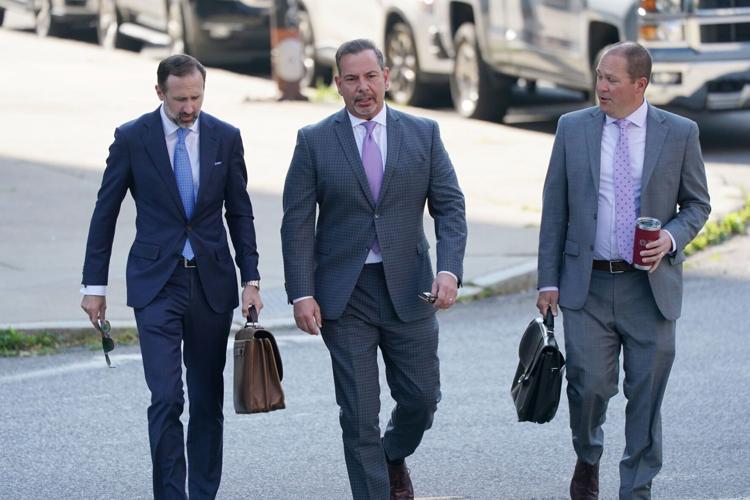
Former DEA agent Joseph Bongiovanni arrives at the Robert H. Jackson U.S. Courthouse for a hearing in June 2024 with his attorneys, Parker MacKay, left, and Robert Singer, right.
The main thrust of the defense’s argument in court Monday relied on the jury finding Bongiovanni not guilty on that count.
“If you decouple bribes from this, it’s difficult to know what he’s on the hook for,” said defense lawyer Parker MacKay, who with attorney Robert Singer, represents Bongiovanni.
What’s more, even though jurors convicted Bongiovanni of narcotics conspiracy, they found that the weight of marijuana that was “reasonably foreseeable” for Bongiovanni to know about was less than 110 pounds.
Had jurors believed Bongiovanni played a role in the thousands of pounds of marijuana that Serio distributed across Western New York, they would have found that a much greater weight was proven in the conspiracy, Bongiovanni’s lawyers said.
Instead, the amount jurors cited was enough to cover only how much marijuana was grown at home by Selva, a longtime friend of Bongiovanni’s and the best man at the agent’s wedding. Selva testified that he worked for the Serio organization and persuaded Bongiovanni to provide protection for it.
“From day one and now for years, the government made this entire case about bribery in its lengthy indictment,” MacKay told The News after Monday’s oral argument. “And the jury absolutely acquitted Joe Bongiovanni of taking bribes. Our motion asks the judge to throw out the conspiracy convictions because they cannot stand where the core part of the government’s story was rejected. In doing so, the jury’s verdict clearly spoke to a belief that Joe Bongiovanni was not connected to Ron Serio’s drug organization, and that he did not participate in the money/information exchange that was so central to the government’s story.”
Prosecutors contend there was enough evidence, even beyond bribery, to support the narcotics and corruption verdicts of the now retired-federal agent.
Other “potent factors” motivated Bongiovanni to betray his oath as a federal law enforcement officer, including his affection for childhood friends like Selva, who became drug dealers as adults, and an affinity for reputed members of La Cosa Nostra and pride in his family’s social connections to Italian organized crime, prosecutors said.
“Every way you slice it, it leads back to the jury verdict is supported by the facts,” Assistant U.S. Attorney Joseph Tripi told U.S. District Judge Lawrence Vilardo.
Vilardo acknowledged the indictment focused on the bribery allegation, but Bongiovanni’s lawyers face a high legal hurdle to get the verdicts tossed.
Vilardo, who reserved ruling Monday, indicated as much as he questioned the defense lawyers.
“Aren’t you asking me to get inside the jury’s head?” Vilardo asked the defense lawyers.

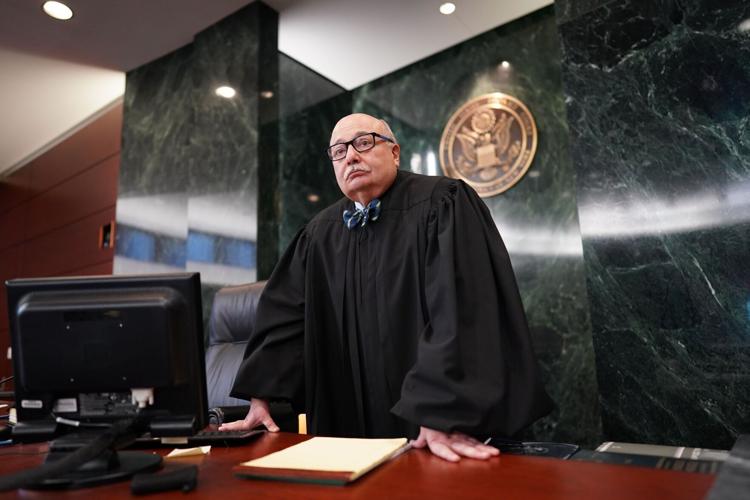
U.S. District Judge Lawrence Vilardo presided over the trials of Peter Gerace Jr. and Joseph Bongiovanni.
Maybe jurors had a good reason to reject the bribery count but find Bongiovanni guilty on the conspiracy count that included bribery as an element, the judge said. Perhaps the jurors found him guilty on one count and not guilty on the other as a compromise among themselves.
“The Supreme Court says that’s OK,” Vilardo said. “Why couldn’t this just be a compromise?”
Tripi said several elements in the indictment “contain zero reference to bribery” but include the friendship and organized crime affinity motivations.
“You take the allegations as a whole,” Tripi said.
But the defense lawyers argued that since jurors rejected the Serio bribery count, all the parts about shiploads of marijuana and the allegations about accepting money to reveal informants’ identities, misdirect other police agencies and provide sensitive law enforcement information should not have been factored into the conspiracy verdict.
Instead, all that was left was Selva’s testimony about what he told Bongiovanni when the agent paid a visit to his home and smelled marijuana.
Selva testified that when Bongiovanni came over sometime between 2014 and 2017, he told the agent “what was going on.” But Selva did not testify that Bongiovanni personally observed the grow operation during the visit, the defense lawyers said.
While Selva testified at length about his indoor home operation and also outdoor grows in the Southern Tier with members of Serio’s drug organization, “he never testified to exactly what he disclosed to Bongiovanni at his residence,” the defense lawyers said of Selva. “He did not, for instance, testify that he told Bongiovanni that the basement marijuana grow was related in any way to Ron Serio’s broader operations.”
Selva testified that Bongiovanni did not arrest him but said, “Be careful. Watch your utilities. Limit your movement.”
At best, Selva’s testimony showed Bongiovanni wished that his best friend would not get caught and cautioned Selva about how to be careful, MacKay and Singer said.
Vilardo asked Tripi what he thought of the jury finding Bongiovanni only knew about the small amount of marijuana.
Tripi said a reasonable view is that the jury noted a gap in evidence. Serio and Selva both admitted roles in the drug-trafficking organization, which initially trafficked marijuana grown in Southern Tier fields and in home basements before expanding by bringing in truckloads from California and British Columbia. But another key figure in the drug-trafficking organization – Michael Masecchia – did not testify in Bongiovanni’s first trial or retrial.
Selva testified he would meet with Bongiovanni to get sensitive law enforcement information, such as the identities of informants and the targets of drug investigations, and then relay that information to Masecchia, who passed it along to Serio. Masecchia took Serio’s money to give to Bongiovanni.
So the jury never heard from the person who prosecutors said put the money into Bongiovanni’s hands, Tripi said.
But jurors had “rock solid” testimony from Selva.
“If the jury was looking to compromise, that was an easy way to get to it,” Tripi told the judge.
At Bongiovanni’s first trial, a jury deadlocked on most of the counts, but convicted him of two charges over a DEA case file kept in his home after his retirement.
At his retrial, jurors convicted Bongiovanni, 60, of four counts related to the Serio drug-trafficking organization: conspiracy to defraud the United States; conspiracy to distribute controlled substances; and two counts of obstruction of justice.
His three other convictions related to Pharaoh’s Gentlemen’s Club owner Peter Gerace Jr.: two counts of obstruction of justice and one count of false statement to a U.S. agency. These convictions were over internal DEA memos he wrote and for what he told investigators about his past contact with the Cheektowaga strip club owner.
Bongiovanni was found not guilty of one count of conspiracy to defraud the United States; one count of conspiracy to distribute controlled substances; and one count of obstruction of justice – all charges that named Gerace.
The defense lawyer argued the proof was insufficient on each of the obstruction counts pertaining to DEA-6 memos because, in their view, the statements were either true or the verdict was at odds with the jury’s acquittal on the bribery count. Likewise, the counts related to Bongiovanni’s statements in internal DEA memos about Gerace were based on statements that were substantially true, the defense lawyers asserted. Also, the false official statement conviction cannot stand because Bongiovanni’s statement was the answer to a vague question, his lawyers said.
Patrick Lakamp can be reached at plakamp@buffnews.com