

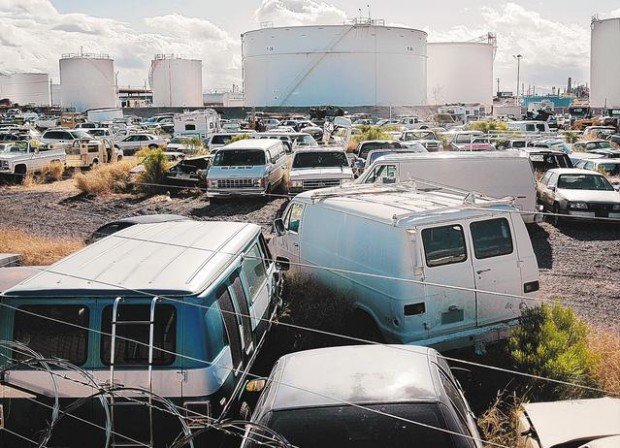
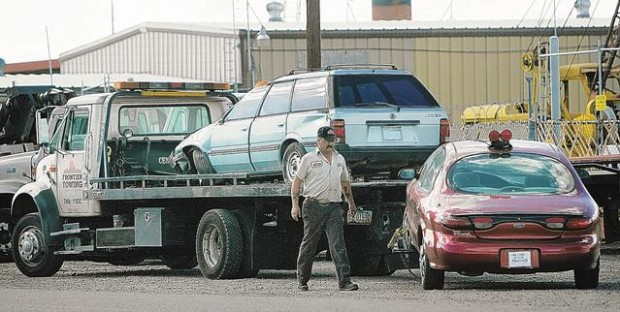
Each month Tucson police seize about 500 vehicles from drivers who are on the road illegally, and Pima County deputies seize anywhere from 275 to 465 more.
In November 2005, a law went into effect that requires officers to impound a vehicle when drivers repeatedly drive on a suspended license, have nearly twice the legal amount of alcohol in their system or get in an accident when their license is suspended and they have no insurance.
Before the law went into effect, police didn't impound vehicles driven by people violating the law, and they seized vehicles only for evidence, officials said.
At first, officers worried about the extra time and paperwork impounding vehicles would take. But they say the law hasn't put a significant strain on law enforcement.
"It's nowhere near as cumbersome as we thought it would be initially," said Lt. Karl Woolridge, with the Pima County Sheriff's Department Traffic Division.
People are also reading…
Before the law went into effect, officers who stopped a person never knew if the person continued driving after the traffic stop, said Tucson Police Department traffic Sgt. Christopher Andreacola.
"This is one of the few statutes out there that has some teeth in it," Andreacola said. "When you take their car away, they can't be driving."
It does add as much as a half-hour to a traffic stop, but most officers think it's worth it, Andreacola said.
When a vehicle is impounded, it's generally not the the driver's first encounter with law officers, Andreacola said.
"The violations on the statute are repeat offenses," Andreacola said.
The law requires impoundment when a person can't drive because of a DUI conviction or when his license is suspended for having previously driven on a suspended license.
Drivers' cars are also impounded when they're arrested for extreme or aggravated DUI or if the driver is a minor under the influence.
Both Woolridge and Andreacola say that since the law went into effect, people are becoming more careful about letting others borrow their vehicles.
In nearly half of the 6,000 vehicle impounds in the city last year — 2,800 cases — the vehicle's owner wasn't driving when the city took the car, Andreacola said.
"People really need to be careful who they're going to lend their cars to," Andreacola said.
While officers thought the number of impounds might decrease as people learned about the law, the number stayed steady through the year, Andreacola said.
More people still need to learn about why their car can get impounded, he said.
Nelly Rios, 47, let her 17-year-old niece borrow her 2000 Buick LeSabre so she could go to the store and get some hamburgers.
An officer pulled her over because one of the car's lights was out, and the officer learned the niece was driving in violation of the law. Rios had to prove she was the owner of the car and pay the $150 administration fee and the towing fees to get her car back.
She said she's never going to let anyone borrow her car again.
"I've learned from this," she said. "It's a hassle for the owner."
Law enforcement also worried about public reaction to the new law, but it hasn't been bad, Woolridge said. "People have been very reasonable as far as when they're going to get their car back," Woolridge said.
The new law has increased the workloads of the towing companies that contract with the city and county, which have to deal with hauling hundreds of additional cars and trucks each month.
"It's been a tremendous burden on our resources," said Jim Mooney the owner of Frontier Towing, which impounds vehicles for the county.
Mooney said his company purchased four new tow trucks, at a cost $85,000 each, to deal with the increased workload.
He's also had to hire more tow-truck drivers and staffers to answer the phone.
People whose vehicles were impounded call the company all the time to find out how they can get them back.
"We spend a lot of time on the phone with people finding out what they need," he said. Mooney also has had to acquire more property to accommodate the growing number of impounded cars.
While people often complain about the hassle of getting their cars back, they've only challenged 12 impoundments, Andreacola said.
If a person believes a car was wrongly impounded, he can request an administrative hearing. Based on the evidence, Andreacola decides if the impound was within the law. If the owner disagrees with that decision, he can take the case to Superior Court.
But Andreacola said that hasn't yet happened.
The fees for having a car impounded can reach $450. Add to that whatever cost people have to pay to get in compliance with the law, like license and registration fees, and the amount can quickly surpass the value of a 20-year-old Ford Taurus, Mooney said.
Sometimes when owners don't want to fork over the money to get their vehicle out of impoundment, they leave it with the towing company. Valuable, late-model cars get picked up fast, though, Mooney said.
If an owner doesn't claim a car, the towing company gets the title after a couple of months.
But it's not exactly a financial windfall, Mooney said. Usually the cars aren't worth more than a few hundred dollars.
Frontier Towing could sell the vehicles for parts, but most towing companies don't dismantle cars. They sell them to a wrecking yard.
The vehicles that don't sell go into the crusher, Mooney said.
The one good thing about the new law, Mooney said, is that he's had to hire additional workers and has given more people jobs.


