

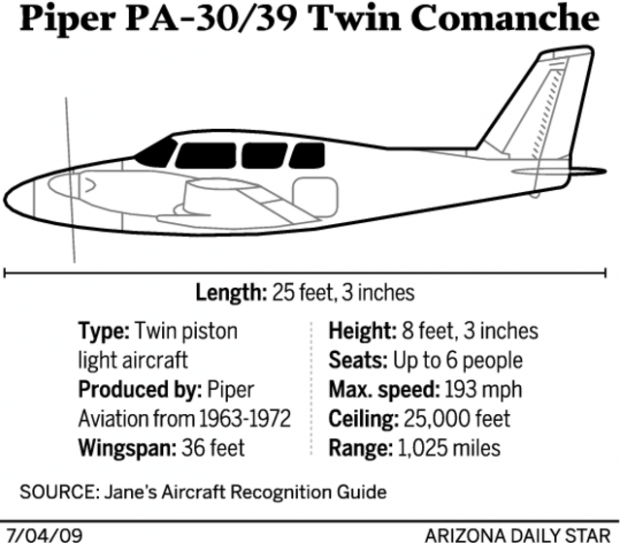
At 30 feet in the air and just after takeoff, Alan Muhs felt the left engine of his Piper Twin Comanche falter.
No big deal, he thought.
Maybe it was a gust of wind. He'd make a slight adjustment. After all, these things happen, especially with light aircraft.
But the left engine kept losing power, and the small plane was veering hard to the left. Within seconds, Muhs lost control and the plane started heading down, slamming into a drainage ditch just off the runway at Tucson International Airport on Friday morning. The crash injured two passengers but could have been much worse. Everyone walked away from it.
"There were four of us in the Piper, and we all are OK," Muhs said by phone from University Medical Center, where his girlfriend and her mother were being treated for minor injuries.
People are also reading…
Muhs took off from the main runway at the airport. The wreckage closed the runway for about an hour but didn't disrupt any flights, said Viki Matthews, a spokeswoman for the Tucson Airport Authority. Investigators from the National Transportation Safety Board were investigating the cause of the crash.
The moments just after takeoff, Muhs said, are a particularly precarious time. At a higher altitude, he could have adjusted the plane and landed it safely. But at 20 to 30 feet, there just wasn't enough altitude to work with. The plane also hadn't reached a fast enough speed for all the controls to be fully effective.
Muhs had planned to head up to the White Mountains with his girlfriend, Ana Leclair, her mother and her mother's friend to celebrate July Fourth. Only Wednesday, Muhs, a Tucson resident, had flown from the White Mountains to Yuma, making the trip in about 90 minutes.
When the engine faltered Friday, the small aircraft was humming at 80-85 miles per hour, then hit the ground next to the runway and skidded a few hundred feet before ending up as a mangled wreck in a dirt median. Dust clouded the scene. Debris was scattered everywhere. Muhs looked around, and was thankful to see that everyone was conscious. Everyone was OK.
"My biggest concern was getting out of the airplane as soon as we could because I was concerned about a fire. We had lots of gas on board," said Muhs, 58, a seasoned pilot who learned to fly in 1976.
He scrambled out, and so did his girlfriend. But her mother and her mother's friend were in the back of the airplane, and although the door was open, they didn't have the strength to pull themselves up and out.
"The door was very hard to open. It was impossible to open," he said.
Rescue workers rushed to the scene. The call came in at 9:15 a.m. and the Air National Guard and Tucson Airport Authority police were on the runway in minutes, working to get the two passengers out. The Tucson Fire Department followed, taking Leclair and her mother to UMC.
A formal investigation into what caused the crash has just begun and will likely take months, said Joshua Cawthra, aviation accident investigator with the National Transportation Safety Board, which is handling the investigation.
An Scottsdale-based investigator drove down to the Tucson airport Friday to collect debris, mark ground scars and document evidence. The materials will be taken to Phoenix.
There will be an initial report filed in five or six days, Cawthra said. But it could take up to a year to finish the investigation.
"We have quite a bit of work to do on it," he said.
Muhs said Friday was both the scariest and luckiest day of his life. In more than 30 years and 2,500 hours of flying, he had never crashed.
He owned the Piper Twin Comanche for five years and clearly mourned its loss. He plans to keep flying.
"It was a good plane," he said.
But he was just as clearly thankful about how things turned out.
"I can get another airplane," he said. "But you can't replace people."


