

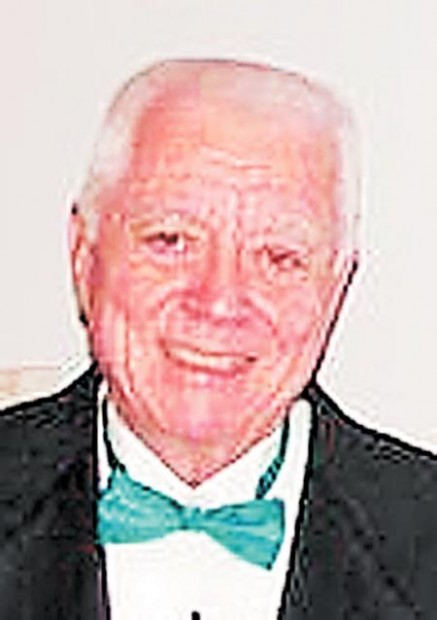
Dr. Owen Williams was an artist trapped in a dentist's lab coat.
A Douglas-born fifth-generation Arizonan, the Tucson dentist made small sculptures from the silver left over after he filled his patients' cavities.
He traded dental services for artwork.
And in 1975 he surrendered to his creative side, abruptly leaving his successful dental practice to follow his passion.
The precision Williams honed as a dentist was demonstrated by the meticulous detail he brought to his art, which is in private collections and displayed in museums and galleries throughout the United States and Mexico.
Williams was already fretting about preparations for his next show in February when he died in hospice care Oct. 14, after recent surgery for pancreatic cancer. He was 70.
People are also reading…
A memorial is scheduled for 11 a.m. Saturday in the courtyard of the Tucson Museum of Art, 140 N. Main Ave.
Terry Etherton met Williams 25 years ago, and his Etherton Gallery has hosted a show of Williams' work every other year for the last 15 years. In a conversation with Etherton before surgery, Williams reviewed final details for his 2008 show.
"He wanted to reassure us the show would go on even without him," Etherton said. "That was so typically Owen, to reassure us knowing he probably wouldn't be around; a guy who never left any stone unturned. He was always planning. It was just his nature. He wanted everything to be perfect and he wanted anyone who went to the trouble to come and see his show, let alone buy his art, to be satisfied."
Williams' choice of medium changed through the decades, but his aesthetic was constant. He used bold graphic images, vibrant colors and unconventional materials — wire, wood slats, plexiglass, lighting, sheet metal — to create meticulously planned abstract art that actively engaged the viewer.
"He would do these incredibly complicated, incredibly precise drawings early on that he called kinetic drawings — paintings on triangular pieces of wood," Etherton said. "They were just meticulously, painstakingly put together. I always marvelled at how fine a detail Owen could get on wood."
Mark Coburn was 15 when he met Williams. The teenager's dentist shared a practice with Williams. In 1975, when Coburn was 22, he ran into Williams at an art show and the two became friends. It was a spate of health issues that year that prompted Williams to leave his practice to pursue art, Coburn said.
"When he got going and he was inspired, he would work 12- and 13-hour days," Coburn said.
What Williams called his kinetic paintings were fractured pieces made from canted slats of wood and acrylic paint. When viewed from left of center, the painting revealed one image and when viewed from right of center an oftentimes contradictory image would appear.
"It was like it was shifting, not an optical illusion, but a perceptual or optical shifting," TMA Chief Curator Julie Sasse said. "Often he would juxtapose the two paintings — night and day, life and death — showing these opposing images."
TMA Director Robert Knight said Williams' kinetic paintings engage the audience.
"It makes the viewer an active participant in the creation of the artwork and Owen always loved that connectivity because he was a people person," Knight said.
Williams didn't take his art too seriously, though.
His paintings weren't "really political or out to make any big, heavy statements," Etherton said. "They were just pictures that made you smile and were amusing but had a little bit of a hook in them, a little visual pun or a metaphor or a play on words so there was always something more than what you saw."
Artist Jim Waid met Williams in 1968. Waid needed some dental work and he traded Williams one of his paintings for a year's worth of care for his family. Waid still remembers the four- and five-inch human figures Williams made with the silver left over from cavity repairs, and followed his development as an artist.
"The work evolved and the imagery evolved from fairly abstract to recognizable, then his work changed to a whole new process," Waid said.
In recent years Williams was working with fused pigment on sheets of aluminum.
In a statement for his 2005 show at Etherton Gallery, Williams wrote: "These works are untitled, distinguished from each other by the dates upon which they were finished and by Roman numerals indicating their place in the series 'Colors, Signs, Symbols and Symbiosis.' The images are purposely ambiguous, sometimes mysterious, often cryptic or totally abstract. Clues in small details or in composition or color can change the apparent meaning of the image. The premise is to involve the viewer as much as possible by engaging the imagination in the creative process. Their only titles are whatever the viewer wants to give them. Their only meaning is what the viewer thinks they mean. I think of them as pages in a small book of poems. Or perhaps as a technicolor Rorschach test."
Williams' focus on art wasn't limited to his own. He served on various boards and committees within the local art community; he was a founder of the TMA's "Memories in the Making" program, which provides tours and hands-on studio experiences for people with Alzheimer's disease and dementia; and he encouraged other artists.
"His life was all about art. He lived for art," Sasse said. "He came to every event. He was an example of somebody who really walked the walk."
"I think the impact he had was more about who he was than the art," Etherton said. "Owen was the ultimate spokesperson and the ultimate diplomat and the ultimate cheerleader for arts in Tucson. You couldn't go to an opening without seeing Owen. He went to every opening and always supported other artists in the community."
On StarNet: Find a photo gallery of this Life Story at azstarnet.com/slideshows
Life Stories
This feature chronicles the lives of recently deceased Tucsonans. Some were well-known across the community. Others had an impact on a smaller sphere of friends, family and acquaintances. Many of these people led interesting — and sometimes extraordinary — lives with little or no fanfare. Now you'll hear their stories. Past "Life Stories" are online at go.azstarnet.com/lifestories

 Tucson official: Air Force won't pay for D-M groundwater cleanup now


