

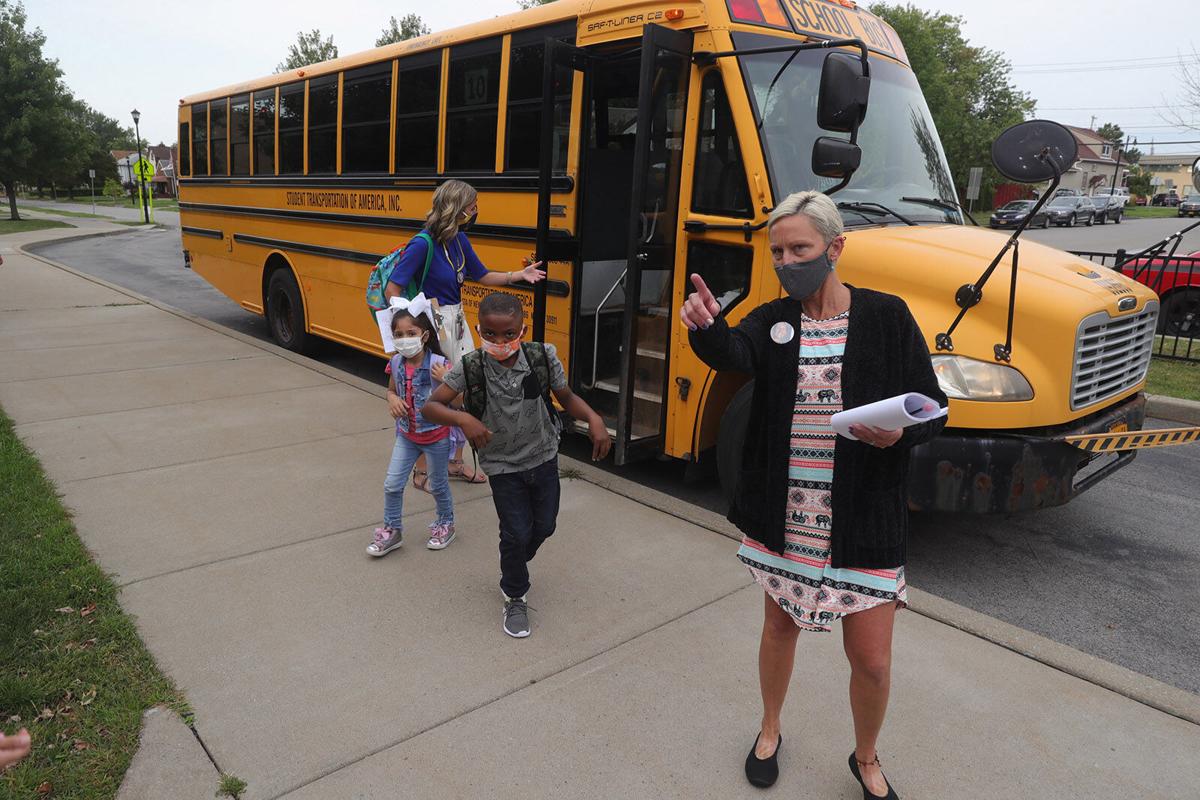
School districts are awaiting a windfall from the latest federal stimulus package, but with it also comes one big concern.
In earlier rounds of Covid-19 relief funding, the federal government appropriated money for school districts which, in turn, saw their state aid reduced in equal amounts to help New York plug its own budget gap.
“That’s our biggest worry,” said Brian Graham, superintendent of the Grand Island Central School District. “I think we’re scheduled to get $2.7 million. Will the governor subtract $2.7 million and supplant it with these dollars?”
That practice disproportionately hurts upstate school districts, which are far more dependent on state aid than districts downstate, said Michael Cornell, superintendent of the Hamburg Central School District.
“That will present a significant financial challenge for upstate schools districts,” Cornell said.
People are also reading…
Cornell, Graham and Jon MacSwan, superintendent of the Cleveland Hill Union Free School District, raised some of those concerns on Tuesday during a meeting with The Buffalo News Editorial Board. The three are officers with the Erie-Niagara School Superintendents Association.
While the exact amount has not been finalized, figures released last month show Erie and Niagara County school districts would receive $414 million under President Biden’s $1.9 trillion American Rescue Plan. Buffalo Public Schools would receive more than half of that.
Given the history of using federal relief funds to offset state education cuts, federal lawmakers have bolstered provisions in the new Covid-19 relief bill that aim to prevent states from cutting school aid to match the increase in federal money. In particular, the bill makes it tougher for states to cut aid to poorer urban school districts.
Cornell, president of the Erie-Niagara School Superintendents Association, said local school districts also have received assurances from Rep. Brian Higgins' office that the intent of Congress is to make sure this money reaches schools.
“Their intent is clearly that we get it and we can use it as extra money and not just money we would use to keep the lights on,” Cornell said.
In Grand Island, for instance, the school district had an additional $600,000 in Covid-related expenses needed to reopen schools in September amid the pandemic, Graham said. The district wants to use some of this new stimulus money for summer school to help catch up elementary students who may have fallen behind over the past year, Graham said.
“But those dollars would be new to our budget and to see this past pattern of supplanting the dollars is obviously troublesome, especially when you’re talking about the potential of $2.7 million,” Graham said.
In addition, using one-time federal funding to offset cuts in state aid not only shortchanges districts now, but it leads to larger budget gaps in years to come. That’s the problem school districts ran into during the financial crisis more than a decade ago, Cornell said.
Hamburg's district is expecting $2 million and Cleveland Hill, $3.1 million.
“What happens next year?” Cornell said. “Next year, I’ve got a $2 million hole in my budget, because the state’s not going to come up with an extra $2 million to put in my budget when my yearly increases in state aid has never even approached that.”
“The concern here is two years out,” MacSwan said. “Next year’s budget, I think we can keep it between the rails, but that pending, large hole that the state won’t be able to fill in those out years is going to be a challenge.”


