

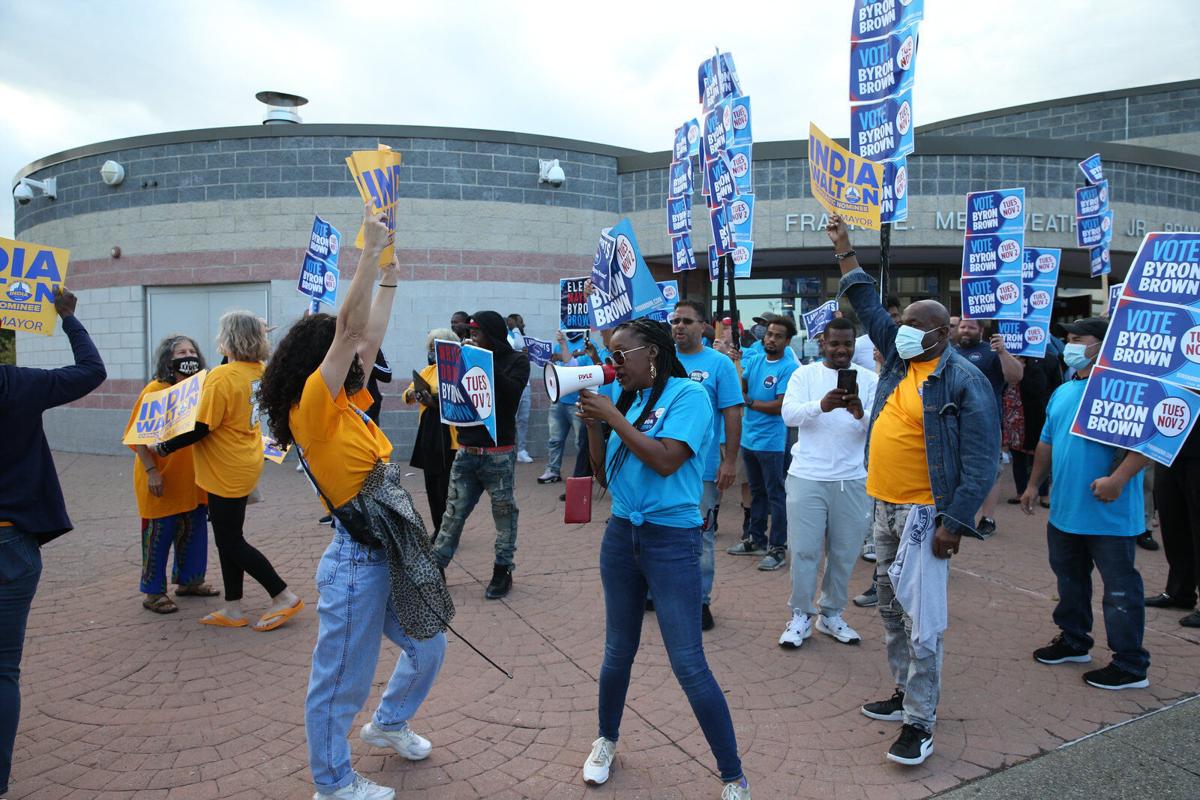
Mayoral candidate India B. Walton embarked on a fundraising mission to New York City during the weekend, venturing into its most progressive enclaves in search of critical financial and political support for her challenge to incumbent Byron W. Brown.
Walton began Friday in Brooklyn with an affair hosted by New York City Public Advocate Jumaane D. Williams, the increasingly visible linchpin of the left who has strongly supported his new Buffalo ally since she beat Brown in the June Democratic primary. On Saturday, the Democratic Socialists of America hosted a Walton event in Queens featuring actress and activist Cynthia Nixon. After meeting with the Rev. Al Sharpton at his National Action Network, she then attended a Manhattan fundraiser sponsored by the liberal Working Families Party. New York City elected officials were set to host another Brooklyn event on Sunday.
Like no other Buffalo Democrat before her, Walton is seeking the mayor's office from a far left platform. She seeks to cut funding for police, initiate new housing programs for the poor, redirect money from programs rewarding "rich developers," and promises to focus her administration on the working class. She makes no apologies for a democratic socialist philosophy that has traditionally failed to gain traction in American politics – even in Democratic cities like Buffalo.
People are also reading…
Read the full story from News Washington Bureau Chief Jerry Zremski
Now Buffalo emerges as a laboratory for her political viability in a campaign capturing national attention. Her candidacy against Brown will test a key premise: Will the overwhelming Democratic city often viewed as home to traditional, blue collar, ethnic and working class Democrats accept her ideas?
Walton thinks Buffalo is not only ready, but eager to embrace a philosophy that represents change – especially after Brown's record-tying four terms in City Hall. While many like-minded candidates tend to campaign on the left for the primary and then veer to the center for the general election's broader electorate, Walton remains committed to her progressive principles. She has not softened her stands, and thinks her message is connecting in Buffalo.
"I think this town is receptive to it, and it's an appropriate time," she said. "I think that having the support of the Erie County Democratic Committee and [Chairman] Jeremy Zellner is proof that we can move the needle further left and place priorities on working-class people."
And, she often emphasizes, she handily beat Brown in the Democratic primary (though the mayor acknowledges he waged a lackluster campaign). Walton believes she triumphed in June after emphasizing values that connected with voters.
Immediately after defeating Brown (not only a Democrat but the former chairman of the New York State Democratic Committee), left-leaning groups around the country began flocking to Walton's candidacy. By July, eight national progressive organizations lined up behind her, claiming to represent thousands of voters in Buffalo. The groups sport names like Our Revolution, which sprang from Sen. Bernie Sanders' 2016 presidential campaign, and MoveOn, which burst onto the national political scene by opposing the Iraq War in the mid-2000s.
The executive director of Our Revolution, Joseph Geevarghese, said then that his group supported the primary winner only partly because of her progressive platform.
"It's also fundamentally important that the Democratic Party respect the progressive wing of the party," he said, "and when we win, they shouldn't try to kneecap us."
Walton has in recent days shored up her staff with veterans of progressive campaigns in New York City. Early next month, she is expected to air her first TV commercials, which campaign sources say are produced by The Win Company following its successful primary effort. The firm has also worked for progressives like downstate Reps. Alexandria Ocasio-Cortez and Mondaire Jones as well as others around the country.
Now the campaign finance reports due Oct. 1 that are expected to reveal if the national groups back up their support with money. If polling reflects significant progress in her campaign, say political observers, the national groups will have written checks to Walton.
Brown did not return phone calls requesting an interview. But some close to him like former Mayor Anthony M. Masiello say the Walton victory would have never occurred if Brown had not ignored her, engaged her in debate, and energized the political organization that sustained him through three decades of elections.
"It was Politics 101," he said. "India got out her vote and Mayor Brown didn't."
Masiello, who won three terms as mayor in addition to city-based campaigns for State Senate and Common Council, acknowledges Buffalo's voting patterns have evolved since he launched his political career 50 years ago. The city's population has dwindled, neighborhoods have changed, and Republicans no longer even field a mayoral candidate.
But the former mayor says he remains connected to Buffalo voters, and does not believe its overwhelming Democratic base accepts Walton's brand of politics.
"She's not a Democrat; she's a socialist," he said. "That's in direct conflict with the capitalism and democracy of our country. This town doesn't like outsiders coming in and telling them whom to vote for and where their tax dollars should go.
"Buffalo people are conservative Democrats," added Masiello, a Brown supporter who does business with the city as an Albany lobbyist. "They're devoted to their country, to God, and to their family. Are they into a Democratic agenda? Absolutely. A far left agenda? I don't think so."
No big American city has elected a socialist since Milwaukee's Frank Zeidler in the 1950s. And recent Buffalo elections show that moderate Democrats fare well against far left candidates. In 2014, for example, Andrew M. Cuomo beat Zephyr Teachout 82%-14% among Buffalo Democrats in the primary for governor. He won again over Nixon in 2018 – 68%-32%. Only Sanders noted marginal success in Buffalo (as he did across the country) in 2016, when he lost to Hillary Rodham Clinton 57%-43% in the presidential primary.
But change may be supporting Walton's effort.
"I want folks to know I am committed to change," she said a few days ago.
Zellner, whose Erie County Democrats originally backed Brown before their post-primary endorsement of Walton, said her fresh approach offers an alternative to a mayor seeking an unprecedented fifth term.
"I think, above everything else, this has been a response to the idea of change and a new voice in City Hall," he said. "Do we want to keep things as they are or change the way we do business in the city?
"And if you listen to her message, she's not a whole lot different than FDR," he added.
Brown, meanwhile, may be banking on that traditional view of Buffalo voters as conservative Democrats. For most of his early career, possibly emulating the tactics of his old boss – the late Democratic County Executive Dennis T. Gorski – Brown also ran on the Conservative Party line. Only when he took over as Cuomo's state Democratic chairman did the mayor and Conservative Party part ways, even though they maintain friendly relations.
Even as Walton criticizes Brown's coziness with developers, Chairman Ralph C. Lorigo says the mayor has struck the right tone.
"The mayor has shown he is capable of working with major developers and has made sure development takes place properly," said Lorigo, who is critical of Walton's democratic socialist politics.
"I don't think we're at the point where that far left base succeeds," he added.
Walton will return to Buffalo buoyed by significant contributions for the last five weeks of her campaign against Brown. She is expected to begin airing her message on television in early October, has shored up her campaign staff in recent days with veterans of New York City progressive efforts, and is committing her progressive stands to a contest being watched across America. Her campaign has told The Buffalo News it expects more of the city's elected Democrats, some previously on the sidelines, to endorse Walton in a steady stream of announcements.
The political pros seem as interested in her experiment as the reporters flocking to Buffalo.
"We'll find out in November," said Zellner, the Democratic chairman.
"I do believe Brown will win," added Lorigo of the Conservatives. "But we're all about to see."


