
This story contains raw language.
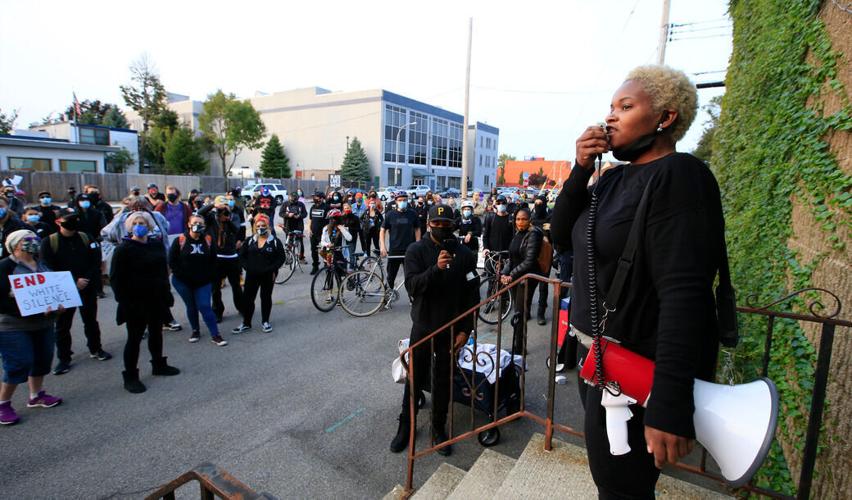
Nine months before she won Buffalo's Democratic mayoral primary, India Walton walked in the middle of Court Street shouting into a megaphone to three dozen protesters in front of the downtown police headquarters.
"They have not listened," she said of the police. "They have not listened because they don't care."
The protesters carried signs that looked like pink slips for police officers, and they placed them in front of the Dillon Building before Walton led them through downtown streets.
"No justice, no peace. Fuck these racist ass police," Walton chanted with the protesters.
Her primary win in June over Mayor Byron Brown puts her within reach of winning the mayor's office, and should she beat his write-in candidacy in the Nov. 2 election, she will shape the budget and policies of the police department she ripped into at the protest.
People are also reading…
Her anti-police rhetoric dramatically softened when she launched her mayoral campaign. She no longer curses police and also moved away from the "defund the police" mantra, although she promises cutting $7.5 million from the police budget.
"We all have room to grow and to learn," she said of her protest speeches.

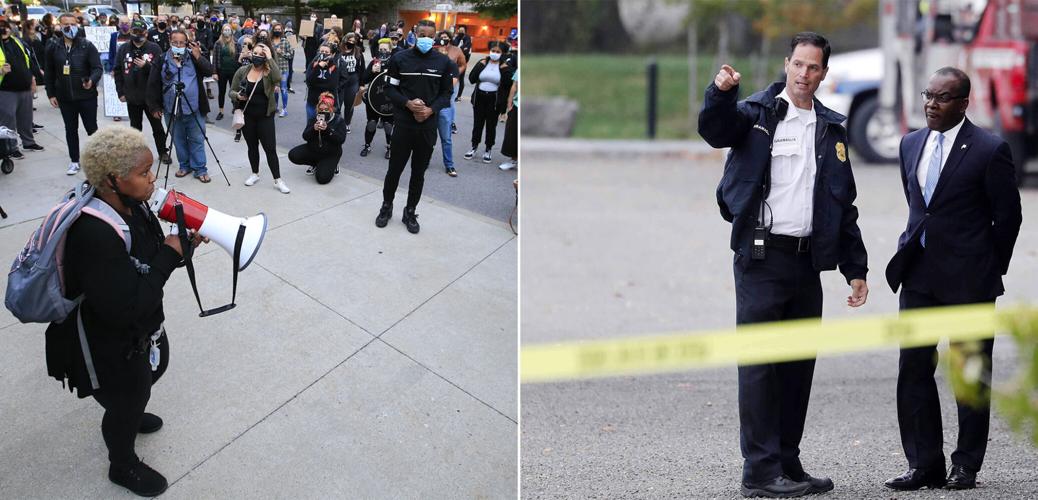
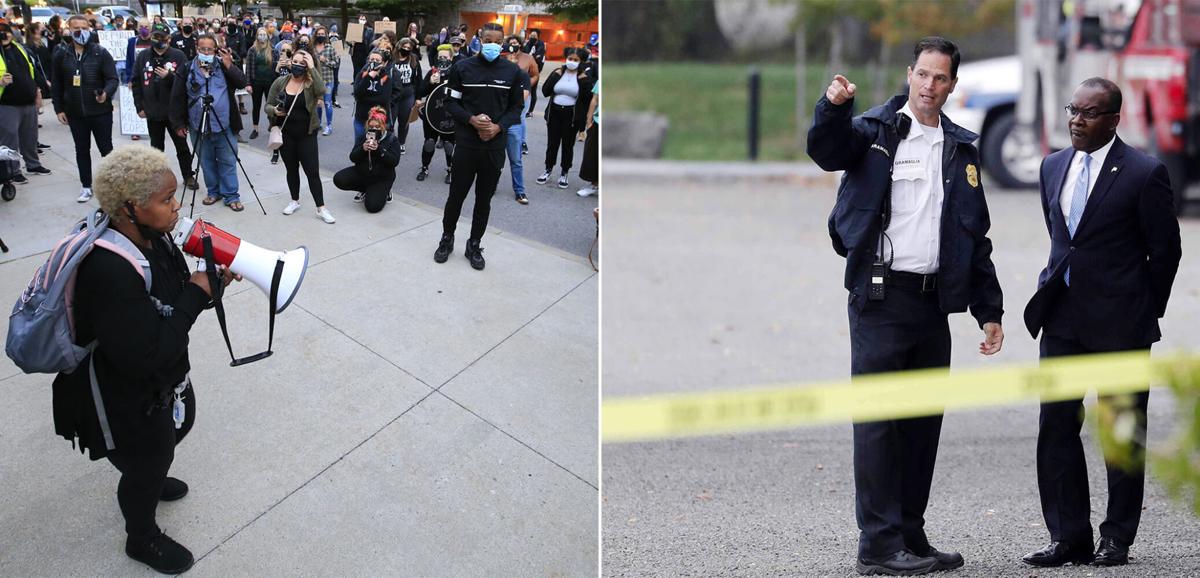
India Walton, left, speaks during a rally Sept. 15, 2020. At right, Mayor Byron Brown, talks with Police Chief Joe Gramaglia in Buffalo.
But as policing emerged as a major campaign issue, Brown has sought to paint Walton as out of step with residents who want to be kept safe, for everything from gun violence in troubled neighborhoods to speeding drivers running stop signs in every neighborhood.
Their contrasting philosophies on policing mirror a nationwide dialogue about the American criminal justice system and the complicated questions raised after the murder of George Floyd, an unarmed Black man, by a white Minneapolis police officer last year and the rise in gun violence and homicides in cities including Buffalo.

When I took office as Buffalo’s mayor in 2006, I promised to work to revitalize our city, bu…
The Buffalo Police Department has gained national attention during Brown's tenure – both good and bad.
In 2017, CNN featured the police department for having gone more than four years without a fatal police shooting – although there have been three fatal shootings and one other death during a police encounter since then. The Atlantic magazine ran a story in 2019 about a police program where police officers work with violence interrupters to steer young people away from crime.
But the department drew international outrage after a viral video showed riot police shoving a 75-year-old protester in front of City Hall as they began to enforce a curfew in June 2020.
Through his 16 years in office, Brown has supported community policing initiatives putting officers alongside members of the community and other agencies. He has also supported strategies targeting "hot spots" and welcomed the assistance of federal and state law enforcement to curb gun violence.
Brown scoffs at Walton's plan to cut $7.5 million from the police budget, which he said would mean layoffs of up to 100 officers. Walton has said the funding cuts would be done through attrition.
Meanwhile, Walton calls for significant changes in the police department, wanting to rely more on civilians like mental health counselors to respond to mental health calls, domestic incidents and traffic problems.
Walton also stresses accountability.
"There has to be transparency," she said. "And there has to be a real shift in culture from one of policing and punishment to one of restoration of care for one another. The police are going to play an integral role in creating that type of culture.
"I want to celebrate officers who do well and also make sure that those who do not are held accountable," Walton said in an interview.
Funding the police
Walton no longer uses the term "defund the police." She acknowledges she has used the term before, along with more provocative language, as she embraced that movement last year amid protests in Buffalo against police misconduct.
"I will also say that the defund movement is not lay person's language," she said. "In activist and social justice circles, we understand that phrase means we reallocate funding to places that are naturally going to reduce crime – and thus reduce this tension, where police are sort of this invasive force in neighborhoods."
Walton said she realizes "the notion of not having police is a scary thing" for people who live in a community affected by violent crime.
She said she does not advocate getting rid of police altogether, as some within the Black Lives Matter movement advocate.

I’ll never forget the Tuesday when a group of sisters came to me with head lice.
"A world without police, where people are safe, where we live in this utopian society where we don't need violence, would be great," she said. "We are not there yet. And we will not be there during a four-year mayoral term."
She said $7.5 million could be cut from the police budget by trimming overtime hours and not filling vacant positions, based on a study by the Partnership for the Public Good, a Buffalo think tank that promotes community policing, rehabilitation, reentry, restorative justice and juvenile diversion programs.
Brown opposes cutting the police budget. In campaign ads featuring Buffalo police officers, he said Walton would "defund the police" and warns that cutting $7.5 million would result in 100 police officers being laid off. He pointed out that the Partnership for the Public Good study, which concludes that $16 million could be cut, includes $11 million in cuts from moving civilian jobs – such as forensic specialists, dispatch and body camera oversight – out of the police department.
"You're spending the same amount of money, you're not eliminating those jobs," Brown said.
Building a better police department costs money, said Brown, who has been endorsed by the Buffalo Police Benevolent Association. More training, new technology and recruiting a more diverse class of officers are not possible with less funding, he said.
Don't send in the police
A key tenet of Walton's policing strategy calls for dispatching someone other than a police officer when calls come in for help.
In a Twitter post Thursday, Walton said, "If a family member or friend of mine was going through a mental health crisis, I’d want mental health professionals to show up, not armed law enforcement officers."
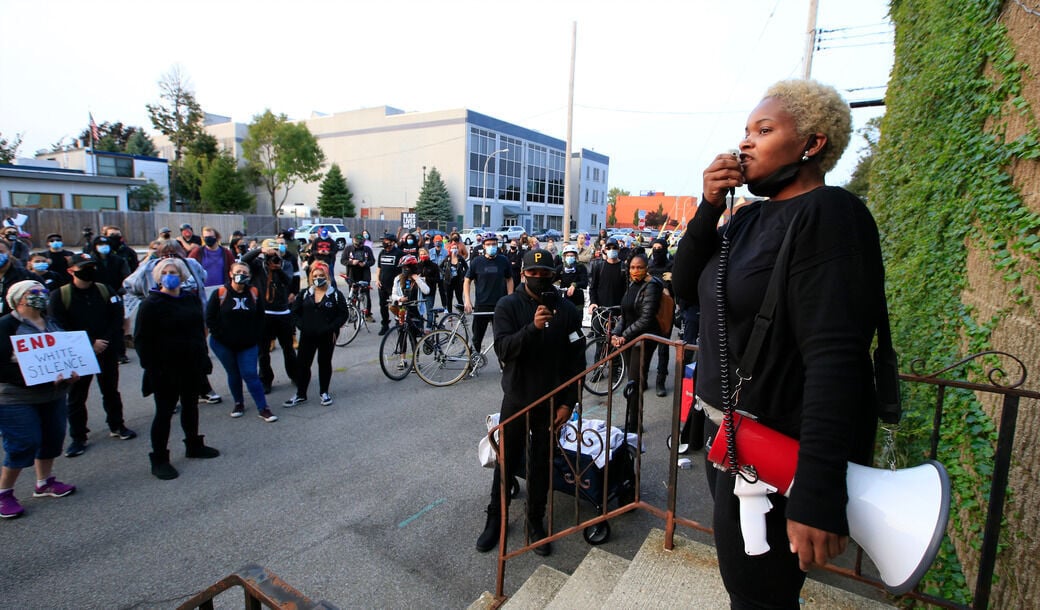
India Walton speaks during a rally supporting a man with emotional problems who was shot by Buffalo police in September 2020 after they said he was wielding a baseball bat.
Removing police from many matters is a way to reduce negative interactions between police and the community, she said.
"We are removing police from having to be first responders to jobs that they're really just not equipped to do," she said.
She wants unarmed mental health professionals to respond to 911 calls over those experiencing a mental health crisis or homelessness, unless there's reason to believe they're armed or pose a danger to themselves or others.
"We do expect the police to be able to respond to those calls with a mental health professional," Walton said. "However, there are lots of circumstances in cases where we don't need police to be the first response."
In many cases, she said, calls about someone with a mental health issue "aren't that serious," she said. "Like folks yelling," she said. "People are calling the police for that and that's just not an appropriate response."
But it can be hard to assess the threat by only a 911 call, experts say.
"What you don't want is only mental health counselors to show up to a crisis because you don't know if someone has a gun or a machete," said Alexis Piquero, a criminologist at the University of Miami and member of the Violent Crime Working Group of the Council on Criminal Justice, a Washington, D.C.-based think tank.
That happened a couple of years ago in Miami, he said. A naked man running through a neighborhood turned out to have a machete.
"Do you call a mental health counselor? No. You call a police officer," Piquero said.
Cities across the country have tried removing some duties from police.
But they have faced a challenge beyond sorting out which calls are dangerous and require police: the cost.
"Most communities are going to be challenged coming up with the resources to do that," said Darrel W. Stephens, former chief of the Charlotte-Mecklenburg Police Department and a nationally recognized expert for his innovations in policing.
Brown said police should work with violence interrupters and social workers.
Last year, the Buffalo Police Department launched its Behavioral Health Team, which pairs police officers with mental health social workers who respond together to mental health and crisis calls.
"There have been well over 800 responses since that unit was established last October without a single incident," Brown said.
Walton also wants to move traffic enforcement away from police, as was done in Berkeley, Calif. "The rationale is not merely to reduce potentially lethal interactions between police officers and Black motorists ... but also because police stops have little effect on achieving safer streets," her campaign manager Jesse Myerson said in an emailed response to questions.
She suggests creating a civilian collision investigation unit and also a civilian public safety detail to handle complaint calls about low-level offenses.
Brown blasted the idea of sending civilians to calls related to mental health, domestic incidents and traffic. Those kinds of calls "are the most dangerous calls that a police officer responds to," he said. "You would be putting members of the community at risk."
Involving the community
As mayor, Brown restored the community policing program, which puts designated community police officers in each of the five district stations. He and Police Commissioner Byron Lockwood also launched the Neighborhood Engagement Team, whose officers plan neighborhood events and handle nuisance calls.
Brown has been a longtime supporter of community-based anti-violence groups, most of which fall under the Back to Basics Ministries, which just marked its 15th year. Led by Pastor James Giles, the group serves as an umbrella organization to multiple groups including the Peacemakers, Stop the Violence Coalition, and Fathers.
Brown said he is preparing to unveil a pilot program to give victims of low-level, nonviolent crime the option of seeking restorative justice options.
Walton said she wants violence interrupters from the community to deescalate and diffuse tensions. She's interested in bringing to Buffalo members of Life Camp, a New York-based group, to work with Buffalo's anti-violence groups like the Peacemakers and the Stop the Violence Coalition.
"There's the perception that I'm just going to come in and get rid of everything," she said.
She said she doesn't want to replace existing groups.
"But I do think there's room for improvement," she said.
Walton says Buffalo's rise in shootings shows Brown's approach is a "catastrophic failure."
"Year after year, the current administration invests in one policy response, to the exclusion of others: heavier policing, more aggressive prosecutions, and harsher punishments," according to her policy statement on public safety.
She wants to find ways to keep people out of the criminal justice system, including restorative justice in some kinds of cases.
Crime dropped from 2005 to 2019, but gun violence has risen since the pandemic, Brown acknowledged, as it has in cities across the country.
To deal with the recent rise, the police department has worked with state and federal authorities to investigate shootings and gets illegal guns off the street, he said.

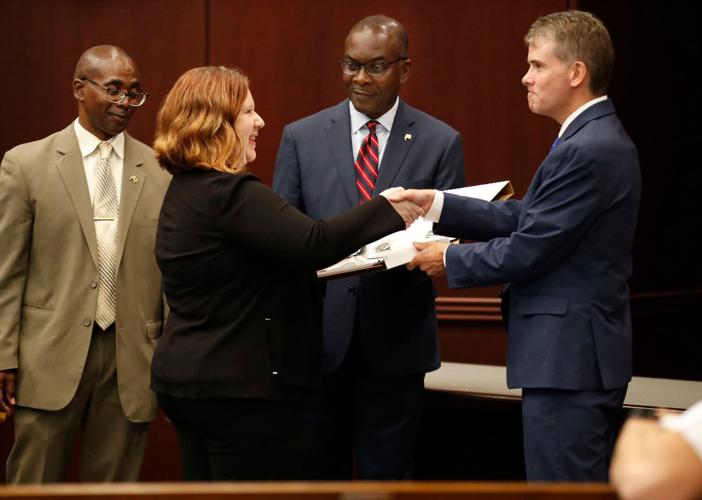
Mayor Byron Brown, center, Commissioner Byron Lockwood, left, and other agencies recognize the members of the FBI Viper Task Force for their recent efforts to help reduce gun violence in Buffalo and Western New York, Wednesday, Sept. 22, 2021. The VIPER team members are from New York, North Carolina, Arkansas, Massachusetts and Syracuse. Staff Operations Specialist Kristen Ford receives her certificate from FBI Special Agent in Charge Steve Belangia.
The department's approach to hot-spot policing has changed, too. The department disbanded the Strike Force unit in 2018 following criticism from activists who said its traffic checkpoints disproportionately impacted communities of color. Now, the department targets hot spots when crimes, particularly shootings, take place.
Police oversight
If she becomes mayor, there will be more discipline and possibly firings for police misconduct, Walton said.
She wants a civilian oversight board with more authority to investigate police officers accused of misconduct.
"When people don't feel like there are any consequences to their actions and behaviors, there's no incentive for them to change," she said.
Brown said his administration takes misconduct accusations seriously, and has referred cases to prosecutors. The city has fired police officers and has a zero-tolerance policy for trainees not under union protection. Since 2015, the city has fired 11 police officers, six of whom were on probationary status, records show. Some 369 officers were hired since then, with 33 resigning.
A mayor cannot unilaterally fire a police officer, Brown said.
Under state law, termination of a police officer is handled through binding arbitration, Brown said. The exception is for any officer convicted of a felony or crime involving moral turpitude. Brown said instead of giving more power to a civilian board, it would be more effective changing state laws to give police administrators more power.
Mayors can't just "flip a switch" to enact sweeping changes, said Christine Cole, executive director of the Boston-based Crime and Justice Institute.
"You've got collective bargaining agreements, you've got budgets, you've got in most places a city council who's got the budget authority," Cole said.
What a mayor can do is set values and influence how money is spent.
"It's my firm belief that a budget tells you what your values are," she said.
From an interview with The Buffalo News Editorial Board on June 3, 2021.
***
Why The News is publishing India Walton's raw language
At The Buffalo News, we encourage civil dialogue. Though coarse language has grown more common in society, The News rarely publishes such language. Even when a colorful quotation is important to a story, writers can usually let readers know something coarser was said without publishing the phrase.
The exception is when the coarse language itself is newsworthy. In today's story about mayoral candidate India Walton's views about policing and the Buffalo police, we are publishing Walton's raw language from rallies a year ago.
If you have thoughts about our decision, email editor@buffnews.com.