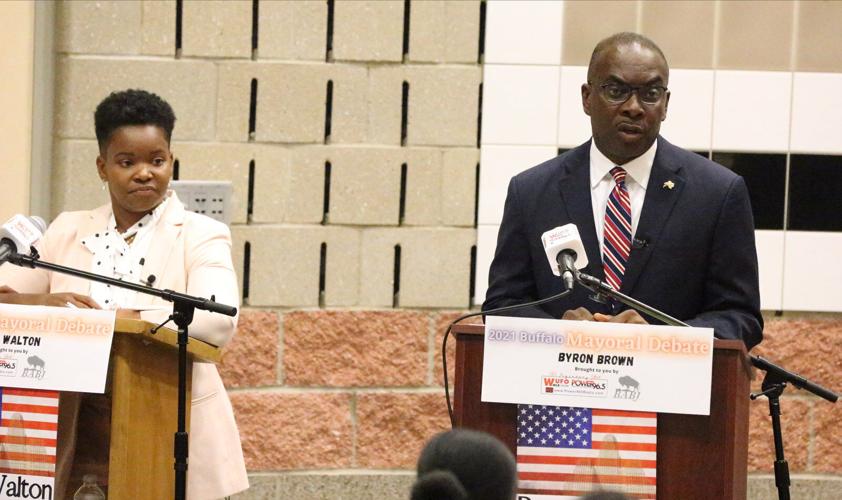
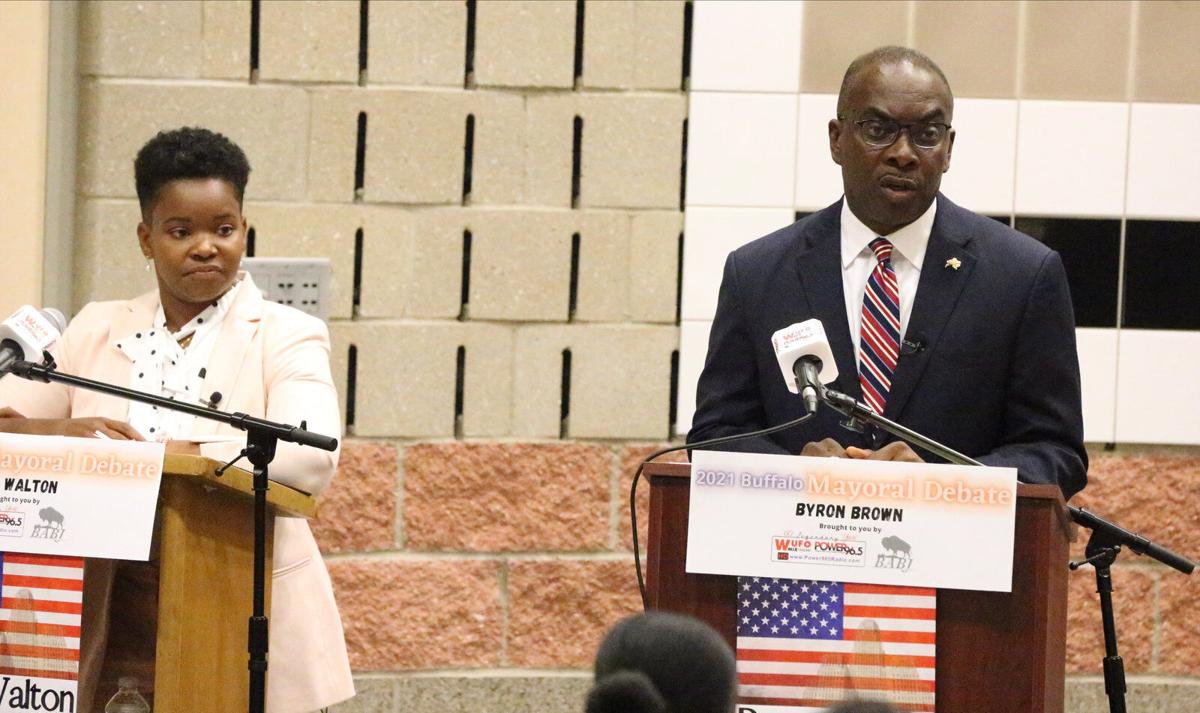
Amid the national attention Buffalo's mayoral race has drawn, one group has been mostly silent.
Most Common Council members are evasive about who they support in the Nov. 2 election: Byron Brown, the four-term incumbent who lost the Democratic primary, or India Walton, the self-described socialist whose surprising primary win puts her on the doorstep of becoming the city's first female mayor.
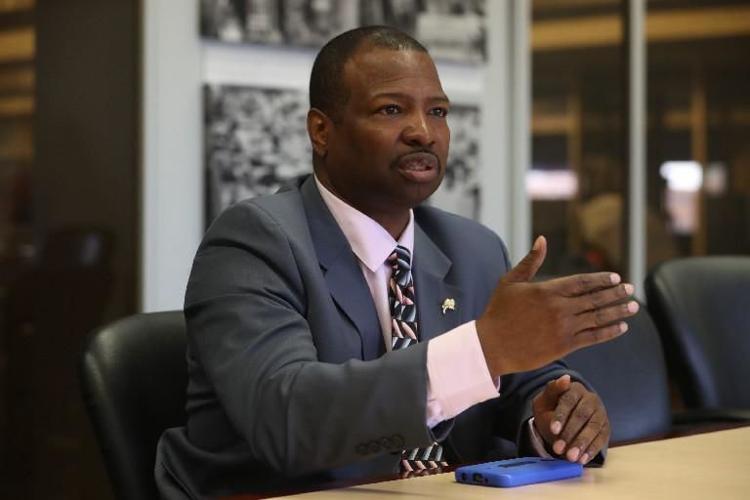
Three of them – South Council Member Christopher P. Scanlon, North Council Member Joseph Golombek Jr. and Masten Council Member Ulysees O. Wingo Sr. – actively support Brown. No one from the Council has endorsed Walton, at least not yet.
Read the full story from News Staff Reporter Robert J. McCarthy
They're either taking a wait-and-see approach, or they're not bothering to come out one way or the other because they don't see their preference making a difference to voters.
Council President Darius G. Pridgen's opinion would likely carry the most weight, beyond the Ellicott District he represents, given his decadelong tenure on the Council, years of experience as a community leader and organizer, and service as senior pastor of True Bethel Baptist Church.
People are also reading…
“At this point I have not endorsed a mayoral candidate,” he told The News.
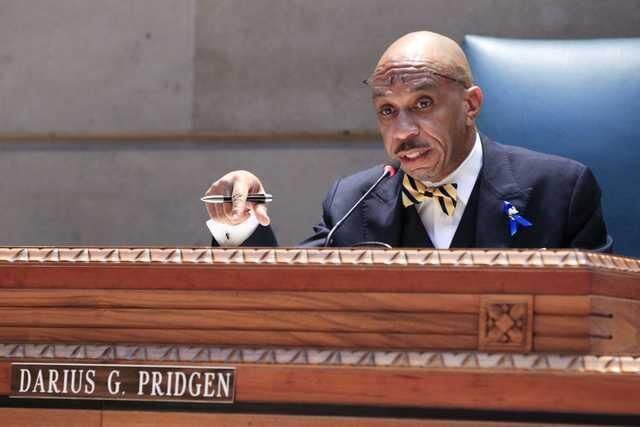
Buffalo Common Council President Darius G. Pridgen.
During his weekly show Friday on WUFO Radio, he explained his thinking.
People call him all the time asking who they should vote for, he said.
"I always tell them, don't go by just the hype of any campaign," he said. "You want to go by what is this person saying they're going to do that I want done in my city, and sometimes you got to dig past all the hype to get to the real facts."
He didn't say if either candidate has his vote yet.
Scanlon is squarely behind Brown, who is waging a write-in campaign to win another term.
“Myself and the vast majority of South Buffalo are behind the mayor,” Scanlon said. “We’re 100% behind him in the election, and I think we’ll get it done.”
Scanlon was among dozens of the mayor's backers who attended a rally at Sahlen Field just after Brown's primary loss. Scanlon also co-sponsored a recent fundraiser for the mayor with the Buffalo Police Benevolent Association at an Outer Harbor restaurant, raising $50,000.
Golombek said he doesn’t see any reason “to change captains at this stage.”
Walton remains nonplussed by the city lawmakers' positions in the race, or more accurately, lack of any from most of them.
Walton campaign spokesman Jesse Myerson said whether or not an elected official endorses her campaign, it will not make a difference "because when she is mayor, she will work with all of our elected officials equally without regard to their political decision in this campaign."
"She's eager to work with all our elected officials, including those who endorsed Mayor Brown, to come together and build a safe and healthy Buffalo," Myerson said.
Walton is "getting more and more support every day from labor unions, community organization and officials," Myerson said. "And we anticipate as the campaign heats up over the course of the fall, more and more elected officials will understand the importance of taking a public stand with the Democratic nominee for mayor."
'Stand back and see'
Niagara Council Member David A. Rivera, a vice chairman of the county Democratic Committee, said he does not know if he will commit to one mayoral candidate before the election.
"I’m going to stand back and see how things go," he said. "It’s a big decision.”
Walton, a West Side resident, lives in Rivera’s district.

“It is with incredible excitement that I lend my support to such a dynamic and engaging leader," Rivera said.
Rivera’s son, Assemblyman Jonathan D. Rivera, endorsed Walton at a press conference last month.
David Rivera, who serves as majority leader on the Council, said he is not sure endorsements affect the outcome of races.
“Endorsements help candidates raise money, but endorsements don’t translate into victories,” he said.
He endorsed Brown in the primary, and Walton won in his Council district overwhelmingly by 45 percentage points over Brown in the June primary.
He recalled the first time he was elected to the Council in 2007, beating out his opponent, even though the opponent received endorsements from “almost all of the electeds” and The Buffalo News.
Fillmore Council Member Mitchell P. Nowakowski also declined to say whom he supports, saying he remains “focused on the needs of the Fillmore district.”
Delaware Council Member Joel P. Feroleto would only say, “I have not endorsed anyone at this point.”
Walton beat Brown by 28 percentage points in the Delaware District in the primary.
Lovejoy Council member Bryan J. Bollman did not respond to requests for comment.
'Not against anybody'
University Council Member Rasheed N.C. Wyatt has clashed with the mayor, particularly over speed cameras in school zones in the city. He did not endorse Brown in the primary.
Wyatt joined Walton for a press conference the day before Buffalo Public Schools opened to mark the replacement of the cameras with radar speed signs.
But Wyatt hasn’t committed to any candidate, citing his proposal to look into a city manager form of government to replace the mayor's office.
Any attempt to eliminate the mayor's office would have to come via a citywide ballot referendum, all but impossible to get on the ballot by November.
Wyatt said he hopes to have a representative from the International City/County Management Association speak at a public meeting next month, but not too close to the November election.

University Council Member Rasheed N.C. Wyatt.
The impetus for discussing a city manager model for Buffalo is not an indictment of Brown or Walton, he said. It is an indictment of the current system of governance, which has led to "disinvestment" in poorer neighborhoods, he said.
“I know that people have been saying, ‘Oh, he’s against India.’ I’m not against anybody," he said. "But I want what’s best for our city.
“I just think that a city manager can assist in making sure that investment throughout the city is evenly done in the most efficient and effective way … so that’s why right now I’m not all into endorsing anyone,” he added.
The good and bad of ambiguity
Jacob Neiheisel, a University at Buffalo political science professor, says ambiguity may be helpful for elected officials.
But it can have a negative effect on their constituents.
“They have to work with whomever wins, and if they’re on the record as being against one or the other ... that could make for some perhaps uncomfortable conversations moving forward," Neiheisel said. "I think that’s in the immediate sense one reason why they in particular might be ambiguous.”
Research shows the electorate has a “remarkable ability” to read their own preferences into those of their elected officials, he said.
If there’s nothing to disabuse voters of the notion that their elected representatives are not in “lockstep” with their constituency, many people simply assume their elected representatives think the way they do, he said.
“The ambiguity – not taking a position – allows people to make up their own minds, and in most people’s minds they think for whatever reason that the elected official agrees with them,” he said.
Still, ambiguity is not a strategy without cost, Neiheisel added.
Some voters take ambiguity as a negative. They are “high information voters” who seek out who their elected representatives are endorsing, and then when they do not find endorsements, they might react negatively, he said.
'We are coming'
None of the Council members publicly pointed to Walton's aggressive tone following her primary victory as the reason why they have not formally supported her.
"This victory is ours, and it’s the first of many," Walton said soon after her primary win. "If you are in an elected office right now, you are being put on notice. We are coming.”
She said she would support "the next generation of progressive candidates that are going to come into leadership."
“The exciting thing to me is that we have built the infrastructure with this campaign to be able to run School Board members, to be able to run Common Council seats, to really get progressive, forward-thinking people into these seats," she told The Buffalo News at the time.
City lawmakers have said they did not feel threatened by her comments.
But her comments did not go over well with Golombek, a Brown supporter.

Common Council member Joseph Golombek Jr., shown here in 2014.
"If I had won an election, and I had absolutely no experience in government, I would be reaching out to work with people rather than attacking people right off the get-go," Golombek said shortly after her comments. "I don't think it bodes well should she win the November election that there's going to be a working relationship with her. She seems like a bully."