Martin Luther King Jr. spoke in Tucson on Sept. 20, 1959, and on this anniversary of the speech, UA basketball legend Ernie McCray is remembering what it meant to him.
McCray, a 6-foot-6 record-breaking center for the Arizona Wildcats, was in his senior year at the time.
“My mother used to take me to the Sunday Evening Forum beginning in my childhood, as she wanted to expose me to the variety of ideas that came out of the minds of great people," McCray, now 88, remembers. His mother, Mary, had graduated from Howard University in Washington, D.C. before moving to Tucson.
The Sunday Evening Forum, the speaker series back then at the University of Arizona, brought many prominent national leaders to Tucson, including Eleanor Roosevelt, John F. Kennedy when he was a senator, and King, the civil rights icon.
People are also reading…

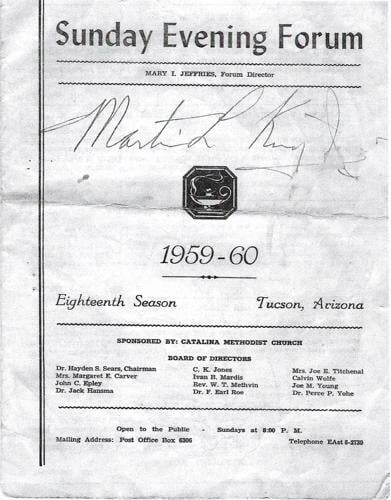
Martin Luther King Jr.'s autograph on a 1959-60 Sunday Evening Forum program.
“I went to hear Dr. Martin Luther King Jr. — whom I refer to as 'Martin' because that makes him more human to me —with my mother," McCray said in a recent email. "I was 21 years old."
“I remember the evening well, hearing a man who was my hero speak, and then getting to shake his hand and exchanging in a very brief conversation.

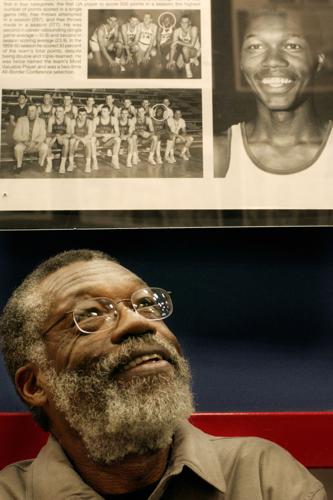
Ernie McCray holds the UA record for points in a game (46). He was photographed here, in 2004, with his portrait and bio that hangs in McKale Center.
"It was most memorable to me because in his talk about making a better world for all people, I found validation for things I was doing in my life, which included being active regarding civil and human rights, having taken a stand in Tucson against the city’s Jim Crow policies."
King's speech in Tucson, delivered in the auditorium now called Centennial Hall, was titled “A Great Time To Be Alive” — a fitting theme as he was speaking on the one-year anniversary of an attempted assassination of King in Harlem.

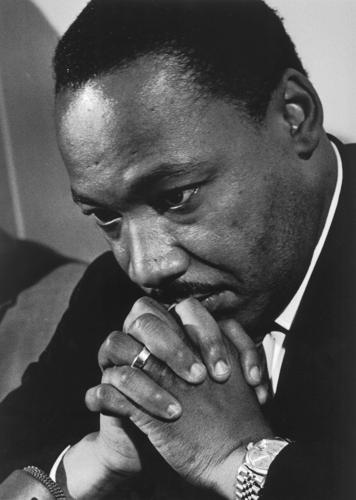
The Rev. Martin Luther King Jr. in a 1968 photo.
King spoke to the ideals of using nonviolent methods in creating social change. He put into words his belief that one must not use force in this struggle “but match the violence of his opponents with his suffering," the Star previously reported.
He warned that the U.S. faced a difficult challenge to achieve racial integration but predicted that within five years much of the mass resistance of the time would be gone and that within 15 years most legal restrictions would be taken away in the states. He emphasized to the crowd that the final period would arrive with integration, “our ultimate aim.”
“Segregation is a festering sore, a cancer,” he told the UA crowd. “It stifles the soul of the nation. We are not looking for an advantage, which would keep the same old problem — black supremacy would be as bad as white supremacy — but we seek equality of all races ... because such equality is right.”
McCray, hearing all of this from the audience, well knew the indignities and injustices of segregation.
As Mike Powell wrote in an article about McCray on the UA Alumni website this summer, "On the court he was a star; after the game, he was just another Black man in segregated America, practically having to press his mouth to the metal on 'colored' water fountains because the pressure was so weak, barred from restaurants downtown no matter how many points he scored."
McCray was both an All-City and All-State basketball star while playing for Tucson High School from 1953-'56, and went on to lead the Wildcats and to be Border Conference Most Valuable Player. He has been inducted into both the UA Ring of Honor and the Pima County Sports Hall of Fame. He was the first Black basketball player to graduate from the UA, where he received degrees in physical education and elementary education, and worked with a group on campus called Students for Equality.

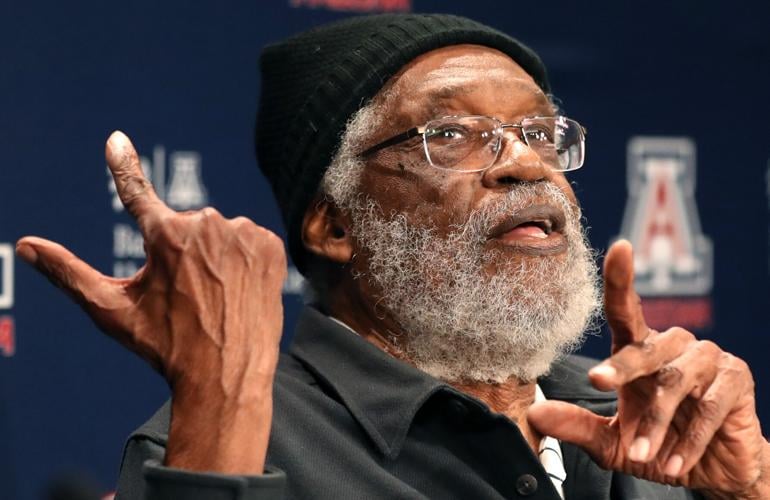
Arizona basketball great Ernie McCray.
The Tucson native was drafted by the Cincinnati Royals of the NBA after UA but did not play professionally, as he became a teacher, a principal and a poet.
During his career, the Tucson High Badger Foundation wrote on its website that McCray "affects real lives by multiplying his talents through the children he teaches in the 'inner city' of San Diego," where he also served on the San Diego Youth Services Board of Directors and the Juvenile Justice Commission. He retired in 1999 after 40 years as an educator, 38 of them in San Diego.
McCray remembers, “Martin’s appearance in my town" back in 1959 "ensured that I would stand for what’s fair and just all my life as I’ve taken on many matters regarding freedom and justice for all."
“I remember him seeming to be larger than life, as he spoke in the crisp silver tones for which he was known, about how we, as citizens in America, need to constantly work towards fulfilling the country’s promise of all of us being equal.
“And if I’m remembering right, he spoke directly about Tucson, specifically, needing to clean up its act when it came to segregation, to people being separated because of their race, and how he faced discrimination during his visit to Arizona — which made me more determined to always work to make our country as good as it can be in human relations.
"Simply put this great man is well imbedded in my very being, tucked away in my soul.”
And when Ernie McCray's mother, Mary McCray, died in 1974, it was on Jan. 15 — "Brother Martin's birthday," he noted in a 2024 Facebook post.
David Leighton, historian and author, has received a Tucson-Pima County Historical Commission Preservation Award and the Arizona Historical Society’s Al Merito Award. Contact him at azjournalist21@gmail.com