A small space telescope with the eyes of a giant will spend the next year studying the planets around distant stars, and the University of Arizona will serve as mission control.

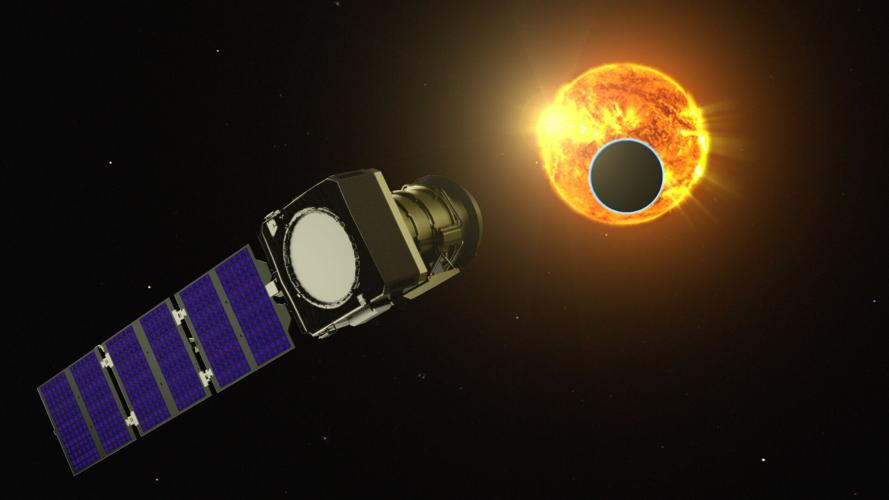
An artist's rendering shows the robotic Pandora space telescope observing a star and its transiting exoplanet.
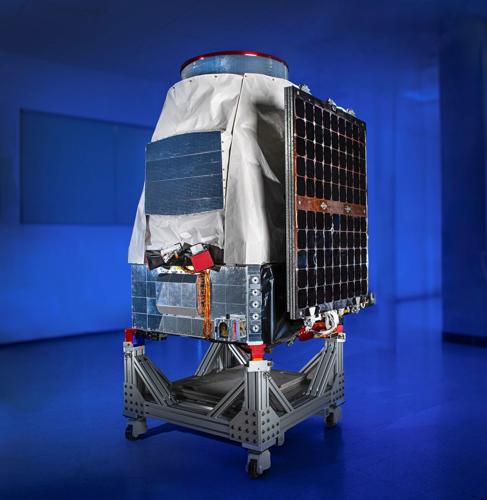
The refrigerator-sized Pandora spacecraft was built to perform long-duration observations of at least 20 handpicked exoplanets and their host stars, using a suite of instruments that includes a spare detector originally made for the powerful, U of A-designed Near-InfraRed Camera on the James Webb Space Telescope.
The robotic probe was carried into orbit on Jan. 11 by a SpaceX Falcon 9 rocket that blasted off from Vandenberg Space Force Base in California before dawn. Pandora was successfully deployed about 2½ hours later, along with several dozen other small cube satellites.
People are also reading…

The Pandora spacecraft as it looked on May 19, 2025, following assembly and testing at Blue Canyon Technologies in Colorado.
On Friday, control of the spacecraft was slated to be handed off to the U of A's Multi-Mission Operations Center, inside the Applied Research Building on Highland Avenue north of Speedway. There, technicians will operate Pandora in real time and monitor its telemetry and overall health under a contract with NASA.
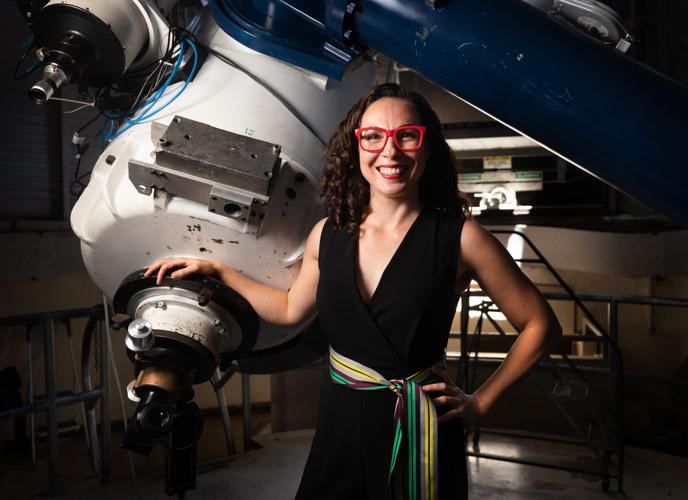
"This is the first time an orbiting astrophysics mission is operating from our new Mission Operations Center at the university," said astrophysicist and professor Erika Hamden, who leads the Arizona Space Institute that oversees the ops center. “We hope this represents just the first of many transformational NASA missions that ASI will operate out of the Applied Research Building."
Pandora is a joint mission by NASA’s Goddard Space Flight Center in Maryland and Lawrence Livermore National Laboratory in California. It is the first space telescope built specifically for detailed multi-color observations of starlight filtered through the atmospheres of exoplanets.

University of Arizona astrophysicist Erika Hamden is director of the Arizona Space Institute.
Since the discovery of the first planets outside of our solar system in 1992, more than 6,000 have been identified.
Exoplanets are generally too distant and too dim to be observed directly, so scientists use indirect means to find them, including the measurement of tiny dips in the brightness of host stars as the planets pass by. These so-called transits also offer the chance to study conditions on these planets by analyzing the starlight filtering through their atmospheres for signs of oxygen, water or other telltale chemicals.
But for this technique to work, scientists have to be able to tease out background interference caused by the chaotic conditions on the surface of the host star.
"Pandora is the first mission really designed to study the stars and their planets together," said U of A professor Daniel Apai, the university’s lead for Pandora and its exoplanet science team. "We will have a much better ability to separate the contribution from the star from that of the planet."
The spacecraft will undergo about a month of commissioning before beginning science operations, which are scheduled to last for a year.

University of Arizona astronomy and planetary sciences professor Daniel Apai is the U of A's lead for the Pandora mission and its exoplanet science team.
The Pandora team plans to train the telescope on each target planet and its star for 24 hours at a time and 10 times each over the course of the mission. What they learn about the planets, their atmospheres and how to filter out what Apai called the “stellar noise” from that data will be used to inform future exoplanet missions and interpret previous observations by Webb and other space telescopes.
"From combining Pandora's observations with data from James Webb, we will better understand the atmospheres of those exoplanets," he said. "At this point, our goal is not to assess these planets for life, but to probe their atmospheres for any water vapor and, importantly, understand their host stars."
Pandora was selected as part of NASA's Astrophysics Pioneers program, which was created in 2020 to foster compelling, relatively low-cost science missions using smaller, cheaper hardware and flight platforms with a price cap of no more than $20 million. By comparison, the Webb telescope — the largest and most powerful astronomical observatory ever sent into space — carries a pricetag of about $10 billion.
Pandora joins a growing list of spacecraft operated from the U of A campus, most notable among them the OSIRIS-REx asteroid sampling probe and the Phoenix Mars Lander, the first NASA mission to the red planet to be led by a public university.
Apai, who has been working on Pandora for the past seven years, traveled to Vandenberg to witness last Sunday's early morning launch in person. He chronicled the experience in a blog post the next day, in which he described the horizon lighting up with the blinding flare of the rocket, followed seconds later by the rumbling wave of sound from its powerful engines.

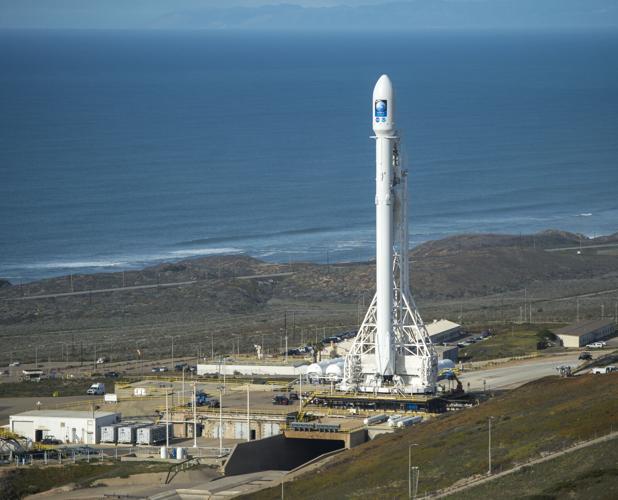
A small space telescope was carried into orbit on Jan. 11 by a SpaceX Falcon 9 rocket that blasted off from Vandenberg Space Force Base in California, shown here in a file photo before a previous blastoff.
The SpaceX Falcon 9 rocket at Vandenberg Air Force Base Space Launch Complex in California, in a 2016 photo.
Apai and his fellow team members then got to watch from Vandenberg mission control as a camera mounted to the SpaceX launch vehicle beamed back live video of their space probe’s release into orbit.
Here’s what Apai wrote about the moment in “Distant Earths,” his blog on exoplanet exploration and astrobiology: “One of the last satellites to deploy, almost alone in the fairing. Behind it, the southern coast of Africa. We hear the confirmation ‘Pandora deployed’ before we see it move. A second later, Pandora is free and gently drifts into space. Our last close-in view. The room erupts again, cheers in the room, relieved smiles, laughter. Tears.”