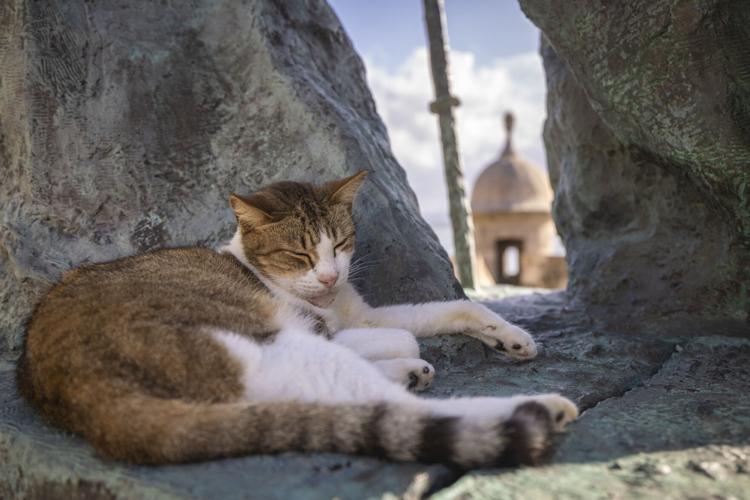
SAN JUAN, Puerto Rico — Hundreds of stray cats that roam a historic seaside tourist area of Puerto Rico’s capital where they are considered both a delight and a nuisance will be removed over the coming year, under a plan unveiled by the U.S. National Park Service.
The agency said Tuesday that it will contract an animal welfare organization to remove the 200 cats estimated to live on 75 acres surrounding a fortress at the San Juan National Historic Site that the federal agency operates in Old San Juan. If the organization fails to remove the cats within six months, the park service said it would hire a removal agency.

A stray cat sits on a wall Nov. 2, 2022, in Old San Juan, Puerto Rico. The famous felines that roam the historic area and attract hordes of tourists will be removed, the U.S. National Park Service disclosed Tuesday.
Cat lovers responded to the plan with dismay, but the agency noted that the felines can transmit illnesses to humans. “All visitors will benefit from the removal of a potential disease vector from the park,” the park service plan stated.
People are also reading…
The six-month timetable to remove the cats is unrealistic, said Ana María Salicrup, secretary of the board of directors for the nonprofit group Save a Gato, which currently helps care for the cats and which hopes to be chosen to implement the plan.
“Anyone who has worked with cats knows that is impossible,” Salicrup said. “They are setting us up for failure.”
Cats of all sizes, colors and temperaments meander the seaside trails that surround a 16th-century fortress known as “El Morro” overlooking an expanse of deep turquoise waters in the northwestern point of the San Juan capital.

A stray cat rest on a statue Nov. 2, 2022, in Old San Juan, Puerto Rico.
Some are believed to be descendants of colonial-era cats, while others were brought to the capital by legendary San Juan Mayor Felisa Rincón de Gautier to kill rats in the mid-20th century. Since then, they have multiplied into the hundreds to the enchantment of some residents and tourists, and the disgust of others.
Visitors can be seen snapping pictures of cats daily as residents and volunteers with Save a Gato tend to them. The group feeds, spays and neuters cats, and places them into adoption.
About two years ago, federal officials said the cat population had grown too much and that the “encounters between visitors and cats and the smell of urine and feces are … inconsistent with the cultural landscape.”
Last year, the U.S. National Park Service held a hearing as part of a plan it said would improve the safety of visitors and employees and protect cultural and natural resources. It offered two options: remove the cats or keep the status quo.
Those who attended overwhelmingly rejected the first option, with one man describing the cats as “one of the wonders of Old San Juan.” The cats even have their own statue in the historic area where they roam.

Residents attend a public hearing Nov. 2, 2022, to create a plan to manage the colony of cats on the Paseo El Morro pathway in Old San Juan, Puerto Rico.
“These cats are unique to San Juan,” Danna Wakefield, a solar contractor who moved to Puerto Rico in 2020, said. She visits the cats weekly. “Me and many other people love that walk because of the cats. Otherwise, it would be a very boring walk.”
She has three favorite cats, including a black one with golden eyes that she nicknamed “Cross.”
“He won’t have anything to do with anybody,” Wakefield said with a laugh.
The U.S. Park Service plan unveiled Tuesday calls for current cat feeding stations to be removed unless they’re being used temporarily to help trap the felines. It noted that unauthorized feeding of the cats is prohibited, that it attracts rats and encourages people seeking to abandon their cats to do so in that area, knowing they’ll be fed.
The agency plan says the animal welfare organization that's selected will be tasked with deciding whether the trapped cats will be adopted, placed in a foster home, kept in a shelter or face other options.
Salicrup said it's difficult to find homes for so many cats, and that Save a Gato has reached out to many sanctuaries in the U.S. mainland. “The response always is, ‘You cannot bring 100 cats here,’” she said.
The National Park Service noted that the six-month deadline to trap cats could be extended if it sees substantial progress. If not, the agency would terminate the current plan and hire a removal agency.
See the iconic cats of Old San Juan, where famous felines keep watch

Cat advocates of the group "Save a Gato" participate in a mass at the seaside walkway of the Old San Juan, Puerto Rico, July 21, 2004. The cats of Old San Juan have long been icons of this tourist town, but the feral cats are in danger of becoming another faded memory after the U.S. National Park Service is planning to trap and send an estimated 200 of them to animal shelters.

Stray cats browse for food given to them by women from the local charity "Save A Gato," along a rocky shore in Old San Juan, Puerto Rico, June 19, 2008. Some say the cats are a tourist draw in the colonial district, just like the narrow cobblestone streets and fortresses overlooking the ocean. But many, including the Puerto Rican government, say the felines have become an unsightly nuisance, a health hazard and a blemish on the area's charm.

Stray cats browse for food given to them by women from the local charity "Save A Gato," along a rocky shore in Old San Juan, Puerto Rico, June 19, 2008. Hundreds of stray cats that roam a historic seaside tourist area will be removed over the coming year, under a plan unveiled by the U.S. National Park Service.

Stray cats browse for food given to them by women from the local charity "Save A Gato," along a rocky shore in Old San Juan, Puerto Rico, June 19, 2008.

A stray cat rest on a statue in Old San Juan, Puerto Rico, Wednesday, Nov. 2, 2022. Cats have long walked through the cobblestone streets of Puerto Rico's historic district, stopping for the occasional pat on the head as delighted tourists and residents snap pictures and feed them, but officials say their population has grown so much that the U.S. National Park Service is seeking to implement a “free-ranging cat management plan” that considers options including removing the animals. Last year, the U.S. National Park Service held a hearing as part of a plan it said would improve the safety of visitors and employees and protect cultural and natural resources.

Stray cats rest on a statue in Old San Juan, Puerto Rico, Nov. 2, 2022. Cats have long walked through the cobblestone streets of Puerto Rico's historic district, stopping for the occasional pat on the head as delighted tourists and residents snap pictures and feed them, but officials say their population has grown so much that the U.S. National Park Service is seeking to implement a “free-ranging cat management plan” that considers options including removing the animals.

Stray cat rest under a tree in Old San Juan, Puerto Rico, Nov. 2, 2022. Cats roam the seaside paths surrounding a historic fort known as "El Morro" that guarded San Juan Bay in the colonial era.

A statue of a cat stands in Old San Juan, Puerto Rico, Nov. 3, 2022. Cats have long strolled through the cobblestone streets of the historic district and are so beloved they even have their own statue in Old San Juan.

A stray cat walks next to a tourist in Old San Juan, Puerto Rico, Nov. 2, 2022. Officials say that the cat population has grown so much that the U.S. National Park Service is seeking to a "free-ranging cat management plan" that considers options including removal of the animals, outraging many who worry they will be killed.

Stray cats rest under a tree in Old San Juan, Puerto Rico, Nov. 2, 2022.

Stray cats rest under a tree in Old San Juan, Puerto Rico, Nov. 2, 2022.

A stray cat sits next to tourists in Old San Juan, Puerto Rico, Nov. 2, 2022. Cats roam the seaside paths surrounding a historic fort known as "El Morro" that guarded San Juan Bay in the colonial era.

A stray cat rests in Paseo del Morro in Old San Juan, Puerto Rico, Nov. 2, 2022. Cats have long walked through the cobblestone streets of Puerto Rico's historic district, stopping for the occasional pat on the head as delighted tourists and residents snap pictures and feed them, but officials say their population has grown so much that the U.S. National Park Service is seeking to implement a “free-ranging cat management plan” that considers options including removing the animals.

Stray cats eat in Old San Juan, Puerto Rico, Nov. 2, 2022.

Stray cats mill around a parking lot as a person returns from work to pick up his car in Old San Juan, Puerto Rico, Nov. 2, 2022.

A sign alerts drivers to slow down because of cats in the area in Old San Juan, Puerto Rico, Nov. 2, 2022.

A stray cat sits near a couple taking photos in Old San Juan, Puerto Rico, Nov. 2, 2022.

Residents and the general public attend a public hearing to create a plan to manage the colony of cats on the Paseo El Morro pathway by the The U.S. National Park Service in Old San Juan, Puerto Rico, Nov. 2, 2022.

Chairs in the figure of cats sit in Old San Juan, Puerto Rico, Nov. 3, 2022. Cats have long strolled through the cobblestone streets of the historic district and are so beloved they even have their own statues in Old San Juan.

Cats eat the food that cat advocates brought them at the seaside promenade of Old San Juan, Puerto Rico, July 21, 2004. The cats of Old San Juan have long been icons of this tourist town, but the feral cats are in danger of becoming another faded memory after the U.S. National Park Service is planning to trap and send an estimated 200 of them to animal shelters.

A cat advocate feeds cats at the seaside walkway of the Old San Juan, Puerto Rico, July 21, 2004.

Cats rest while tourists take a walk at the seaside promenade of the Old San Juan, Puerto Rico, July 21, 2004.