NEW YORK — Almost two decades ago, legendary labor rights activist Dolores Huerta joined Mónica Ramírez at a Chicago event to promote the Bandana Project, a campaign Ramírez had launched to raise awareness about sexual violence against women farmworkers.
Huerta spoke there about the need to educate women farmworkers about their rights and empower them to speak out about sexual exploitation that is both widespread and underreported among agricultural field workers. Little did anyone know at the time that Huerta herself had been sexually abused at the hands of César Chavez, who in 1962 co-founded with Huerta the organization now known as the United Farm Workers.

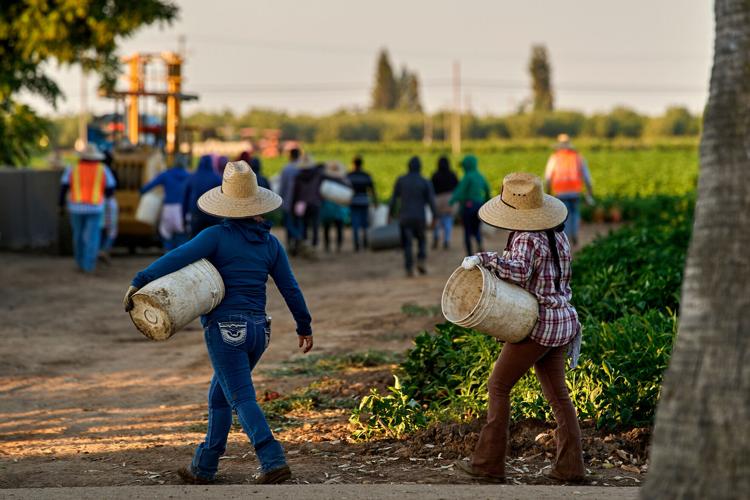
Migrant farmworkers head to pick crops on an early morning July 18 in Fresno, Calif.
The allegations against Chavez by Huerta and other women and girls show that the culture of fear and intimidation that enables sexual abuse in agricultural fields had also for many years existed within top ranks of the male-dominated labor movement that fought for farmworker rights.
People are also reading…
At the same time, advocates like Ramírez say the decision by Huerta and other women to speak out — first revealing their allegations to the New York Times — is a sign that things have changed since Chavez's time. Since Chavez died in 1993, the network of grassroots organizations led by women farmworkers has grown, pushing for federal and state investigations into sexual abuse on farms and laws mandating sexual harassment training, as well as securing commitments from growers and produce buyers to adopt policies for women, among other gains.
To Ramírez, Chavez's alleged abuse feels like a betrayal because she and other advocates admired him and credited him with inspiring the movement that galvanized their own organizing efforts. But his shattered legacy does not erase the gains women farmworkers and advocates have made on their own.

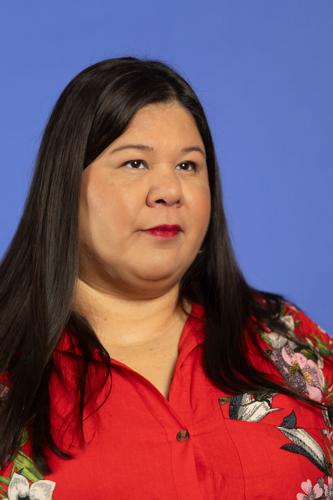
Mónica Ramírez
"It feels a little bit bewildering because so many of us have grown up looking up to César Chavez," said Ramírez, founder and president of the advocacy group Justice for Migrant Women and whose own parents were migrant farmworkers in Ohio. "But we have to remind each other that this is a long-standing movement that is made of many, many people, including women leaders."
Some 25% of the country's more than 1 million hired farm workers are women, according to government figures, although estimates on the population of agricultural workers vary. The prevalence of sexual harassment and abuse is difficult to quantify because it often goes unreported, but in field surveys conducted by groups Human Rights Watch, the Southern Poverty Law Center and the University of California-Santa Cruz, some 80% or more of women crop workers have reported some form of sexual harassment.
A watershed moment in building awareness came in 1999 when the U.S. Equal Employment Opportunity Commission won a $1.85 million settlement against a major U.S. lettuce grower on behalf a California worker who was subjected to sexual advances by her managers and fired when she complained.
Since then, the EEOC has secured millions more in compensation from farmworkers who have reported sexual harassment or abuse.

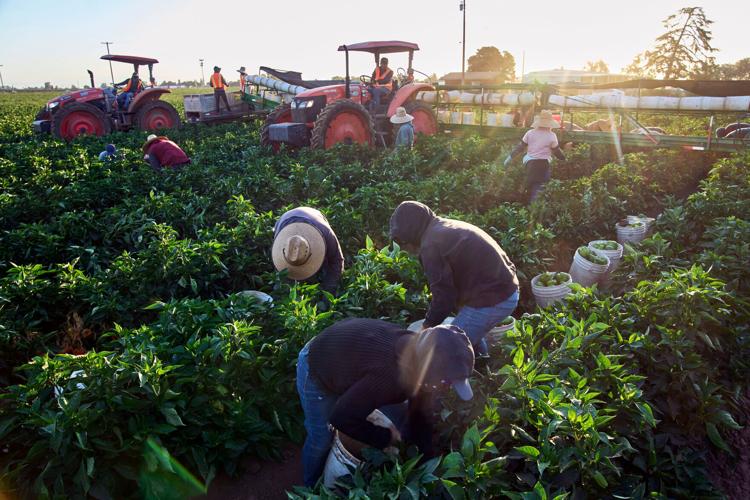
Migrant farmworkers pick a vegetable crop July 18 in Fresno, Calif.
It's hard to say how much sexual violence against women farmworkers has eased as a result of government enforcement and growing outreach and educational efforts. Fear, isolation in the fields, language barriers, and immigration status continue to make farmworkers particularly vulnerable to exploitation. More than 40% of agricultural workers had no work authorization between 2020 and 2022, according to government estimates, and many are in the country on H2-A visas that are tied to their employment, increasing their fear of dismissal and deportation if they speak out.
Darlene Tenes, executive director of Farmworker Caravan, an advocacy group in California, said that during meetings, majorities of women still report being victims of sexual abuse, and that the Trump administration's immigration crackdown has forced them to cancel education conferences and try to visit communities directly to quietly provide resources.
Still, in regions where the most robust legal protections and protective programs have been put into place, women farmworkers say things have started to improve.
Nely Rodriguez worked the fields decades ago but she didn't fully understand her rights until she joined the Florida-based Coalition of Immokalee Workers, which runs the Fair Food Program, a partnership with major produce buyers that pledge to source food from growers who have entered into a legally binding agreement to abide by a code of conduct. That includes sexual harassment training and a system for investigating complaints and holding perpetrators accountable.

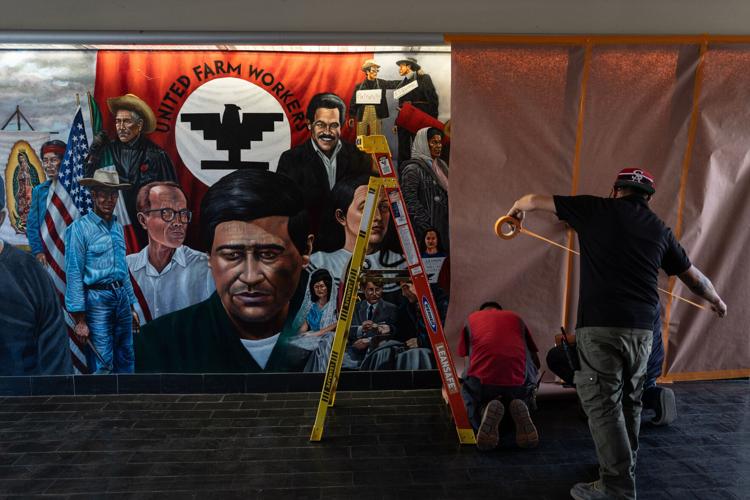
Workers cover a mural by Emigdio Vasquez featuring Cesar Chavez and other figures March 19 at Santa Ana College in Santa Ana, Calif.
For many women advocates, the biggest difference has been breaking the taboo in farm worker communities about speaking about sexual abuse.
In her statement saying that Chavez raped her in the 1960s, Huerta, now 96, said she kept her secret for so long because she feared that "exposing the truth would hurt the farmworker movement," but today, she understands she is a "survivor — of violence, of sexual abuse, of domineering men who saw me, and other women, as property, or things to control."
Patricia Campos-Medina, executive director of the Worker Institute at Cornell University, said the allegations against Chavez are a reminder that the labor movement "is not immune" to abuses of power, and for her, it was especially painful that Huerta "had to keep that secret for that long so that she could keep her respectability within the movement."
"You cannot expect the victim to be the one that holds the person accountable, because it takes a lot of personal courage," Campos-Medina said. "I can imagine when she was trying to co-create this union with him, how much it would have cost her to speak up."