TAIPEI, Taiwan — Using military threats, diplomatic pressure, fake news and financial inducements for politicians, China is being accused of deploying a broad strategy to influence voters in Taiwan’s elections to pick candidates who favor unification.
China’s ultimate goal is to take control of the self-governing island democracy, whose high-tech economy supplies key components for computers, cellphones and other electronic devices and ships much of the world’s goods out from the Taiwan Strait. Beijing has long insisted Taiwan is part of China and must be regained, by military force if necessary, regardless of the views of the island’s people.

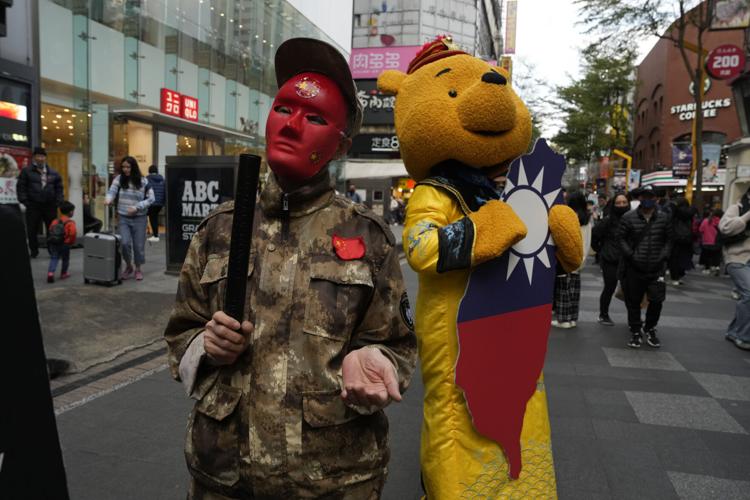
Protesters against the Chinese Communist Party dress up Sunday to depict an authoritarian China and Chinese President Xi Jinping during a rally in Taipei, Taiwan. China is accused trying to influence voters in Taiwan’s elections to pick candidates who favor unification.
Taiwanese Foreign Minister Joseph Wu says China’s “global objective is that they want to use Taiwan as a test ground. If they are able to successfully shape the results of the Taiwan elections, they will try to apply their tactics on other countries.”
People are also reading…
China has been sending warships and fighter jets near Taiwan on a near-daily basis in recent years, hoping to intimidate the island’s 23 million people and wear down its military, which relies heavily on support from the United States. China has described Saturday’s elections as a choice between war and peace.
While the numbers of such missions have dropped off slightly in recent days, Taiwan has reported a number of suspicious balloons traveling over the island from China. The Defense Ministry also sent out an air raid alert via cellphones about a Chinese rocket launch Tuesday that it later amended to describe as the placement of a satellite into space but on an “abnormal trajectory.” It said the alert was justified by the potential threat to civilians on the ground in Taiwan.
Previous efforts to intimidate Taiwanese voters with missile launches and direct threats were largely seen as backfiring after the election of China critics in 1996 and 2000.

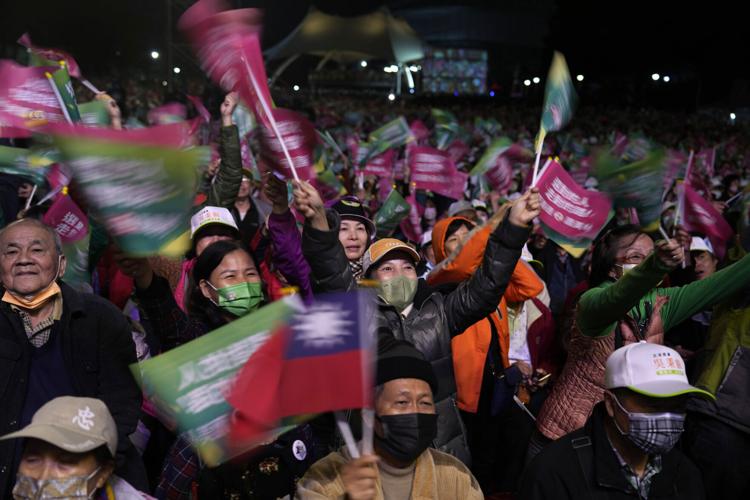
Supporters cheer for the Democratic Progressive Party during an elections rally Saturday in New Taipei City, Taiwan.
China has also restricted imports from Taiwan and invited local leaders on all-expenses-paid visits aimed at persuading them to press colleagues to support pro-China candidates in the elections for the island’s president and 113-member legislature. Cases have been opened against dozens of ward officials for accepting such gifts in violation of Taiwanese law.
China in general refuses to acknowledge the legitimacy of Taiwan’s political institutions in keeping with the Communist Party’s insistence that the democracy does not exit.
In line with that policy, China has not commented on Taiwan’s upcoming elections. However, the head of the Chinese Cabinet’s Taiwan Affairs office, Song Tao, said on Jan. 2 that China would continue to “unswervingly oppose” Taiwan’s independence while also working to “safeguard peace, expand exchanges, enhance cooperation, deepen integration and advance reunification to ensure that cross-Strait relations move in the right direction of peaceful development,” according to the official Xinhua News Agency.

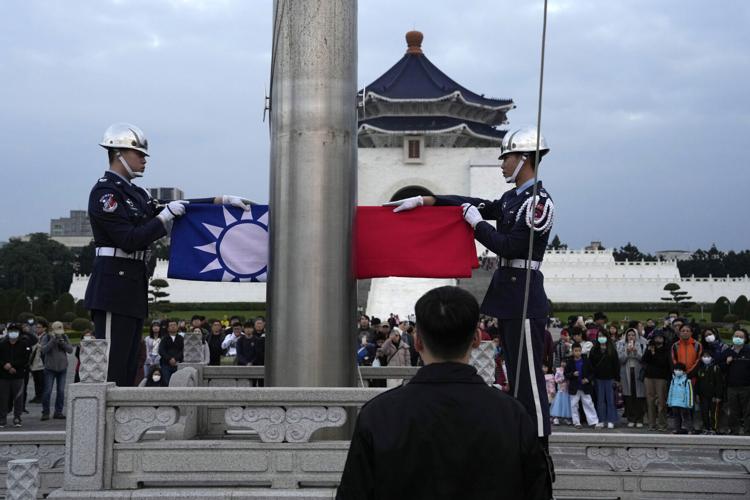
Members of an honour guard lower the national flag during the daily flag ceremony Sunday on Liberty Square near the Chiang Kai-shek Memorial Hall in Taipei, Taiwan. China’s ultimate goal is to take control of the self-governing island democracy.
Surveys show most Taiwanese embrace their current de facto independence — including compulsory military service for all men, the ability to travel worldwide on Taiwanese passports, and the right to choose their leaders in democratic elections at all levels.
While the race remains tight, support is strong for the ruling Democratic Progressive Party, even though China has refused to engage with the government since President Tsai Ing-wen was elected in 2016. She is unable to run again due to term limits.
The DPP favors closer ties with the United States as a way to preserve Taiwan’s separate status and has refused to agree that Taiwan falls under the sovereignty of the People’s Republic of China, which has never exercised political control over the island or its outlying territories. The DPP’s presidential candidate, current Vice President William Lai, leads most pre-election surveys.
The main opposition Nationalist Party candidate, Hou Yu-ih, is appealing to voters who fear a military conflict with China that could draw in the U.S. and disrupt the global economy. Hou opposes Taiwanese independence and agrees with Beijing’s view that Taiwan is part of China, although under separate governments.
A third candidate, Ko Wen-je of the Taiwan People’s Party, has sought to straddle the differences by appealing to young voters turned off by the rivalry between the Nationalists, also known as the KMT, and the DPP.
However, Taiwanese elections are often decided on the basis of local issues such as housing, employment, education and healthcare that are separate from relations with China.
Taiwan, long a melting pot of Asian and European cultures, was a Japanese colony for 50 years until 1945, when it was handed over to Chiang Kai-shek’s Chinese Nationalist government at the end of World War II. The Nationalists relocated their government and military to the island in 1949 after the Communists under Mao Zedong took power on the mainland amid a civil war in which millions were killed and which has yet to be formally resolved.
China accuses the U.S. of encouraging Taiwan to raise tensions between the sides by supplying it with military weapons.
“Any attempt to use Taiwan to contain China is doomed to failure,” Chinese Defense Ministry spokesperson Col. Wu Qian said at a briefing in Beijing last week. “Seeking independence by military force is a dead end.”
Popular videos from the past week you may have missed
Deputies in Florida rescued a woman and her baby from a submerged car, scientists have captured rare footage of the oceanic whitetip shark, and more popular videos from the past week you may have missed.