CAPE CANAVERAL, Fla. — Asteroid samples fetched by NASA hold not only the pristine building blocks for life but also the salty remains of an ancient water world, scientists reported Wednesday.
The findings provide the strongest evidence yet that asteroids may have planted the seeds of life on Earth and that these ingredients were mingling with water almost right from the start.
"That's the kind of environment that could have been essential to the steps that lead from elements to life," said the Smithsonian Institution's Tim McCoy, one of the lead study authors.

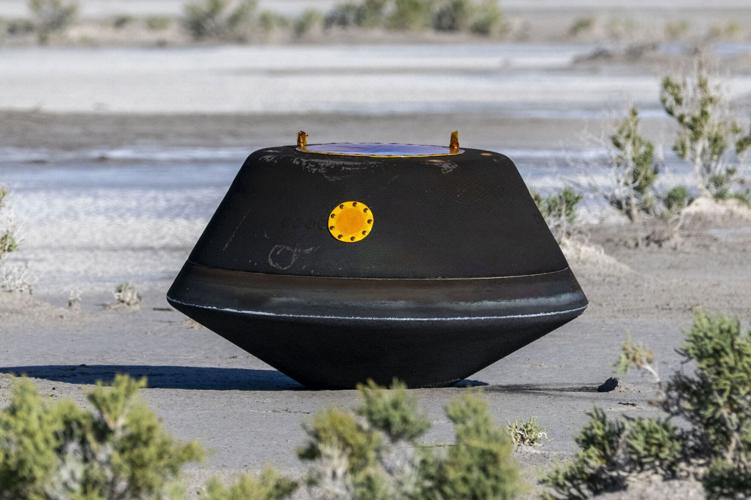
The sample return capsule from NASA's Osiris-Rex mission lies on the ground shortly after touching down in the desert Sept. 24, 2023, at the Department of Defense's Utah Test and Training Range.
NASA's Osiris-Rex spacecraft returned 4 ounces of dust and pebbles from the near-Earth asteroid Bennu, delivering the sample canister to the Utah desert in 2023 before swooping off after another space rock. It remains the biggest cosmic haul from beyond the moon. The two previous asteroid sample missions, by Japan, yielded considerably less material.
People are also reading…
Small amounts of Bennu's precious black grains — leftovers from the solar system's formation 4.5 billion years ago — were doled out to the two separate research teams whose studies appeared in the journals Nature and Nature Astronomy. It was more than enough to tease out the sodium-rich minerals and confirm the presence of amino acids, nitrogen in the form of ammonia and even parts of the genetic code.
Some, if not all, of the delicate salts found at Bennu — similar to what's in the dry lake beds of California's Mojave Desert and Africa's Sahara — would be stripped away if present in falling meteorites.

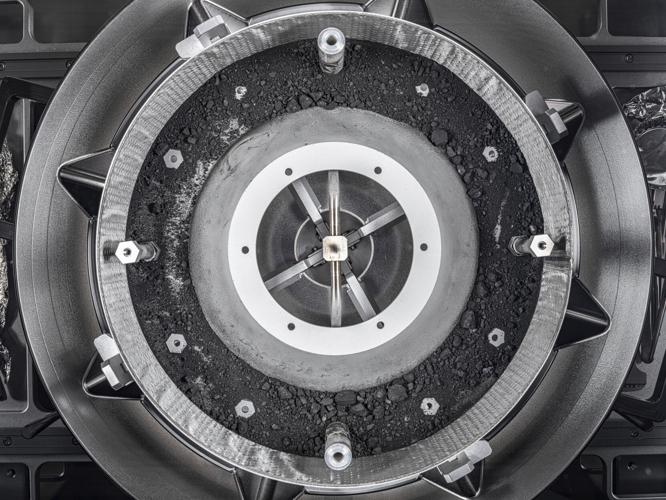
The remainder of the Bennu asteroid sample can be seen inside this top-down view of the Osiris-Rex spacecraft head with its lid removed.
"This discovery was only possible by analyzing samples that were collected directly from the asteroid, then carefully preserved back on Earth," the Institute of Science Tokyo's Yasuhito Sekine, who was not involved in the studies, said in an accompanying editorial.
Combining the ingredients of life with an environment of sodium-rich salt water, or brines, "that's really the pathway to life," said McCoy, the National Museum of Natural History's curator of meteorites. "These processes probably occurred much earlier and were much more widespread than we had thought before."
NASA's Daniel Glavin said one of the bigger surprises was the relatively high abundance of nitrogen, including ammonia. While all of the organic molecules found in the Bennu samples were identified before in meteorites, Glavin said the ones from Bennu are valid — "real extraterrestrial organic material formed in space and not a result of contamination from Earth."
Bennu — a rubble pile just one-third of a mile across — was originally part of a much larger asteroid that got clobbered by other space rocks. The latest results suggest this parent body had an extensive underground network of lakes or even oceans, and that the water evaporated away, leaving behind the salty clues.
Sixty labs around the world are analyzing bits of Bennu as part of initial studies, said the University of Arizona's Dante Lauretta, the mission's chief scientist who took part in both studies.

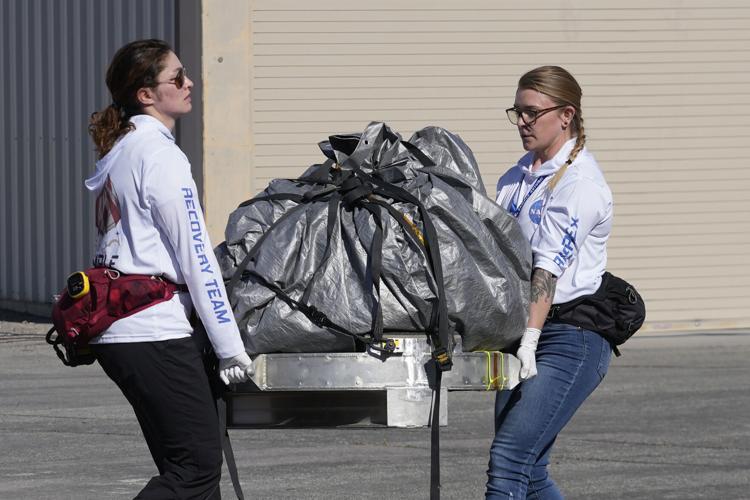
Recovery team members carry a capsule containing NASA's first asteroid samples to a temporary clean room at Dugway Proving Ground in Utah on Sept. 24, 2023.
Most of the $1 billion mission's cache was set aside for future analysis. Scientists stress more testing is needed to better understand the Bennu samples as well as more asteroid and comet sample returns. China plans to launch an asteroid sample return mission this year.
Many are pushing for a mission to collect rocks and dirt from the potentially waterlogged dwarf planet Ceres in the main asteroid belt. Jupiter's moon Europa and Saturn's moon Enceladus also beckon as enticing water worlds. Meanwhile, NASA has core samples awaiting pickup at Mars, but their delivery is on hold while the space agency studies the quickest and cheapest way to get them here.
"Are we alone?" McCoy said. "That's one of the questions we're trying to answer."
Photos: NASA releases Webb telescope images
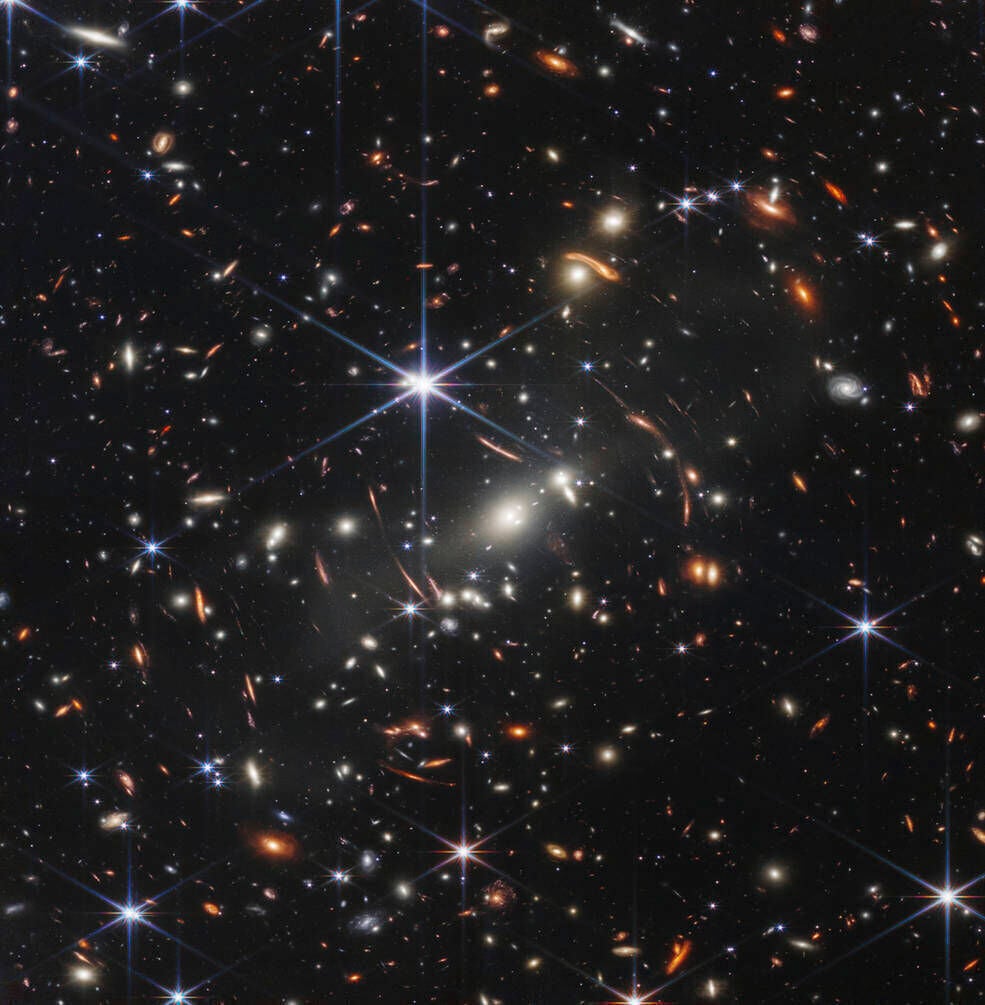
This image provided by NASA on Monday, July 11, 2022, shows galaxy cluster SMACS 0723, captured by the James Webb Space Telescope. The telescope is designed to peer back so far that scientists can get a glimpse of the dawn of the universe about 13.7 billion years ago and zoom in on closer cosmic objects, even our own solar system, with sharper focus.

This combo of images provided by NASA on Tuesday, July 12, 2022, shows a side-by-side comparison of observations of the Southern Ring Nebula in near-infrared light, at left, and mid-infrared light, at right, from the Webb Telescope.

This image released by NASA on Tuesday, July 12, 2022, shows the bright star at the center of NGC 3132 for the first time in near-infrared light.

This image provided by NASA on Tuesday, July 12, 2022, shows Stephan's Quintet, a visual grouping of five galaxies, as observed from the Webb Telescope. This mosaic was constructed from almost 1,000 separate image files, according to NASA.

This image provided by NASA on Tuesday, July 12, 2022, shows Stephan's Quintet, a visual grouping of five galaxies captured by the Webb Telescope's Mid-Infrared Instrument (MIRI).


This image released by NASA on Tuesday, July 12, 2022, shows the edge of a nearby, young, star-forming region NGC 3324 in the Carina Nebula. Captured in infrared light by the Near-Infrared Camera (NIRCam) on the James Webb Space Telescope, this image reveals previously obscured areas of star birth, according to NASA.

This image released by NASA on Tuesday, July 12, 2022, combined the capabilities of the James Webb Space Telescope's two cameras to create a never-before-seen view of a star-forming region in the Carina Nebula. Captured in infrared light by the Near-Infrared Camera (NIRCam) and Mid-Infrared Instrument (MIRI), this combined image reveals previously invisible areas of star birth.