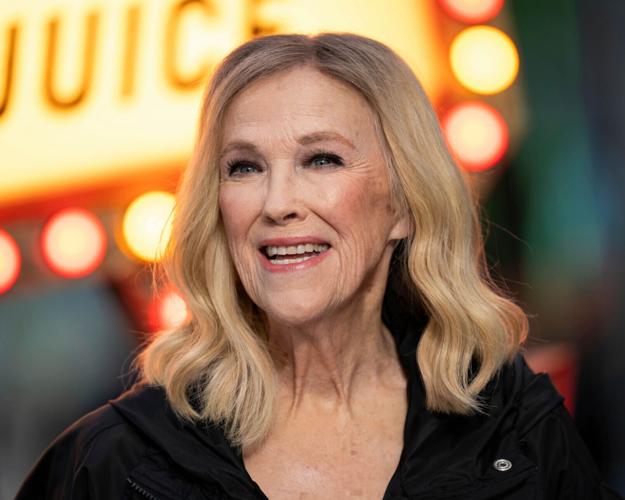
When actress Catherine O’Hara died recently, multiple media outlets reported she was “just 71 years old.”
I thought, just 71? Seriously? A life that began in 1954. Seven decades. Nearly 26,000 days. I’d kill to live that long.
Remember in our younger days when anyone who was 71(!) seemed on the verge of death? I had a grandmother who was 71 for more than 20 years. She never changed over that period. And she looked and acted 71 the entire time, whatever that means.
As we get older, our perception of aging evolves. What seemed “old” becomes “older.” In our 30s, 71 seems ancient. In our 40s, it becomes more plausible. In our 50s, it’s an attainable milestone. In our 60s, the age of 71 seems quite mortal. Too mortal actually.
Father Time begins tapping on your shoulder. You politely ignore him for as long as possible.
People are also reading…
The late actor Abe Vigoda was “just” 54 when he played the gruff but lovable police detective Phil Fish on the TV show “Barney Miller.” His character was known for his world-weary demeanor and persistent case of hemorrhoids. Vigoda looked at least 71.
Our view of aging, as a society, constantly changes as it mirrors our personal outlooks and statistical outcomes.
U.S. life expectancy averages 78.4 years, with females (81.1 years) living longer than males (75.8 years). In Canada, where O’Hara was from, life expectancy is 81.7 years, with women living to about 83.9 years. So, in that sense, she was “just” 71 when she died.
I’ll bet she didn’t feel 71. What age do you “feel”?
I asked this question to two of my work colleagues, one who’s older, one who’s younger. They both paused to think about it. The younger coworker, who’s in her late 30s, said she feels like she’s in her 20s. The older coworker, who’s 70, said he feels like he’s in his 40s.
This is probably true for most of us. I also feel like I’m in my 40s, though my body sometimes reminds me otherwise. But I know some people who look and feel their age. Life has not been easy on them, and it shows. Their eyes are empty. Their face is ravaged by time. Their body, once their strongest attribute, is now their biggest enemy.
A while back, I bumped into a woman my age who I haven’t seen since we were teens. In a split second, she aged 45 years right before my eyes. It was startling.
My only memory of her was an unforgettable image of youthful attractiveness, appealing features and coming-of-age allure. I’ve had this image in my mind since then, as many of us do with former high school classmates. We age but they don’t. Or so it seems in our mind.
I bumped into this woman at a store where my past image and her current image collided, just as hers likely did with mine, though I could never be described as a teenager in such an attractive way as I just described her.
Her current appearance: gray hair, wrinkles, heavyset and a dour attitude. I didn’t recognize her at all. She somehow recognized me, though I also look nothing like I did back then.
In that instant I had to update my mental Rolodex and recalibrate my past and present through the realities of natural aging. From now on, if I think of this woman, both images of her pop to mind. I’m guessing that others have had similar experiences at a certain age.
It was different with O’Hara, who aged publicly as her fans watched with admiration. She always seemed younger than her age, even when she played older characters.
I remember enjoying her comedy work on Second City Television from 1976 to 1984, then mega-popular movies that catapulted her into fame, including “Beetlejuice” (1988) and “Home Alone” (1990). I especially enjoyed O’Hara on the show “Schitt's Creek” (2015–2020) when she played Moira Rose, the eccentric matriarch known for her flair for the dramatic as a former soap opera star.
“Who knows what will befall us tomorrow? You could be hit by a Mack truck or bopped on the head by a tiny piece of space debris,” Rose once said on the show.
Unlike her limited life span, her wisdom about aging had no bounds.
“You'll soon learn that we aging mortals are blessed with weakening eyes and memories, so we don't have to really see ourselves. If you love the number 19, you go be 19,” she said.
Wouldn’t you like to be 19 again, if only for a day? Or possibly 29 or 39 or 49. It’s all relative depending on your current age. Would you settle for death at 71? Probably at 31 but not at 61.
The secret of aging is about attitude and perspective. Because my father and brother both died at 50, my perspective may be skewed. But context is an ageless prism to understand getting older.
As Moira Rose said, “Take a thousand naked pictures of yourself now. You may currently think, ‘Oh, I'm too spooky.’ But believe me, one day you will look at those photos, with much kinder eyes and say, ‘Dear God, I was a beautiful thing!’”