Ben Krakowka has the heads of two big-horn sheep hanging in his office in Montana's Butte-Silver Bow County courthouse.
One is from the time he lucked out, drew a sheep tag and shot one himself. The other, he said, is from the time he successfully prosecuted a sheep poacher, while working as the Anaconda-Deer Lodge county attorney.
People are also reading…
“When the case was done, FWP gave me the head so they could hang it in my office,” Krakowka said. “So I have a trophy of my own, and then somebody else's trophy. That's a trophy of my prosecuting the case.”
Krakowka relishes that trophy, in part, because of the many challenges that arise when prosecuting poaching cases.

The guide acknowledges the difficulty of prosecuting "poachers on some of our largest and most complex cases." Read the full 2025 Budget Information and Guide, Montana Fish, Wildlife and Parks here.
In its 2025 Budget Information and Guide, Montana Fish, Wildlife and Parks acknowledged the difficulty of prosecuting “poachers on some of our largest and most complex cases.”
“Many of the cases that game wardens are spending countless hours responding to and investigating are being plead down or dismissed and not prosecuted at all,” the FWP guide read. “Case load demands continue to rise, and poaching in Montana is being made a low priority in terms of crimes.”
In an interview with the Lee Enterprises Public Service Journalism Team, Ron Howell, FWP’s chief of law enforcement, said he empathizes with the challenges and “workload of local prosecutors.”
“I can't imagine sitting in their chair sometimes,” Howell said. “And I'm not just talking fish and game stuff. They're dealing with all types of crimes. So I can imagine what their workloads are like, and it's very tough. They do a great job for us, generally, and sometimes you're frustrated with them. But overall, they do a great job. But they have a difficult job, too.”

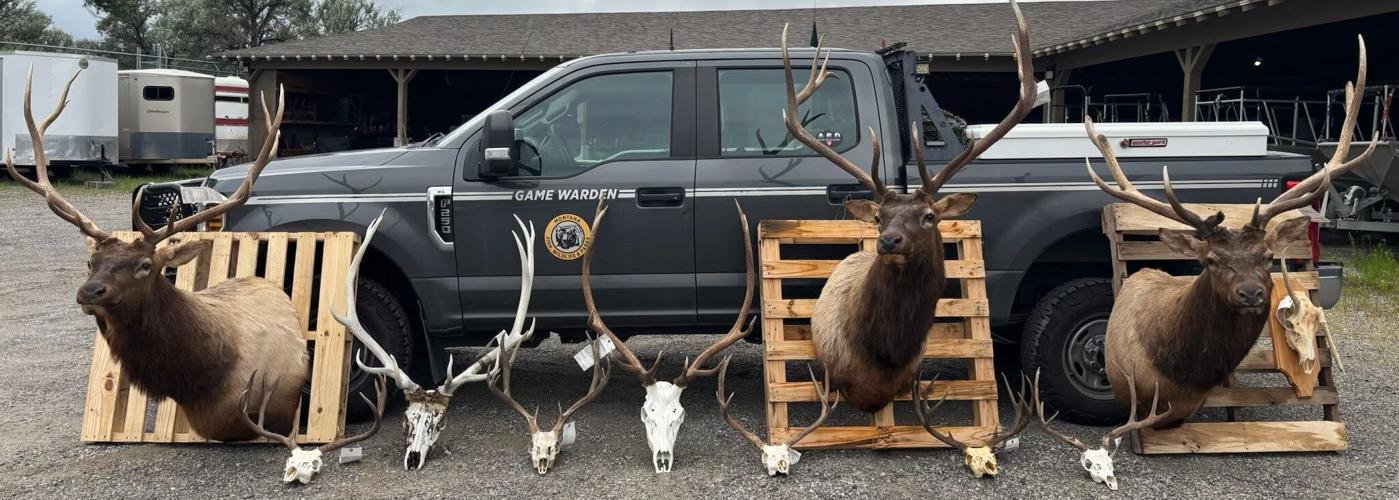
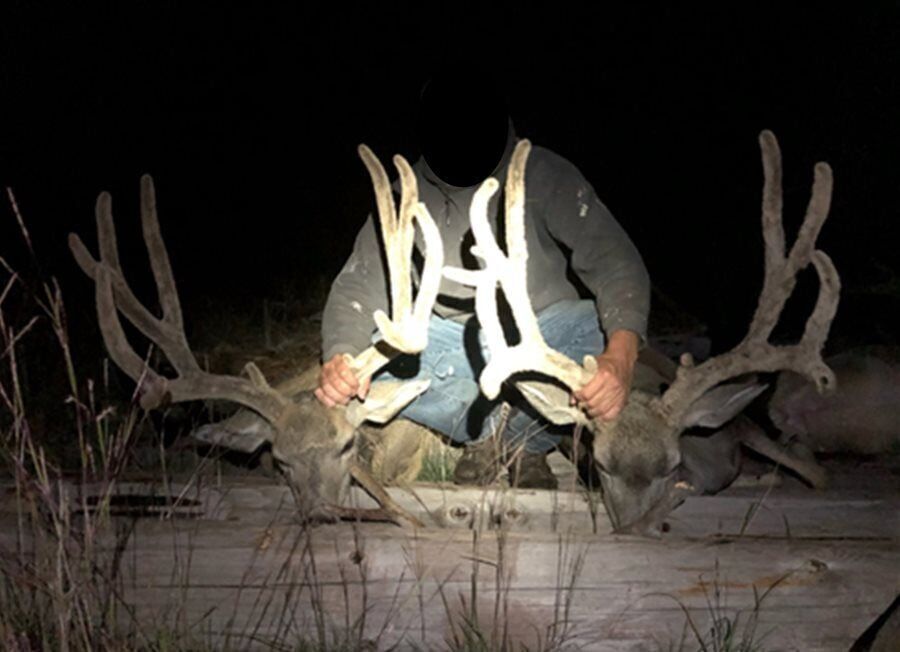
These are some of the trophies Montana Fish, Wildlife & Parks wardens recovered from their Musselshell County poaching bust.
‘Incredibly labor intensive’
During a career that has taken him from the county attorney’s offices in Butte, Anaconda and Musselshell County, Krakowka said the challenges begin right from the start, when “putting the case together, because a lot of times you don't realize the crime was committed until months or sometimes even a couple years later.”
“If somebody shoots a bull elk illegally in a place they weren't allowed to be, how's Fish and Game going to know about that?” he said. “Because they've got maybe one guy out there covering two or three counties that are bigger than Rhode Island, only with fewer roads. And so how do we find out about it? And it usually starts out as a tip. Somebody provides a tip, 'Oh, so and so illegally shot the bull elk.'
“And in our area,” Krakowka continued, “it's hard sometimes to even confirm where that occurred, because if you shoot an elk and you got it out in the field right there, you swing them with a pickup truck, throw in the back of your truck, and then you drive off and that gut pile is going to be gone by tomorrow morning. The coyotes are going to get into it, the crows are going to get into it, the bears are going to get into it, and the only thing you have left is kind of like a bloody stain out on the ground. So there isn't any indication of whether somebody shot it legally, illegally, whether it was a bull, whether it was a cow, whether it was even a deer, right, or an antelope. It's just impossible to tell at that point.”
Those kinds of hurdles mean that “fish and game cases are incredibly labor intensive” as “gathering all that information takes a huge amount of work and a huge amount of time,” said Krakowka, who is currently a deputy county attorney in Butte-Silver Bow.
Lenore Bushey, a deputy county attorney in Flathead County, agreed that poaching cases can be labor and evidence intensive, which can pose a “challenge.”
“When you're talking about wildlife crimes in general, most of the time there aren't any witnesses, “ Bushey said. “Most of these people are out there, and they're driving around by themselves in their car. They're walking around in the woods by themselves. The only witnesses are maybe the animal that they shoot. … So getting information on these is very difficult.”

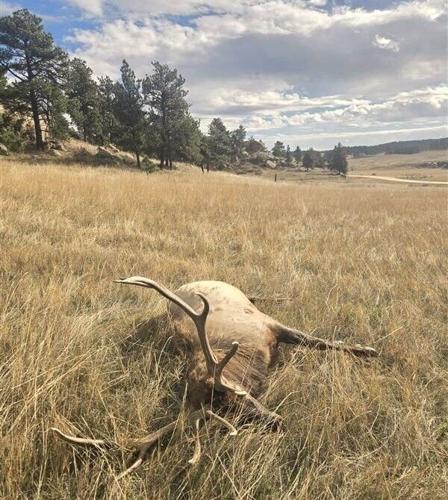
A 6x6 bull elk was poached in October 2025 near Musselshell.
And while Bushey said “FWP is really great in how they investigate their crimes,” the kinds of evidence they collect can be complex to use in court.
“Some of these cases end up having DNA, hair samples,” Bushey said. “Those get sent out to a crime lab, and the lab that processes evidence for FWP is in Wyoming. So if we're having a jury trial, then we have to have those witnesses come from out of state. The state has to pay for that prosecution, for that witness to come testify. So prosecution costs get very high.”
Bushey emphasized, though, cost is “not going to be a reason that we would dump the case or plead it out.”
But she did say that “sometimes the evidence is just very thin, and sometimes they get pled down because it's just very, very burdensome to prove as well.”
The result, she said, is that “a very small fraction” of wildlife cases “even go to trial.”
“I know right now we only have, I think, two felony cases pending,” Bushey said. “So they're not very common in district court.”
‘Compelled to document’
These days, the evidence that prosecutors do get often comes from the criminals themselves.
“Fish and game offenses are interesting because they fall into a category of only two kinds of cases that I know of where the offender is compelled to document their criminal activity,” Krakowka said. “Sex offenders are compelled to document their criminal activity all the time. …. Hunters, they save the heads. They save the trophies.”
And social media, he said, often proves an irresistible place to post images of their crimes.

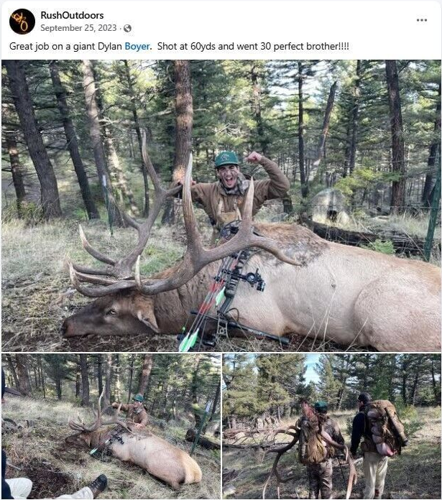
A screenshot of a Facebook post referenced in the charging documents for Cameron Wyant and Dylan Boyer. Authorities allege the two men killed the pictured bull elk in Hunting District 380 without the necessary licensing or permissions.
“And really, what's the fun of going out and shooting a big game animal if you can't tell your friends about it?” Krakowka said. “And so they're sending these pictures to their friends. They're posting them on their Facebook accounts, on their Instagram accounts. They're sharing a YouTube video that actually shows them breaking the law.”
‘Reluctant to convict’
Even when prosecutors can put a case together, such cases can be hard to win, Krakowka said.
“Citizens are reluctant to convict on a fish and game case,” Krakowka said. “And the reason they can be reluctant to convict on those kinds of cases is so many of our citizens hunt and fish.”
They can be reluctant, he said, because they know “that when you get convicted of a fish and game offense, you're going to lose your hunting and fishing privileges. And people are kind of reluctant to do that to somebody else, unless it's really egregious.”
Montana juries, Krakowka said, can be sympathetic to people who “break the law or they accidentally break the law” while out hunting.

There are big poaching busts in Montana every year. Here's a list of some of the most heinous cases in the state's recent history.
“In Montana, we have so many people hunting that inevitably, there are going to be violations of the law,” Krakowka said. “Somebody didn't fill their tag out properly, somebody crossed over onto somebody else's land accidentally or on purpose. Somebody shot a game animal they didn't have a tag for on purpose or on accident. So those are always going to be there.”
But there’s “a subset of hunters,” Krakowka said, who “tend to overlap quite a bit with other criminal law, that just think that the rules don't apply to them.”
“You've got the people who are going out on purpose” to poach, he said. “We're hunting bulls in an area where hunting bulls isn't permitted. We're hunting these deer in an area that's not permitted.”
But the line between the two types of violators can be hard to define.
“The law isn't black and white,” Krakowka said. “The law is mostly gray. And that's why we have juries right? So they will come back and tell us whether or not they think somebody broke the law. And so it's up to individual prosecutors to know their community and know when that jury is going to come back and say, ‘I think something wrong, something illegal happened here.’ And you know that's going to vary. That's going to be different in Missoula than it's going to be in Miles City. It's going to be different in Kalispell than it is in Golden Valley.”
‘Putting the odds in your favor’
But Krakowka said prosecutors don’t just have to hope a jury sees things the way they do.
“You can do all kinds of things ahead of time to start putting the odds in your favor,” he said.
During his stops around the state, Krakowka said he has met with local FWP wardens and “talked to them right off the bat” about how they are enforcing game laws.
Krakowka said he urges the wardens to think twice before citing people for relatively minor violations of the law and to instead focus on “the guys causing the most damage,” the people “intentionally going out and violating the law.”

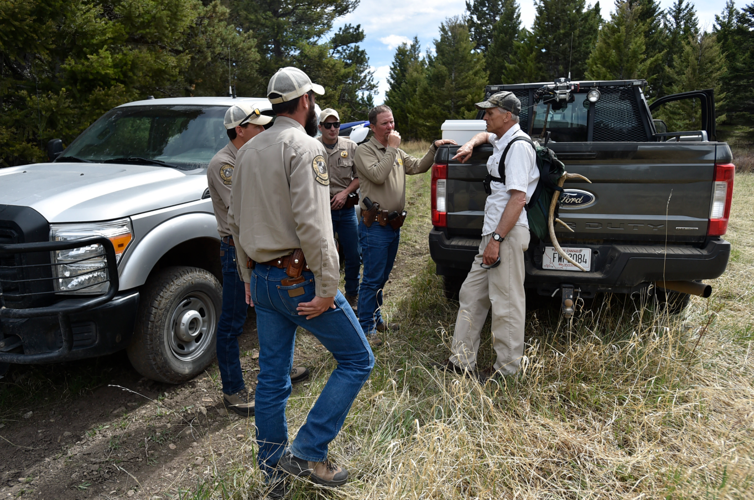
Montana Fish, Wildlife and Park game wardens chat with a shed hunter in 2019 after reports of early trespasser on to the wildlife management area. The man pictured is not one of the violators.
Doing so wouldn’t just allow his office to focus resources on ”what the community is worried about,” Krakowka said. It would also help bolster the jury pool’s perception of the FWP warden as someone who won’t write tickets for minor infractions but will instead crack down on people who are harming the resource and violating the law egregiously.
While wardens have sometimes pushed back and told him that their “job isn't for people to like me,” Krakowka said his response has been: “Your job is to write tickets that I can get a conviction on, because somebody broke the law. If everybody thinks you're a jerk, no one's ever going to convict on your tickets.”
“When we take our (case) in front of a jury, we want that jury to say, ‘Hey, you know what, this game warden here, he's a good guy,’” Krakowka added.
Krakowka said this approach “increased my ability to prosecute these major cases.”
‘The way the law is set up’
But even when he can get a conviction, Krakowka said violators often receive light punishments, especially if they have no criminal history.
In part, that has to do with Montana’s wildlife laws.
Howell, the FWP law enforcement chief, is among those who “would like to see stiffer penalties” for poaching-related violations, he said. But only legislators can change those laws.
And Krakowka said it’s not just wildlife-specific laws that make it difficult to impose stiff penalties on poachers.
“The way the legislation is set up right now is, if it's your first felony, you're likely to get a deferred imposition of sentence,” he said. “That means you successfully complete probation, and the felony charge drops off your record like it never happened.”
Krakowka said that discourages felony poaching prosecutions.
Instead, he said has often treated such cases “as an incredibly serious misdemeanor,” which can lead to a person losing his ability to “hunt anywhere in the continental United States for the next 10 years.”
“So really, the way the law is set up is it's set up to incentivize prosecutors to pursue misdemeanors instead of felonies from a punishment perspective,” Krakowka said.