

Racist meme; deadly bear-bicyclist crash; illegal fee for beach access
- Updated
Odd and interesting news from around the West.
- The Associated Press
- Updated
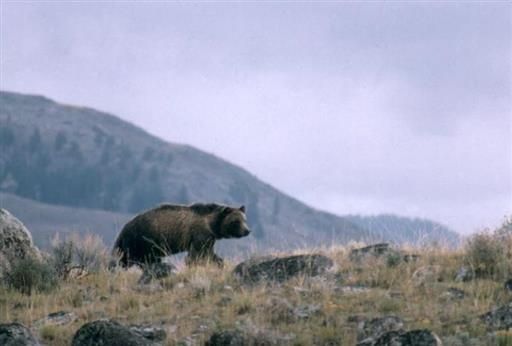
HELENA, Mont. — Montana wildlife officials say a 38-year-old mountain biker who was killed by a bear riding just outside Glacier National Park likely collided with the bear before he was attacked.
Following an investigation, they have removed bear traps and cameras used to find the bear from the area and are continuing to investigate.
Brad Treat, who was a law enforcement officer with the U.S. Forest Service, was found dead on Wednesday by officers at the scene of the attack. Treat's riding companion reported the incident and was not attacked.
Wildlife response team investigator Brian Sommers says he believes Treat was riding at a high rate of speed along a narrow trail and hit the bear.
Authorities say visibility was limited and they believe the collision was unavoidable.
- The Associated Press
- Updated
ARTESIA, N.M. — Two New Mexico lawmakers are hoping conversations with ranchers will convince the U.S. Forest Service to rethink federal water restrictions.
U.S. Rep. Steve Pearce and state Rep. Jim Townsend, both Republicans, met with Forest Service representatives and ranchers in Cloudcroft this week about water access and its impact on the economy.
"I'm cautiously optimistic about the outcome from it all," Pearce said. "I think we will be able to reach an agreement where the ranchers will be given enough flexibility to do their work and stay in business, and also preserve the habitat."
Both are supporting ranchers in an ongoing dispute over water restrictions on national forest lands. Townsend, who represents Artesia, recently joined several legislators from the area in drafting a letter directed at Gov. Susana Martinez. In it, the lawmakers call on Martinez and the state engineer to be more aggressive in protecting New Mexico's water rights from "federal government overreach." Townsend said water access is key to the agriculture industry, which contributes about $4 billion to New Mexico's economy each year.
The issue reached a tipping point with recent closures of parts of Lincoln National Forest to protect the habitat of the endangered New Mexico meadow jumping mouse, Townsend told the Artesia Daily Press.
"If your water rights aren't valid and they're not worth anything, we have real problems. And if the federal government can just come in and take people's water away without due process, we have real problems in New Mexico," Townsend said.
The U.S. Forest Service has repeatedly defended its actions, saying it has responsibilities under the Endangered Species Act to ensure the survival of the rodent. Agency officials reiterated during the meeting Thursday that there had to be limits on livestock and wildlife traffic to allow the mouse species to recover. But they also agreed to seek out a compromise with ranchers.
In fact, Pearce said the Forest Service has already agreed to reposition the location of some fences in the coming days.
___
Information from: Artesia Daily Press, http://www.artesianews.com
- The Associated Press
- Updated
MALIBU, Calif. — The operators of the Paradise Cove restaurant in Malibu came under investigation again for charging people access to its nearby public beach and pier.
State regulators began investigating last month complaints from beachgoers that the restaurant was charging $20 "daily beach club membership" fee to access the shore, The Los Angeles Times reported.
The California Coastal Commission threatened in a June 16 letter to Kissel Co., which operates as Paradise Cove Land Co., to impose up to $11,250 in fines per day for blocking public access.
A message seeking comment from the company has not been returned Saturday.
The company has since complied with the law, and its website no longer mentions any membership fees, The Times said.
Public trails to the beach have been blocked in a number of Southern California coastal communities, and the fines have been an effective tool in ensuring access, said Andrew Willis, an enforcement supervisor for the commission.
In 2014, the commission sent a letter telling Kissel it was violating state law by posting signs banning surfing and surfboards and closing the pier behind a locked gate. The commission threatened hefty daily fines.
The owner agreed to stop charging a walk-in fee, remove all signs banning surfing and unlock a gate to the beach's pier shortly after.
"People think of gates and fences, but there are other ways to chip away at access — fake garages, access fees, 'no parking' signs," Willis said.
- The Associated Press
- Updated
CODY, Wyo. — Two teens have been ordered to pay restitution for illegally harvesting six antelope and three sage grouse near Cody.
The Cody Enterprise reports that a 14-year-old boy pleaded guilty to spotlighting big-game animals, wanton destruction, taking game birds out of season and wasting edible portions of a bird and a 17-year old pleaded guilty to spotlighting and wanton destruction of big game animals.
According to the Cody Regional office of Wyoming Game and Fish, the younger boy was sentenced to $12,300 in restitution, but that amount was reduced to $1,200 because of inability to pay. He will work off the restitution with community service.
The 17-year-old was ordered to pay $3,000 in restitution and ordered to work 100 hours of community service.
Both boys lost their hunting privileges.
___
Information from: The Cody Enterprise, http://www.codyenterprise.com
- The Associated Press
- Updated
LAKE STEVENS, Wash. — Police are investigating a nighttime collision between a motorboat and kayak that left two people injured.
KOMO-TV reports the Friday crash threw a male and a female kayaker into the water several hundred feet from the Lake Stevens shore.
Lake Stevens Fire Department Battalion Chief Perry Putnam said the propeller hit the male kayaker, whose arm was seriously injured.
The woman was not as seriously hurt.
People on the boat that hit the kayak rescued the man and woman.
Both kayakers were taken to the hospital.
- The Associated Press
- Updated
SHOHONE, Idaho — The mother of a 3-year-old boy found wandering alone in Shoshone is facing marijuana and child endangerment charges.
The Times-News reports that police were called after the 3-year-old walked into a neighbor woman's home Friday morning. The woman did not know the boy's identity or age.
Police canvassed the neighborhood for nearly two hours before finding his mother. When the Department of Health and Welfare inspected the child's home, as mandated by Idaho law, the mother was found to be in possession of marijuana.
The mother was arrested on suspicion of possession of marijuana and two counts of injury to a child for the two children in her care. The children were released to their father.
The woman is expected to appear in Lincoln County Magistrate Court on Tuesday.
___
Information from: The Times-News, http://www.magicvalley.com
- The Associated Press
- Updated
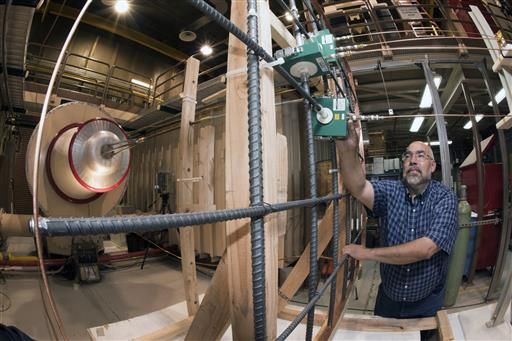
ALBUQUERQUE, N.M. — Researchers at one of the nation's federal laboratories are creating simulated lightning as part of an effort to determine how everything from nuclear weapon components to entire buildings will hold up to Mother Nature.
They're building upon what is already known about the physics of lightning to make sure the blast of energy released by a strike doesn't affect sensitive areas of a weapon, said Larry Schneider with Sandia National Laboratories' electrical sciences group.
"Sandia's primary mission is to assure an 'always/never' operating condition for nuclear weapons. They must work when authorized and never function otherwise," he said. "Direct strike lightning is a threat in the 'never' scenario."
Sandia's lightning simulator has been performing tests since the 1970s, but officials say the focus now is on improving the understanding behind lightning and the ways it interacts with various systems.
Researchers are looking at how lightning flows through lattices of rebar and what kind of electromagnetic forces are generated when protective wiring is exposed to currents that would be equivalent to a lightning strike, or as much as 200 kilo Amps.
A lightning strike can last a quarter of a second, but the effects can linger. Through computer modeling and testing in the simulator, researchers can ensure that small components, subsystems and nuclear weapon systems meet requirements whether lightning directly strikes the weapon, the missile or the aircraft that carries it.
Tests can also be done to mimic lightning strikes that are nearby and generate electromagnetic fields.
Leonard Martinez of Sandia's electrical science and experiments group said most of the tests are done on pre-fabricated samples of reinforced concrete walls. However, researchers also measure currents at locations in the lattice without the surrounding concrete to better understand how the energy might be distributed in a realistic situation.
The test results are being compared to modeling so researchers can calculate expected forces on protective wiring assemblies.
High-speed cameras are helping to capture what's happening.
Sandia's simulator creates a lightning pulse — like a massive jolt of static electricity — by discharging high-voltage generators. A continuing current can be injected between pulses, much like natural lightning.
The lab does 200 to 300 tests a year, and Martinez said operators can fire the machine several times a day. It fits into a large room that includes diagnostic recorders, fiber optic transmitters and walls that can filter out electromagnetic waves.
Aside from helping to ensure the safety of the nuclear stockpile, the simulator also was used following a deadly 2006 explosion at a West Virginia coal mine. The federal Mine Safety and Health Administration asked Sandia to study whether energy from a lightning strike could travel underground to ignite an explosive mixture of gas trapped in a sealed section of the mine.
After spending days at the site, a team from Sandia determined that current from a surface strike can generate electromagnetic fields that spread through the earth. The findings were part of mining agency's report to Congress.
- The Associated Press
- Updated
SHELLEY, Idaho — An Army soldier reported missing in action during the Korean War is to be buried in his hometown of Shelley, Idaho, next week.
DNA and other evidence helped identify the remains of Army Corporal Charles B. Crofts, who was 19 when he was reported missing in 1950.
The Defense POW/MIA Accounting Agency said Thursday that his remains will be returned to his family for burial with full military honors. Graveside services are scheduled July 9 at Shelley Cemetery.
The Army said Crofts' regimental combat team was overwhelmed by Chinese forces in North Korea. According to the Army, it wasn't until 2004 that recovery teams were able to find and remove remains in the area Crofts went missing.
Crofts' brother, Kim Croft, tells KPVI-TV that he and his sister gave DNA to the military about 15 years ago but didn't think anything would come of it.
- The Associated Press
- Updated
SALT LAKE CITY — Memberships have more than doubled in a national LGBT, pro-gun rights organization since a gunman opened fire at a gay nightclub in Florida, killing 49 people.
The Salt Lake Tribune reported that Pink Pistols membership has grown from 1,500 to 4,000 since Omar Mateen's June 12 rampage.
That's according to Pink Pistols Utah chapter president Matt Schlentz, who said it's sad that the Orlando shooting is what made some realize this need exists in the LGBT community.
Schlentz owns semi-automatic rifles similar to the Sig Sauer MCX that Mateen used and said he gets mixed reactions from people who learn he's a gun rights advocate.
Pink Pistols organized in 2000 in response to a series of violent incidents like the murder of gay college student Matthew Shepard.
- The Associated Press
- Updated
SUTHERLIN, Ore. — Sutherlin Police say two juveniles have been taken into custody after a grass fire spread rapidly, destroying three homes and killing a dog.
Police Chief Kirk Sanfilippo said Saturday that the two were lodged into Douglas County Juvenile Hall on suspicion of starting the Friday blaze. They face charges of reckless endangering another person, reckless burning, assault and animal abuse.
The fire began at West Intermediate School at about 2:30 p.m. Friday. Strong winds stoked the blaze, which quickly engulfed three mobile homes, a shed and a vehicle.
A police officer was admitted to a local hospital for smoke inhalation, and a firefighter was treated and released from the scene for smoke inhalation and dehydration.
A dog died in the fire.
- The Associated Press
- Updated
DELTA, Colorado — The chairwoman of the Delta County Republican Party who was accused of favoritism and posting a racist meme on her Facebook page has resigned.
Linda Sorenson stepped down after an accountability meeting was convened by the county's Republican Central Committee investigating the allegations.
According to the Grand Junction Daily Sentinel, Sorenson announced her resignation in an email to fellow party members.
Sorenson said her Facebook page was hacked, but Colorado Party Chairman Steve House said that was not the case.
- Kodiak Daily Mirror
- Updated
KODIAK, Alaska — This past season, Kodiak's Josh Morin proved to be one of the best youth bowlers in the state.
Now, the Kodiak teenager is taking on America.
Morin's bowling tour will take him to compete at a pair of prestigious youth tournaments, reported the Kodiak Daily Mirror.
The first stop: Teen Masters July 2-8 in Fort Lauderdale, Florida.
The tournament is labeled as "American's premier high school championship event."
"This is a great opportunity," said Morin Wednesday morning. "Considering I'm pretty much done bowling in Kodiak, I can meet college coaches."
Bowlers from around the United States qualify for Teen Masters through various tournaments, but Morin received an invitation after several past participants lobbied organizers to include the kid from Alaska.
Teen Masters is different than any other tournament Morin has competed in, as the event requires bowlers to use plastic and urethane PBA skills balls. The older-style balls require more skill from the bowlers than reactive resin balls.
Morin recently received his PBA skills balls and has been practicing twice a week to get used to his new equipment. He has produced a high game of more than 200 with his 16-pound urethane ball.
"I'm hoping that it won't be too much of a challenge, but I am expecting it to be," said Morin, a member of the Kodiak Lion's Club and a former Kodiak Elks volunteer of the year.
The recent Kodiak High School graduate is among a 220-person field, which includes Marcus and Mason Yamada of Kenai. The entire lineup bowls July 3-6, before bracket play starts.
"I'm pretty excited," Morin said. "The nerves haven't really kicked in; I don't think they will probably kick in until I am down there and getting ready to bowl."
After Teen Masters, Morin heads to Indianapolis to compete in the Junior Gold Championships July 16-23.
The Kodiak bowler qualified for the biggest youth tournament in the nation by placing second at the Alaska USBC Youth State Tournament. He joins Dustin Swearingin (2015), Germain Jimenez (2013) and the Bormuel brothers (2012) — Jason, Jerish and Jacque — as Kodiak bowlers who recently advanced to the tournament.
A high finish could earn Morin scholarships for college, or a spot on Junior Team USA. He will be attending Arizona State University in the fall, right now only as a student in the architectural program.
"I'm hoping at these tournaments I get to talk to their coach and get some pointers and try to get on the bowling team," he said.
Morin is coming off his most successful season as a bowler. He averaged a 196 this past youth season and shot a career-best 289 game and a 760 series — a three-game total pinfall.
He said practice has been the staple for his improvement.
"You just can't stop. You have to keep doing it. You can't take long breaks or else you start to fall apart," said Morin, who has been bowling since the age of 4.
While tuning up for the tournaments, Morin picked up a few pointers from Jim Kent — the father of PBA professional Marshall Kent. Jim used to live in Kodiak and was back in town working on fishing boats.
The trip to Florida and Indiana does come at a price tag. Morin has been doing odd jobs to help pay for the trip and a GoFundMe page has also been set up for Morin.
"This is the sport that I have been with the longest and the one that I find most enjoyable," he said.
- Daily Herald
- Updated
PROVO, Utah — Just as many people show up for the Soap Box Derby regional competition now as when Sonny Hardman was a kid.
The Highland father of three, who grew up in Pleasant Grove, competed in regionals and nationals in the early 1990s when he was a teenager — and, before that, his father Gary competed in the 1950s. Sonny's three boys, Beckett, 8, Asher, 10, and Grayson, 14, have kept the family tradition alive, competing at regionals in Colorado for the past few years, including this past June 12 in Colorado Springs.
The Soap Box Derby has existed since 1934, reported the Daily Herald. As a national pastime it lives on somewhat quietly, but steadily sustaining itself over generations — even if the average outsider knows nothing about it these days.
If you were wondering: No, it's not the same as the pinewood derby. (Sonny's wife, Carolyn, said a lot of people think so.) Racers zoom downhill in their motor-free soapbox cars, propelled only by gravity, with the most advanced racers reaching 70 miles per hour. The youth racers typically reach speeds around 30 mph. It's not for the faint of heart.
•••
The racers Hardman — all three generations of them — gathered in Gary's Lehi home in late June to recall races past and present. Gary is a few steps behind the others during the conversation — he's in the final stages of an ongoing battle with brain cancer — but his memories are among the best parts of the afternoon. He summoned an anecdote about watching a racer crash during nationals in Akron, Ohio, during his visit in 1957.
"I don't know if he hit something or was going too fast or what, but he flew up in the air about this high," Gary recalled, resting his hand 4 or 5 feet in the air, "and hit a reporter in the stomach."
Thank goodness for news reporters: Gary has a binder full of old newspaper clippings from his racing days. There are pictures of celebrities such as Jimmy Stewart, Roy Rogers and Dinah Shore attending the national finals. He even has a photo of him with 1957 Miss USA Charlotte Sheffield.
"I thought that was pretty neat," he recalled quietly.
•••
Seeing pictures of the teenage Gary, one notices a family resemblance spanning generations. Gary's grandson, Grayson, is now the same age Gary was when he went to nationals. Those who place first in the upper divisions of regionals go on to compete in Ohio, and Grayson hoped this year (his fourth) would be his turn. Alas, his car had an in-race accident — but didn't hit any reporters — and the repairs slowed him down. Beckett, however, placed first in his division and Asher got second.
"And the only person who beat Asher was a 19-year-old," his mother, Carolyn, said.
"And barely," Asher added quickly.
For the Hardmans, this year was even more of a family affair than usual. Because of Gary's declining health, Sonny's sister (who also used to race) and her children attended, too, as did Gary.
"The whole family was there, and that's never happened in the past," Carolyn noted.
Having everyone present was particularly special, she said. When Grayson's car crashed, his dad and extended family rushed to the car and helped pull together the repairs. At one point the announcer came on over the loudspeaker and said Sonny's boys were all dedicating their races to their grandfather.
"It was hard, too," Carolyn said. "It was hard to get out there, and it was hot, and we were nervous about how grandpa was feeling, but I think to be able to be there with him was really important."
•••
The Hardmans aren't the only family with a soapbox heritage. Sonny said there are quite a few families like theirs across the country — handing down those tricks of the trade can be advantageous. Sonny even uses a few special tools that Gary built in the 1990s specifically for soapbox cars.
"They were a little upset that we came in and took a few of their trophies," Sonny said with a smile.
Soapbox cars aren't cheap. Sonny said they start at approximately $700, and the more expensive ones are $1,500 once they're completed. Building them takes several months and more than a few late nights. Though it does take a lot of work, Sonny appears to follow in the rather easygoing footsteps of his father.
"He was pretty laid back about it," Sonny remembered. "It almost feels like it backfires when you put pressure on them — you get more nervous. He knew I would put enough pressure on myself."
Building the cars together, Sonny said, is really one of the best parts of the whole experience — it's where the bulk of the time actually gets spent.
"And of course dad wants to get it perfect and fine-tuned, so that wears on their patience a little," he said.
This was the first year Gary wasn't actively involved in building the cars. Between his own, his son's and his grandson's, they estimate Gary has helped build 10 soapbox cars over the years.
"It was actually harder for us this year, because usually grandpa carries a lot of the weight," Sonny said. "I had to pick up the slack."
•••
Carolyn gets emotional when discussing what the tradition has meant to her and her family. She gets choked up mid-sentence, pausing to collect herself.
"And for my kids to be able to feel like they can be part of a legacy has been really important to me," she said. "It's fun to see Sonny's joy when he can watch the kids do it. And it's fun to be with Gary especially, and have that."
By the looks of it, the family tradition will live on another few years. Beckett raced for the very first time this year, and it won't be his last.
"I felt scared at first . and then after that first race I saw the first place trophy, and it was really, really big. And I really wanted to win it, so I kept racing."
- The Associated Press
HELENA, Mont. — Montana wildlife officials say a 38-year-old mountain biker who was killed by a bear riding just outside Glacier National Park likely collided with the bear before he was attacked.
Following an investigation, they have removed bear traps and cameras used to find the bear from the area and are continuing to investigate.
Brad Treat, who was a law enforcement officer with the U.S. Forest Service, was found dead on Wednesday by officers at the scene of the attack. Treat's riding companion reported the incident and was not attacked.
Wildlife response team investigator Brian Sommers says he believes Treat was riding at a high rate of speed along a narrow trail and hit the bear.
Authorities say visibility was limited and they believe the collision was unavoidable.
- The Associated Press
ARTESIA, N.M. — Two New Mexico lawmakers are hoping conversations with ranchers will convince the U.S. Forest Service to rethink federal water restrictions.
U.S. Rep. Steve Pearce and state Rep. Jim Townsend, both Republicans, met with Forest Service representatives and ranchers in Cloudcroft this week about water access and its impact on the economy.
"I'm cautiously optimistic about the outcome from it all," Pearce said. "I think we will be able to reach an agreement where the ranchers will be given enough flexibility to do their work and stay in business, and also preserve the habitat."
Both are supporting ranchers in an ongoing dispute over water restrictions on national forest lands. Townsend, who represents Artesia, recently joined several legislators from the area in drafting a letter directed at Gov. Susana Martinez. In it, the lawmakers call on Martinez and the state engineer to be more aggressive in protecting New Mexico's water rights from "federal government overreach." Townsend said water access is key to the agriculture industry, which contributes about $4 billion to New Mexico's economy each year.
The issue reached a tipping point with recent closures of parts of Lincoln National Forest to protect the habitat of the endangered New Mexico meadow jumping mouse, Townsend told the Artesia Daily Press.
"If your water rights aren't valid and they're not worth anything, we have real problems. And if the federal government can just come in and take people's water away without due process, we have real problems in New Mexico," Townsend said.
The U.S. Forest Service has repeatedly defended its actions, saying it has responsibilities under the Endangered Species Act to ensure the survival of the rodent. Agency officials reiterated during the meeting Thursday that there had to be limits on livestock and wildlife traffic to allow the mouse species to recover. But they also agreed to seek out a compromise with ranchers.
In fact, Pearce said the Forest Service has already agreed to reposition the location of some fences in the coming days.
___
Information from: Artesia Daily Press, http://www.artesianews.com
- The Associated Press
MALIBU, Calif. — The operators of the Paradise Cove restaurant in Malibu came under investigation again for charging people access to its nearby public beach and pier.
State regulators began investigating last month complaints from beachgoers that the restaurant was charging $20 "daily beach club membership" fee to access the shore, The Los Angeles Times reported.
The California Coastal Commission threatened in a June 16 letter to Kissel Co., which operates as Paradise Cove Land Co., to impose up to $11,250 in fines per day for blocking public access.
A message seeking comment from the company has not been returned Saturday.
The company has since complied with the law, and its website no longer mentions any membership fees, The Times said.
Public trails to the beach have been blocked in a number of Southern California coastal communities, and the fines have been an effective tool in ensuring access, said Andrew Willis, an enforcement supervisor for the commission.
In 2014, the commission sent a letter telling Kissel it was violating state law by posting signs banning surfing and surfboards and closing the pier behind a locked gate. The commission threatened hefty daily fines.
The owner agreed to stop charging a walk-in fee, remove all signs banning surfing and unlock a gate to the beach's pier shortly after.
"People think of gates and fences, but there are other ways to chip away at access — fake garages, access fees, 'no parking' signs," Willis said.
- The Associated Press
CODY, Wyo. — Two teens have been ordered to pay restitution for illegally harvesting six antelope and three sage grouse near Cody.
The Cody Enterprise reports that a 14-year-old boy pleaded guilty to spotlighting big-game animals, wanton destruction, taking game birds out of season and wasting edible portions of a bird and a 17-year old pleaded guilty to spotlighting and wanton destruction of big game animals.
According to the Cody Regional office of Wyoming Game and Fish, the younger boy was sentenced to $12,300 in restitution, but that amount was reduced to $1,200 because of inability to pay. He will work off the restitution with community service.
The 17-year-old was ordered to pay $3,000 in restitution and ordered to work 100 hours of community service.
Both boys lost their hunting privileges.
___
Information from: The Cody Enterprise, http://www.codyenterprise.com
- The Associated Press
LAKE STEVENS, Wash. — Police are investigating a nighttime collision between a motorboat and kayak that left two people injured.
KOMO-TV reports the Friday crash threw a male and a female kayaker into the water several hundred feet from the Lake Stevens shore.
Lake Stevens Fire Department Battalion Chief Perry Putnam said the propeller hit the male kayaker, whose arm was seriously injured.
The woman was not as seriously hurt.
People on the boat that hit the kayak rescued the man and woman.
Both kayakers were taken to the hospital.
- The Associated Press
SHOHONE, Idaho — The mother of a 3-year-old boy found wandering alone in Shoshone is facing marijuana and child endangerment charges.
The Times-News reports that police were called after the 3-year-old walked into a neighbor woman's home Friday morning. The woman did not know the boy's identity or age.
Police canvassed the neighborhood for nearly two hours before finding his mother. When the Department of Health and Welfare inspected the child's home, as mandated by Idaho law, the mother was found to be in possession of marijuana.
The mother was arrested on suspicion of possession of marijuana and two counts of injury to a child for the two children in her care. The children were released to their father.
The woman is expected to appear in Lincoln County Magistrate Court on Tuesday.
___
Information from: The Times-News, http://www.magicvalley.com
- The Associated Press
ALBUQUERQUE, N.M. — Researchers at one of the nation's federal laboratories are creating simulated lightning as part of an effort to determine how everything from nuclear weapon components to entire buildings will hold up to Mother Nature.
They're building upon what is already known about the physics of lightning to make sure the blast of energy released by a strike doesn't affect sensitive areas of a weapon, said Larry Schneider with Sandia National Laboratories' electrical sciences group.
"Sandia's primary mission is to assure an 'always/never' operating condition for nuclear weapons. They must work when authorized and never function otherwise," he said. "Direct strike lightning is a threat in the 'never' scenario."
Sandia's lightning simulator has been performing tests since the 1970s, but officials say the focus now is on improving the understanding behind lightning and the ways it interacts with various systems.
Researchers are looking at how lightning flows through lattices of rebar and what kind of electromagnetic forces are generated when protective wiring is exposed to currents that would be equivalent to a lightning strike, or as much as 200 kilo Amps.
A lightning strike can last a quarter of a second, but the effects can linger. Through computer modeling and testing in the simulator, researchers can ensure that small components, subsystems and nuclear weapon systems meet requirements whether lightning directly strikes the weapon, the missile or the aircraft that carries it.
Tests can also be done to mimic lightning strikes that are nearby and generate electromagnetic fields.
Leonard Martinez of Sandia's electrical science and experiments group said most of the tests are done on pre-fabricated samples of reinforced concrete walls. However, researchers also measure currents at locations in the lattice without the surrounding concrete to better understand how the energy might be distributed in a realistic situation.
The test results are being compared to modeling so researchers can calculate expected forces on protective wiring assemblies.
High-speed cameras are helping to capture what's happening.
Sandia's simulator creates a lightning pulse — like a massive jolt of static electricity — by discharging high-voltage generators. A continuing current can be injected between pulses, much like natural lightning.
The lab does 200 to 300 tests a year, and Martinez said operators can fire the machine several times a day. It fits into a large room that includes diagnostic recorders, fiber optic transmitters and walls that can filter out electromagnetic waves.
Aside from helping to ensure the safety of the nuclear stockpile, the simulator also was used following a deadly 2006 explosion at a West Virginia coal mine. The federal Mine Safety and Health Administration asked Sandia to study whether energy from a lightning strike could travel underground to ignite an explosive mixture of gas trapped in a sealed section of the mine.
After spending days at the site, a team from Sandia determined that current from a surface strike can generate electromagnetic fields that spread through the earth. The findings were part of mining agency's report to Congress.
- The Associated Press
SHELLEY, Idaho — An Army soldier reported missing in action during the Korean War is to be buried in his hometown of Shelley, Idaho, next week.
DNA and other evidence helped identify the remains of Army Corporal Charles B. Crofts, who was 19 when he was reported missing in 1950.
The Defense POW/MIA Accounting Agency said Thursday that his remains will be returned to his family for burial with full military honors. Graveside services are scheduled July 9 at Shelley Cemetery.
The Army said Crofts' regimental combat team was overwhelmed by Chinese forces in North Korea. According to the Army, it wasn't until 2004 that recovery teams were able to find and remove remains in the area Crofts went missing.
Crofts' brother, Kim Croft, tells KPVI-TV that he and his sister gave DNA to the military about 15 years ago but didn't think anything would come of it.
- The Associated Press
SALT LAKE CITY — Memberships have more than doubled in a national LGBT, pro-gun rights organization since a gunman opened fire at a gay nightclub in Florida, killing 49 people.
The Salt Lake Tribune reported that Pink Pistols membership has grown from 1,500 to 4,000 since Omar Mateen's June 12 rampage.
That's according to Pink Pistols Utah chapter president Matt Schlentz, who said it's sad that the Orlando shooting is what made some realize this need exists in the LGBT community.
Schlentz owns semi-automatic rifles similar to the Sig Sauer MCX that Mateen used and said he gets mixed reactions from people who learn he's a gun rights advocate.
Pink Pistols organized in 2000 in response to a series of violent incidents like the murder of gay college student Matthew Shepard.
- The Associated Press
SUTHERLIN, Ore. — Sutherlin Police say two juveniles have been taken into custody after a grass fire spread rapidly, destroying three homes and killing a dog.
Police Chief Kirk Sanfilippo said Saturday that the two were lodged into Douglas County Juvenile Hall on suspicion of starting the Friday blaze. They face charges of reckless endangering another person, reckless burning, assault and animal abuse.
The fire began at West Intermediate School at about 2:30 p.m. Friday. Strong winds stoked the blaze, which quickly engulfed three mobile homes, a shed and a vehicle.
A police officer was admitted to a local hospital for smoke inhalation, and a firefighter was treated and released from the scene for smoke inhalation and dehydration.
A dog died in the fire.
- The Associated Press
DELTA, Colorado — The chairwoman of the Delta County Republican Party who was accused of favoritism and posting a racist meme on her Facebook page has resigned.
Linda Sorenson stepped down after an accountability meeting was convened by the county's Republican Central Committee investigating the allegations.
According to the Grand Junction Daily Sentinel, Sorenson announced her resignation in an email to fellow party members.
Sorenson said her Facebook page was hacked, but Colorado Party Chairman Steve House said that was not the case.
- Kodiak Daily Mirror
KODIAK, Alaska — This past season, Kodiak's Josh Morin proved to be one of the best youth bowlers in the state.
Now, the Kodiak teenager is taking on America.
Morin's bowling tour will take him to compete at a pair of prestigious youth tournaments, reported the Kodiak Daily Mirror.
The first stop: Teen Masters July 2-8 in Fort Lauderdale, Florida.
The tournament is labeled as "American's premier high school championship event."
"This is a great opportunity," said Morin Wednesday morning. "Considering I'm pretty much done bowling in Kodiak, I can meet college coaches."
Bowlers from around the United States qualify for Teen Masters through various tournaments, but Morin received an invitation after several past participants lobbied organizers to include the kid from Alaska.
Teen Masters is different than any other tournament Morin has competed in, as the event requires bowlers to use plastic and urethane PBA skills balls. The older-style balls require more skill from the bowlers than reactive resin balls.
Morin recently received his PBA skills balls and has been practicing twice a week to get used to his new equipment. He has produced a high game of more than 200 with his 16-pound urethane ball.
"I'm hoping that it won't be too much of a challenge, but I am expecting it to be," said Morin, a member of the Kodiak Lion's Club and a former Kodiak Elks volunteer of the year.
The recent Kodiak High School graduate is among a 220-person field, which includes Marcus and Mason Yamada of Kenai. The entire lineup bowls July 3-6, before bracket play starts.
"I'm pretty excited," Morin said. "The nerves haven't really kicked in; I don't think they will probably kick in until I am down there and getting ready to bowl."
After Teen Masters, Morin heads to Indianapolis to compete in the Junior Gold Championships July 16-23.
The Kodiak bowler qualified for the biggest youth tournament in the nation by placing second at the Alaska USBC Youth State Tournament. He joins Dustin Swearingin (2015), Germain Jimenez (2013) and the Bormuel brothers (2012) — Jason, Jerish and Jacque — as Kodiak bowlers who recently advanced to the tournament.
A high finish could earn Morin scholarships for college, or a spot on Junior Team USA. He will be attending Arizona State University in the fall, right now only as a student in the architectural program.
"I'm hoping at these tournaments I get to talk to their coach and get some pointers and try to get on the bowling team," he said.
Morin is coming off his most successful season as a bowler. He averaged a 196 this past youth season and shot a career-best 289 game and a 760 series — a three-game total pinfall.
He said practice has been the staple for his improvement.
"You just can't stop. You have to keep doing it. You can't take long breaks or else you start to fall apart," said Morin, who has been bowling since the age of 4.
While tuning up for the tournaments, Morin picked up a few pointers from Jim Kent — the father of PBA professional Marshall Kent. Jim used to live in Kodiak and was back in town working on fishing boats.
The trip to Florida and Indiana does come at a price tag. Morin has been doing odd jobs to help pay for the trip and a GoFundMe page has also been set up for Morin.
"This is the sport that I have been with the longest and the one that I find most enjoyable," he said.
- Daily Herald
PROVO, Utah — Just as many people show up for the Soap Box Derby regional competition now as when Sonny Hardman was a kid.
The Highland father of three, who grew up in Pleasant Grove, competed in regionals and nationals in the early 1990s when he was a teenager — and, before that, his father Gary competed in the 1950s. Sonny's three boys, Beckett, 8, Asher, 10, and Grayson, 14, have kept the family tradition alive, competing at regionals in Colorado for the past few years, including this past June 12 in Colorado Springs.
The Soap Box Derby has existed since 1934, reported the Daily Herald. As a national pastime it lives on somewhat quietly, but steadily sustaining itself over generations — even if the average outsider knows nothing about it these days.
If you were wondering: No, it's not the same as the pinewood derby. (Sonny's wife, Carolyn, said a lot of people think so.) Racers zoom downhill in their motor-free soapbox cars, propelled only by gravity, with the most advanced racers reaching 70 miles per hour. The youth racers typically reach speeds around 30 mph. It's not for the faint of heart.
•••
The racers Hardman — all three generations of them — gathered in Gary's Lehi home in late June to recall races past and present. Gary is a few steps behind the others during the conversation — he's in the final stages of an ongoing battle with brain cancer — but his memories are among the best parts of the afternoon. He summoned an anecdote about watching a racer crash during nationals in Akron, Ohio, during his visit in 1957.
"I don't know if he hit something or was going too fast or what, but he flew up in the air about this high," Gary recalled, resting his hand 4 or 5 feet in the air, "and hit a reporter in the stomach."
Thank goodness for news reporters: Gary has a binder full of old newspaper clippings from his racing days. There are pictures of celebrities such as Jimmy Stewart, Roy Rogers and Dinah Shore attending the national finals. He even has a photo of him with 1957 Miss USA Charlotte Sheffield.
"I thought that was pretty neat," he recalled quietly.
•••
Seeing pictures of the teenage Gary, one notices a family resemblance spanning generations. Gary's grandson, Grayson, is now the same age Gary was when he went to nationals. Those who place first in the upper divisions of regionals go on to compete in Ohio, and Grayson hoped this year (his fourth) would be his turn. Alas, his car had an in-race accident — but didn't hit any reporters — and the repairs slowed him down. Beckett, however, placed first in his division and Asher got second.
"And the only person who beat Asher was a 19-year-old," his mother, Carolyn, said.
"And barely," Asher added quickly.
For the Hardmans, this year was even more of a family affair than usual. Because of Gary's declining health, Sonny's sister (who also used to race) and her children attended, too, as did Gary.
"The whole family was there, and that's never happened in the past," Carolyn noted.
Having everyone present was particularly special, she said. When Grayson's car crashed, his dad and extended family rushed to the car and helped pull together the repairs. At one point the announcer came on over the loudspeaker and said Sonny's boys were all dedicating their races to their grandfather.
"It was hard, too," Carolyn said. "It was hard to get out there, and it was hot, and we were nervous about how grandpa was feeling, but I think to be able to be there with him was really important."
•••
The Hardmans aren't the only family with a soapbox heritage. Sonny said there are quite a few families like theirs across the country — handing down those tricks of the trade can be advantageous. Sonny even uses a few special tools that Gary built in the 1990s specifically for soapbox cars.
"They were a little upset that we came in and took a few of their trophies," Sonny said with a smile.
Soapbox cars aren't cheap. Sonny said they start at approximately $700, and the more expensive ones are $1,500 once they're completed. Building them takes several months and more than a few late nights. Though it does take a lot of work, Sonny appears to follow in the rather easygoing footsteps of his father.
"He was pretty laid back about it," Sonny remembered. "It almost feels like it backfires when you put pressure on them — you get more nervous. He knew I would put enough pressure on myself."
Building the cars together, Sonny said, is really one of the best parts of the whole experience — it's where the bulk of the time actually gets spent.
"And of course dad wants to get it perfect and fine-tuned, so that wears on their patience a little," he said.
This was the first year Gary wasn't actively involved in building the cars. Between his own, his son's and his grandson's, they estimate Gary has helped build 10 soapbox cars over the years.
"It was actually harder for us this year, because usually grandpa carries a lot of the weight," Sonny said. "I had to pick up the slack."
•••
Carolyn gets emotional when discussing what the tradition has meant to her and her family. She gets choked up mid-sentence, pausing to collect herself.
"And for my kids to be able to feel like they can be part of a legacy has been really important to me," she said. "It's fun to see Sonny's joy when he can watch the kids do it. And it's fun to be with Gary especially, and have that."
By the looks of it, the family tradition will live on another few years. Beckett raced for the very first time this year, and it won't be his last.
"I felt scared at first . and then after that first race I saw the first place trophy, and it was really, really big. And I really wanted to win it, so I kept racing."
 Japanese company invests in mine near Mount Lemmon
