

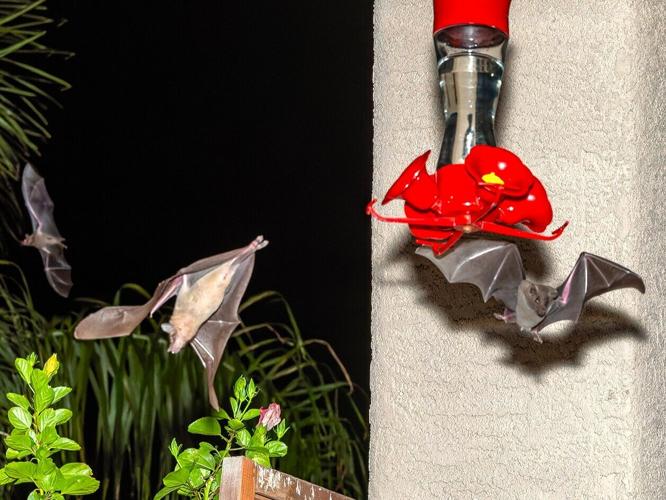



Most people have mixed feelings about bats. Mention birds and people picture bluebirds, hummingbirds, and eagles. Mention bats and many people picture Dracula. Yet bats are among the most remarkable animals on Earth, and nowhere is their story more interesting than in the deserts and mountains surrounding Tucson.
Worldwide, scientists recognize more than 1,400 species of bats, representing roughly one-fifth of all mammal species. They live on every continent except Antarctica and occupy habitats ranging from tropical rainforests to scorching deserts. In terms of diversity, bats rank among nature's greatest success stories, ranging in size from southeast Asia's bumblebee bat (less than 1.5 inches total length) to the Philippines' giant golden-crowned flying fox (wingspan up to 6 feet).
Bats belong to the order Chiroptera, which means "hand-wing." If you could examine a bat's wing closely, you would discover that it is essentially a hand with extraordinarily long fingers connected by a thin membrane of skin. Bats are the only mammals capable of true, sustained flight. Flying squirrels may glide, but bats actually fly. Somewhere in the distant past, evolution looked at a small furry mammal and apparently decided, "You know what this creature needs? Air travel."
People often compare bats and birds because both fly, but they are only distant relatives. Birds are feathered descendants of dinosaurs. Bats are mammals, more closely related to humans than to hawks. Birds navigate primarily with vision, while many bats employ echolocation, emitting high-frequency sounds and interpreting the returning echoes. Some species can detect objects as thin as a human hair in complete darkness. In effect, they carry their own biological radar system, millions of years before engineers invented one.
The fossil record suggests that bats resembling modern species appeared more than 50 million years ago. Human cultures have viewed them in dramatically different ways. In Europe, bats often became symbols of mystery, witches and vampires. In China, however, bats symbolize good fortune and happiness. In the bird world, owls are one of the few animals that have managed to be both lucky charms and horror-movie stars at the same time.
Tucson happens to be one of North America's premier bat cities and Arizona contains at least 28 species of bats. Around Tucson alone, researchers report at least 18 species living in and around the metropolitan area. The most familiar are Mexican free-tailed bats, which form enormous colonies beneath several Tucson bridges. On summer evenings, thousands emerge in swirling clouds that resemble living smoke rising into the twilight sky. Watching them pour out from beneath the Campbell Avenue bridge is one of Tucson's most unusual wildlife spectacles. But Tucson is small potatoes compared to Austin, where we watched 1.5 million Mexican free-tailed bats fly out from under the Congress Avenue Bridge in April 2009. Nearly all those spring bats are pregnant females who fly from Mexico to the U.S. to bear their young. The Austin bats consume as much as 30,000 pounds of mosquitoes and other bugs every night
Tucson's bats are not all insect hunters. Our region is famous for nectar-feeding species such as the lesser long-nosed bat and the Mexican long-tongued bat. These night-flying pollinators visit saguaro blossoms and agave flowers, transporting pollen from plant to plant. Every time someone raises a glass of tequila or sweetens coffee with agave syrup, they may owe a silent toast to a hardworking bat. University of Arizona researchers have even used citizen-science observations from hummingbird feeders to help monitor these important pollinators. Early after our move to Arizona years ago, we were curious why our hummingbird feeders were emptying overnight in late summer. We set up a camera to take photos of one feeder, and the next morning we downloaded the images. Imagine our surprise when we discovered 964 photos of bats at the feeder!
The benefits bats provide are enormous. Scientific reviews have documented hundreds of bat species providing ecosystem services through insect control, pollination, seed dispersal and nutrient recycling. Without bats, farmers would face larger pest populations, forests would regenerate more slowly and many flowering plants would struggle. Because nectar-feeding bats are so beneficial, you should leave at least one hummingbird feeder up during their heaviest period of feeder use (their fall migration back to Mexico sometime from late July through early October.) It’s easy to know when this migration begins; your feeders are emptied overnight.
So should people fear bats?
Generally, no. Contrary to popular myths, bats are not blind, they do not deliberately fly into people's hair, and the vast majority pose no threat. Rabies is the primary health concern, but only a small percentage of bats carry the disease. The sensible rule is simple: never handle a bat with bare hands and avoid contact with any bat that appears sick or injured. Admire them from a respectful distance and most everyone remains happy including the bat. Everyone but the mosquitoes.
In many ways, bats are the unsung night-shift workers of the Sonoran Desert. While Tucson sleeps, they patrol the skies, harvest insects, pollinate cactus flowers and maintain ecological balance. They may never achieve the popularity of hummingbirds or cardinals, but they deserve our admiration. After all, any creature that can navigate in darkness, eat its weight in insects, help produce tequila and still find time to star in Halloween decorations has earned a permanent place in Arizona's hall of fame.
If you have questions or comments about SaddleBrooke’s birds, or to receive emailed information about local birding, call (520) 330-0366 or email bobandpru@gmail.com. Previously published articles can be found at birdingthebrookeandbeyond.com.


