

The oral history of the Arizona Wildcats' march to the 1997 national championship
- Updated
A look at all of the obstacles and adversity the Arizona Wildcats overcame to win the 1997 national championship.
- Jon Gold
- Updated
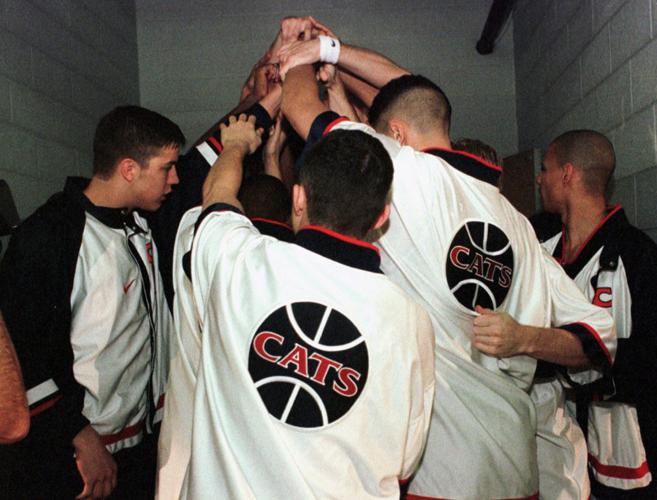
Thrilling upsets, a brutal gauntlet and Steve Urkel: Looking back 20 years later, Arizona’s run toward the 1996-97 national championship stands out as one of the great March marches in history.
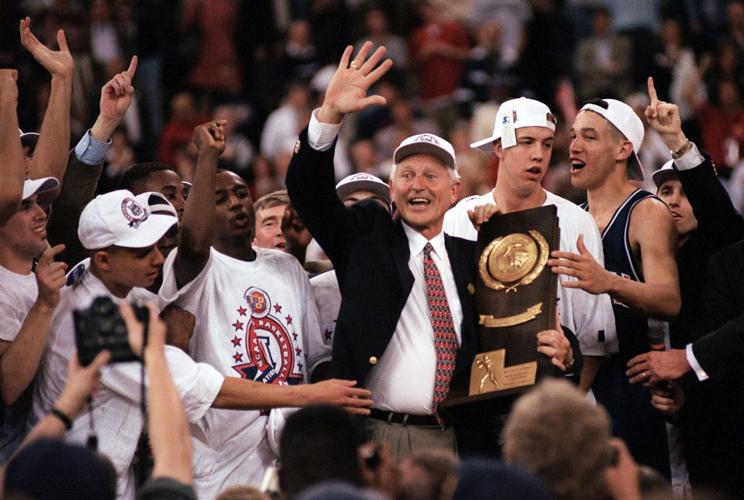
It all came together on March 31st, when Lute Olson cut down the nets for the first time, the only time, in his illustrious career, the first time, the only time, in the history of Arizona’s illustrious program.
And it all started with little Josh Pastner opening his big, goofy mouth.
“I was in the training room one day, and Josh is riding the elliptical, and he looks at me and says, ‘Donnell, you’re the key to us winning the national championship,’ ” forward Donnell Harris said. “I said, ‘Fine, if that’s all it is, great.’ ”
The Wildcats were projected as contenders but nothing more. Certainly not favorites. Certainly not talked about like the North Carolinas and Kentuckys of the world.
Pastner was earnest, and undeterred. Bennett Davison remembers.
“Miles (Simon) was apologizing to us, and Josh was a new guy, Mr. Positive, Mr. Everything, and he was just talking, saying that we could win it all,” Davison said. “But you know, we started believing it. During the regular season, we didn’t really dominate. We had no seniors. But we played with nothing to lose.”
And ultimately, they didn’t.
Through a perilous preseason and a Pac-12 campaign littered by devastating defeats, an NCAA Tournament gauntlet like no other, and a date with destiny with the defending champions, the Wildcats persevered.
Twenty years later, gathered at McKale Center in October 2016 for Arizona’s Red-Blue Game and Simon’s jersey retirement ceremony, several Wildcats joined the Star to look back on their run.
- Jon Gold
- Updated
Assistant coach Jim Rosborough: “It never occurred to us that we could win it. Maybe in the back of our minds after we beat Kansas. We’d played North Carolina before, beat them the first game of the year. But nobody talked about it, I can guarantee you that.”
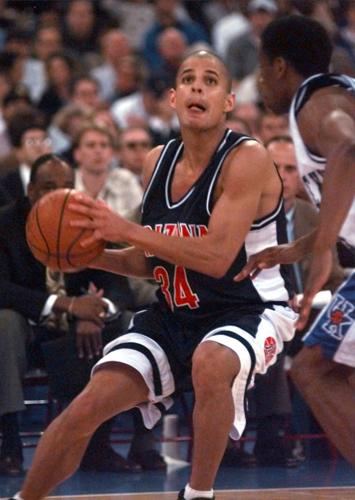
Guard Miles Simon: “I always thought our team could win at a high level. Mike Bibby, Mike Dickerson, Jason Terry, Bennett Davison — there was no doubt in my mind we could win at a high level. But that was the only expectation I had.”
Forward Donnell Harris: “The first two days back at school, we had an open gym. I called my mom and said, “I don’t know how good we are, but we’re good enough to win. My mom recently reminded me of that.”
Forward Bennett Davison: “AJ (Bramlett) and I were dominant forces on defense. I look back and wonder if I’d have picked a different school, maybe I could’ve been more of an offensive player. But look, every team has a Kobe and a Shaq, and great role players. You’ve got to have your Shane Battiers, your Rick Foxes, who go out and do the dirty things no one wants to do.”
Forward Eugene Edgerson: “I can’t single out one guy from that group. Collective effort. Everyone carried their own weight and more. Today, if you’re ever around us, spend time with us together, you’re going to see a bond that will always be there. It was a team. You don’t see that nowadays. It’s a lot of individuals trying to do their own thing, who don’t understand if everyone does their role, everyone will get a piece of the pie. Those days unfortunately are gone.”
Rosborough: “If you were at our practices, you saw things develop. We had a great, great defensive team; Bennett Davison was probably as good a defensive player as anyone I ever coached. He could guard anyone one through five. A.J. Bramlett just got better and better. Jason Terry, Miles Simon, who was a proven guy, Michael Dickerson, no one could guard him. We had some tools.”
Simon: “All of us were so different in how we played. Bibby is such a great passer and became a great shooter. He was a sneaky good defender, especially off the ball. JT (Terry) was just a monster all around, a future Player of the Year off the bench? He could change the whole pace and tempo of the game. He could take their best player out of the game. Mike Dickerson, as explosive a scorer there has ever been. I remember an assistant coach, now a friend of mine, said we were the hardest team to prepare for. We just ran motion, and all the guys were so smart. We were always moving, and in different places.”
- Jon Gold
- Updated
One place Simon was glued to for the beginning of the season: the bench.
The junior guard had been ruled academically ineligible for the fall and missed the first 11 games of the season. He needed an emergency A in winter mini-session just to graze past the eligibility threshold. In the meantime, the Wildcats would have a loaded nonconference schedule that included games against top-ranked North Carolina in the season-opening Hall of Fame Tipoff Classic.
Harris: “Coach Olson, when we had the banquet before the game, we all met, and no one came matching. Coach O saw UNC come in like they’re in the military, he turned around and swung to us and said, ‘You guys look like a bunch of ragamuffins, go get changed.’ As the season went on, he let us be. But that was huge. I don’t think any Arizona team beat North Carolina once or even twice.”
Arizona would win the season-opener over the Tar Heels 83-72, setting the stage for a 7-2 preseason.
Pastner: “We had some really good wins — we beat UNC, and we ended Dean Smith’s career, too. We found a way.”
Harris: “I remember Antawn Jamison crying to the referee all game about me elbowing him. And I told him, ‘You’re an All-American, stop crying.’ ”
- Jon Gold
- Updated
Simon was finally deemed eligible on Jan. 11, the same day Arizona beat Arizona State at McKale Center. Simon’s academic issues brought loud criticism from local and national outlets, and helped to galvanize the team with him and around him. The time off also put a chip on Simon’s shoulder, one he’d revisit again in March.
Edgerson: “It’s no different than what this generation is facing. You live in a fishbowl, and everyone is always watching what you’re doing. It’s to your benefit to do the right thing at the right time.”
Simon: “I don’t think I played any different when I returned. I played every game the same, as hard as I could, played to win. I’m super competitive. I don’t think there was a way for me to play with any more fire. I was excited to get back out on the court, but once you start getting into the game, your normal actions take over.”
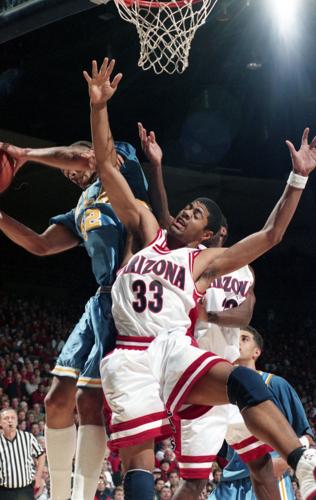
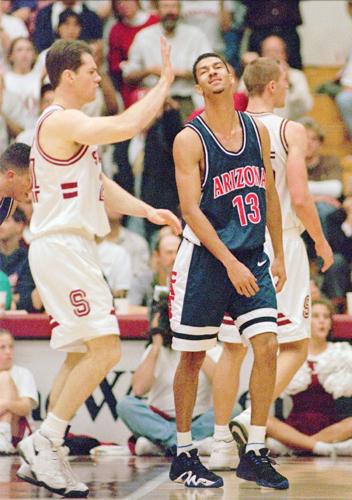
And then, a resounding thud. After a 10-2 start, and with Simon back in the lineup, the Wildcats traveled to Los Angeles and lost at USC and then fell two days later at UCLA in overtime. It would take some time for Simon to work himself back into the lineup, and back into the good graces of his teammates.
Davison: “Coach O was like let me take the pressure, let me take the stress off you after the Los Angeles trip. But we were good kids. Nobody was in a fraternity, we weren’t into drinking and partying, we were into video games, girlfriends, school and basketball.”
For Simon to thrive, future NBA star Jason Terry would have to take a backseat.
Rosborough: “When Jason Terry volunteered to be the sixth man. That was huge for the team. We shared the ball. Bibby was very unselfish. Bennett had a role, and we knew he could score. A.J. could score, too, but we had four of the best perimeter players around. We took players out of their game.”
Simon: “I think it took a few games, but only because of the fact that I was coming off the bench. JT was starting, which was fine because that dude was balling. But when I was on the floor, our team was super unselfish, and we just played for the open guy.”
- Jon Gold
- Updated
By late-February, things were humming again.
Arizona went 9-3 in the middle stretch of Pac-12 play, with one bad loss — a 66-64 home loss to talented UCLA — setting up a crucial finale to the conference slate: the Bay Area swing.
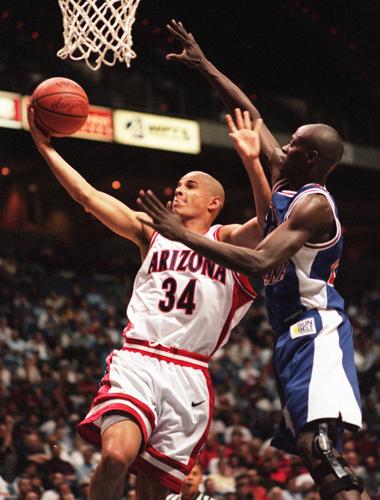
Stanford and Cal were among the top teams in the country, and the Wildcats left their hearts in San Francisco, along with their confidence, losing back-to-back games by a total of three points.
They prepared for a thrashing from the staff that never came.
Simon: “One thing I learned from Lute is that he was usually more positive after losses. I learned this when I coached under him. Because the team was already down. We already lost the game. He was harder on teams after we won, to keep everything even-keel.”
Harris: “Lute didn’t speak to us like normal. He said the teams we played, at the caliber they’re at, two points on the road is a win.”
Pastner: “We lost to Stanford and Cal, but (Olson) felt we played really well even though we lost. When you lose two in a row, the psyche of a team is on thin ice. That’s a credit to Coach Olson. When you lose two in college athletics, you’re teetering on a dangerous line. And that line, man, you can go south in a hurry. Both times we had the losing streaks, we found a way to get out of it.”
Edgerson: “It was brutal! We just played poorly. There are no excuses for that kind of play at that time. I’m glad we were able to get out of that funk and turn things around magically. It was unexpected, something that hadn’t happened all season. It just happened at the wrong time.”
Simon: “We all wanted to win. We were a close-knit group even though there were new faces. More than anything, it was just disappointment. We were a competitive group, disappointed we lost. Stanford and Cal were Sweet 16 teams that year, and we didn’t get swept at home — lost last-second shot at Stanford and the last 30 seconds at Cal. There was nothing to hold our heads down. We felt we should win every game. That was the only down part. There was disappointment that we lost, and on our team, there was no dissention.”
Well, no, that’s not true.
Rosborough: “I’m not gonna name names, but after we lost the second game against Cal, we had a scuffle in the locker room. It was not awful, but it was not pretty. People were frustrated. That might have turned us around. We came back from that and had good practices. It wasn’t all players in this scuffle.”
Davison: “We lost the last two games, lost some close games, and then we were staying in the hotel, and there were a couple fights. A.J. and I broke the backboard.”
- Jon Gold
- Updated
They wouldn’t have long to stew on it.
After a 19-9 regular-season and an 11-7 Pac-12 campaign, the Wildcats entered the tournament as the No. 4 seed in the Southeast Region, behind Roy Williams and Kansas, Mike Krzyzewski and Duke, and Tubby Smith and Georgia. Arizona had finished fifth in a packed Pac-10 — behind UCLA, Stanford, Cal and USC — and the Wildcats felt like their seeding was a slight.
Harris: “There was no recognition for the Pac-10, even though there were some very, very, very talented players before us. But Dick Vitale didn’t like us. I was really offended when I went to Arizona, and he’d talk so horribly about us. I looked forward to the opportunity to play the All-Americans if they were really that good.”
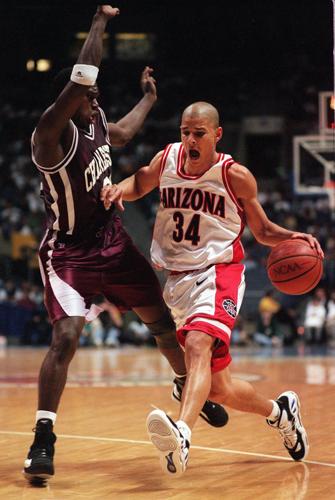
Up first for the Wildcats: No. 13 seed South Alabama, out of the Sun Belt Conference, in Memphis’ Pyramid Arena for the first round. The Jaguars, led by head coach Bill Musselman, had been in the tournament only four times prior.
Big deal.
The Jaguars slogged through the game, slowing the ball down to a crawl, completely taking Arizona out of its game. South Alabama led by 10 with under eight minutes left, but the Wildcats avoided yet another first-round exit by outscoring the Jaguars 22-4 over the last seven-plus minutes.
Rosborough: “We were down with seven minutes to go, and everyone on the bench was sick.”
Harris: “South Alabama was the compete opposite team as us. They always made sure we were seeded in a way that it was nowhere near a fair game. Anything could happen, and they don’t do that for all teams.”
Edgerson: “It was so scary because they played a different style than we were used to playing. They slowed the ball down, shot the ball with one second left on the shot clock, forced us to defend, to play a game we weren’t comfortable playing. We had guys on our team who refused to lose. They just had a will, a desire. That’s what made that team so special. Everybody on the team dug deep down when it really counted. We wanted to get that prize at the end of the tournament which was to raise that trophy in the air as the No. 1 team in the nation.”
Davison: “The first two games seemed to be the hardest games because we were supposed to win, and they were ready for us. The ones we were supposed to lose, we were like, let’s have fun.”
- Jon Gold
- Updated
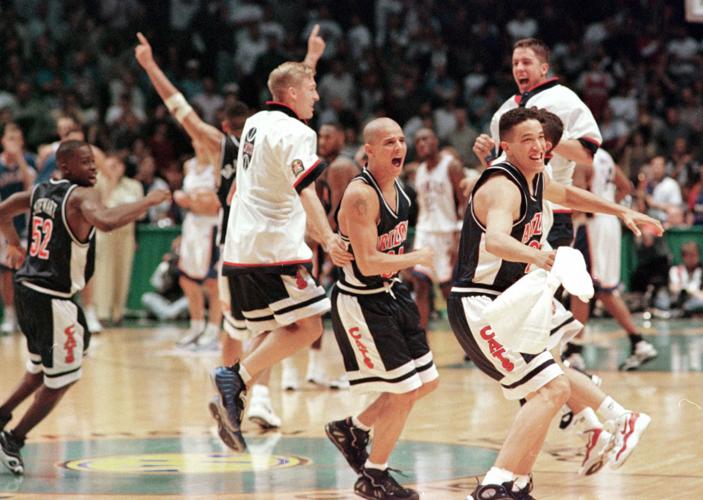
After beating South Alabama, the Wildcats had a bit of good luck: No. 5-seed Maryland had been upended by 12th-seeded College of Charleston, a 28-2 squad out of the Atlantic Sun Conference. The Cougars were no pushovers, led by center Thad Delaney and guard Anthony Johnson, who formed a potent inside-out trio.
College of Charleston actually led at the half 34-33, but the Wildcats responded with a second-half surge as Simon led the way with 20.
Edgerson: “At the end, when it really counted, we found a way to put it together. It had to do with timing. We always felt we had a good team; it just didn’t jell till the end.”
Simon: “We didn’t think of it as a gauntlet, because we never looked too far ahead. We saw who was the No. 1 seed in our bracket, but it’s not like we were looking at the Final Four. We saw South Alabama, and in our minds we thought we’d beat them fairly easily. I for sure knew COC was good, I knew Delaney and Anthony Johnson. But we weren’t gonna fear anybody. We just wanted to play. More so, teams needed to fear us because we had really good players.”
Rosborough: “The next game up for us was the biggest game, and that was one thing we always did real well — there wasn’t up and down preparation. If we were playing a school down here or at North Carolina, the prep was the same. I would think our guys would say they’d never go into a game feeling unprepared.”
- Jon Gold
- Updated
It’s a good thing the Wildcats never got too high or too low, seeing as they’d have to face a murderer’s row of basketball royalty starting in the Sweet 16.
Kansas, with one of the most formidable rosters in the program’s long history, was on deck. The Jayhawks were led by Paul Pierce and Raef LaFrentz, with some help from Jacque Vaughn and Scot Pollard. Arizona was loaded in the backcourt, and Kansas was in the frontcourt.
The Wildcats, though, were still playing with nothing to lose, house money. They were loose — Lute let them be loose — and they caught Kansas napping, despite 27 points from Pierce. Arizona had a more balanced attack, with 21 points from Bibby and 20 from Dickerson, and the Wildcats won 85-82 to advance to the Elite 8, where they faced Providence.
Edgerson: “We looked forward to each and every one of those games. We knew we could play with those teams. We needed to be put in the position, and when we were, we showed the world we were just as good as them. Unfortunately, there was a West Coast, East Coast bias, and nobody was watching our games. All these Midwest, East Coast teams were getting on TV. They didn’t know about us. It worked against them, because we were the underdogs, and we took it seriously.”
They wouldn’t be underdogs in the Elite 8, where No. 10-seeded Providence awaited. The Friars, led by Austin Croshere and God Shammgod, had defeated Marquette, Duke and Chattanooga to reach their first Elite 8 in 10 years. They proved to be a tough out, taking Arizona to overtime before the Wildcats eventually won 96-92, setting up a pivotal rematch with North Carolina, whom they beat in the first game of the season.
Simon: “I don’t think we took momentum from Providence into UNC because those games were six days apart. There was no momentum to be carried, especially because we didn’t finish the Providence game well. We were fortunate to win that in OT. We carried new life into the UNC game and knew they were just as hungry and we’d beaten them already.”
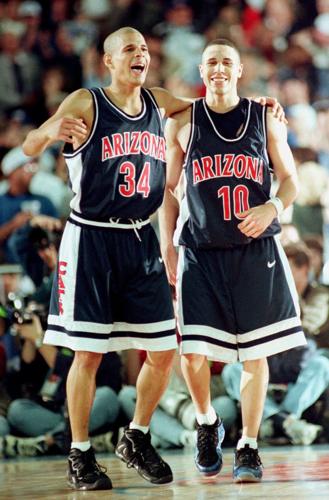
Arizona arrived in Indianapolis wide-eyed and excitable. Olson made it a conscious effort not to monopolize his players time. He gave them freedom to live, and that let them relax.
Simon: “When we first got to Indy, we stayed in a downtown hotel, and from what I understood, you got the hotel according to seed, and we got the worst hotel. But it was cool because Coach O gave us a lot of freedom. Pastner, Bibby and I went down to the mall. We got something to eat, went to Lids, hung out, no one even bothered us. Went to the FanFest pretty much unnoticed. That kind of stands out.
“Jaleel White, who played Steve Urkel, was a friend of Coach Olson’s, a fan of the Wildcats, and I remember he played PlayStation with us in our room, and he came to dinner.”
- Jon Gold
- Updated
Arizona was clearly at ease.
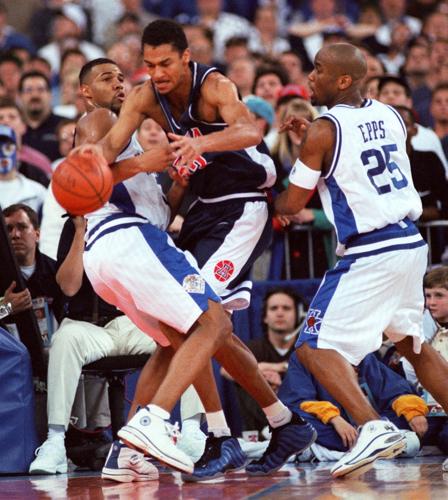
The Wildcats beat North Carolina for the second time that season, ending Dean Smith’s career with a 66-58 Arizona win. Simon had 24 points, Bibby had 20, and the Wildcats shut down everyone not named Jamison and Vince Carter.
With the wind in their sails, Arizona came back two days later and edged defending-champion Kentucky in overtime 84-79 behind Simon’s 30 points. The clutch guard, named the tournament’s Most Outstanding Player, went 14 for 17 from the free-throw line, icing the win.
A win that would make them immortal.
Davison: “After every game, we got on the bus, saying who do we have next? Even after the national championship game it was like, who’s next? We were always ready for it. We looked around like, wait, we’re the No. 1 team? Us? A bunch of knuckleheads, jokesters? Everyone overlooked us. It was a mathematical anomaly, I guess you could say. The legends of ’97. We did the unexpected, but we took advantage of our position.”
Harris: “I believe Coach Olson, (and assistants Jessie) Evans, “Roz” and (Phil) Johnson met up at the right time. They had all that success before us. And I believe they learned a great deal about parents, children, how things work. All that experience of having that success and not winning I think maybe allowed us to win.”
Davison: “People say how’d you win, and I say, how can you put the six luckiest games together? How does the ball bounce? Who snaps into the right place at the right time? It’s the little nuances. Our defense won us the championship, I can say that.”
- Jon Gold
- Updated
Twenty years later, the feeling hasn’t gone away.
Pastner: “Everyone says it every year, but I think it’s the greatest run of any NCAA championship run in history. Three No. 1 seeds, a freshman point guard, an inexperienced team, we lost the last two regular-season games, we weren’t deep, should’ve lost in the first round against South Alabama. Bottom line is, I think it’s the greatest run in NCAA tournament history.”
It could be.
But to these guys, it’s so much more.
These are treasured memories, collectively, but each player and coach has his own sense of pride about the title. That will never fade. Standing around McKale Center on a Friday night to soak in the roaring applause and to cheer on Simon, their erstwhile leader, they reminisced.
Harris: “It seems as if all of us have retained our youth. We all look pretty much like we did.”
Davison: “I’ll be in Dallas, and I’ll be driving, and I’ll just see the A. I was in Rome, and I met these people in front of the Coliseum, and I saw their A, and we hugged. People ask, did you play, and look I don’t wear the gear, all the jewelry — but I’ll say yeah. When? I say ’97, and it dawns on them … wait, didn’t … wasn’t that the … you were on that team?... Are you A.J. Bramlett?”
Simon: “I’ll never get tired of it. I love college sports. I was fortunate enough to win a national title, but I also went to six or seven Final Fours as a kid. I love college basketball. I’ll watch it over pro sports any day of the week. It’s a cool, cool thing. To win one with my teammates, and more importantly for Lute Olson — one of the greatest there ever was — and I’m so glad he got a title on his résumé. He deserves it.”
Edgerson: “The beauty of life is being able to share it with family. I have my 8-year-old son here, and he gets an opportunity to see that dad really did something amazing. He gets a chance to look around McKale, see the place packed, same as it was when I played, the video of us winning the national championship, and I get the chance to share those moments with my son, and to me that’s priceless. Who knows, maybe one day he’ll get the opportunity to come to the UA and play ball and maybe attain something like we attained back in 1997.”
Pastner: “When I talk to my team, you know what I tell the guys? How many of you have won a national championship? How many people can say that? Since 1939 is when the NCAA started awarding championships in men’s basketball. UCLA has won what? Eleven? Duke? Kentucky? With all those duplicates, you’re in such rarified air. So when I talk to my kids I say you want to win? Well I’m the only one who has, so you better listen to me. I have the blueprint.”
Harris: “A friend of mine told me, ‘Most things in life, people can take from you.’ And then he said, ‘But what you guys did, no one can ever not acknowledge it. It’s something that will be etched in stone, and you should be proud of it.’ Cool. So I’m going to be proud of it, I’m going to come back and get to see my friends, the friends who were closest to me. I take it as a blessing.”
More like this...
- Jon Gold
Thrilling upsets, a brutal gauntlet and Steve Urkel: Looking back 20 years later, Arizona’s run toward the 1996-97 national championship stands out as one of the great March marches in history.
It all came together on March 31st, when Lute Olson cut down the nets for the first time, the only time, in his illustrious career, the first time, the only time, in the history of Arizona’s illustrious program.
And it all started with little Josh Pastner opening his big, goofy mouth.
“I was in the training room one day, and Josh is riding the elliptical, and he looks at me and says, ‘Donnell, you’re the key to us winning the national championship,’ ” forward Donnell Harris said. “I said, ‘Fine, if that’s all it is, great.’ ”
The Wildcats were projected as contenders but nothing more. Certainly not favorites. Certainly not talked about like the North Carolinas and Kentuckys of the world.
Pastner was earnest, and undeterred. Bennett Davison remembers.
“Miles (Simon) was apologizing to us, and Josh was a new guy, Mr. Positive, Mr. Everything, and he was just talking, saying that we could win it all,” Davison said. “But you know, we started believing it. During the regular season, we didn’t really dominate. We had no seniors. But we played with nothing to lose.”
And ultimately, they didn’t.
Through a perilous preseason and a Pac-12 campaign littered by devastating defeats, an NCAA Tournament gauntlet like no other, and a date with destiny with the defending champions, the Wildcats persevered.
Twenty years later, gathered at McKale Center in October 2016 for Arizona’s Red-Blue Game and Simon’s jersey retirement ceremony, several Wildcats joined the Star to look back on their run.
- Jon Gold
Assistant coach Jim Rosborough: “It never occurred to us that we could win it. Maybe in the back of our minds after we beat Kansas. We’d played North Carolina before, beat them the first game of the year. But nobody talked about it, I can guarantee you that.”
Guard Miles Simon: “I always thought our team could win at a high level. Mike Bibby, Mike Dickerson, Jason Terry, Bennett Davison — there was no doubt in my mind we could win at a high level. But that was the only expectation I had.”
Forward Donnell Harris: “The first two days back at school, we had an open gym. I called my mom and said, “I don’t know how good we are, but we’re good enough to win. My mom recently reminded me of that.”
Forward Bennett Davison: “AJ (Bramlett) and I were dominant forces on defense. I look back and wonder if I’d have picked a different school, maybe I could’ve been more of an offensive player. But look, every team has a Kobe and a Shaq, and great role players. You’ve got to have your Shane Battiers, your Rick Foxes, who go out and do the dirty things no one wants to do.”
Forward Eugene Edgerson: “I can’t single out one guy from that group. Collective effort. Everyone carried their own weight and more. Today, if you’re ever around us, spend time with us together, you’re going to see a bond that will always be there. It was a team. You don’t see that nowadays. It’s a lot of individuals trying to do their own thing, who don’t understand if everyone does their role, everyone will get a piece of the pie. Those days unfortunately are gone.”
Rosborough: “If you were at our practices, you saw things develop. We had a great, great defensive team; Bennett Davison was probably as good a defensive player as anyone I ever coached. He could guard anyone one through five. A.J. Bramlett just got better and better. Jason Terry, Miles Simon, who was a proven guy, Michael Dickerson, no one could guard him. We had some tools.”
Simon: “All of us were so different in how we played. Bibby is such a great passer and became a great shooter. He was a sneaky good defender, especially off the ball. JT (Terry) was just a monster all around, a future Player of the Year off the bench? He could change the whole pace and tempo of the game. He could take their best player out of the game. Mike Dickerson, as explosive a scorer there has ever been. I remember an assistant coach, now a friend of mine, said we were the hardest team to prepare for. We just ran motion, and all the guys were so smart. We were always moving, and in different places.”
- Jon Gold
One place Simon was glued to for the beginning of the season: the bench.
The junior guard had been ruled academically ineligible for the fall and missed the first 11 games of the season. He needed an emergency A in winter mini-session just to graze past the eligibility threshold. In the meantime, the Wildcats would have a loaded nonconference schedule that included games against top-ranked North Carolina in the season-opening Hall of Fame Tipoff Classic.
Harris: “Coach Olson, when we had the banquet before the game, we all met, and no one came matching. Coach O saw UNC come in like they’re in the military, he turned around and swung to us and said, ‘You guys look like a bunch of ragamuffins, go get changed.’ As the season went on, he let us be. But that was huge. I don’t think any Arizona team beat North Carolina once or even twice.”
Arizona would win the season-opener over the Tar Heels 83-72, setting the stage for a 7-2 preseason.
Pastner: “We had some really good wins — we beat UNC, and we ended Dean Smith’s career, too. We found a way.”
Harris: “I remember Antawn Jamison crying to the referee all game about me elbowing him. And I told him, ‘You’re an All-American, stop crying.’ ”
- Jon Gold
Simon was finally deemed eligible on Jan. 11, the same day Arizona beat Arizona State at McKale Center. Simon’s academic issues brought loud criticism from local and national outlets, and helped to galvanize the team with him and around him. The time off also put a chip on Simon’s shoulder, one he’d revisit again in March.
Edgerson: “It’s no different than what this generation is facing. You live in a fishbowl, and everyone is always watching what you’re doing. It’s to your benefit to do the right thing at the right time.”
Simon: “I don’t think I played any different when I returned. I played every game the same, as hard as I could, played to win. I’m super competitive. I don’t think there was a way for me to play with any more fire. I was excited to get back out on the court, but once you start getting into the game, your normal actions take over.”
And then, a resounding thud. After a 10-2 start, and with Simon back in the lineup, the Wildcats traveled to Los Angeles and lost at USC and then fell two days later at UCLA in overtime. It would take some time for Simon to work himself back into the lineup, and back into the good graces of his teammates.
Davison: “Coach O was like let me take the pressure, let me take the stress off you after the Los Angeles trip. But we were good kids. Nobody was in a fraternity, we weren’t into drinking and partying, we were into video games, girlfriends, school and basketball.”
For Simon to thrive, future NBA star Jason Terry would have to take a backseat.
Rosborough: “When Jason Terry volunteered to be the sixth man. That was huge for the team. We shared the ball. Bibby was very unselfish. Bennett had a role, and we knew he could score. A.J. could score, too, but we had four of the best perimeter players around. We took players out of their game.”
Simon: “I think it took a few games, but only because of the fact that I was coming off the bench. JT was starting, which was fine because that dude was balling. But when I was on the floor, our team was super unselfish, and we just played for the open guy.”
- Jon Gold
By late-February, things were humming again.
Arizona went 9-3 in the middle stretch of Pac-12 play, with one bad loss — a 66-64 home loss to talented UCLA — setting up a crucial finale to the conference slate: the Bay Area swing.
Stanford and Cal were among the top teams in the country, and the Wildcats left their hearts in San Francisco, along with their confidence, losing back-to-back games by a total of three points.
They prepared for a thrashing from the staff that never came.
Simon: “One thing I learned from Lute is that he was usually more positive after losses. I learned this when I coached under him. Because the team was already down. We already lost the game. He was harder on teams after we won, to keep everything even-keel.”
Harris: “Lute didn’t speak to us like normal. He said the teams we played, at the caliber they’re at, two points on the road is a win.”
Pastner: “We lost to Stanford and Cal, but (Olson) felt we played really well even though we lost. When you lose two in a row, the psyche of a team is on thin ice. That’s a credit to Coach Olson. When you lose two in college athletics, you’re teetering on a dangerous line. And that line, man, you can go south in a hurry. Both times we had the losing streaks, we found a way to get out of it.”
Edgerson: “It was brutal! We just played poorly. There are no excuses for that kind of play at that time. I’m glad we were able to get out of that funk and turn things around magically. It was unexpected, something that hadn’t happened all season. It just happened at the wrong time.”
Simon: “We all wanted to win. We were a close-knit group even though there were new faces. More than anything, it was just disappointment. We were a competitive group, disappointed we lost. Stanford and Cal were Sweet 16 teams that year, and we didn’t get swept at home — lost last-second shot at Stanford and the last 30 seconds at Cal. There was nothing to hold our heads down. We felt we should win every game. That was the only down part. There was disappointment that we lost, and on our team, there was no dissention.”
Well, no, that’s not true.
Rosborough: “I’m not gonna name names, but after we lost the second game against Cal, we had a scuffle in the locker room. It was not awful, but it was not pretty. People were frustrated. That might have turned us around. We came back from that and had good practices. It wasn’t all players in this scuffle.”
Davison: “We lost the last two games, lost some close games, and then we were staying in the hotel, and there were a couple fights. A.J. and I broke the backboard.”
- Jon Gold
They wouldn’t have long to stew on it.
After a 19-9 regular-season and an 11-7 Pac-12 campaign, the Wildcats entered the tournament as the No. 4 seed in the Southeast Region, behind Roy Williams and Kansas, Mike Krzyzewski and Duke, and Tubby Smith and Georgia. Arizona had finished fifth in a packed Pac-10 — behind UCLA, Stanford, Cal and USC — and the Wildcats felt like their seeding was a slight.
Harris: “There was no recognition for the Pac-10, even though there were some very, very, very talented players before us. But Dick Vitale didn’t like us. I was really offended when I went to Arizona, and he’d talk so horribly about us. I looked forward to the opportunity to play the All-Americans if they were really that good.”
Up first for the Wildcats: No. 13 seed South Alabama, out of the Sun Belt Conference, in Memphis’ Pyramid Arena for the first round. The Jaguars, led by head coach Bill Musselman, had been in the tournament only four times prior.
Big deal.
The Jaguars slogged through the game, slowing the ball down to a crawl, completely taking Arizona out of its game. South Alabama led by 10 with under eight minutes left, but the Wildcats avoided yet another first-round exit by outscoring the Jaguars 22-4 over the last seven-plus minutes.
Rosborough: “We were down with seven minutes to go, and everyone on the bench was sick.”
Harris: “South Alabama was the compete opposite team as us. They always made sure we were seeded in a way that it was nowhere near a fair game. Anything could happen, and they don’t do that for all teams.”
Edgerson: “It was so scary because they played a different style than we were used to playing. They slowed the ball down, shot the ball with one second left on the shot clock, forced us to defend, to play a game we weren’t comfortable playing. We had guys on our team who refused to lose. They just had a will, a desire. That’s what made that team so special. Everybody on the team dug deep down when it really counted. We wanted to get that prize at the end of the tournament which was to raise that trophy in the air as the No. 1 team in the nation.”
Davison: “The first two games seemed to be the hardest games because we were supposed to win, and they were ready for us. The ones we were supposed to lose, we were like, let’s have fun.”
- Jon Gold
After beating South Alabama, the Wildcats had a bit of good luck: No. 5-seed Maryland had been upended by 12th-seeded College of Charleston, a 28-2 squad out of the Atlantic Sun Conference. The Cougars were no pushovers, led by center Thad Delaney and guard Anthony Johnson, who formed a potent inside-out trio.
College of Charleston actually led at the half 34-33, but the Wildcats responded with a second-half surge as Simon led the way with 20.
Edgerson: “At the end, when it really counted, we found a way to put it together. It had to do with timing. We always felt we had a good team; it just didn’t jell till the end.”
Simon: “We didn’t think of it as a gauntlet, because we never looked too far ahead. We saw who was the No. 1 seed in our bracket, but it’s not like we were looking at the Final Four. We saw South Alabama, and in our minds we thought we’d beat them fairly easily. I for sure knew COC was good, I knew Delaney and Anthony Johnson. But we weren’t gonna fear anybody. We just wanted to play. More so, teams needed to fear us because we had really good players.”
Rosborough: “The next game up for us was the biggest game, and that was one thing we always did real well — there wasn’t up and down preparation. If we were playing a school down here or at North Carolina, the prep was the same. I would think our guys would say they’d never go into a game feeling unprepared.”
- Jon Gold
It’s a good thing the Wildcats never got too high or too low, seeing as they’d have to face a murderer’s row of basketball royalty starting in the Sweet 16.
Kansas, with one of the most formidable rosters in the program’s long history, was on deck. The Jayhawks were led by Paul Pierce and Raef LaFrentz, with some help from Jacque Vaughn and Scot Pollard. Arizona was loaded in the backcourt, and Kansas was in the frontcourt.
The Wildcats, though, were still playing with nothing to lose, house money. They were loose — Lute let them be loose — and they caught Kansas napping, despite 27 points from Pierce. Arizona had a more balanced attack, with 21 points from Bibby and 20 from Dickerson, and the Wildcats won 85-82 to advance to the Elite 8, where they faced Providence.
Edgerson: “We looked forward to each and every one of those games. We knew we could play with those teams. We needed to be put in the position, and when we were, we showed the world we were just as good as them. Unfortunately, there was a West Coast, East Coast bias, and nobody was watching our games. All these Midwest, East Coast teams were getting on TV. They didn’t know about us. It worked against them, because we were the underdogs, and we took it seriously.”
They wouldn’t be underdogs in the Elite 8, where No. 10-seeded Providence awaited. The Friars, led by Austin Croshere and God Shammgod, had defeated Marquette, Duke and Chattanooga to reach their first Elite 8 in 10 years. They proved to be a tough out, taking Arizona to overtime before the Wildcats eventually won 96-92, setting up a pivotal rematch with North Carolina, whom they beat in the first game of the season.
Simon: “I don’t think we took momentum from Providence into UNC because those games were six days apart. There was no momentum to be carried, especially because we didn’t finish the Providence game well. We were fortunate to win that in OT. We carried new life into the UNC game and knew they were just as hungry and we’d beaten them already.”
Arizona arrived in Indianapolis wide-eyed and excitable. Olson made it a conscious effort not to monopolize his players time. He gave them freedom to live, and that let them relax.
Simon: “When we first got to Indy, we stayed in a downtown hotel, and from what I understood, you got the hotel according to seed, and we got the worst hotel. But it was cool because Coach O gave us a lot of freedom. Pastner, Bibby and I went down to the mall. We got something to eat, went to Lids, hung out, no one even bothered us. Went to the FanFest pretty much unnoticed. That kind of stands out.
“Jaleel White, who played Steve Urkel, was a friend of Coach Olson’s, a fan of the Wildcats, and I remember he played PlayStation with us in our room, and he came to dinner.”
- Jon Gold
Arizona was clearly at ease.
The Wildcats beat North Carolina for the second time that season, ending Dean Smith’s career with a 66-58 Arizona win. Simon had 24 points, Bibby had 20, and the Wildcats shut down everyone not named Jamison and Vince Carter.
With the wind in their sails, Arizona came back two days later and edged defending-champion Kentucky in overtime 84-79 behind Simon’s 30 points. The clutch guard, named the tournament’s Most Outstanding Player, went 14 for 17 from the free-throw line, icing the win.
A win that would make them immortal.
Davison: “After every game, we got on the bus, saying who do we have next? Even after the national championship game it was like, who’s next? We were always ready for it. We looked around like, wait, we’re the No. 1 team? Us? A bunch of knuckleheads, jokesters? Everyone overlooked us. It was a mathematical anomaly, I guess you could say. The legends of ’97. We did the unexpected, but we took advantage of our position.”
Harris: “I believe Coach Olson, (and assistants Jessie) Evans, “Roz” and (Phil) Johnson met up at the right time. They had all that success before us. And I believe they learned a great deal about parents, children, how things work. All that experience of having that success and not winning I think maybe allowed us to win.”
Davison: “People say how’d you win, and I say, how can you put the six luckiest games together? How does the ball bounce? Who snaps into the right place at the right time? It’s the little nuances. Our defense won us the championship, I can say that.”
- Jon Gold
Twenty years later, the feeling hasn’t gone away.
Pastner: “Everyone says it every year, but I think it’s the greatest run of any NCAA championship run in history. Three No. 1 seeds, a freshman point guard, an inexperienced team, we lost the last two regular-season games, we weren’t deep, should’ve lost in the first round against South Alabama. Bottom line is, I think it’s the greatest run in NCAA tournament history.”
It could be.
But to these guys, it’s so much more.
These are treasured memories, collectively, but each player and coach has his own sense of pride about the title. That will never fade. Standing around McKale Center on a Friday night to soak in the roaring applause and to cheer on Simon, their erstwhile leader, they reminisced.
Harris: “It seems as if all of us have retained our youth. We all look pretty much like we did.”
Davison: “I’ll be in Dallas, and I’ll be driving, and I’ll just see the A. I was in Rome, and I met these people in front of the Coliseum, and I saw their A, and we hugged. People ask, did you play, and look I don’t wear the gear, all the jewelry — but I’ll say yeah. When? I say ’97, and it dawns on them … wait, didn’t … wasn’t that the … you were on that team?... Are you A.J. Bramlett?”
Simon: “I’ll never get tired of it. I love college sports. I was fortunate enough to win a national title, but I also went to six or seven Final Fours as a kid. I love college basketball. I’ll watch it over pro sports any day of the week. It’s a cool, cool thing. To win one with my teammates, and more importantly for Lute Olson — one of the greatest there ever was — and I’m so glad he got a title on his résumé. He deserves it.”
Edgerson: “The beauty of life is being able to share it with family. I have my 8-year-old son here, and he gets an opportunity to see that dad really did something amazing. He gets a chance to look around McKale, see the place packed, same as it was when I played, the video of us winning the national championship, and I get the chance to share those moments with my son, and to me that’s priceless. Who knows, maybe one day he’ll get the opportunity to come to the UA and play ball and maybe attain something like we attained back in 1997.”
Pastner: “When I talk to my team, you know what I tell the guys? How many of you have won a national championship? How many people can say that? Since 1939 is when the NCAA started awarding championships in men’s basketball. UCLA has won what? Eleven? Duke? Kentucky? With all those duplicates, you’re in such rarified air. So when I talk to my kids I say you want to win? Well I’m the only one who has, so you better listen to me. I have the blueprint.”
Harris: “A friend of mine told me, ‘Most things in life, people can take from you.’ And then he said, ‘But what you guys did, no one can ever not acknowledge it. It’s something that will be etched in stone, and you should be proud of it.’ Cool. So I’m going to be proud of it, I’m going to come back and get to see my friends, the friends who were closest to me. I take it as a blessing.”
More like this...
Tags
Most Popular
-
Oklahoma reckons with environmental costs of marijuana industry
-
Chiricahua poised to become Arizona’s fourth national park
-
 Tucson's having a big fast-food reshuffle
 -
Feds don't renew water station permits for Tucson-based Humane Borders
-
Arizona border protesters removed; 'Grandmother' cottonwood toppled

