A giant cottonwood along the U.S.-Mexico border in Arizona was knocked down by heavy equipment, after authorities cleared out protesters who had been camping in the tree for more than two months to try to save it from destruction.
In a video posted on social media at just after 9 a.m. Monday, people can be heard screaming as the massive tree crashes to the ground in Lochiel, about 85 miles southeast of Tucson.
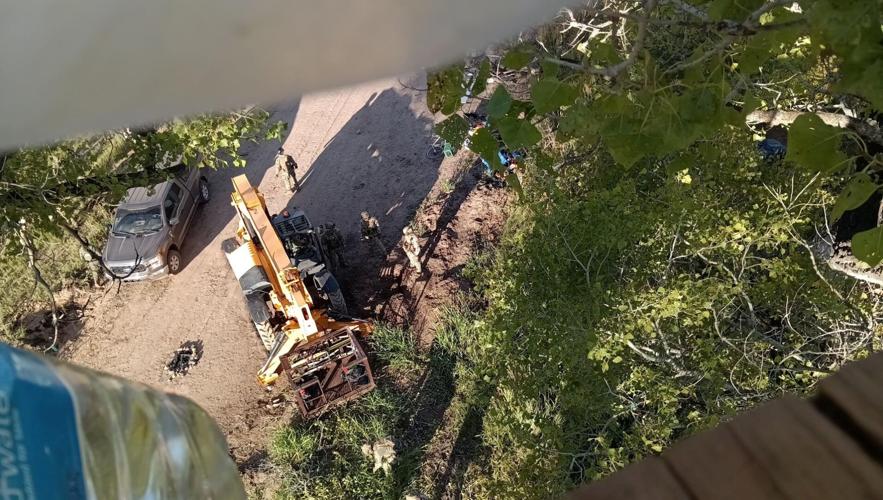
The toppling came after law enforcement officers raided a nearby encampment of self-described “land defenders” just after sunrise and used a crane to pull a demonstrator from the branches of the tree, according to Erick Meza, borderlands coordinator for the Sierra Club who has also been serving as a spokesman for the protest group.
Meza said Border Patrol arrested about a dozen people, though some of them were in the process of being released early Monday afternoon.
People are also reading…
U.S. Customs and Border Patrol spokeswoman Jessica Turner confirmed the removal of the tree but did not acknowledge the law enforcement action or provide any information about it.
Turner did not respond to the Star’s questions about how many arrests were made or provide the locations and alleged offenses of those taken into custody.
According to a press release from the protest group, more than 50 armed Border Patrol agents entered the encampment on private property next to the border at 6:30 a.m. The release states that the officers ignored demands for a warrant and refused to identify themselves as they knocked down tents and tackled protesters.
A video from the scene shows officers, most of them wearing masks, tussling in the grass with demonstrators.
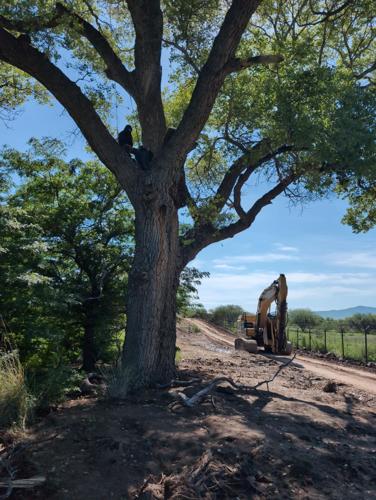
Once the activists were forced out of the way, Meza said, construction equipment was brought in to remove the tree-sitter from a platform in the branches, about 60 feet above the ground, and then topple the roughly 100-year-old Fremont cottonwood.

Before the Border Patrol used a crane Monday to pull the demonstrator from the tree, a protestor sat in a cottonwood tree to try to save it from destruction by federal contractors building a new double barrier along the U.S.-Mexico border in the San Rafael Valley near Lochiel.
Santa Cruz County Sheriff David Hathaway said his office did not take part in Monday’s raid and didn’t know anything about it until after it was over.
Hathaway said it is standard protocol for outside agencies to notify local authorities before conducting operations in their jurisdictions, but that did not happen in this case. “Nobody told me,” he said. “It was just as much of a surprise to me as anyone.”
Santa Cruz County deputies arrested a Tucson man on suspicion of criminal trespassing on July 27 after he allegedly tried to block equipment at the border wall construction site near Lochiel. Since then, though, Hathaway said he has instructed his officers not to participate in the arrest of protesters on federal property along the border or house anyone in a county jail cell who is arrested for protesting the wall project.
He said he has received numerous requests from the Border Patrol, the border wall contractor and the contractor’s private security personnel to arrest activists for trespassing in the San Rafael Valley. “We have said no. This is a federal project. This is a federal matter,” Hathaway said.
Protestors had occupied the so-called “Grandmother Tree” day and night since July 29, after workers brought in by North Dakota-based wall contractor Fisher Sand and Gravel knocked down three other mature cottonwoods growing nearby in the 60-foot-wide strip of federally owned land known as the Roosevelt Reservation along the southern border.
The demonstration in Lochiel has since expanded to include an encampment — and another tree-sitting protestor — at a cottonwood on the Mexican side of the border, right across from the Grandmother Tree.
The activists, sometimes dressed as endangered animals, have also blocked work at border wall construction sites elsewhere in the San Rafael Valley, where the Trump administration is in the midst of building primary and secondary border barriers that could eventually seal off nearly the entire southern border from the Pacific Ocean to the Rio Grande.

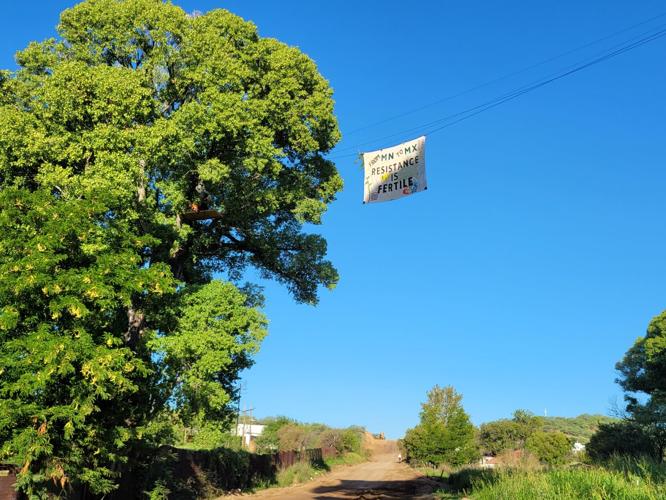
Before a giant cottonwood tree was toppled Monday on the U.S. side of the border for wall construction, a banner hung between Fremont cottonwood trees on both sides of the U.S.-Mexico border at Lochiel, Arizona, as part of a tree-sit protest.
Monday’s action came within days of an emergency closure order from the U.S. Forest Service that blocks public access to portions of the border where wall construction is planned or already underway.
The Sept. 28 order, citing "public health and safety," includes portions of the Coronado National Forest along the international boundary on either side of Lochiel and in an area from west of Nogales to the eastern edge of Buenos Aires National Wildlife Refuge.
The Bureau of Land Management issued a similar order earlier last month barring public entry to a 4-mile stretch of the border in the San Rafael State Natural Area near Lochiel.
U.S. Rep. Adelita Grijalva criticized the closures and the arrests that followed it.
“Just days after the U.S. Forest Service closed miles of public lands along the border, armed Border Patrol agents conducted a raid that injured protesters and uprooted the last of four century-old cottonwood trees,” the Democrat from Tucson said in a written statement. “That is why public access and oversight are so critical. Instead, DHS is following the same playbook: shut out the public, evade scrutiny and recklessly bulldoze our lands.”
The day before Monday’s law enforcement action, the Lochiel camp hosted a gathering to raise awareness of the ongoing protest activity and to celebrate a recent court ruling that halted border wall construction in the Big Bend region of Texas amid opposition there.
Meza said between 70 and 100 people attended the all-day event, which was scheduled to include food, music, costumes, a parade, a plant walk and informational presentations.

A photo taken from the branches of a cottonwood along the U.S.-Mexico border Monday morning shows federal agents preparing to remove a protester from what activists nicknamed the “Grandmother Tree.”
Monday’s raid won’t deter those fighting against the border wall, he said. Already, follow-on protests were in the works, starting with a rally held Monday afternoon outside the Tucson federal building.
Several dozen people attended the hastily assembled gathering downtown, including Michelle Ivarra, who said she was drawn to the protest after making a handful of visits to the “really beautiful and peaceful” encampment in Lochiel.
“There's a lot of grief,” Ivarra said. “It was really painful to see my friends being arrested and detained in such violent ways, so illegally and suddenly. It was something that we knew might be coming, but without a warrant, without anything, it was just really painful and shocking.”
The raid was especially jarring after Sunday’s triumphant gathering beneath the “Grandmother Tree,” she said.
“We were kind of celebrating the fact that we had been able to stave off construction and protect the grandmother for this long, and now they have used that opportunity to really try and strike fear and to kind of kill that hope that we had built,” Ivarra said. “We're not going to let it. We're going to make sure that La Abuela continues to live on.”
According to Meza, activists are now planning a rally outside the BLM’s office in Tucson on Thursday to protest the recent public land closures associated with wall construction.
“It’s really hard to see what’s happened in Arizona,” he said, “but they’re not going to be able to stop the movement they sparked with the destruction of these beautiful trees.”
Star reporter Analeise Mayor contributed to this story.
Contact reporter Henry Brean at hbrean@tucson.com. On X: @RefriedBrean

Henry Brean
Reporter


 Second wall planned across Arizona as Trump administration doubles down on border