Federal agencies have declined to renew permits for a dozen water stations operated by the Tucson-based nonprofit Humane Borders to help migrants trekking across the Arizona desert, the group said.
The decisions by the Bureau of Land Management, National Park Service and U.S. Fish and Wildlife Service affect 30% of the permitted stations the nonprofit typically operates, according to Humane Borders. The remaining stations are on private or locally managed land.

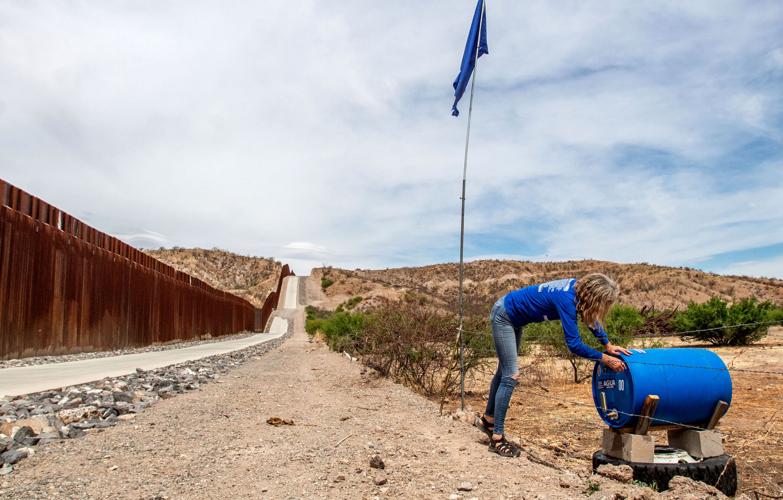
In this 2025 file photo, volunteer Christy Coverdale Stewart checks the water level at a Humane Borders water station near Sasabe.
While the stations provide drinking water for migrants they also are used by others traveling across the desert, including hikers and hunters, the group said.
Humane Borders fears losing the stations will lead to more deaths in the desert, said Octavio Fuentes, the group's executive director.
The permit nonrenewals began earlier this year. In March, Humane Borders removed one station at Cabeza Prieta National Wildlife Refuge and two at Buenos Aires National Wildlife Refuge, both managed by the U.S. Fish and Wildlife Service, said Laurie Cantillo, the group's board chair.
People are also reading…
Last week, the Bureau of Land Management informed the nonprofit by phone that permits for three stations at Ironwood Forest National Monument would not be renewed, Cantillo said. The group was given 30 days to remove the stations. It plans to take them down at the end of October.
Those stations operate seasonally from May through October, during the hottest months, and have seen recent use, she said.
At Organ Pipe Cactus National Monument, the National Park Service denied a permit renewal application covering six water barrels, according to a Sept. 28 letter signed by Superintendent Raquel Montez. The existing permit expired Sept. 30.

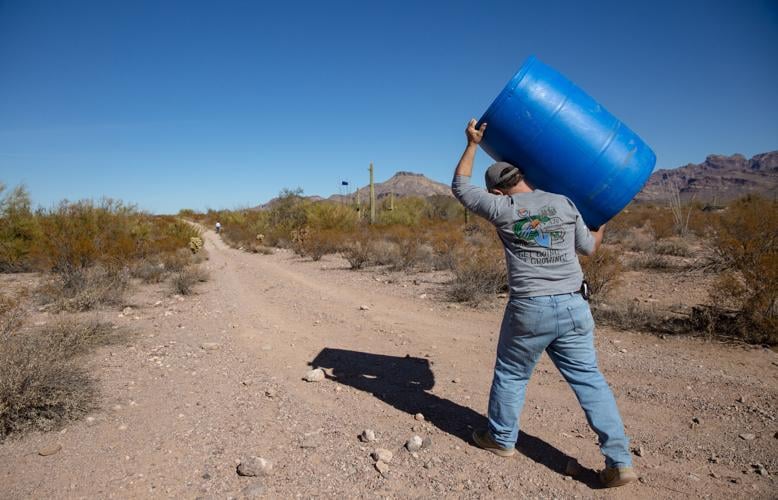
In this 2021 file photo, a Humane Borders volunteer carries a water barrel to a station in Organ Pipe National Monument.
The Park Service said the stations encourage migrants to travel deeper into dangerous terrain under a false sense of security. The agency also said that Humane Borders had not consistently removed trash or monitored refuse at the sites, with several weeks sometimes passing between inspections or cleanups.
The agency cited federal regulations governing permits, sanitation and unattended property. Montez also wrote that continuing to allow the stations would be inconsistent with cooperation with federal partners to strengthen border security within the monument.
In a response letter, Fuentes disputed the agency’s reasoning, saying monument staff had not raised those concerns with him, the organization’s staff or its field volunteers. He said Humane Borders first obtained a permit in early 2001 and had renewed it annually since.
“Our stations follow the deaths; they do not lead them,” Fuentes wrote. “We place water where people are already dying.”
The Park Service requested removal of the equipment as soon as possible. Fuentes said Humane Borders would comply and remove the stations by Oct. 30.
Cantillo said five stations remain at Organ Pipe and would be removed in about two to three weeks. A sixth was removed last month after a road closure prevented the group from accessing it, she said.
The remains of 16 people have been recovered within Organ Pipe this year, more than twice the total for all of 2025, according to Humane Borders’ response letter. Ten were found within a week of their deaths, Fuentes wrote.
The remains of 19 migrants were recovered in the Southern Arizona borderlands in July, the highest monthly figure in two years, the Arizona Daily Star previously reported, citing data from Humane Borders and the Pima County Office of the Medical Examiner. Some of those remains were months old when discovered.
More than 4,500 migrants’ remains have been discovered in the region over the last quarter century, according to the Star’s report.
Founded in 2000, Humane Borders works with public and private landowners to maintain water stations marked by blue flags. The stations use 55-gallon blue barrels and are placed in areas where migrant deaths have occurred, according to the group.
Humane Borders said it has partnered with federal agencies in Arizona for 25 years and will pursue every lawful avenue to restore water access at the affected locations. Its work will continue with ranchers, local government partners and other supporters, the group said.


 Arizona man hospitalized in Equatorial Guinea; U.S. officials mum on abuse claims