When Oklahoma lawmakers finally gave Sheriff Jim Mullett the go-ahead, he began to rein in Garvin County’s marijuana businesses and shut down the illegal ones.
Mullett said there were 470 grows in the county in 2021. With the Oklahoma Bureau of Narcotics and Dangerous Drugs Control, the state attorney general’s office and other local, state and federal agencies, Mullett said he and his deputies brought the number of grow sites down to 33.
But what happens to all the stuff left behind — including the land, chemicals and agricultural equipment?

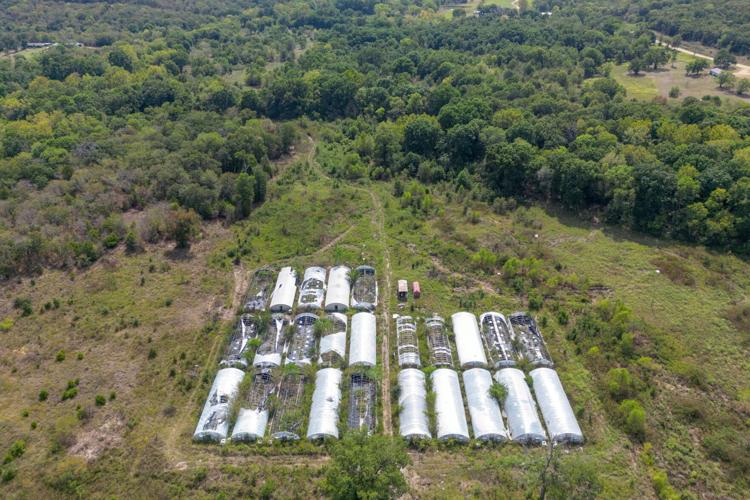
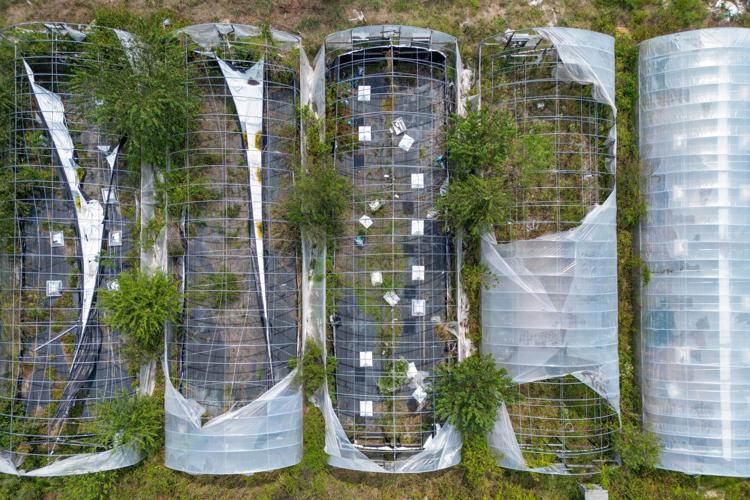
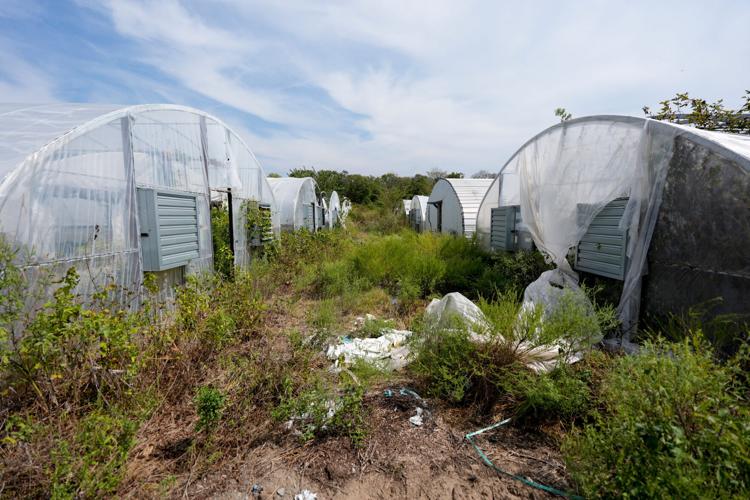
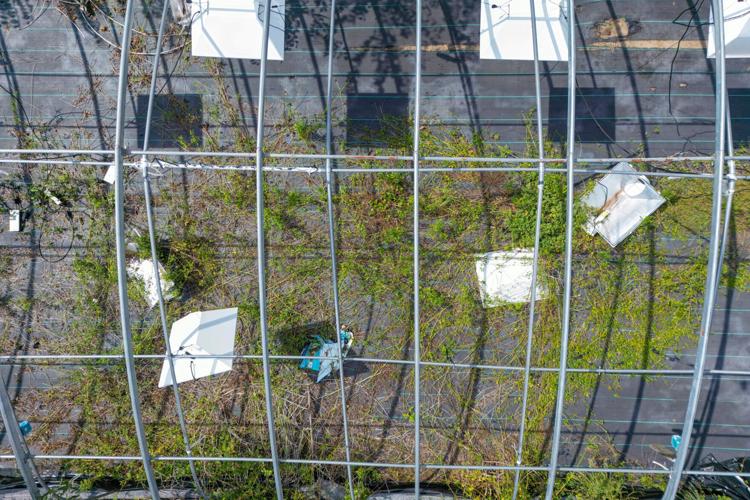
Grow houses are in various states of disrepair at the site of a former marijuana grow in Holdenville, Okla.
“What’s going on in, around the state of Oklahoma, is that you got these abandoned grows that are just left there to rot, and now you got trash, and it’s all grown up,” Mullett said. “It’s land that’s not being used.”
In 2018, Oklahomans voted into law a medical marijuana industry that had few regulations and possibly fewer safeguards. At the high-water mark in 2021, Oklahoma had more than 9,000 licensed marijuana grow facilities.
People are also reading…
When hundreds of licenses were shown to be fraudulent, many operators walked away. Officials believe as many as 6,000 were shut down, sold off or abandoned.
Possibly thousands of those properties are now derelict. Thieves target them for copper and equipment. Chemicals and pesticides often sit deteriorating, at risk of leaking into the soil and groundwater.
Hear why Pat Foor bought an abandoned marijuana grow site in Holdenville, Oklahoma.
Boom, then bust
In 2021, Gov. Kevin Stitt tapped Adria Berry, an attorney, to lead the Oklahoma Medical Marijuana Authority. The state oversight agency put in place a quality assurance lab, a team dedicated to analyzing consumer pot products. It also has field inspectors and handles administrative enforcement of state rules.
Berry said the authority now tests the legally grown pot for potency and harmful chemicals, but it also must regulate the sites at which pot is grown.
When voters passed State Question 788 in 2018, OMMA’s task was to turn out licenses within 60 days, with few safeguards. Soon, a scheme emerged in which out-of-state owners paid residents to falsely claim the required 75% local ownership of a given property.
The Oklahoma narcotics bureau uncovered that hundreds of grow sites and other businesses were operated through such straw ownership schemes. Hundreds of such illicit businesses were closed, making the issue of cleanup more pronounced.

A marijuana grow site sits abandoned in September in rural Holdenville, Okla. The property was sold at an auction, with its new owner, Pat Foor, left to clean up.
One of the first legislative attempts to address the problem came in 2023, in which a licensed grower would pay a bond for cleanup required should the grow be closed. Sen. Darcy Jech, a Republican from Kingfisher, was one of the authors of the bill.
Jech said he believes there were once 9,400 grows operating in the state, and fewer than 1,800 still exist today. “Do the math,” he said. “That’s a lot of grows that have been abandoned out there, and they’re in various stages of disrepair.”
Brian Surber, a deputy director at the narcotics bureau, told a House committee in October that operators may have abandoned as many as 6,000 grows. No official number has been published.
The Oklahoman reporter Ben Fenwick explains how the state's medical marijuana industry, which grew exponentially in the beginning, has changed after several years.
Surber showed lawmakers photos of the abandoned grows, including illegal pesticides dumped into a hole. Piles of trash, buckets of chemicals and other debris were left to drain into the watershed and into rivers and lakes used for drinking water. He described illegal toilets draining directly into a nearby pond.
All of it requires intensive cleanup, and money.
“Just forfeiting these, when we have an illegal grow on it, has proved to be extremely complicated for us,” Surber said.

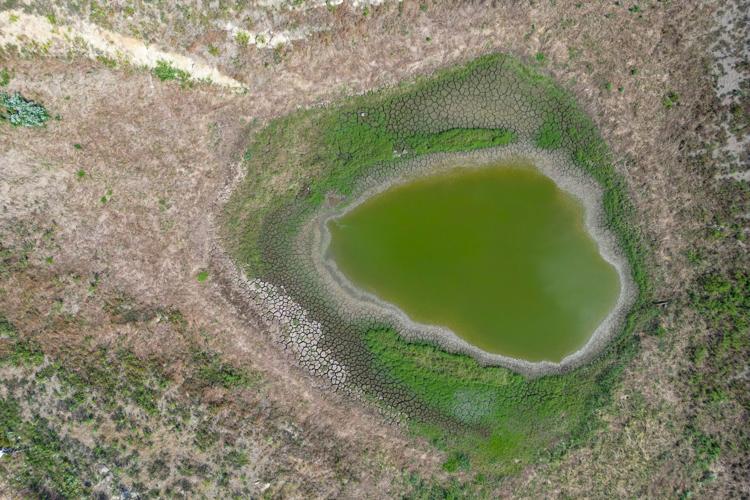
A drained lake bed sits on the property of an abandoned marijuana grow site in rural Holdenville, Okla.
Land seized for such activities is difficult to sell, Mullett said, because few want to buy land laden with potential environmental hazards.
According to the OMMA’s website, the new law required license holders to submit proof of a $50,000 bond to be used to clean up a property.
“We have revoked quite a few licenses,” Berry said. “But we have attempted to pull bonds and have as yet been unsuccessful.”
Not one bond has been used to clean up a single site, she said. In many cases, responsibility and authority as to who is supposed to supervise such a cleanup, or through what office the bond money would be dispensed, is unclear.
Outside of the bonds, lawmakers have not dedicated a funding stream for cleanup costs.
Jech said the issue of which agency has jurisdiction over abandoned grows and who will pay for cleanup of polluted sites will be discussed at an Oct. 6 hearing.

Officials believe rural Oklahoma is littered with thousands of abandoned marijuana grows, often with chemicals and other hazardous materials left behind.
Weapons-grade poisons
Authorities say one of the most vexing problems is the presence of hazardous chemicals, including some outlawed in the U.S.
In July, federal prosecutors in Muskogee charged two men working at a legal marijuana grow with smuggling in illegal pesticides from China.
Other states linked marijuana grow sites to illegal pesticides with nerve agents that are deadly if inhaled.
In California, where illegal grows abound in the state’s many national parks and forests, illegal grow operations are blamed for the death of wildlife unfortunate enough to come into contact, according to several reports. These include isoprocarb and fenobucarb — neurotoxins so dangerous, they have no legal use in the U.S.
In July 2025 in northern California’s Siskiyou County, officials declared a state of emergency regarding illegal marijuana grows using these and other illegal pesticides. The proclamation stated the growers used sawdust soaked in the substances, which was then burned, fumigating the grows with “thick, poisonous smoke” comparable to “chemical warfare nerve agents by attacking the central nervous system.”
The Oklahoma narcotics bureau reported that such pesticides also are found regularly in illegal Oklahoma grows.

Debris litters the site of a shuttered marijuana grow site in rural Holdenville, Okla.
Additionally, marijuana grows use strong fertilizers and even different hormones on the plants to boost production and the levels of tetrahydracannibinol, or THC.
The compounds can leach into the groundwater or drain into the local watershed through runoff. All can devastate the land surrounding the site, said Mourad Gabriel, an ecologist and the co-director and co-founder of Integral Ecology Research Center in Blue Lake, Calif.
Gabriel said the West Coast state struggles to contain the damage caused by as many as 4,500 illegal grows in its parks and forests.
“That is not even mentioning the numbers of private abandoned sites or state land sites,” he said. “Those are just federal trespass cultivation sites.”

The compounds also threaten agriculture. The runoff goes into water used for cattle and farm irrigation. They’re often present in marijuana products that users with legal prescriptions consume for their health.
Gabriel said smoking cannabis with traces of these compounds on it acts just as it would if the pesticide were being burned to fumigate a growhouse. The burning activates the compounds in the mouth and lungs of the consumer.
In May, OMMA issued a recall for more than 200 different marijuana products after tests revealed pesticides in the products.