
This beeping has a rhythm to it, almost like the sound of a machine in a hospital room.
A lifeline is what it sounds like, and that is exactly what beep ball has been to Pete Trejo Jr.
He was a high school baseball player once, first at Flowing Wells and then Desert View. It has been a couple decades since then, but he still looks like one, standing in his Arizona Phenoms jersey on a windy Tuesday night.
In other parts of Tucson it will hail on this night, but Palo Verde Park will remain mostly unaffected, spare a few drops here or there.
This is good. The Phenoms have a game to play.
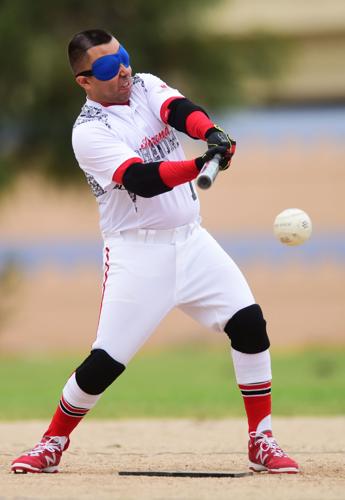
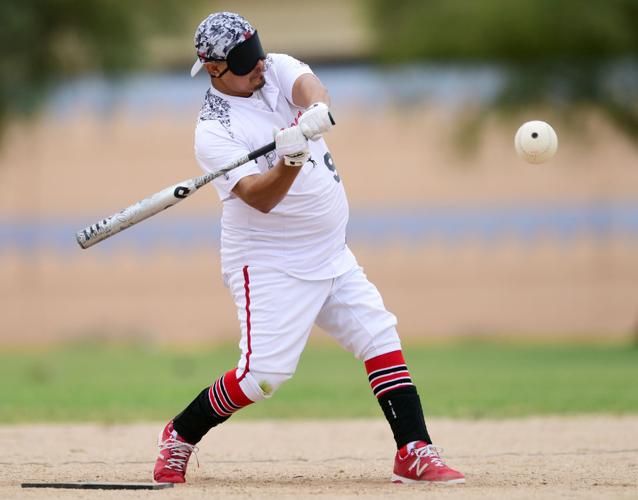
Trejo jaunts to the plate as if he has been waiting all day for his turn. He kneels and places his bat on the ground next to home plate, measuring it against the width of the plate, lining himself up. He stands and swings the bat a few times, digging his back foot into the dirt. He tugs at his jersey as it hangs off his shoulder. He looks like a stouter Ichiro Suzuki, especially with the shades he’s wearing.
People are also reading…
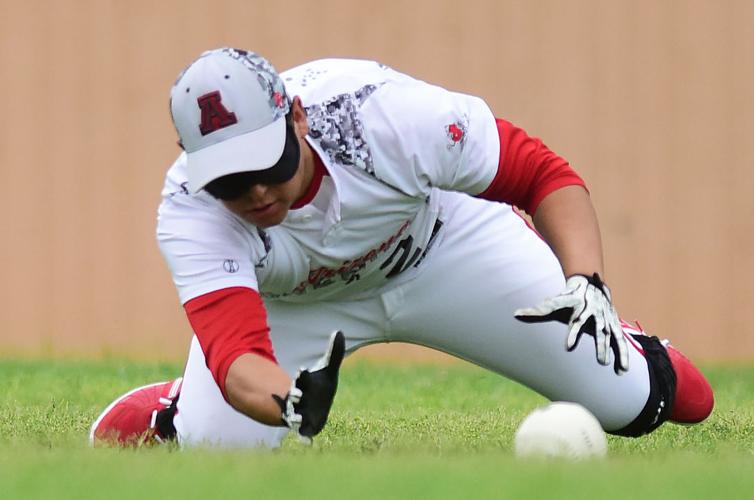
The pitcher lobs the ball toward Trejo, and he listens intently. The beep gets louder, louder, louder, and … bam! He pivots and swings, driving the ball up the middle. The fielders barely move, frozen by the fear of midnight. The defense is made up of mostly volunteers in this friendly exhibition, blindfolds on tight, volunteers who don’t often have to rely on senses two through five.
Trejo drives hard and runs right, bearing down an invisible base path.
He runs hard and tough, straight toward a buzzing base that he cannot see, straight into the dark.
•••
An athlete, even one whose best days are behind him, is always in search of a moment.
Not all moments are moonshot home runs in blue cloudless skies to win Game 7 of the World Series. Honestly, most aren’t. A chubby senior offensive guard gets his first start and pancakes a defensive end; he doesn’t forget that.
That’s a moment. A girl in pigtails and hockey pads splits two defenders and pokes it through the five-hole and it is seared in the memory bank for life.
Trejo’s came in 2010, against the Carolina Pride. He hit a ball — smashed it, to be clear — and he was safe by a mile. Running to the dugout, a member of the Pride stopped him and said it was the highest and furthest he had ever seen a ball hit.
“I got my moment,” Trejo said.
Just a few years earlier, Trejo wasn’t sure he ever would have them again.
Like anyone who suffers a sudden loss of vision, he wondered if he’d be able to experience the joys of life in the same way, sports in particular. His two young children, Petey and Gabriela, shared his passion. With his sight gone, he worried he would become a spectator for the rest of his life.
Beep ball, he says — and his family agrees — has saved him from the fear.
“Honestly, if beep ball didn’t exist, it’d be really scary,” said his sister, Sonia. “It gives him a joy. It really does. It gives him something to hang onto. Pride. Emotionally it has matured him. His outlook is totally different.”
It is that kind of spark of optimism that motivates Christian Padilla in his role as a life skills coach for the DIRECT Center for Independence, a Tucson-based organization that promotes independent living and supports people with disabilities.
Padilla is among a small core of players — including Trejo, Sam Griswold and Nick Waldron — who split off from the Southwest Slammers of the National Beep Ball Association to form the Phenoms this season.
Padilla has quickly become enamored and involved, spearheading a fundraising drive to help send the team to this month’s Beep Ball World Series in Rochester, New York. He only began playing last year. Attending the 2014 World Series — held in Rochester, Minnesota — “was a game-changer for me in many ways.”
“I had never seen so many blind people together before,” he said. “It opened up my mind.”
For years, Padilla said, he was under the impression that the sport wasn’t competitive, and the last thing Padilla wanted to do was play a game for fun. Padilla lost his vision at the age of 9 because of medical negligence. Born and raised in Mexico, he said an ear infection worsened and ultimately spread to affect his vision, though through various surgeries he gained some sight back. Because he has spent the majority of his life with vision difficulties, he learned early to adapt and thrive in sports in which he could compete seriously.
He participated in track in high school and won back-to-back track gold medals in the Special Olympics in California, he said. He has boxed and kickboxed. He’s always had that competitiveness, though, and unless the stakes are somewhat high, Padilla doesn’t buy in.
It took some prodding from University of Arizona women’s wheelchair basketball coach Peter Hughes, a co-worker and friend, to convince Padilla to give beep ball a shot.
“For me, it was easy winning track events, but when Peter asked me to try out, I thought it was going to be an easy game and no competition,” Padilla said. “But once I tried it out, I’m so glad he insisted on it. I fell in love with it.”
And not just the competitiveness, but the camaraderie.
The Phenoms have found within themselves, within the sport, a sense of togetherness with people facing the same situations, the same highs and lows, the same triumphs and struggles.
This is something Padilla experiences every day in his professional world, and beep ball has helped him find a way to combine those two passions, his love of sports and his love of service.
On Tuesday, no one cheered louder as Cesar Lazcano walloped a pitch into right field. Trejo heard about Lazcano, an excellent athlete from Casa Grande who recently lost his vision, and convinced him to make the trek to Tucson to attend a Phenoms practice.
Now, Padilla said, “he honestly might be our MVP.” He’s opened up a bit to Padilla in post-practice lunches, talked about his struggles.
“You realize the barriers everyone faces,” Padilla said. “Before, he’s thinking to himself, ‘I have my life planned out, I’m going to become firefighter.’ And my role is saying there are jobs out there where you can still serve people and have that sense of accomplishing something. That’s where the life skills coach side of me comes in. ‘You’re great at sports and you should pursue it, you have to, to live a more fulfilled life. There are people like yourself, like myself, who are going to be accomplishing bigger and better things.’
“There’s a point in time it hits them: ‘It’s limitless what I can do.’”
•••
There are tough times, too.
Pete Trejo calls them his blind days.
“I’ll be going and going and going, and maybe I have an awesome dream that night where I can see my kids, and I wake up and I go, ‘Oh my god.’ It hits you to the heart. It hangs a cloud over you that you can’t run away from.”
The lights went out on a Sunday in 2006. He was 26.
Trejo, a welder, went to work on a Friday and remembers waking up on a Sunday on his way to an emergency room, unable to see. A year earlier, a rock hit him in his right eye, and he lost vision.
It was a pain, literally and figuratively, and maybe his left eye overcompensated. Or maybe it was as simple as, he says, not properly taking care of his diabetes.
Either way, by 2007, diabetic retinopathy robbed him of his vision completely.
He was depressed. Frightened. Afraid of how things would change. How am I going to be a dad? How am I going to play catch? How am I going to work and be a provider again?
“The dark days are exactly that,” Trejo said. “They’re dark.”
He underwent more than a dozen surgeries to correct his vision. They didn’t work.
Gradually, he began to accept help, comfort, support.
“Tucson has great resources for blind people,” he said.
With the help of Arizona’s vocational rehabilitation services, Trejo attended the Colorado Center for the Blind in Littleton. He learned how to read and write braille, learned to walk with a cane, to cook and clean. As he says, he learned to live life all over again as a blind man.
He returned to Tucson following nine months in Colorado and, soon after, took up beep ball. The sport traces its origins to the mid-1960s, when an engineer at Mountain Bell Telephone named Charley Fairbanks installed a beeping device in a softball.
A team from Colorado had a tryout down in Arizona, and he and current teammate Griswold made it. Before he went blind, Trejo was training for his first amateur match as a boxer. He admits freely now that he needed to find an outlet like beep ball, that he needed that outlet like he needs oxygen, or water.
“It’s almost a necessity now,” he said. “It helps us feel accomplished. It’s a challenge. A ball is hit at you, you get it, you stop it; you hit a ball in the air, you run freely. It’s a lot of trust, it’s a lot of chemistry. It gets in your blood.”
And in your bloodlines.
•••
Almost a decade ago, Trejo learned he would never again see. Instantly, he thought of his children. He’d only barely learned how to be a father. Now he’d have to learn how to be a blind father. How would they feel? How would they connect?
On this Tuesday in Tucson, the sun is peaking through clouds, dropping over the mountains. Dusk is upon us.
The team lines up for a team picture, and Pete is happy. He is married again with two young children and a great job as a software quality assurance manager for AudioEye, a company that, Trejo says, acts as the “ramps and the rails for the Internet.”
He is embracing fatherhood all over again, and now, there are Trejos all around him.
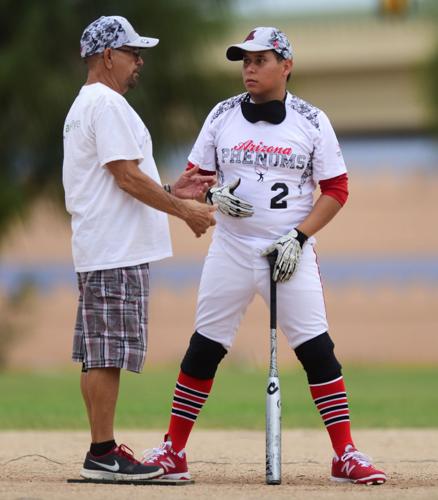
Pete’s sister Sonia is a spotter, a position that his wife, Haley, often plays. Dad, Pete Sr., is the team’s coach. And his kids, the ones with whom he was so worried about connecting?
Gabriela is off to Pima on a softball scholarship, and Petey is a baseball star in Chandler.
That is, when he’s not playing with dad. On Tuesday night, Petey served as the Phenoms’ pitcher.
“I can’t go out and play catch with him, but I’ve figured ways to (play) pepper with him,” he said. “We have home run derbies. He says, ‘I’m gonna beat you, Dad,’ and then when I beat him he says he wasn’t trying. There’s a competition with him and me that I never thought I’d have.”
When she sees them together, Sonia Trejo is reminded of the player she used to see, the one so concerned with how he looked in his jersey, how he looked in his strut.
“Awesome ballplayer, awesome ballplayer,” Sonia says. “But I’ll never forget the first day I saw him practice this. It just turned me inside out. He plays just like he did then. … He could’ve just stopped and stood on the sidelines of life and stood and cheered. But he’s in it. He can share it, it brings him and his kids closer together, brings all of us together, and everybody is just so proud of him because he didn’t, he didn’t stay stagnant, he didn’t stay lost, in the dark.
“He pushes through.”
Trejo now he sees a whole new future. One he never thought he’d see.
“My family asks me, if they had an eye transplant for you, would you take it?” Trejo said. “Before I went blind, I wasn’t living the right way. I was into materialistic things. Now I believe in meaningful things. I think I’d rather stay blind. If I could see them one day, every now and then — I’ve never seen my little girl, my little boy; it’s been years since I’ve seen my wife — I would.
“But I like the person I am blind.”