




This story was created by #ThisIsTucson and underwritten by the Humane Society of Southern Arizona. Thank you for supporting the local organizations that support us!
There are 13 rattlesnake species in Arizona and 36 total in North America and South America, according to the most recent data.
Howard Byrne, the curator of herpetology, ichthyology and invertebrate zoology at the Arizona-Sonora Desert Museum, says that data is ever-changing.
With more than a dozen species currently in our home state, #ThisIsTucson recently chatted with Byrne to find out more about rattlesnakes and how to avoid them. Plus, read about the Humane Society of Southern Arizona's rattlesnake avoidance classes for dogs!

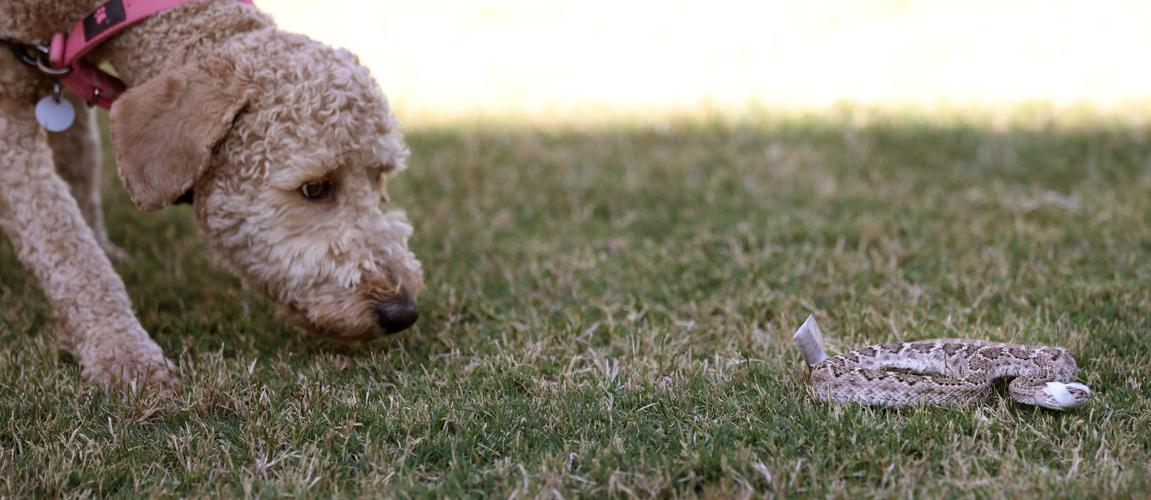
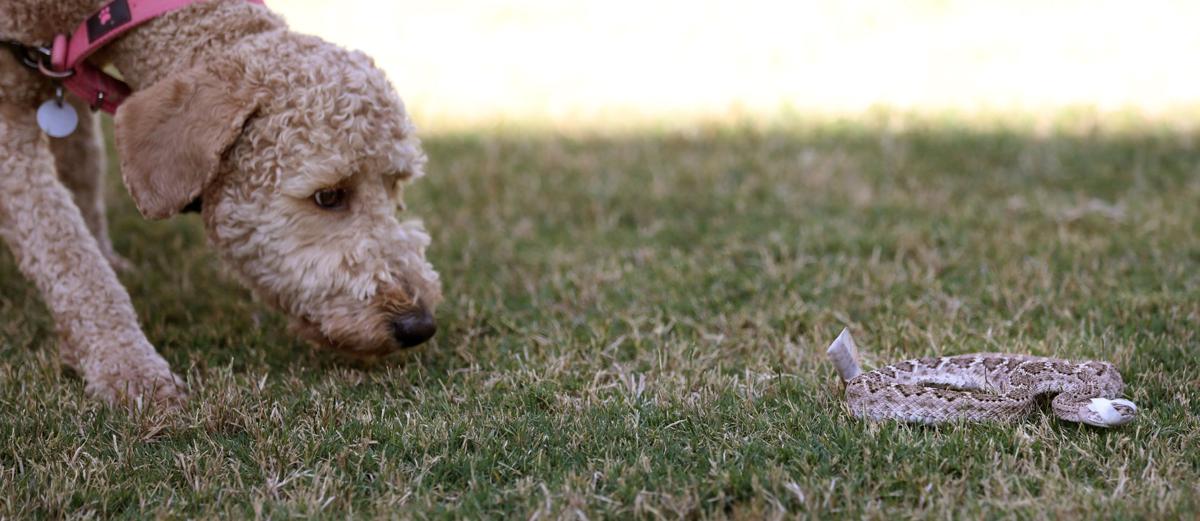
A western diamondback rattlesnake stands alert during one of the Humane Society of Southern Arizona's rattlesnake avoidance trainings for dogs.
Let’s slither into some fun and interesting facts about rattlesnakes 🐍
Unlike constrictor snakes that have to wrap themselves around their prey, rattlesnakes can “strike from a distance and let the venom do the work,” Byrne said. In addition, with their super-strong senses of smell, rattlesnakes can track their wounded prey no matter how far it has attempted to flee.
Rattlesnakes have around 10 different defense mechanisms, including remaining motionless, camouflage, fleeing and rattling. However, rattlesnakes aren’t “cookie-cutter” animals, according to Byrne. Instead, they can mix and match any defense mechanisms to fit an individual situation. They also have the ability to choose between fight or flight.
Rattlesnakes have excellent memories that allow them to remember where dens and holes are so they can burrow and escape from extreme temperature changes.
A rattlesnake can strike at about one-tenth of a second, which is “faster than our eyes can track it,” Byrne said.
Rattlesnakes are their “own living water dish,” according to Byrne. Water droplets are able to stick to their keeled scales, which allows them to drink water without going anywhere. Byrne says that no other snake in the desert can do that.
Rattlesnakes’ pupils can appear very round at nighttime or in lowlight.
Baby rattlesnakes have brightly colored tails, according to Byrne.
No rattlesnake can deliver all of its venom in one bite. “Defensive bites are usually very quick and very brief,” Byrne said.
Baby rattlesnakes aren’t necessarily more dangerous than adult rattlesnakes. “While some components of young rattlesnake venom can sometimes be more concentrated, if we're going to talk about a defensive bite, the most dangerous rattlesnake potentially would be the larger one, because it's a volume thing at that point,” Byrne said. “So their ability to dose that larger volume is of much greater concern than anything a small rattlesnake can deliver.”
A few rattlesnake avoidance tips
Here's what Byrne said about how you can avoid rattlesnakes:
Respect rattlesnakes and they’ll respect you.
According to Byrne, there’s no such thing as an “aggressive rattlesnake” because “all the behaviors that all the snakes do on planet Earth, including rattlesnakes, is only defensive.” This means that a rattlesnake “will never choose to interact with us,” Byrne said. “Rattlesnakes only interact with us when we accidentally or on purpose interact with them.” So if you stumble across a rattlesnake in the wild, give it a little bit of space and understanding and the rattlesnake should happily go on its way.
Communication is key.
Sometimes rattlesnakes will slither close to your home, garage or even dog house, but Byrne says that because rattlesnakes want no interaction, they don’t “want anything to do with us, or our kids, or our pets.” So, in these situations, it’s critical to communicate with others in your presence that there’s a rattlesnake near, so everyone can avoid the snake who may just be temporarily visiting.
“We just (need to) communicate about the snake and then it leaves. So rattlesnakes are easier to live with than some people really think,” he said.
But if a rattlesnake gets inside of a place it shouldn’t be, Byrne recommends calling in a professional that can safely trap and relocate the snake a short distance away.
Learn more about rattlesnakes and their behaviors.
With so many animals inhabiting the Sonoran Desert, it can be difficult to keep track of the potential dangers that each species presents. But by taking the time to learn more about inhabitants like the rattlesnake, the more informed you can be about protecting both yourself and the animal.
Places like the Arizona-Sonora Desert Museum offer shows to help educate the public about rattlesnakes and their behaviors (where you can learn a few rattlesnake fun facts too).
“I think the more we know about something, the less scary it becomes,” Byrne said.

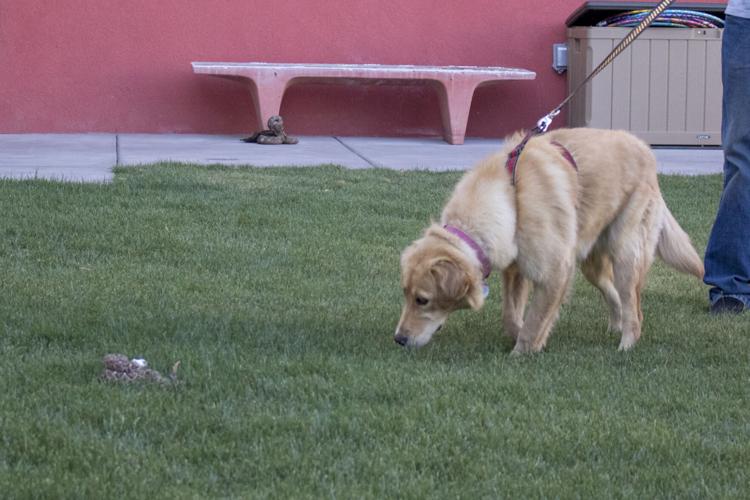
A golden retriever participates in the Humane Society of Southern Arizona's rattlesnake avoidance training classes.
Your dog can learn to avoid rattlesnakes too
The Humane Society of Southern Arizona’s rattlesnake avoidance training sessions return this month in an effort to help local pets avoid costly and possibly deadly rattlesnake bites this spring.
The hour-long training sessions run on Tuesday evenings and Saturday mornings from March 1 through mid-to-late October, with tuition prices starting at $125 for one dog. If you plan on bringing a second dog to the training session, the price is $105 for the second dog. (Important note: There needs to be one handler per dog.)
If you’ve attended an HSSA rattlesnake avoidance training session before, it’s $75 for a refresher course.
The HSSA requires participating dogs to be at least 6 months old, be up-to-date on vaccinations and be in overall good health. Senior dogs are recommended to get approval from their veterinarian before participating in the training, according to Inge Koopman-Leyva, the HSSA’s director of education and community outreach.
“In many cases, when training happens, it's not just protecting your pet, it also actually ends up protecting your humans because then the dogs are warning you of the rattlesnakes,” Koopman-Leyva said. “So it is just another measure that we have in place to help protect dogs and humans against rattlesnake bites that could be deadly and extremely costly and traumatic, more so to the owners and the guardians than to the dog itself.”

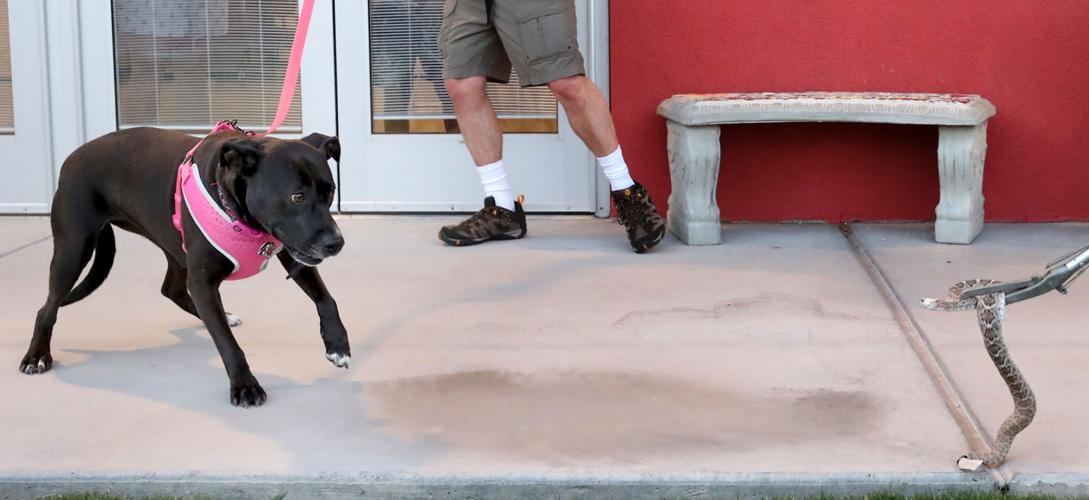
Holly, a pit mix, backs off fast as James Stokoe, with Arizona Animal Experts, approaches her with a tape-bound diamondback rattler during Rattlesnake Avoidance classes at the Humane Society of Southern Arizona in 2019.
So, how does the training work?
The participants will meet up as a group at the HSSA’s Education Center for a 10-minute educational session about rattlesnakes and what to expect during the training. After the brief educational session, dogs and their handlers will go to the courtyard, one at a time, where there will be five stations set up.
“They're all based on sight, scent and sound, so each station really reinforces the previous,” Koopman-Leyva said.
The first station features a model rattlesnake stored in a real-life snake container. The purpose of this station is for dogs to get the sensation of being near a snake. At the first station, pets will receive a shock from a shock collar, which is used to startle the dog and help it associate the shock with the danger of the snake.
“The shock collar is used just to startle the dogs, it's set at a low setting,” Koopman-Leyva said. “And then based on the dog's reaction or nonreaction, it might need to be increased. But it's really to startle them, it's not to cause them pain.”
While the HSSA uses shock collars for this training, it’s not something they regularly endorse, according to Koopman-Leyva. This particular course is an exception because it’s “valuable and life-saving training,” she said.
By the second station, your pet will be able to see and hear a real rattlesnake as it sits in an erected position and rattles its tail. The third and fourth stations focus on sound and scent, including hearing the muffled sound of a rattler when wet and smelling a scent rag that is housed with the rattlesnakes.
At the fifth and final station, the rattlesnake handler will lift the rattlesnake and present it to your furry companion.
“At that point, we want the dog to make their own decision without looking to their owner for guidance and to say, ‘Oh, I want nothing to do with this, get me the heck out of there,’” Koopman-Leyva said.
To make the training as safe as possible for everyone involved, the training is directed by professionals from Arizona Animal Experts, Inc. and Adobe Dog Training.
The rattlesnakes used from Arizona Animal Experts, Inc. have recently been trapped and will be relocated to safer locations. Every snake’s mouth is secured with surgical tape to prevent possible bites.
“That's why we use those animals because they haven't been defanged, so they're not altered in any way,” Koopman-Leyva said. “They have their venom and they're eating live wild prey, where captive rattlesnakes who have been defanged, who are altered, are eating grain-fed rats that live in a warehouse, so they smell different (from wild rattlesnakes).”
If your pet avoids the snake in the final station, the training is considered a success and provides your dog with a tool they can now utilize in the real world while on hikes or just strolling through your neighborhood with you. And one of the most foolproof ways to prevent a possible snake bite is following local leash laws, according to Koopman-Leyva.
There are three main points that the HSSA hopes participants will learn from the program: help dogs become more aware of their surroundings, help owners become more knowledgeable of what their furry companions are trying to tell them and realize the importance of rattlesnakes in our environment.
“Every dog is individual, but for the amount of dogs that we've had go through the class, we've had a very high number of positive cases and people call us and they're like, ‘I was out on a hike and my dog avoided this,’” Koopman-Leyva said. “Like they didn't believe during the class that it worked. But then they'll go out and have a real-life experience and, like, realize, ‘Oh, it did actually work.’”
The HSSA offers Colorado River Toad avoidance training, too! For more information about their avoidance training courses, visit their website.

Learn more about the Humane Society's rattlesnake avoidance classes
The Humane Society of Southern Arizona provides valuable and life-saving Rattlesnake Avoidance training classes for dogs and their owners from the spring to the fall. Each Rattlesnake Avoidance training class gives dogs the necessary training to help prevent an expensive and potentially deadly snakebite.

