

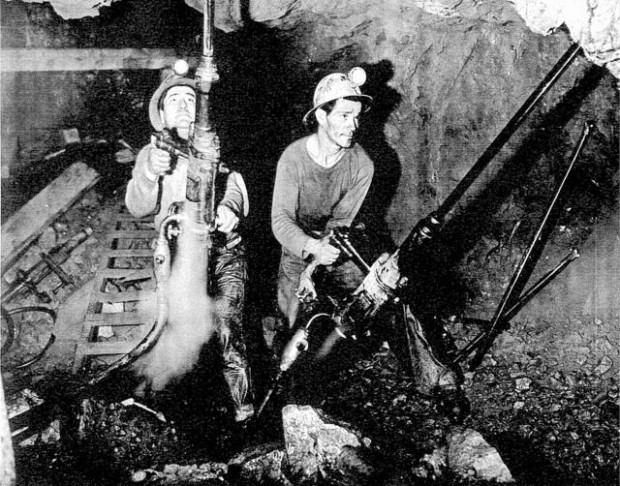
Decades of toil by thousands of workers produced billions in wealth at the former Magma Copper complex on the northeast flank of the Santa Catalinas.
At full production, San Manuel's underground copper mine — the largest in North America — could disgorge an average of more than 38 tons of ore every minute around the clock, every day of the year.
In its lifetime, the smelter produced 14 billion pounds of copper.
The last vestiges of San Manuel's copper legacy are to be blasted into oblivion today.
Twin smelter stacks, each more than 500 feet tall and weighing 10,000 tons, will crumble to the ground as a symbolic, dramatic end to the age of mining at San Manuel. The town founded on mining, 45 miles northeast of Tucson, is changing into a bedroom community.
"It's the end of an era," said Dave Ridinger, a mining engineer who first arrived in San Manuel to work as a shift boss underground in 1956, a few months after the first copper was poured in the smelter.
People are also reading…
Ridinger went on to become a Magma vice president and, later, president of the Arizona Mining Association until 1996.
Magma had a huge impact on the region's employment picture, he said.
"It was a real big thing. What a bunch of good jobs out there. Lots of summer jobs, too, with good pay. One of the problems was the pay was so good, workers didn't want to go back to school."
The smelter, after several modernizations, was "one of the best in the world" in terms of efficient operation and meeting environmental requirements, he said.
"A lot of people put their lives into that place. There's lots of good jobs gone forever," Ridinger said.
Despite innovative labor relations, improved productivity, untapped mineral resources and nearly $1 billion in plant modernization, nothing could derail a corporate decision made on the other side of the globe to put an end to San Manuel's half-century of copper production in 1999.
Anglo-Australian giant BHP Billiton, now the world's biggest mining company, slipped Magma into its global portfolio in 1996 for $2.4 billion. Less than four years later, San Manuel was sent to the corporate trash heap.
BHP didn't pull the plug on San Manuel because the ore was gone. Nearly 2 billion pounds of copper remains entombed in the lower reaches of the San Manuel and Kalamazoo ore bodies that were in production when the lights went out. The decision was based on copper's selling for 66 cents a pound in 1999. Last May, it topped $4 a pound. On Tuesday, the price was down to $2.57 per pound, still a very profitable level.
But San Manuel's production infrastructure was already being dismantled, cut up and carted away by the time the historic rebound in copper prices gained steam.
Reflecting on the copper left in the ground at San Manuel and the difficulties of getting permits for new mines, Ridinger noted that when he left the mining association about 10 years ago, the United States was fairly self-sufficient in copper production. Now the nation must import about 40 percent of its copper needs.
"That's what really gets me," he said.
The 1998 copper output from San Manuel, if sold at last year's average spot price of $3.05 a pound, would be worth $826 million.
Now, nearly every trace of San Manuel's half-century of industrial production has been erased in a $120 million closure project.
One of the largest underground copper mines in the world has been stripped of equipment, sealed and allowed to flood with water. The huge smelter, which once accounted for 25 percent of U.S. copper smelter capacity, is gone, as is a rod plant and electrolytic refinery.
Also gone are more than 2,000 jobs and annual payrolls in excess of $100 million.
Another tally of cost is being constructed along Arizona 77 in nearby Mammoth, where retired miners are erecting a memorial to more than 50 men who died in mining accidents in the area between 1939 and 1998, most of them in the San Manuel underground mine.
Since the 1999 closure of the mine, the landscape has been reshaped by BHP in an effort to return the land to other uses.
The transformation of San Manuel from mining town to residential uses will take time. Thousands of houses could be built in the area in addition to the 1,200 built by Magma Copper in the 1950s to house workers.
BHP Copper owns around 20,000 acres in the area, and up to 9,000 acres are conducive to future residential, commercial and light-industrial development, said Jeff Parker, director of health, safety, environment and community for the company.
After the stacks come tumbling down, the last signs of copper's reign over the area will be gone.