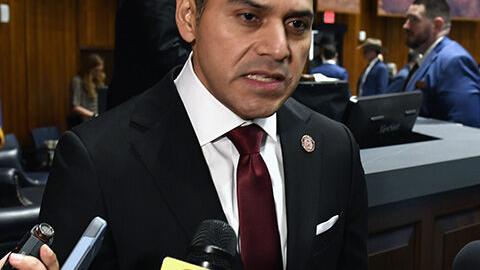
PHOENIX — Attorney General Kris Mayes is telling a federal judge to reject a bid by an immigrant rights group to immediately block enforcement of a new state immigration law, saying there's no evidence anyone's rights have been violated by the week-old statute.
Nor, Mayes' office said, is there any reason to think anyone is at imminent risk of being arrested by state or local police for entering Arizona at other than a port of entry. Authority to make such arrests is a key provision of voter-approved Proposition 314 which, because of legal maneuverings, did not become enforceable until July 14.
The ACLU has sued on behalf of the Florence Immigrant Rights and Refugee Project to try to block enforcement.
People are also reading…
"Florence Project has not shown and likely cannot show that anyone has been subject to arrest, detention, or prosecution for violating the illegal entry provision,'' wrote Assistant Attorney General Timothy Horley on behalf of Democrat Mayes, who is the defendant in the lawsuit.
Horley acknowledged there are other provisions in the new law that allow a state judge to have someone deported as an alternative to jail time here if they have been arrested by state or local police on illegal entry charges. But here, too, no such order has been issued.

Arizona Attorney General Kris Mayes
Mayes' office also told U.S. District Court Judge Michael Liburdi that there's no legal basis for the Florence Project to sue in the first place.
Horley said that organization, which provides legal help to migrants, is not currently representing anyone charged with breaking the new law. Nor is there evidence that the Florence Project will end up with such a person as a client, he wrote.
How it became law
The measure's background is this: In 2024 Republicans in the GOP-controlled Arizona Legislature approved legislation to give state and local police the power to arrest people who cross the border in between ports of entry.
Democratic Gov. Katie Hobbs vetoed the measure, saying it would be "harmful for communities and businesses in our state, and burdensome for law enforcement personnel.'' She also said the legislation "presents significant constitutional concerns'' that "would be certain to mire the state in costly and protracted litigation.''
Undeterred, GOP lawmakers put the issue to state voters, along with some unrelated provisions on things like harsher penalties for fentanyl sellers in case of an overdose death. The measure was approved in 2024 by a 2-1 margin.
Arizona lawmakers, seeking to avoid having to go through litigation, inserted a provision into Prop. 314 saying it could not be enforced until at least 60 days after a final ruling on a virtually identical Texas law. That occurred May 14, making the Arizona law valid this past week.
That led the American Civil Liberties Union, representing the Florence Project, to seek an immediate restraining order, claiming the state was illegally intruding into an area exclusively reserved for the federal government. It also contends the law would curb otherwise legal rights that belong to all, including migrants.
But Mayes' office, in its legal arguments to the judge, said there is no legal basis for him to restrain enforcement of a law that, as far as anyone can tell, has not been used against anyone.
Horley also told Liburdi the right to sue belongs to people apprehended, assuming any ever will be under the new law.
"The Project would be injured only if that apprehended person wished to be represented by the Florence Project, the Florence Project actually decided to represent that client, and the Florence Project was frustrated or impaired from meeting with that client or adequately representing the client's interests,'' Horley wrote. "That chain of speculation is too long.''
Republican lawmakers defend legality
In a separate legal filing, an attorney for Republican House Speaker Steve Montenegro and Senate President Warren Petersen said Prop. 314 doesn't run afoul of federal law because it doesn't regulate immigration.
Their attorney, Beau Roysden, said nothing precludes "aliens'' from entering Arizona through a port of entry for whatever reason, whether to claim asylum, to visit as a tourist, or even for an illegal purpose such as smuggling drugs.
He said the law's application "begins and ends with commonsense border security and the people of Arizona's sovereign decision to require entry through lawful channels — a decision aliens can respect while still lawfully entering the state myriad ways."
Roysden defended the legality of the provision that allows judges to deport those arrested by state and local police. In fact, he argued, it really isn't "deportation'' in the sense of federal law.
The new law makes it a misdemeanor, with a possible six-month jail term, for someone crossing the border from outside a port of entry.
"In such cases, a person can avoid conviction for such illegal conduct by agreeing to an order to return'' (to leave the United States), he wrote.
None of that, he said, requires the person to abandon any pending immigration processing or asylum claims. Roysden said they remain free to try to enter the United States through a regular port of entry.
What's next
Liburdi is set to hear arguments on Friday.
What the ACLU is seeking on behalf of the Florence Project is a restraining order, barring enforcement of the law until there can be a full-blown trial. Even if Liburdi says such an order is not appropriate, that will still give challengers a chance to argue the law is invalid.
But it also would mean that law enforcement, prosecutors and courts would be free to start making arrests and doing deportations while the case makes its way through the legal system.
That could take years as shown by the fact that the law approved in Texas in 2023, on which Arizona's is modeled, has been in court pretty much ever since.
In general, one factor a judge has to weigh when deciding whether to grant a restraining order is whether the challengers have a "likelihood of success'' after a full-blown trial. And if Liburdi finds that the Florence Project does not, that would add another hurdle if and when the case gets heard.