


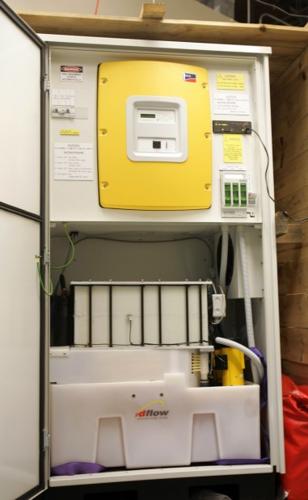

Entering the shop area of Aztera LLC's Tucson headquarters, CEO Manny Teran points to a refrigerator-sized battery and control system housed in a shipping crate.
"This is the answer to all the world's problems - energy-storage problems anyway," Teran said of the "flow battery" module made by an Australian client company.
There are a lot of answers in the works at Aztera's headquarters near West Grant Road and Interstate 10.
In one office, a young engineer mocks up the layout of a test platform for a new kind of diesel engine.
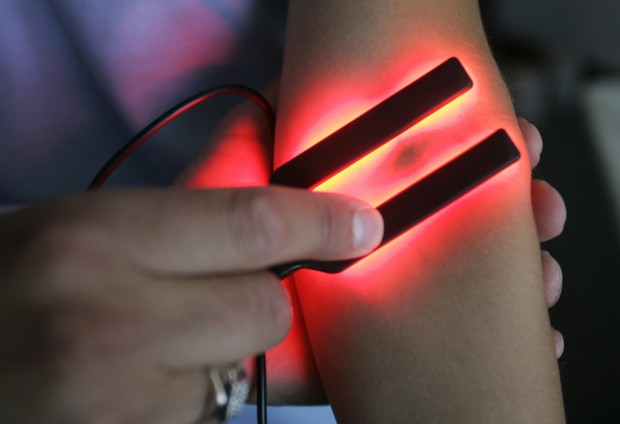
In the company's shop area, a Rube Goldberg-like wooden structure holds an array of pneumatic aircraft valves for testing, a few feet away from setups designed to test a new breathing apparatus for sleep-apnea sufferers and a kind of forked wand that uses light to help nurses locate hard-to-find veins.
People are also reading…
Every high-tech startup company reaches a critical point where it must prove it can make an effective, marketable product.
That's where Tucson-based Aztera (www.aztera.com) enters the picture.
The two-year-old company specializes in testing and technology development, helping high-tech companies transform their laboratory creations into bankable products.
"You've got to make sure what you're doing works, and once you can do that, you can get funding and bring all the other pieces together," said Teran, a University of Arizona engineering grad who founded Aztera.
The company uses off-the-shelf tools, internal processes and expertise of about a dozen engineers and other pros to help tech startups rapidly develop ready-to-market products.
"That's kind of our claim to fame - to be able to do that very quickly," Teran said.
The flow battery is a prime example, he said.
The company developing the technology, Brisbane-based Redflow Ltd., already has tested its zinc-bromine flow battery extensively in Australia, including a system connected to a 1-megawatt solar-power array at the University of Queensland.
But Redflow is still refining the product and needed to create a new version to work with slightly different U.S. power grids.
"The technology might be proven, but how it interfaces to the grid or to solar, or to other things, has to be perfected, and that's what we're helping out with," Teran said.
Energy storage is seen as a major challenge for solar and other intermittent renewable-energy sources.
Redflow's technology is a type of flowing electrolyte, or flow, battery - technology originally invented in the mid-1800s - that uses zinc and bromine in a circulating solution.
Lead-acid storage batteries use lead plates as electrodes that eventually erode away as part of the chemical reaction. The zinc-bromine chemical reaction inside Redflow's battery is essentially a reversible electroplating process, coating carbon-impregnated plastic conductor "stacks" with metallic zinc during the charge phase and then deplating them during discharge.
Not only does the technology lend itself to relatively inexpensive mass production, Redflow's zinc-bromine batteries can be charged up and fully discharged regularly, without significant degradation, said Steven Hickey, head of testing for Redflow.
Aztera has helped Redflow install four of its Zinc Bromine Modules in the U.S. for testing that could lead to larger, utility-scale deployments, Hickey said. The company's testing clients are confidential, but the 5-kilowatt units are being tested in Albuquerque, Florida, on the West Coast and in Tucson at the UA's Arizona Research Institute for Solar Energy (AzRISE).
In Tucson, Redflow is in discussions with AzRISE Director Joseph Simmons on possibly testing the system as part of an energy-storage demonstration project, Hickey said.
The Redflow system could be used with lead-acid batteries or with a compressed-air storage system AzRISE is developing as part of a demonstration project at the UA Science and Technology Park.
The next step, Hickey said, is to create utility-scale 100-kilowatt test units by combining 20 of the 5-kilowatt battery modules.
"I think that will be the door opener for Redflow to engage seriously with some of the big players in the energy market," he said.
Aztera's Teran is all about opening doors for his clients.
The company is a one-stop development shop with about a dozen staffers - mostly UA grads - including electrical, mechanical, bio-systems, chemical, software and optical engineers.
"Where Aztera really shines is where electronics and mechanical and software and optics all come together," Teran said.
Besides helping small tech companies perfect their products, Aztera has designed tests and performed testing for some major companies, including Intel Corp. and a major local defense employer, Teran noted.
A related company Teran started with several partners, NascentMD, focuses on helping medical-device companies, such as Chandler-based Solvonics Medical, maker of the vein-finding device, and Xeridiem Medical Devices, a Tucson firm that designs and makes advanced catheters and similar items.
Teran said he's in discussions to start a for-profit tech "accelerator" - a kind of business incubator - to help push more technologies to market.
That effort should dovetail into the UA's effort to launch a new technology-transfer entity to bring more ideas out of the labs.
"We need to do it," Teran said. "There's no doubt there's technology within the university that's ripe for commercialization."
Contact Assistant Business Editor David Wichner at dwichner@azstarnet.com or 573-4181.