It was a deep, dark subterranean secret.
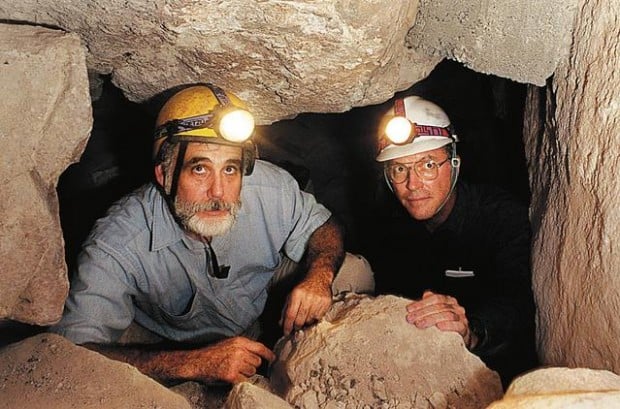
Two Tucson cave explorers — Gary Tenen and the late Randy Tufts — discovered majestic Kartchner Caverns southwest of Benson in 1974. Then, fearing that the cave's fragile limestone formations would be damaged by mobs of unregulated sightseers, they kept their find a closely guarded secret for 14 years.
Only in 1988, after the state of Arizona bought the property and officials made plans to protect it as a park, did Tufts and Tenen publicly reveal their incredible story.
Now, a new book — "Kartchner Caverns: How Two Cavers Discovered and Saved One of the Wonders of the Natural World" — offers a detailed account of this underground tale of adventure and intrigue.
See the cover story inside this section for excerpts from the book and an interview with author Neil Miller. — Doug Kreutz
People are also reading…
This excerpt, reprinted with permission of The University of Arizona Press, begins as the book does with the initial excursion into what the discoverers first called Xanadu — now the world-renowned Kartchner Caverns. The story ends today with the realization of the magnitude of the discovery, but the book continues the tale of approaching the Kartchner family on whose land the cave was found, leading then-Gov. Bruce Babbitt into the undeveloped cave and the opening of the park to the public in 1999.
Randy Tufts and Gary Tenen were always looking for holes in the ground, and on a Saturday in November 1974, they found one. The two young men left Tucson at about one o'clock in the afternoon in Tufts's red Rambler and headed east on the interstate toward the Whetstone Mountains. It was going to be a short trip, just following up a hunch. They didn't bother to bring much caving equipment. They took with them miners' hard hats, which attached to their heads by a chin strap, and carried a hammer and chisels, some rope, and a few crumpled packages of M&Ms and other snacks in their packs. The yellow-white gas flame of carbide lanterns, affixed to their helmets, would provide their only source of light.
Few of the other spelunkers in Tucson's Escabrosa Grotto, the local caving club, had much interest in exploring the isolated mountain range. The Whetstones loomed harsh and uninviting, known primarily for their white-tailed deer and javelinas — the wild, sharp-tusked mammals that look like pigs and dine on prickly pear cactus. It was in these mountains where the Apaches hid out and ambushed military patrols during the Indian wars of the 1870s, where, a decade later, the legendary Wyatt Earp faced down his enemies after his brother Morgan was shot dead at a billiard table in a Tombstone saloon.
But, as Tufts and Tenen knew, the Whetstones possessed all the geologic elements ideal for the formation of caves: limestone, natural faults, and water. What they didn't know was that that day—while the attentions of their caving colleagues back at the Tucson grotto were focused elsewhere, on the Grand Canyon, on Mexico, on the Santa Ritas to the south—they would discover something extraordinary.
Seven years before, in the summer of 1967, while still in high school, Tufts had gone on a caving foray to the Whetstones with his uncle and two friends. On that occasion, in the Whetstone foothills, the group had stumbled upon a sinkhole, a natural depression usually formed by the collapse of the roof of a cave room. The sinkhole was in a low spot, almost invisible due to the contours of the rocky hills. But one of Tufts's companions, Steve Wade, had managed to pick it out. "There's a hell of a hole here," Wade shouted, and the group had scrambled down the twelve- to fifteen-foot-deep "sink." There, they found themselves in a small entryway, with a skull-and-crossbones and a cross carved on the wall and cactus spines and packrat dung littering the floor; they were evidently not the first who had made it into the sinkhole. In the midst of a jumble of large boulders, the visitors noticed a narrow crack descending parallel to the bedrock wall. But they never bothered to explore it, doubting that the crack led anywhere. Tufts marked the spot in his small blue notebook, calling it "Wade's Cave." Then he put the map in a drawer and ignored it for seven years.
Now, in the autumn of 1974, while hiking with his girlfriend, Randy Tufts had come upon the sinkhole again. A week after his rediscovery, Tufts persuaded Tenen, one of his roommates in a "group house" just off the campus of the University of Arizona in Tucson, to drive out with him and investigate. The pair lowered themselves into the sinkhole, quickly finding themselves inside the same dry and dusty entrance that Tufts had visited seven years before. Here, they encountered the skull-and-crossbones on the wall, as well as broken stalactites and footprints, and the ten-inch-wide crack. They could still see daylight through the overhang of the sinkhole above them. But something was different from that day back in 1967. This time, the air seemed to be moving. Through the crack, a faint current of air was coming up from among the rocks, warm and moist and enticing, with the musty smell of bats.
"There has got to be a cave here!" exclaimed an excited Tenen.
Tenen, who at 5'7" was the smaller of the two, wasted no time squeezing through the crack. Back home in Tucson, he had been practicing navigating his way through narrow spaces by wiggling through his closet coat hangers. Tufts, at 6 feet tall and 170 pounds, had a little more trouble: He had to fully exhale to twist through the opening, nearly turning a somersault on the way. Five feet down they came upon a chamber about the size of a living room, just high enough to stand in. Next to it, linked by another short crawl, was a similar room with a lower ceiling and an eight-inch stalagmite in the middle of the floor, expanding at the tip. Tufts, a space enthusiast, thought the formation resembled the footpad of the Apollo lunar module spacecraft.
But the small volume of the two rooms just didn't account for the breeze. The air current had to be coming from someplace else, somewhere farther, deeper underground. In the second room, Tufts and Tenen shined their lights through all the nooks and crannies. They didn't see anything. Just when they were about to give up, hidden underneath a small flowstone shelf in the back corner, Tufts noticed a low, tight crawlway, ten inches high and two feet across, twisting into the darkness in the direction of the air current.
They followed it. Tufts crawled on his belly for an agonizing twenty feet, scraping his ribs and elbows and pushing his pack in front of him along the rough gravel; Tenen inched his way behind him. The passage ended abruptly at a rock barrier.
However, in the center of that barrier was a grapefruit-sized hole, a "blowhole," in caver's parlance, large enough to see through with only one eye. When Tufts shined his carbide lamp through the hole, the swirling air behind blew out the flame almost immediately. For a caver, that was the road sign, a sure clue that there was some kind of passage beyond, a passage that most likely led somewhere. The men lay there for two hours hacking away at the wall with a two-pound sledgehammer and chisel, one person going at it at a time, trading off when their arms got tired. Sweat was pouring off them in the underground air whose humidity approached 100 percent. Tenen was becoming more and more frustrated at the wall's dogged refusal to yield to his persuasions. He swung his hammer back to give it a good pounding and wound up walloping himself in the forehead instead. That happened more than once. But the two men kept at it, focused and persistent.
It was all routine, even if hundreds of pounds of earth were pressing down on their heads, even though the ceiling might potentially collapse at any moment, even if they were surrounded by a sea of darkness and had no idea what lay in front of them. Tufts and Tenen didn't worry about those things. For cavers, it was all in a day's work.
With the constant pressure and pounding, they managed to widen the hole ever so slightly. The air behind it kept moving as if a giant bellows lay on the other side of that wall, as if the earth was taking deep breaths, accompanying them as they worked. Finally, Tenen took off his shirt and was able to squeeze through the expanded opening. He chipped away from the other side so Tufts could just make it through, grunting and scraping. The ceiling was higher on the far side of the blowhole, three feet now, and they could maneuver more easily there. Hackberry seeds and bat guano (excrement) covered the floor. On their hands and knees, they made their way for about 250 feet along a corridor where they could stand up, and where there were no more signs of previous human visitors. The "stand-up passage" was the first indication that they had found something significant.
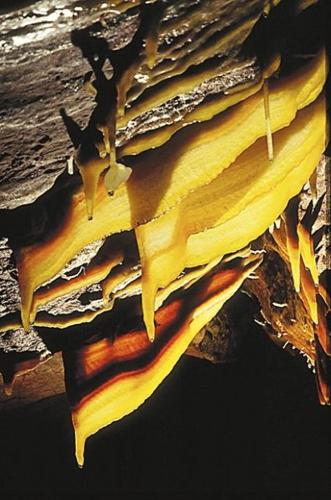
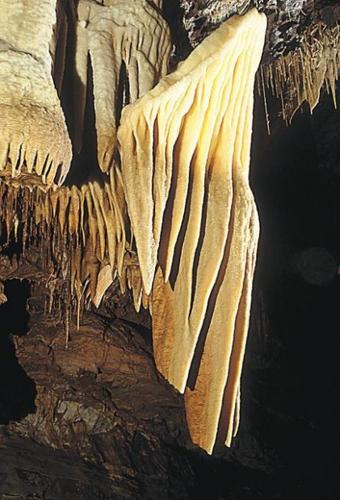
They continued down a corridor that appeared to be a main route. Wet, glistening stalactites, conical in shape, and hollow, filamentlike soda straws hung down from the ceiling; the two cavers crouched to avoid bumping their heads and breaking off formations. The floor became a thin crust of flowstone, no longer the rough gravel of the earlier portions. Water was dripping everywhere. It was warm, about 68 degrees, but it seemed warmer; the air was dank and humid, so humid that their skin glistened and they could see their own breath. The damp air smelled like a basement of a house that had been shut up since the beginning of time. They passed a gleaming three-foot calcite scroll and took a close look at a distinctive boulder as they passed — they needed to remember it as a landmark to find their way back out. As the two men pushed on and the distance seemed to only expand, their hearts were racing.
"It's got to stop, right?" Tenen kept asking.
But it didn't stop.
Tufts and Tenen entered a larger room that appeared to extend ahead for quite a while. A ceiling decorated with brightly colored orange stalactites curved eight feet above them, and piles of pungent bat guano — five feet in diameter, in some cases — blocked their path. The oppressive damp closed in, and it was hard to see. The range of their headlamps was only fifty feet or so; everything beyond that was shrouded in shadow and mystery. The two men couldn't tell how far the chamber went or where it might lead. When they reached a flat expanse of mud, they stopped for a moment, turning out their lamps, and sat in the great empty blackness — as black as anything they had ever seen. It was impossible to see their hands in front of their faces. The only sounds were the meditative tick-tock of water dripping from the tips of the stalactites and soda straws to the floor. After a few minutes the cavers re-lit their lights. Everything was as astonishing as it had seemed before: the glistening orange flowstone streaming down from the ceiling, the water droplets shimmering on the cave floor, the darkness and mystery just beyond the range of their carbide lanterns, beckoning them, perhaps cautioning them as well. . . .
'Exploring Xanadu'
A week had passed since they had found the cave in the Whetstone Mountains, and Randy Tufts and Gary Tenen had thought of little else. They returned that Saturday, as planned. For this expedition, they were better prepared, bringing two friends, both novice cavers. Things got off to a less-than-promising start when one of the neophytes, a roommate of Tufts and Tenen, proved to be too large to negotiate the tight squeeze leading into the cave; he couldn't proceed any further. Still, with the second "recruit," Eric Gill, Tufts and Tenen crawled along the rough, guano-covered cave floor and wriggled through the blowhole.
There, they split up. Tenen and Gill headed for the mud flats, the spot where the two discoverers had turned back the previous week. Tufts clambered up a pile of breakdown, rock that had fallen from the ceiling over the years. He could hear his friends' voices below. Climbing through an arched portal, Tufts immediately sensed something was different.
Straight ahead loomed a black void. In the weak glow of his carbide lamp, it was difficult to grasp just how far this extended. Everything just beyond the range of his light was faint, murky, monochromatic, like a movie that suddenly switches from color to black-and-white and then fades out entirely. Tufts couldn't make out the dimensions or get any idea of walls or ceiling or floor. But, despite the darkness, he could feel the enormity of what was in front of him. The way the air moved and sounds carried indicated that he must be on some kind of overlook, and below him lay — who knew what? He called out excitedly to Tenen and Gill.
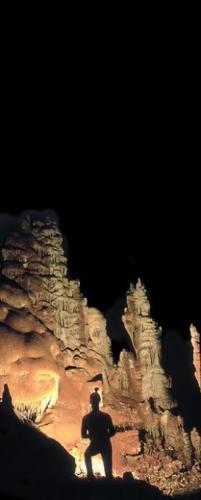
The three cavers met somewhere in the center of the vast space. Removing their flashlights from their packs, they could make out what appeared to be walls and a vaulted ceiling. They were in a large chamber that seemed to have no end: in fact, it was 400 feet long, 240 feet wide, and 50 feet high, larger than a football field. (They called it, simply, the "Big Room.") As they wandered about, shining their lights toward the fractured ceiling, the three men could see pale and delicate stalactites and soda straws dangling from jagged heights. Stalagmites, ridged and scalloped, rose up from the floor, like pillars of some deserted temple, lost in the midst of an overgrown jungle. Crystalline shields protruded from the walls. Amidst the luxuriant beauty, there was an almost whimsical quality. The walls were decorated with thin, brownish-red, translucent sheets that bore an uncanny resemblance to strips of bacon, and there was a stalagmite that resembled a fried egg on top; the cave seemed to have a sense of humor, too. All around they could make out a veritable riot of color. The tans and browns were the result of decaying organic matter; the blues, oranges, and blacks derived from manganese; and the pervasive reddish-rust tinge caused by iron oxide.
At one moment, the chamber resembled an ancient ruined city, at another a child's fantasy garden, and, at still another, a giant cosmic joke. Like the previous week, the "tick tock" of dripping water was the only sound they heard, except for the clumping of their boots on the rocks and their own strenuous breathing. Tufts and Tenen giggled and tugged at each other's sleeves.
No one had ever laid eyes on it before. Just looking at the sight all around them was a kind of act of creation. "I thought we were dreaming," said Tufts. "If we were to blink, it would all go away. You just realize that every gaze you cast on everything, it was the first time that thing has ever been seen. It was almost as if you are bringing it into being just by looking at it."
Meanwhile, Steve Northway, the other recruit, who hadn't been able to fit into the tight initial squeeze, had returned to the surface. As the others explored the cave, Northway sat in the sun beside the sinkhole entrance. To pass the time, he toyed with various possible names for the cave, finally settling on "Xanadu," which he took from the opening lines of the British romantic poet Samuel Taylor Coleridge's 1798 poem, "Kubla Khan":
In Xanadu did Kubla Khan
A stately pleasure-dome decree:
Where Alph, the sacred river, ran
Through caverns measureless to man
Down to a sunless sea.
Xanadu became the name Tufts and Tenen would adopt for many years, a password to a private world of which only a tiny number of initiated knew the meaning.
From "Kartchner Caverns." Copyright 2008 Neil Miller. Reprinted by permission of The University of Arizona Press. 215 pages, $15.95 paperback. Available at local bookstores and from www.uapress.arizona.edu.