

Mayor Byron W. Brown stopped far short of "defunding" or "dismantling" the Buffalo Police Department as activists across the nation have urged in their cities amid protests and unrest sparked by the death of George Floyd in Minneapolis.
But on Wednesday, the mayor announced a major shift in policing policies in the city.
"I am not in favor of defunding the police department," Brown said in an afternoon news conference. "But I am in strong favor of reforming the police department."
Joining him at his news conference were local social justice activists; some members of the police department, including the famous "Buffalo singing cops;" and two NFL players.
The mayor called the changes "a critical first step in a shared journey that we must all undertake to help make Buffalo more just, inclusive and equitable for black people."
People are also reading…
"We will shift policing in Buffalo, away from enforcement and to a restorative model that promotes stronger community bonds, civic engagement and an end to young black men, black people, being caught in a cycle of crime and incarceration by consciously limiting their negative engagement with police," Brown said.
The changes that Brown wants include:
- No longer having the Emergency Response Team respond to peaceful protests.
- Making police body camera footage more easily accessible to the public.
- Displaying the police department's use of force policy on the city and police websites.
- Directing Police Commissioner Byron Lockwood and his leadership team to incorporate a law enforcement assisted diversion program into the existing community policing program.
- Giving Buffalo police officers additional training in de-escalation, recognizing implicit bias and developing trauma-informed practices.
- Convening a special commission to examine current procedures to make recommendations to shift the city's policing model to a restorative approach.
- Issuing an executive order to stop arrests of low-level nonviolent offenses.
- Reforming and restructuring fines and fee schedules so they do not become an undue burden on economically struggling people.
In a statement provided to the media, Brown also announced he was directing the commissioner "to require officers to explain to citizens why they are being stopped or pulled over, and document that reason with 'stop tickets' each time they have an interaction with the community that is initiated by an officer."
He elaborated somewhat on the end of arrests for low-level offenses.
"I am ordering all Buffalo police officers to implement a policy providing for the issuance of appearance tickets for all non-violent crimes that do not involve property damage, weapons related offenses, large drug sales, or arrests mandated by state law," Brown said in the statement.
Activists who have been negotiating with the mayor want those arrested on such low-level charges to be issued an appearance ticket on the scene rather than being brought to Central Booking and fingerprinted.
Since Jan. 1, following the implementation of bail reform laws, almost all arrests for misdemeanors and nonviolent felonies result in appearance tickets.
Regarding calls for former Buffalo police officer Cariol Horne, who was fired in 2008, to receive a pension, Brown said he had referred her case again to the Attorney General's Office.
The changes come after a tumultuous week and a half for Buffalo that has put the City of Good Neighbors in the national spotlight.
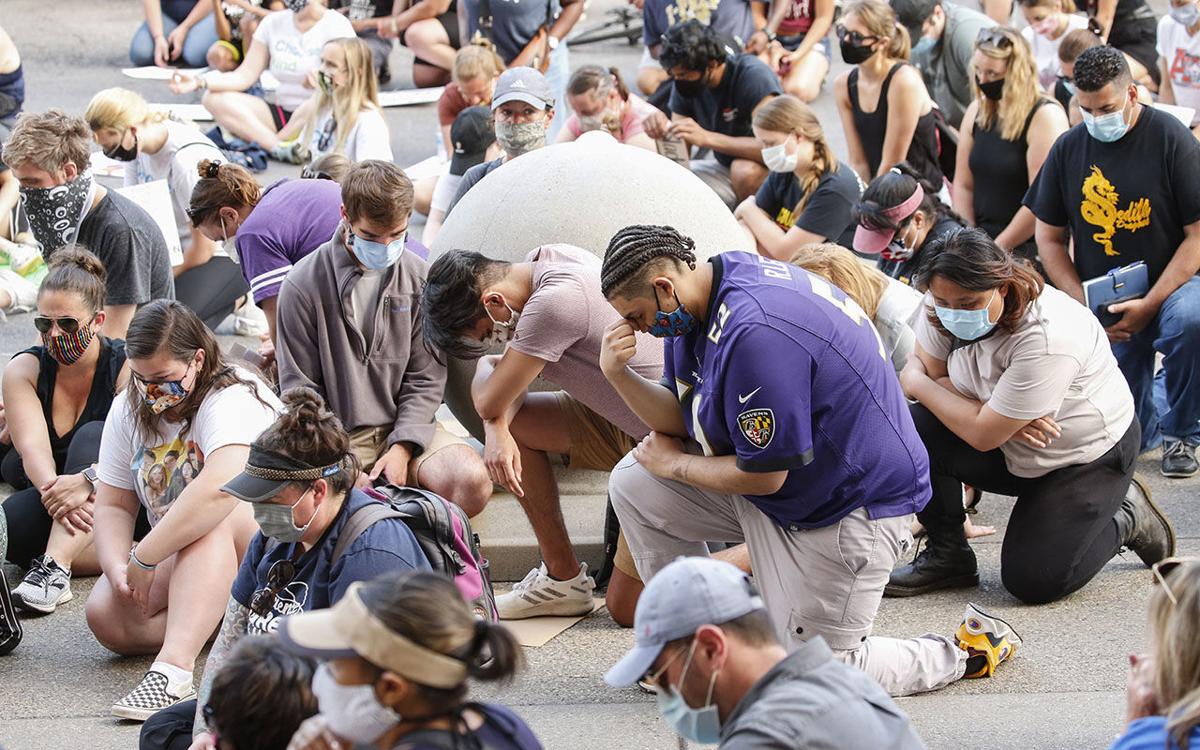
On May 30, a Saturday, a loosely organized Black Lives Matter protest in Niagara Square turned from a peaceful march into violence, fires and looting as protesters squared off against law enforcement in riot gear.
Two nights later, another peaceful march that began in Niagara Square made its way through the East Side and ended in front of the Northeast District Police Station. Organizers asked the marchers to disperse and most did, but others drawn to the commotion remained outside the police station and the protests turned violent. A woman who police and supporters agree was not part of the protest drove through a line of Buffalo and State Police on Bailey Avenue, injuring two state troopers and a police officer.
On the following Thursday, as protests seemed to be dying down in the evening, a 75-year-old protester approached a line of police clearing the front of Buffalo City Hall shortly after curfew had begun. A video shows two police officers pushing Martin Gugino and walking past him as he lay on the ground, bleeding from his head. The incident has now been seen tens of millions of times, and two of the officers were charged with felony assault. After that night, police were much less visible and did not actively enforce curfew as protesters continued to meet and march around downtown Buffalo.
The two officers involved in the pushing incident were members of the Emergency Response Team, which will now be transformed into a "Public Protection Detail," Brown said.
"It has become apparent that meeting protesters with a tactical unit of officers does not lead to peaceful results. As such, I ask that Commissioner Lockwood not deploy the Emergency Response Team for any future peaceful protest or demonstration, and instead create a new detail, the Public Protection Detail, to work with protesters and ensure their safety."
Members of the detail will receive "specialized training in constitutional rights, such as the freedom of speech and freedom of assembly, and will work with protesters to ensure their safety, their freedom of speech, and their freedom of assembly rights," Brown said.
Brown also asked the police union to work with the city.
"In the past the police union has been a barrier to reform," Brown said. "We are going to call on our police union to do the right thing by the people and by our community and be a partner for reform."
Joining him in the announcement at the Northland Workforce Training Center were members of Free the People Western New York, a coalition of local social justice organizations which has been negotiating with City Hall; Josh Norman of the Buffalo Bills and Demario Davis of the New Orleans Saints; members of the police department, including Deputy Commissioner Barbara Lark, Capt. Steve Nichols, who is charge of community relations, Capt. Amber Beyer, who is the health services coordinator, the "singing cops" Officers Moe Badger and Michael Norwood, Common Council President Darius Pridgen and Councilmember Ulysees Wingo Sr.
"I'm not going to say I'm happy, but I'm happy that we are taking the first step with Mayor Brown," said Christian Parra, who is part of Citizen Action, which has advocated for changes in marijuana regulation and against roll backs of bail reform. "This is only the beginning. We are going to work hard to make sure that the changes are going to be made."
Danielle Johnson, a Buffalo Police Advisory Board member to the Common Council, said the mayor has been receptive to the calls for change from activists as they met for hours to discuss policy changes.
"We felt the intention in the room when meeting with Mayor Brown," she said. "We felt the intention that he wants to create a better community and allow for the residents of the City of Buffalo to live better lives."
Mercedes Overstreet, who organized the march on June 1 and tried to get people to disperse, said: "We know our stuff, from our laws to the policies to the budgets. And we are not going anywhere until there's change."
Badger and Norwood announced a plan for the singing cops to join all of the police department and the city and to hold a unity walk in the next coming weeks.
"We ask for peace. We hate to see our city like this, be blanketed by the events that's going on across the world," Norwood said.
Davis said he and Norman have traveled the country "to get a pulse of what our nation is going through."
"There is a global outcry going on right now, on behalf of the people, a specific people that's been held down in this country," Davis said. "It's amazing to see that we have everybody at the table."
"What the outside world sees ... they see a 75-year-old man in the street get knocked over the police," Norman said.
He pointed to the policy changes being announced and Badger and Norwood's unity walk as positive steps.
"Things must change," he said. "People are talking about Covid-19 is the pandemic. This is the pandemic."
Monica Lynch, of Buffalo, was skeptical. “The mayor wants to be a people person, but everyone knows you can’t please everybody,” said Lynch, who became an activist after her 44-year-old brother, Connell A. Burrell, died in 2019 following a medical crisis after spending less than a day at the Erie County Holding Center.
Juan Santos, who has attended every rally in Niagara Square since May 30, said Brown should continue to reach out to more protesters.
News Staff Reporter Harold McNeil contributed to this report.


