


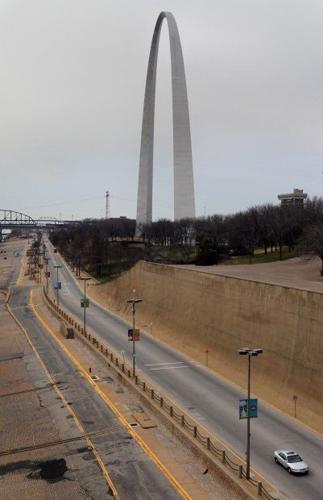
ST. LOUIS • A few things are certain in the days before Tuesday’s election.
Construction will continue on urban trails throughout the region. St. Louis and St. Louis County parks will get funded next year.
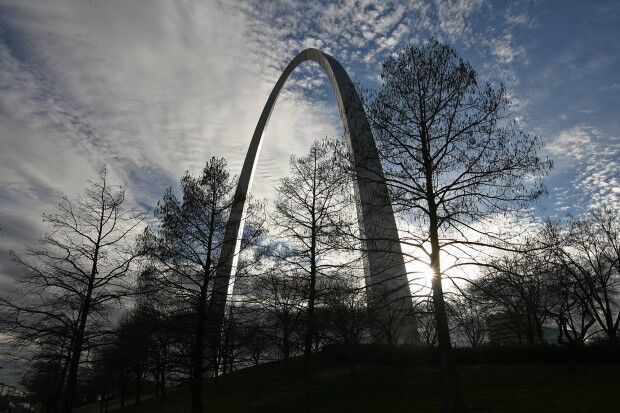
And, whether or not voters pass the 3/16-cent sales tax increase on Tuesday’s ballot, work will start this summer on renovations to the Gateway Arch grounds. In fact, two major projects — a refurbished river road and a park covering the highway — have gotten the green light.
Millions of dollars are already flowing to the Arch grounds improvements, as well as hiking and biking trails from St. Charles to the
Mississippi River.
The question is how many more trails the region wants, whether voters think city and county parks need a cash infusion, and how much of an Arch overhaul voters want to see.
People are also reading…
Proposition P, on the ballot in St. Louis and St. Louis County, would boost sales taxes by about 2 cents on a $10 purchase and raise about $780 million over the 20-year life of the tax.
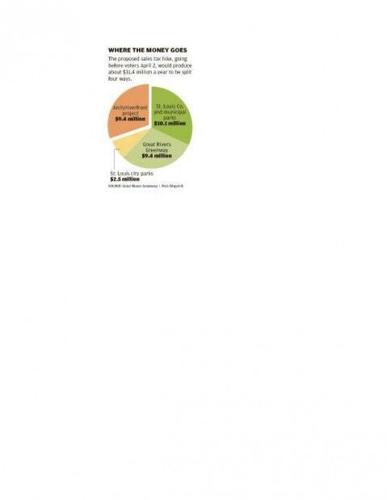
Forty percent of the money, or about $12.5 million in the first year, would stay in the city and county, to be used to maintain or expand parks. Thirty percent, or about $9.4 million, would go to the Great Rivers Greenway parks district to expand its network of trails in the region. The remaining third would be used to cover the public portion of the $380 million Arch grounds renovation.
Advocates of the tax insist that millions of dollars in extra sales taxes would solidify parks funding, redouble trail-building and transform the Arch grounds.
The money would allow Great Rivers Greenway to finish 90 miles of off-street trails in about 10 years, instead of double that time. When finished, a cyclist could bike from Jefferson Barracks Park to the Katy Trail in St. Charles, more than 30 miles away.
City and county parks would get desperately needed dollars for maintenance and renovations that have languished for years, officials say.
And with the tax money, the Arch team could broaden its plans: building a set of interconnected gardens and pathways, opening walkways under the Eads Bridge into Laclede’s Landing, turning the Arch museum entrance to face downtown, and tying Market Street’s Gateway Mall all the way to the riverfront promenade. More than $160 million alone would go towards a vast expansion of the Arch museum’s dark and dated interior.
Walter Metcalfe, senior counsel at the Bryan Cave law firm and chairman of CityArchRiver, the nonprofit spearheading the renovation, said the Arch project is on track toward raising $100 million in donations by the end of April.
But without the tax money? Metcalfe isn’t sure what would happen. “We have a tremendous opportunity,” he said. “So many agencies that could say no are saying yes.”
A failure at the polls, he said, could send a message to donors.
“I can’t say everyone else would be on board with another way to move forward if Prop P doesn’t pass,” he said. “I know what I have if it passes. I don’t know what I have if it fails.”
But critics question the immediate need for new trails, the real cost of parks maintenance, the Arch grounds design and expense, and the wisdom of spending local sales tax on federal land.
“I’m not against doing something at the Arch grounds. It looks a little tired,” said downtown resident Frank DeGraaf, who runs the blog Countondowntown.com.
Still, he asked, “Do we really need to spend $380 million now on a national park?”
‘TAXED TWICE’
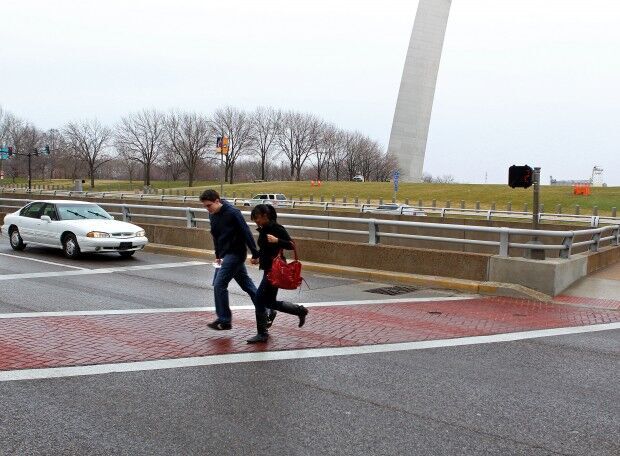
The Arch project has already secured $36 million in state and federal transportation dollars for the “lid” that will cover one block downtown, closing Memorial Drive, and capping the sunken lanes of Interstate 70 from Chestnut to Market streets. Another $10 million in private donations will rebuild Luther Ely Smith Square and landscape the new park, from North 4th Street to the Arch grounds. Construction starts this summer.
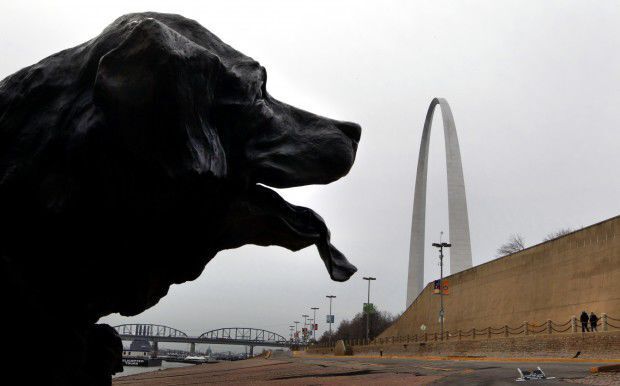
Federal money is also in hand to elevate Leonor K. Sullivan Boulevard largely out of the Mississippi River floodplain and landscape it for several blocks.
DeGraaf is among those who aren’t thrilled with the Arch grounds design, think there hasn’t been enough public input and don’t like the plans to remove Memorial Drive.
Others don’t like the idea of a tax increase. The St. Louis County Republican Central Committee has recently come out against Prop P, said committee chair Bruce Buwalda.
County residents, Buwalda noted, will cover the lion’s share of the tax increase, by virtue of the county’s larger size. “Why are we being taxed twice to help maintain federal property?” he asked. “People are tired of paying taxes.”
St. Charles County leaders, citing similar concerns, refused to put the measure on their ballot, pulling $7 million in potential annual tax dollars out of the project.
Beyond the Arch, the parks departments in the city and county have begun creating lists of maintenance and expansion projects that they say are long overdue. But some critics have questioned the need to funnel millions of new dollars to those departments — and wondered whether that money would just allow the governments to shift existing parks money to other parts of the budget.
And others argue that Great Rivers Greenway doesn’t need to grow larger, faster.
Last week, Kirkwood resident Gwyn Wahlmann walked the banks of the Meramec River in Emmenegger Nature Park, at Interstates 44 and 270.
“It’s really the first taste of the Ozarks west of the city,” she said.
But asphalt trails, Wahlmann said, would ruin it. Bikers whizzing through Emmenegger would destroy the peace of the place, she said. Worse, the trails could block wildlife movement from the forest to the river, or from one protected forest to another.
So, no, she said, she won’t vote for the tax increase.
DEMAND FOR TRAILS
Sometimes residents such as Wahlmann are right, said Janet Wilding, the director of administration for Great Rivers Greenway. Great Rivers can adapt its plans, she said.
But giving residents access to wilderness saves the space from further development and builds support for more conservation, she said. And the sales tax money would allow Great Rivers to build trails more quickly.
The agency already gets about $10 million a year in public money, set aside by a 2000 vote to increase sales taxes by 1/10 of a cent in St. Louis, and St. Louis and St. Charles counties. It has built 114 miles of trails.
But the last decade was easy miles, said Great Rivers planning director Todd Antoine. The agency built on land set aside for the trails, with willing landowners and inexpensive engineering.
Connecting those disparate greenways is harder. Some trails need bridges. Some need more land. Others require walls or elevated platforms to protect from flooding.
“Now it’s getting more challenging,” Antoine said.
If the tax doesn’t pass, it will take Great Rivers 20 years to build the next 148 miles of trail and bike lane, if not longer. But if it passes, Great Rivers could cut that timeline in half.
Residents are clamoring for trails, agency leaders say. Earlier this month, a Richmond Heights resident went to a City Council meeting to hear Great Rivers Executive Director Susan Trautman speak.
Some council members were critical, said resident Cheryl Robinson. So she approached Trautman after the meeting and asked how to get trails in her neighborhood.
“There’s tons of people that want that access,” Robinson said. “Everybody that walks and bikes.”
Maggie Hales, executive director of CityArchRiver, is optimistic the sales tax will pass. The community has long been discussing Arch grounds renovations. The Arch may be on federal land, she said, but it’s the region’s symbol.
This is the right time for a tax to pass, she argues. “If it doesn’t, we’ll sit down on Wednesday and figure it out,” she said. “We’re not thinking about doing anything less than the full project.”
David Hunn covers taxpayer spending on regional cultural institutions. Follow him on Twitter @davidhunn.


